
Talking about AI has become easy. Working with it has not. Between the demo and the working day lies a stretch that appears in no keynote: the day the tool asserts something wrong very convincingly. The week a process is half automated and therefore takes twice as long. The invoice at the end of the month. This page holds what I have learned in my own companies, detours included.
How widespread AI actually is
Perception runs ahead of reality. A good quarter of companies in Germany use AI, and the gap between large and small is considerable.
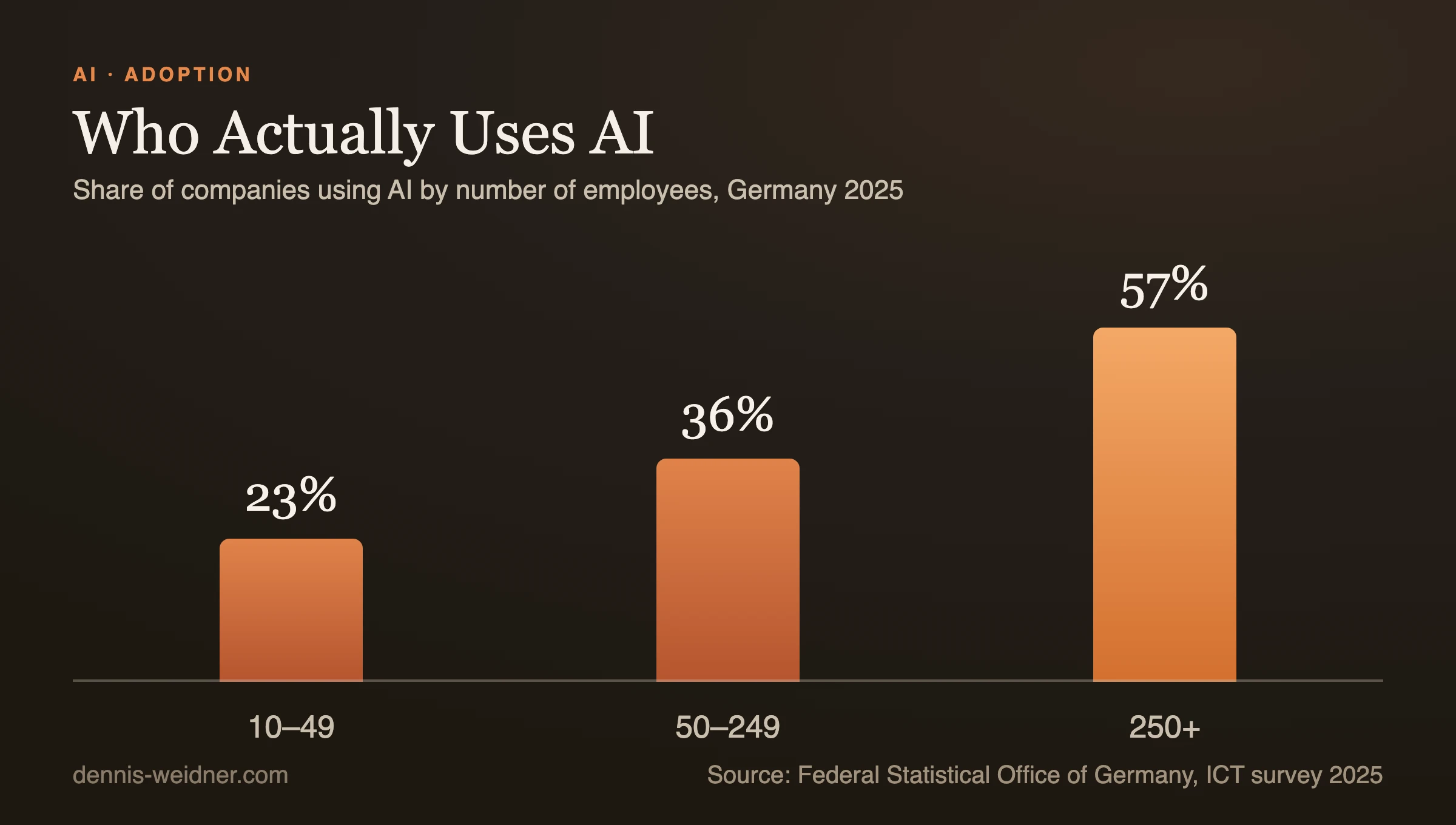
For founders that is good news. The tools a corporation uses are available to a team of three today, often on the same day and for the price of a lunch. The advantage no longer comes from access, it comes from who builds them properly into their processes. That is where more will be decided over the next few years than by capital.
What genuinely works day to day
Condensing. Contracts, studies, minutes, a competitor's website: wherever a lot of text has to become a few defensible statements, the time saved is largest. The decisive advantage is not the speed, it is that the result stays checkable because the source sits right next to it.
First drafts. A proposal, a concept, a rejection, a job ad, a blog post. A first draft in five minutes changes the work more than a perfect one in two hours, because it starts the conversation earlier. A human still finishes it.
Building. Small tools that would never have existed before because they would have cost half a developer day: an analysis script, a bridge between two systems, a dashboard. This website is one of those cases; agents build it, deploy it and measure it. How that came about I wrote up here.
Routines. Recurring work nobody enjoys: competitor monitoring, reporting, data hygiene, translations. The gain is not the hour saved, it is that the task reliably happens at all. What counts as an agent in the technical sense and what merely sounds like one I separate in its own piece.
What does not work
Anything somebody has to answer for. A model carries no responsibility, it produces the most likely continuation. That is useful in a summary and dangerous in a commitment.
Concretely useless: numbers without a source. A draft that sounds plausible and is wrong costs more time than it ever saved, and in a client presentation it costs more than time. Equally delicate: customer relationships. An automatically sent personal message is not a personal message, and recipients notice faster than you think. And finally the half-automated process: where a human has to check every result without being allowed to change the setup, you have created extra work, not relief.
My rule against all of this is plain. An agent gets an assignment with a clear, checkable result and a person who is accountable for it. Everything else is tinkering.
One boundary cuts across all of it: the data. Before anything goes into a tool, it has to be clear where it is processed, whether it is used for training and whether a data processing agreement exists. Customer data, employee data and anything under an NDA belong only in tools where those questions are answered. That is not paperwork, it is the difference between a productivity gain and a reportable incident.
How I know a task is ready for it
Before I hand anything over, I check four things, and that check takes longer than the setup itself.
One: is there a checkable result? "Take care of marketing" is not an assignment. "Turn this data into a weekly overview with five key figures" is, because you can see immediately whether it was met. Two: does the task repeat? You do one-off work, you do not hand it over. The effort of a clean handover only pays from the third repetition. Three: what happens when it goes wrong? If a faulty result can slip unnoticed into an invoice, a client email or a contract, a human belongs in front of it, not behind it. Four: have I understood the task myself? Anyone who cannot explain a process is automating their own vagueness, and it comes back faster.
If a task fails on any of the four, it stays with a person. Not out of caution, but because the automation would otherwise cost more than the work.
What it costs
The software is the smaller item. Per-seat licences sit in the range of a few tens of euros per person per month; agentic usage with many calls runs higher and scales with usage rather than headcount. So plan in tasks, not in licences.
The larger item is the learning curve: the weeks in which a team works out which task to hand over how, what context to supply and when to stop. That time appears in no budget and is nonetheless the real price.
The most expensive item appears in no invoice at all: wrongly automated processes that have to be dismantled later. So I start small, with a task whose result is measurable, and let it run alongside for two weeks before it becomes part of operations.
How decisions change
The most interesting change is not speed, it is preparation. A proper market overview used to cost two days, so it existed only for the big decisions. Today it costs an hour, so it exists for the medium ones too. And medium decisions are where most of the invisible damage in a company is done.
At the same time a risk grows: a cleanly written result feels more correct than a handwritten note without being so. For every decision that costs money I therefore ask for two things: the source, and an attempt to refute our own thesis. That costs ten minutes and has saved me more than any tool.
How we handle it
In every company I am involved in, the same order applies: before a process gets a new hire, we check whether an agent can reliably take it over. Reporting, research and routine work run automatically as a result, while teams spend their time on strategy and customer relationships. People still decide, and every automation has an owner with a name.
What comes out of that, I write down here: not as a forecast, but as a report from the engine room. The posts below are the long version.
Frequently Asked Questions
Is AI worth it for a small team?
Yes, and often more than for a corporation: a team of three can now use tools that used to require a department. What matters is not access but whether the task is handed over cleanly.
What should I automate first?
A recurring task with a measurable result that nobody enjoys: reporting, research, data hygiene. Not customer contact, and nothing a person has to answer for personally.
How do I deal with wrong answers?
Never take a number without a source, and make every result checkable. Where that is impossible, the task does not belong to a model. A plausible-sounding error costs more time than the automation saved.
What does getting started realistically cost?
Licences are the smaller item, and agentic usage scales with usage rather than headcount. The bigger price is the learning curve, and the most expensive one is wrongly automated processes you have to dismantle.
