
A German tax office (Finanzamt) is an authority of the federal state it sits in. It is supervised by that state's finance ministry, in some states through a state tax agency or a regional finance directorate, and for the big taxes the federal government steers it through binding instructions. Anyone who wants a tax assessment changed still needs a formal objection within one month: complaints about officials, petitions and ombudspersons change no assessment and stop no deadline.
As of 25 September 2026. Not tax advice, see the note at the end.
More on this topic: AI in the Founder's Working Day, with background, practice and every article in one place.
How German Tax Offices Are Organised: Article 108 of the Basic Law and the Fiscal Administration Act
Germany's constitution, the Basic Law, splits tax administration between two levels. Customs, excise duties and motor vehicle tax are run by federal authorities. All other taxes are administered by the states under Article 108 (2) of the Basic Law. Income tax, corporate income tax, VAT and the base amount for trade tax therefore all run through the local Finanzamt. Where a tax flows wholly or partly to the federal budget, the states act on the federation's behalf (Article 108 (3)). The Federal Ministry of Finance can then issue instructions, and under Article 85 (4) federal oversight covers both legality and expediency. This is why every tax office follows the ministry's circulars, known as BMF letters.
The structure is set out in Section 2 of the Fiscal Administration Act (FVG): the state finance ministry at the top, intermediate authorities where a state has set them up, and the tax offices at the bottom. States use this freedom differently. Bavaria runs the Bavarian State Tax Office as an intermediate authority, Baden-Württemberg the regional finance directorate (Oberfinanzdirektion) in Karlsruhe. Brandenburg dissolved the tax department of its Cottbus directorate in 2004, and since then the finance ministry in Potsdam has run the tax offices directly. Section 2a FVG expressly allows states to drop the middle tier.
This administration works with fewer people than it used to. According to a report by the Federal Court of Audit dated 26 June 2025, tax administration staff fell from about 115,070 full-time equivalents in 2003 to 97,350 in 2023. Between 2002 and 2022, income tax cases rose from 26.5 million to 31.6 million. For every 1,000 cases there were 3.08 full-time staff instead of 4.34. Software with risk filters does the rest, and that is where many of the errors come from that business owners later have to correct.
Who Supervises a German Tax Office? Service Supervision and Subject-Matter Supervision
The first layer of control is internal. Service supervision (Dienstaufsicht) covers how staff behave: tone, availability, processing times, handling of documents. Subject-matter supervision (Fachaufsicht) covers the substance, meaning whether the office applies the law correctly. Both sit with the head of the tax office and, above that, with the intermediate authority or the ministry.
The 2024 annual report of the Rhineland-Palatinate ombudsperson shows how this plays out. A citizen had complained about his tax office to the state finance ministry, the State Tax Office reviewed the case from a service and subject-matter perspective and found nothing to object to. I consider that the typical outcome, because here the administration is reviewing itself rather than an independent court doing so.
Complaining About a German Tax Office Official: What It Can and Cannot Do
A complaint about an official (Dienstaufsichtsbeschwerde) targets the personal conduct of a civil servant. A complaint to the supervising authority about the substance (Fachaufsichtsbeschwerde) targets a decision you believe is wrong. That is how the Hamburg finance authority describes them. Neither appears in the Fiscal Code (Abgabenordnung, AO). The ministry's guidance on the code calls them informal remedies, alongside a simple request for reconsideration. They cost nothing and have no deadline, but they give you nothing you could enforce.
What matters is what they do not do. The one-month objection deadline under Section 355 AO keeps running. Once it has passed, the assessment is final, and even the supervising authority can then only have it changed where a correction rule such as Section 172 AO allows it. Enforcement also continues, because not even a formal objection suspends it (Section 361 (1) AO); for that you need a suspension of enforcement. One safeguard exists: under Section 357 (1) AO a wrong label does no harm, and the ministry's guidance says that in case of doubt a letter is to be treated as an objection. I would not rely on that. Any letter I send against an assessment carries the word Einspruch (objection), and a complaint about conduct goes separately.
Petitions Committee: Why the State Parliament Handles Tax Office Cases
Under Article 17 of the Basic Law, anyone may petition parliament. For tax office cases, though, the Bundestag is usually the wrong address. The law on the powers of its Petitions Committee obliges only the federal government and federal authorities to hand over files. Tax offices are state authorities, so the Bundestag passes such petitions on to the state parliaments: 501 of them in 2025, according to the Petitions Committee's report for 2025.
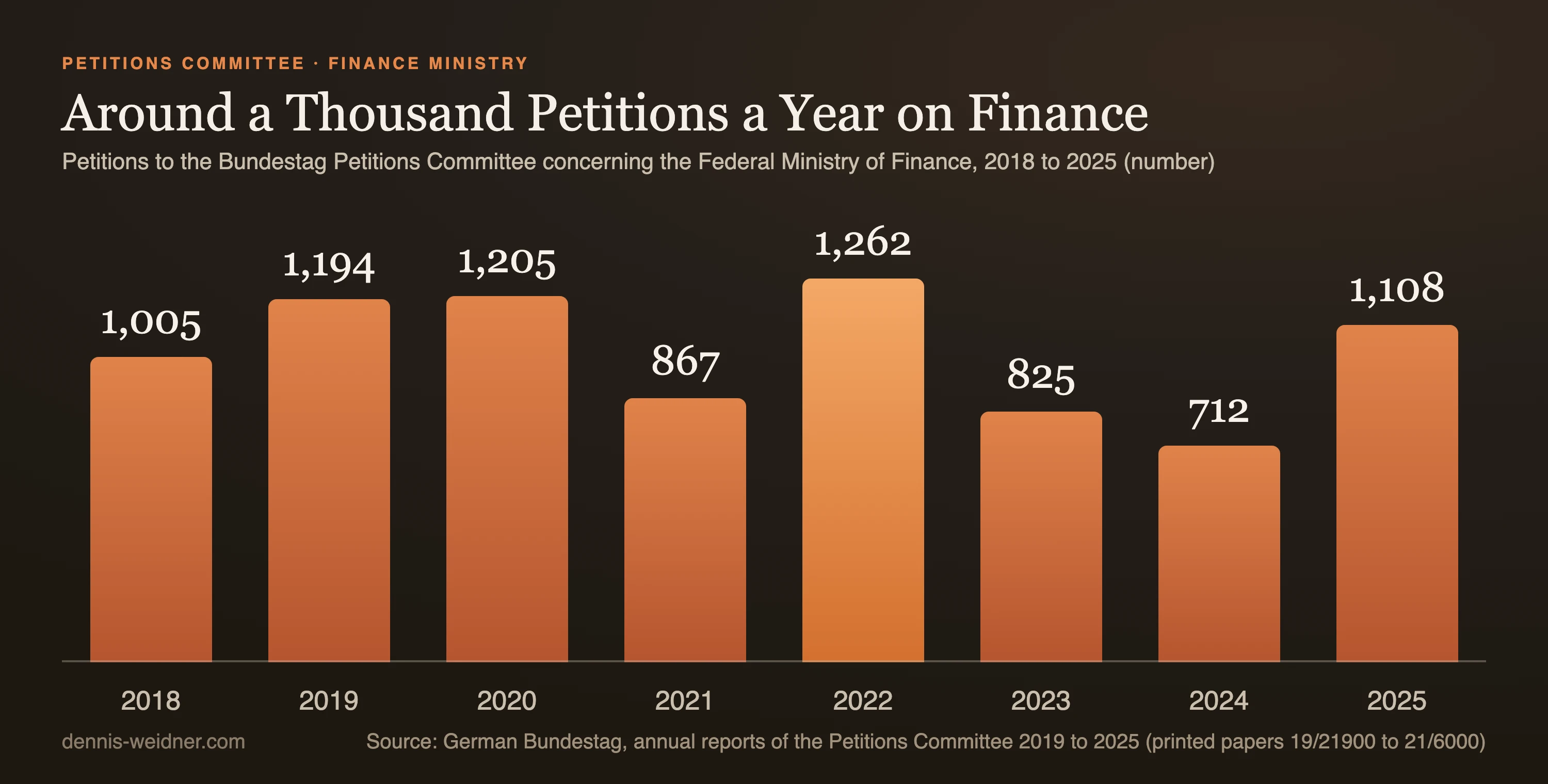
In 2025 the committee received 1,108 petitions concerning the Federal Ministry of Finance, out of 12,399 in total. Most were about legislation, such as wealth tax, inheritance tax and VAT rates. On the complaints about individual income tax assessments that arrive regularly, the report notes that the committee had no means of intervening because the federation is not responsible. Of the 10,298 petitions the committee closed in 2025, 584 were granted, or 5.67 percent. How rarely a petition reaches a public hearing is something I traced using petition 201716 on the crypto holding period.
A state parliament has more reach. In Brandenburg, for example, Article 71 (2) of the state constitution obliges all state authorities to show files and give information to the petitions committee on request. Even a state parliament cannot cancel an assessment, though. It asks, the ministry answers, and sometimes something moves afterwards. A petition does not stop any deadline.
Ombudspersons and Data Protection: Who Else Helps With German Tax Office Problems
Several states have ombudspersons elected by their parliaments, among them Rhineland-Palatinate, Baden-Württemberg, Mecklenburg-Western Pomerania and Thuringia. They request statements and mediate, but they decide nothing. In Rhineland-Palatinate, 34 cases in 2024 concerned tax law. Of all 1,717 admissible cases closed there in 2024, 236 ended in agreement. The report also shows where mediation helps: an imminent account seizure was avoided through an instalment plan. And it shows the limit: an account seizure is not announced in advance, otherwise the debtor could empty the account.
Data has its own watchdog, and surprisingly it is a federal one. Under Section 32h AO, the Federal Commissioner for Data Protection supervises all tax authorities, including the state tax offices. Under Article 15 GDPR you can ask what data the tax office processes about you. On 12 March 2024 (IX R 35/21), however, the Federal Fiscal Court made clear that this generally gives no right to copies of the entire file. What data tax offices now receive automatically is covered in my piece on DAC8 and crypto reporting.
Courts of Audit: Supervising the System, Not the Individual Case
The Federal Court of Audit and the state courts of audit review the administration under Article 114 of the Basic Law, Section 88 of the Federal Budget Code and the state budget codes. In its 2025 report, the Federal Court of Audit criticises that the effect of the risk filters cannot be reliably measured. The tax administration fully reviews only two percent of cases picked at random, which statistically means each taxpayer once every 50 years. You can send the court suggestions for audits. It will not step into your case; in its own words, it has no direct powers to intervene.
Overview: Ways to Challenge a German Tax Office, With Legal Basis, Deadline and Effect
| Route | Legal basis | Deadline | Effect on assessment and enforcement |
|---|---|---|---|
| Objection (Einspruch) | Sections 347, 355 AO | 1 month from notification | keeps the assessment open; enforcement continues |
| Suspension of enforcement | Section 361 (2) AO | while the objection is pending | stops enforcement if granted |
| Complaint about an official | Art. 17 Basic Law, not in the AO | none | concerns conduct, no effect on the assessment |
| Complaint on the substance | Art. 17 Basic Law, Section 3 (2) FVG | none | instruction possible, change only within Sections 172 et seq. AO |
| Petition to the state parliament | Art. 17 Basic Law, state constitution | none | files and information, no cancellation, deadline keeps running |
| Petition to the Bundestag | Art. 17, 45c Basic Law | none | for legislation; tax office cases go to the state |
| Ombudsperson | state law, only in some states | none | mediation, no decision |
| Data protection complaint | Art. 15 and 77 GDPR, Section 32h AO | none | information about your data, no effect on the tax |
| Court of audit | Art. 114 Basic Law, Section 88 BHO | none | reviews the system, not the individual case |
The table shows the gradient: only the top two routes have a legal effect on your assessment and your bank account, and only the objection has a deadline. Everything below is pressure, not a decision.
What a Business Owner Can Realistically Do When the Tax Office Gets It Wrong
My order is clear. First the objection, within the deadline, and if money is due, a request for suspension of enforcement in the same letter. Then a phone call with the case officer, because an informal request on the phone sorts out many transposed figures faster than three letters. I keep the complaint about an official for genuine misconduct, for example when documents are ignored repeatedly. Petitions and ombudspersons make sense when a case reaches beyond the individual matter or when enforcement threatens a livelihood.
In my view, this is too little oversight for an authority that can seize accounts, hold managing directors personally liable and estimate taxes before any court has looked at the matter. I have experienced more than once that a won objection was followed by the next query and the next assessment, and it felt like a contest. None of the bodies above helps with that; only careful documentation does. Why I am calling for a reform of the tax administration is set out in Entrepreneurs and Politics. More tax topics are collected under Crypto and Finance.
If an objection deadline is running for you right now, do not let it pass on the strength of a blog post; ask your tax adviser or a lawyer specialising in tax law.
Frequently Asked Questions
Who is the tax office's superior authority in Germany?
The finance ministry of the respective state, in some states with an intermediate authority in between, such as the Bavarian State Tax Office or the regional finance directorate in Karlsruhe. In Brandenburg, the ministry has run the tax offices directly since 2004.
Does a complaint about a German tax official achieve anything?
It can change something about an official's conduct, for example an apology or a new case officer. It does not change an assessment, and the one-month objection deadline keeps running.
Where do I complain about a German tax office?
About conduct to the head of the tax office, about the substance to the superior authority. In parallel, every wrong assessment needs a formal objection, because only that keeps it open.
Can a petitions committee cancel a German tax assessment?
No. It can request files and ask the ministry for a statement. For tax offices the state parliament is responsible; in 2025 the Bundestag passed 501 petitions on to the state parliaments.
Can I get my tax file under the GDPR?
You get information on what data the tax office processes about you. A copy of the entire file generally does not follow from that, according to the Federal Fiscal Court's ruling IX R 35/21 of 12 March 2024.
Note: This article is not tax or legal advice. It describes the legal position in Germany as of 25 September 2026 and deliberately simplifies: structure, ombudspersons and petition law differ from state to state, and running deadlines and enforcement depend on the details of each case. Anyone who wants to challenge an assessment should ask a tax adviser or a lawyer specialising in tax law.
Best,
Dennis Weidner
Note: AI tools supported me in writing this article, and some images were edited with AI. I stand behind its content and every statement with my name.