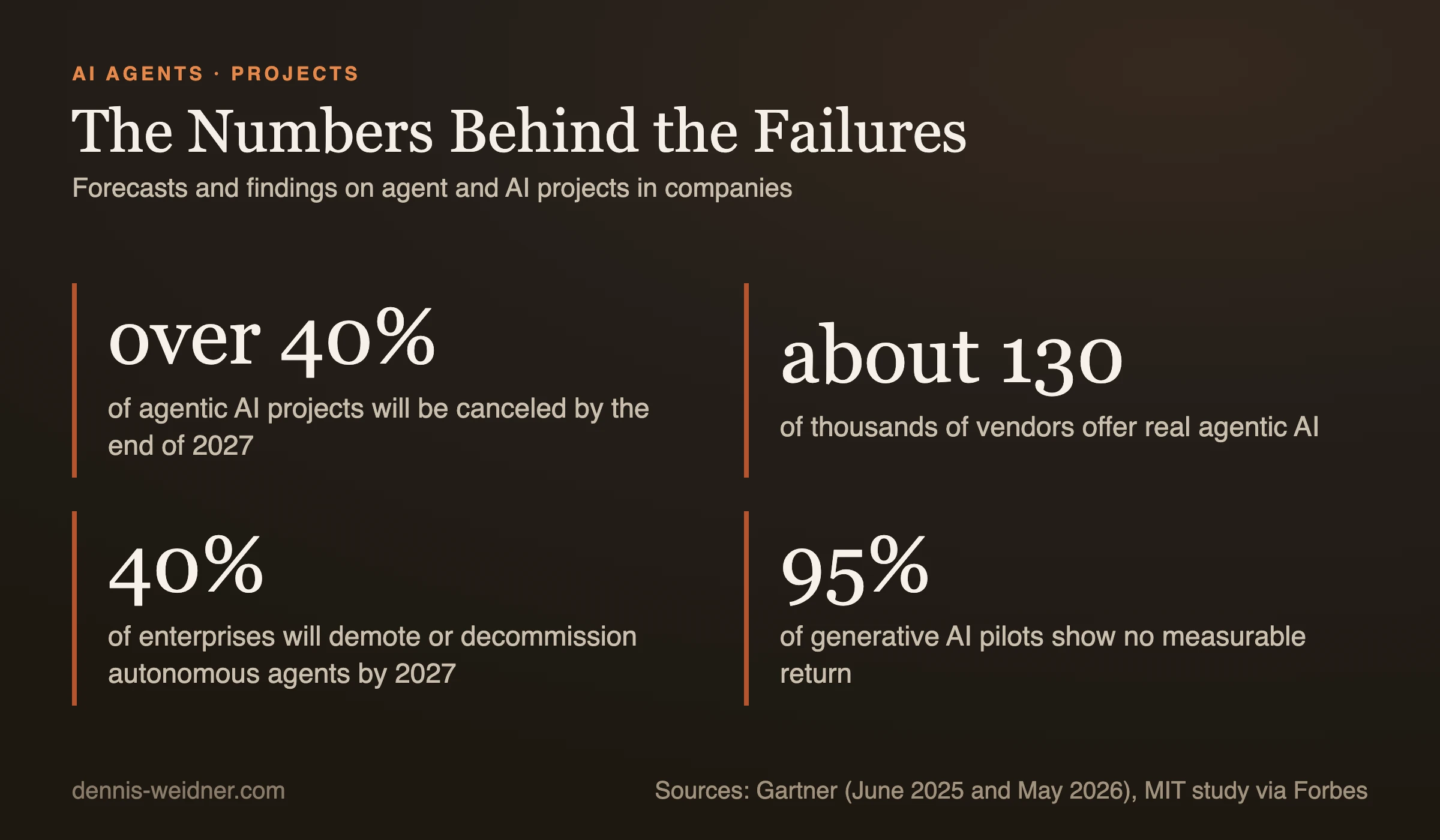
In the summer of 2025, Gartner put a number into the world that spoils the mood for a lot of people in AI: more than 40 percent of all agentic AI projects will be scrapped by the end of 2027. Not out of bad intent, but because of rising costs, unclear business value and missing controls. I have been building with agents myself for years, and I do not find this forecast depressing. I find it honest. Because it says one thing above all: almost 60 percent still make it. And the difference is surprisingly predictable.
Reading the 40 percent number correctly
In its official forecast, Gartner names three reasons for failure: escalating costs, no discernible business value and inadequate risk controls. Anushree Verma, the analyst behind it, says one sentence I have kept: most of these projects today are early experiments, driven by hype and often aimed at the wrong problem.
More on this topic: AI in the Founder's Working Day – background, practice and every article in one place.
That matches my experience. A cancelled project is rarely a technology failure. Usually the use case was thin from the start, and at some point someone notices that an expensive agent is doing a job a simple script or a clearly defined process could have handled. So the 40 percent are not a verdict against the technology. They are a verdict against building without a plan.
Agent washing, the first warning sign
A big part of the problem starts at the point of purchase. Gartner calls it agent washing: vendors slap the agent label onto old chatbots, RPA tools and assistants, with no real autonomy underneath. The analysts estimate that of the thousands of vendors on the market, only around 130 deliver genuinely agentic capabilities. The rest sell new wine in old bottles.
Anyone who does not understand what an agent actually is will almost inevitably buy the wrong thing in this environment. That is why it pays to look at the fundamentals before any project. I explained them from the ground up in What is an AI agent. The short rule of thumb: a real agent plans, calls tools and acts independently toward a goal. A relabeled chatbot only answers questions. Both can be useful, but only one justifies the investment in an agent project.
Why projects really fail
When I sort the failures I have seen myself or watched up close, they almost always land in the same four boxes.
No clear use case. The project starts with the tool, not the problem. Someone wants an agent and then goes looking for a task to justify it. That nearly always goes wrong.
Poor data. An agent is only as good as what it is allowed to reach. MIT found in its widely cited report that around 95 percent of enterprise generative AI pilots deliver no measurable financial return. The authors are clear about the cause: it is rarely the models, but an organizational learning gap, missing integration and bad data. You can read the summary in Forbes on the MIT study.
Missing governance and guardrails. Many teams treat an agent like a feature you switch on, not like an employee you grant rights to. Gartner is already warning about the next wave: by 2027, around 40 percent of enterprises will demote or shut down autonomous agents because governance gaps only surface after an incident.
No human in the loop. An agent that intervenes fully autonomously in critical processes, with no checkpoint, is not progress but a liability. That is exactly what produces the incidents that eventually topple whole programs.
What the successful 60 percent do differently
Now the interesting part. In its study The State of AI in 2025, McKinsey compared the winners with the rest, and one pattern stands out. Sixty-five percent of high performers have clearly defined human-in-the-loop processes, against just 23 percent of everyone else. They are also far more willing to rebuild entire workflows rather than bolt an agent on top.
This is not rocket science, but it is uncomfortable. Success with agents does not mean buying a model and hoping. It means cutting the process cleanly, granting access rights deliberately, and building a human checkpoint exactly where things can get expensive. In our setup, people decide and the agent executes. What that looks like when you organize a whole company around it, I described in The Autonomous Organization. And why someone who has been building companies for more than 20 years went this deep into the topic at all, you can read on my About page.
My checklist for the 60 percent
If you are starting an agent project, honestly walk through these points first. Every one of them has already saved projects I know.
First, start with the problem, not the agent. State the business value in one sentence and in euros. If you cannot, do not build anything yet.
Second, check your data before you check the model. Can the agent even reach clean, current information? If not, that is your first project.
Third, define rights and limits like you would for a new hire. What may the agent do, what can it access, where does its autonomy end? Governance is not an afterthought, it is part of the blueprint.
Fourth, put the human in the loop deliberately. Not everywhere, but exactly where a mistake really hurts. That is the difference between brave and reckless.
Fifth, start small and measure for real. One productive agent on a clearly defined task beats ten proofs of concept that nobody ever puts into production.
The 40 percent do not fail because of the model. They fail on discipline. And discipline is something you get to choose.
Frequently Asked Questions
Why do so many AI agent projects fail?
According to Gartner, more than 40 percent will be scrapped by the end of 2027, mainly due to rising costs, unclear business value and inadequate risk controls. In practice a thin use case, poor data or missing governance almost always add to it.
What is agent washing?
It is Gartner's term for relabeling old chatbots, RPA tools and assistants as agents without real autonomy. Of the thousands of vendors, an estimated 130 or so deliver genuinely agentic capabilities, while the rest sell old technology under a new name.
What sets successful agent projects apart?
According to McKinsey, successful companies are far more likely to have a defined human in the loop, 65 versus 23 percent, and they rebuild entire workflows instead of bolting an agent on top. A clear use case, good data and deliberate governance complete the picture.
Should an AI agent run fully autonomously?
Rarely. Full autonomy in critical processes without a checkpoint is a liability. The sensible pattern is a human checkpoint exactly where a mistake gets expensive, while the agent handles routine and execution.
Warmly,
Dennis Weidner
Note: AI tools supported me in writing this article, and some images were edited with AI. I stand behind its content and every statement with my name.