The debate about AI in retail runs on a figure that does not contain small retailers at all: the official survey starts at ten employees, and 84 percent of German retail sits below that line. I recalculated what the statistic covers and wrote down where the advantage of a small business really lies.
The Statistic That Talks About Small Retailers Does Not Include Them
Whenever artificial intelligence in small and medium-sized business comes up, the same figure appears: 26 percent of enterprises in Germany use AI technologies. It comes from the ICT survey of the Federal Statistical Office for the 2025 reporting year, published on 24 November 2025, and it is correct. It simply does not describe the businesses most readers have in mind.
The quality report for that survey states the population explicitly: all enterprises based in Germany whose main activity falls into economic sections C to J, L to M or group 95.1, and that have at least ten persons employed. Retail belongs to section G and is covered. The single retailer with four people is not.
The size of that blind spot can be calculated. For the 2024 reporting year, as of 1 December 2025, the German business register counts 557,277 legal units in section G, meaning retail including the maintenance and repair of motor vehicles. Of those, 468,895 sit in the smallest size class, that is below the threshold of ten employees. That leaves 88,382 units above it.
That puts 84.1 percent of German retail below the line where the AI statistic begins. The much quoted 26 percent therefore describe the remaining 15.9 percent. About the other five sixths the figure says nothing at all, neither good nor bad.
Why This Is Not a Complaint About the Statistic
The threshold of ten employees is a European specification, and the reasoning is sound. Below that line the number of units grows so large and their structure so heterogeneous that a sample cannot produce reliable values at acceptable cost.
The error appears in the quoting. „26 percent of enterprises" becomes „26 percent of businesses", then „small companies hesitate too", and at the end there is a sentence about a group that was never in the number. Dropping the lower bound of a survey does not change the precision of the figure, it changes its subject.
The quality report contains two further details that are almost never quoted. First, participation is voluntary, there is no obligation to respond. For 2025 the response rate was 24.6 percent; roughly 98,800 units were contacted in order to reach the legally required net sample of 20,000. Second, the relative standard error of the main indicators at federal level was below five percent, a solid value.
And You Cannot Stack the Figure on Last Year's
In 2024 the same office reported that one in five enterprises, meaning 20 percent, used AI, and 17 percent in the 10 to 49 employee class. A year later it is 26 and 23 percent. The temptation to turn that into six percentage points of growth in twelve months is strong. It is misleading, and the source itself says so.
In its chapter on comparability over time, the quality report writes: „Until 2024 the presentation units were legal units. Since 2025 the presentation units are enterprises according to the EU units regulation. In addition, enterprises with fewer than 10 persons employed are no longer included in the survey. The values from 2025 onwards are therefore only comparable with previous years to a limited extent."
An enterprise under the EU units regulation can consist of several legal units. Where three companies used to be counted, one enterprise may now be counted, and that one has more employees than any of the three did. Part of the jump from 20 to 26 percent is therefore a change in definition rather than a purchase. These two figures do not form a time series.
The same applies to the business register. From the 2024 reporting year it switched from a person concept to a job concept, which according to the Federal Statistical Office makes a comparison with 2023 uninformative.
The Unfair Advantage Is Not the Tool
The advantage a small retailer currently holds is not a better model. The good models are open to anyone with a credit card and cost less per month than a day of temporary help. The advantage is decision distance.
In a business with four people, the path from idea to use is a conversation at the packing table. There is no alignment with IT, no works council approval, no architecture decision, no security review by a department that does not know the use case. Whoever decides in the morning to generate product descriptions from raw data can try it on twenty items in the afternoon and decide in the evening whether it stays.
That distance is long in a corporation, and it does not shorten because the tool improves. It is a property of the organisation. A small retailer can discard in one day what is scheduled elsewhere for a quarter. That is the unfair part, and it expires as soon as the practice becomes standard.
This advantage can only be secured by using it while it lasts.
What Actually Stops People, According to Those Concerned
The same survey asks enterprises that considered adoption and then dropped it for their reasons. The shares refer to all enterprises that considered using AI but have not done so yet. For 2025 the picture looks like this, with the value for the 10 to 49 employee class in brackets:
- Lack of knowledge: 72 percent (73)
- Uncertainty about legal consequences: 62 percent (64)
- Concerns about data protection and privacy: 60 percent (60)
- Incompatibility with existing devices, software and systems: 45 percent (46)
- Difficulties with the availability or quality of data: 44 percent (44)
- Costs too high: 32 percent (33)
The two bold lines are the actual finding. Knowledge is missing more than twice as often as money. Anyone deriving “free up budget” from this table is working on the side issue.
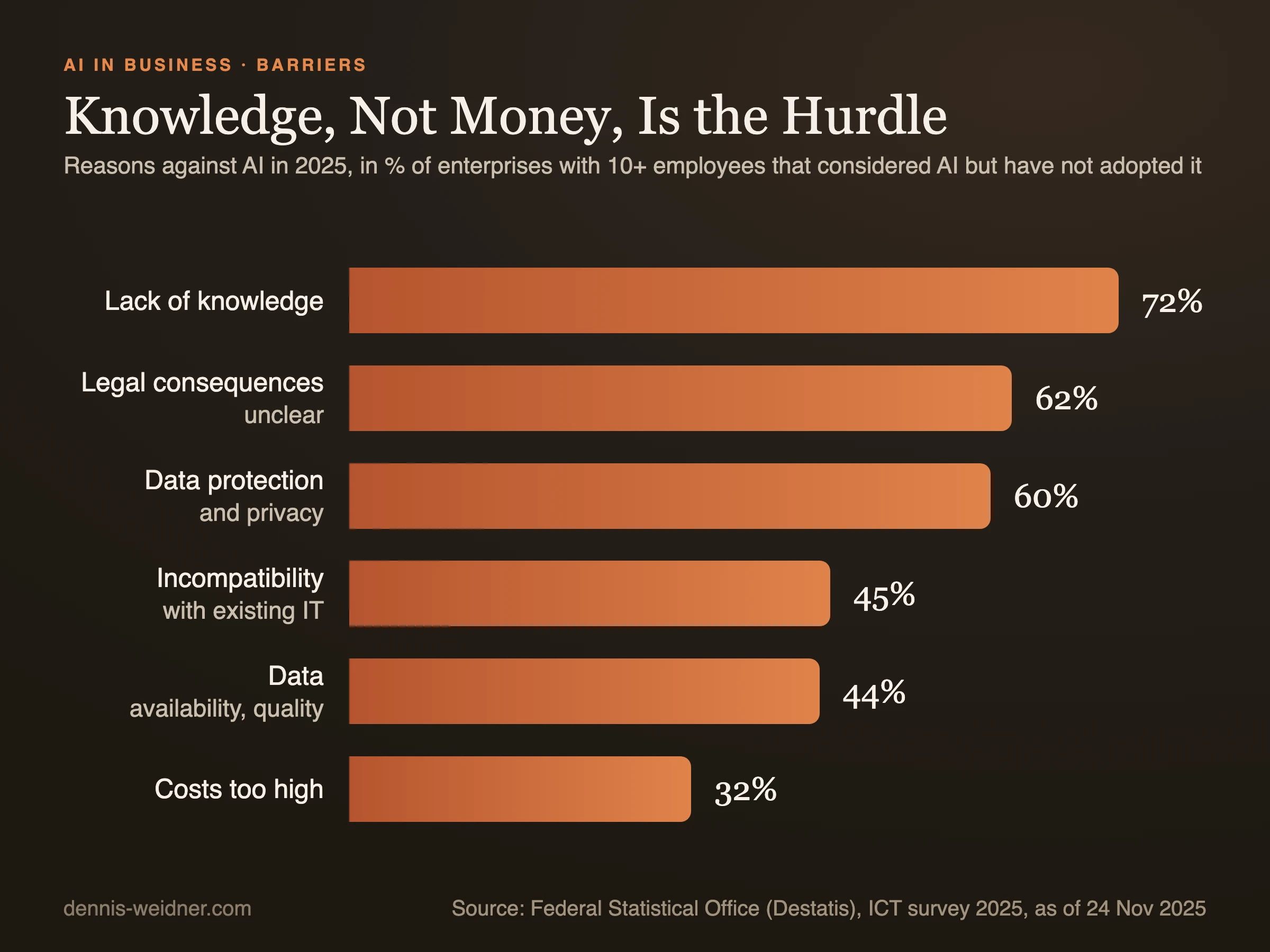
For a small retailer that is good news, because a knowledge barrier is cheaper to clear than an investment barrier. It costs time rather than capital, and time is the one resource a four person business has enough of between January and September, but not in November.
Three Places Where It Actually Holds for Us
I am not writing this as an observer. With Slabhit we are building live shopping for trading cards, and the operation behind it is small enough that every piece of automation shows immediately, for better or worse. Three uses have survived, others I switched off again.
First, text from raw data. Condition, print run, language and price become a product description. That is a translation from table into sentence, and language models are strong at it. The main gain is that a description exists at all instead of an empty field.
Second, sorting the inbox rather than answering it. Whatever arrives is read, classified and linked to the matching case. A human writes the reply, because sorting can be undone and a reply that has gone out cannot.
Third, recurring checks. Price and stock reconciliation against the source, every morning, always to the same pattern. A human does that reliably for three weeks and then stops. A machine does it on day 200 exactly as on day one, and that is its real advantage.
Everything that went outside without being read first, I switched off again. The output was good, but a mistake there goes unnoticed until somebody complains. I wrote about that in more detail in my piece on where agents escape their guardrails.
The Three Questions Before Any Agent
Before I hand a task to a machine, I ask three questions. Together they take five minutes and have saved me more than any choice of tool.
What does a mistake cost? A wrong product text costs a correction. A wrong price label costs the difference times the units sold, plus annoyance. A wrong promise to a customer costs a promise. These three do not belong in the same category and must not be given the same freedom.
Who notices it? What counts is who looks at the output in the course of normal work anyway. If the answer is „nobody", the task is not automatable, it is merely unobserved.
How long may it stay unnoticed? That question sets the checking rhythm. A mistake that may stand for a day needs a daily sample. One that may stand for an hour needs a different construction, usually one in which a human releases the result.
These three questions prevent the most common error, which is giving a machine a task whose output nobody looks at. How I have organised this in my own work is in my AI stack, and the cost side of the regulation is in what EU AI Act compliance actually costs.
Frequently Asked Questions
How many enterprises in Germany use artificial intelligence?
The Federal Statistical Office reports a share of 26 percent for the 2025 reporting year, as of 24 November 2025. By size class that is 23 percent for 10 to 49 employees, 36 percent for 50 to 249 and 57 percent from 250 upwards. The survey only covers enterprises with at least ten persons employed.
Does the 26 percent figure apply to small retailers?
No. The survey starts at ten persons employed. In the retail section the business register counts 557,277 legal units for 2024, of which 468,895 sit below that threshold. That is 84.1 percent, and about this group the AI statistic says nothing.
Did AI use rise from 20 to 26 percent?
That calculation is not permissible. The quality report of the Federal Statistical Office states that until 2024 legal units were presented and from 2025 enterprises under the EU units regulation, and that units with fewer than ten persons employed are no longer included. It says in plain words that values from 2025 onwards are only comparable with previous years to a limited extent.
What stops small companies from adopting AI?
In the 2025 survey, 72 percent name a lack of knowledge, 62 percent uncertainty about legal consequences and 60 percent concerns about data protection. Only 32 percent name excessive cost. The shares refer to the enterprises that considered adoption but have not implemented it.
What is the advantage of a small business when adopting AI?
Not the tool, since the same models are open to everyone. The advantage is short decision distance: what is a conversation in a four person business is a project with approvals in a corporation. A small business can try an idea in a day and discard it. This advantage decays as soon as the practice becomes standard.
Which tasks are suitable to start with?
Those whose output somebody looks at in the course of normal work anyway, and whose errors are reversible: generating text from existing data, sorting and classifying incoming messages, recurring checks against a source. Unsuitable is anything that goes outside without being read, because a mistake there only surfaces when somebody complains.
Warm regards,
Dennis Weidner
Note: AI tools supported me in writing this article, and some images were edited with AI. I stand behind its content and every statement with my name.