
I was one of the first in Germany to pull crypto out of its niche, long before the topic went mainstream. Out of that grew CryptoTicker, one of the leading German-language research and comparison platforms for digital assets: a "Check24 approach" to digital finance, with a real research house behind it.
How to sort digital assets in the first place
The most common mistake in this market is treating everything as one thing. It helps to separate four groups, because they follow different rules and carry entirely different risks.
Bitcoin is the special case: a scarce, decentrally secured store of value with no company behind it, priced almost purely by supply and demand. Stablecoins are the opposite, namely payment infrastructure with an issuer, a balance sheet and a reserve you can audit and should. Infrastructure tokens belong to networks that are genuinely used, and the question that counts is the plain one: does anybody pay for that usage? And then there is the fourth group, which fills most of the headlines: tokens without usage, priced entirely on expectation.
Sorting like this replaces no analysis, but it answers the question that gets skipped far too often: what are we actually talking about?
Right next to it sits the second question, which almost always comes too late in a conversation: custody. Holding crypto-assets on an exchange means holding a claim against that company, not a value in your own hands. Holding them yourself means full responsibility for keys, backup and succession, and in practice that is where things fail far more often than on price. For companies there is the added point that custody is a regulated activity. This is not a detail for later, it is the decision that counts on the day something goes wrong.
A network grown over years
Over that time, large German exchange and banking houses have come to me – for research, for building crypto hubs, for an honest read between hype and substance. This view into both worlds, the young crypto economy and classic finance, is rare, and that is exactly where the interesting conversations happen.
What remains after the euphoria
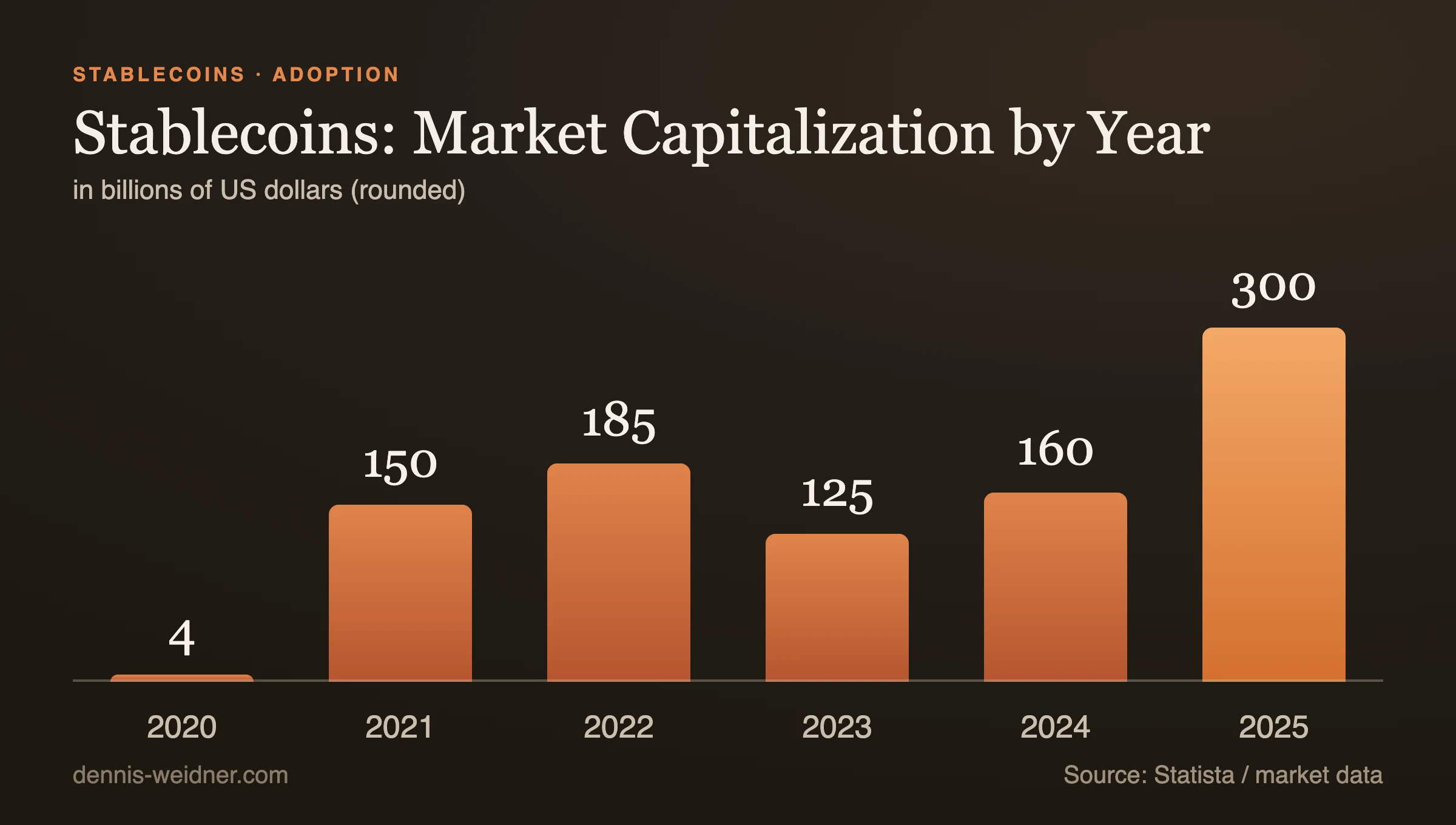
I care less about what is rising or falling than about what outlasts the cycle. Stablecoins are one such case: their market capitalization has grown from a few billion to several hundred billion dollars – a quiet but profound rebuild of how money moves.
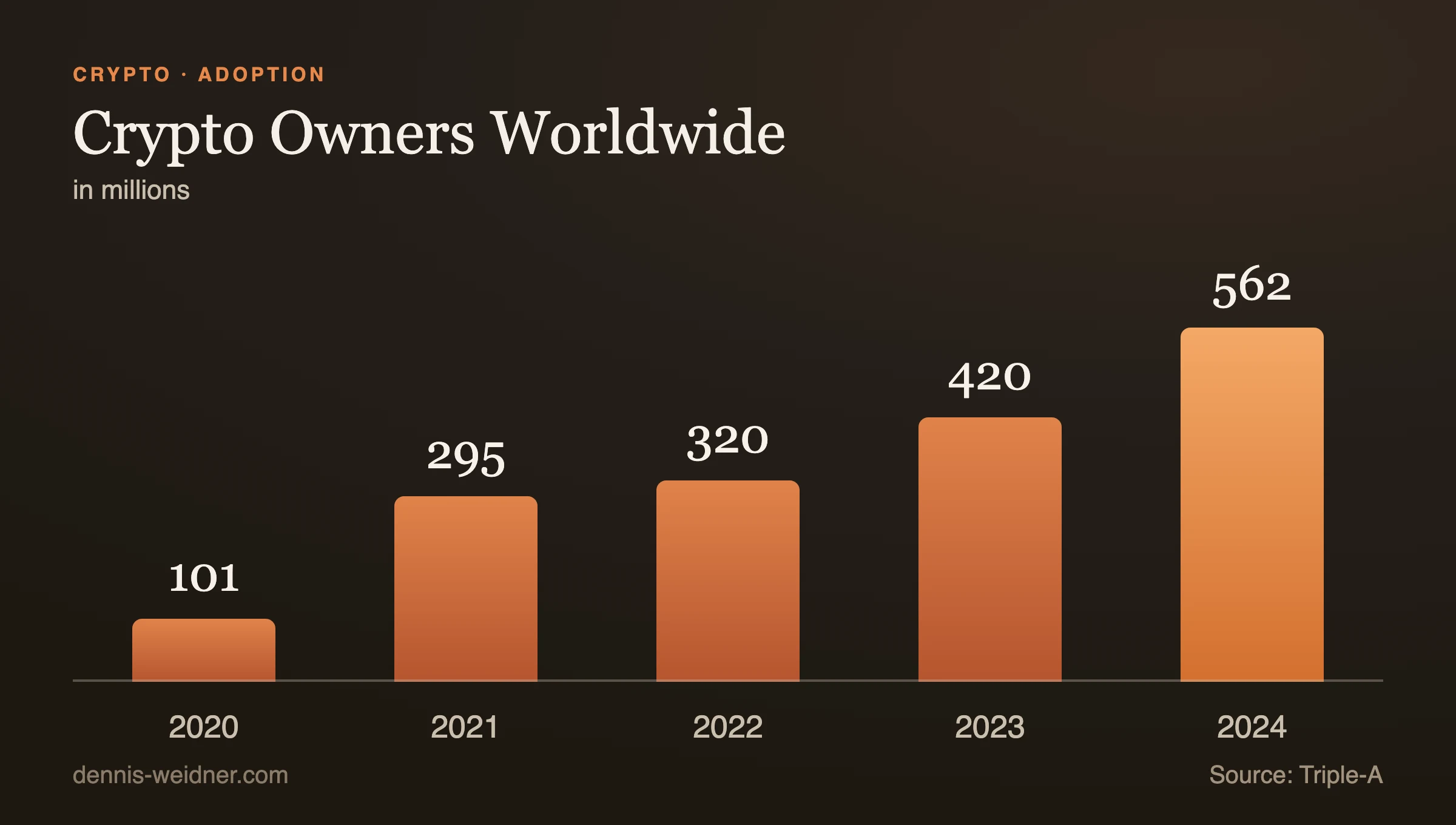
And the base keeps growing: more than half a billion people worldwide now own crypto, up more than fivefold in just a few years. This is no longer a fad, it is a new reality in finance.
What changed legally, and why that is the real shift
For companies, this topic was mainly a legal question for years. That has moved. With MiCA, the EU has had a single framework for issuers and service providers since the end of 2024, including requirements for stablecoin reserves and for the authorisation of trading venues. Since the start of 2026, DAC8 adds automatic exchange of information on crypto-assets between the tax authorities of the member states. In parallel, Germany is debating the one-year holding period for private disposals.
The practical effect is unspectacular and important for exactly that reason: anyone working with digital assets today works inside a regulated environment rather than a grey zone. That rules some business models out and opens others, and it is a major reason why classic banks and exchanges are participating in this cycle instead of watching it. I have written this out in detail in my pieces on DAC8, on the holding-period debate and on the rebuild of payments.
How I spot a project that lasts
Five questions I ask every team, and they sort surprisingly reliably. Does the product work without its own token? Who pays, and for what exactly? Where do the assets sit, and who can reach them technically and legally? What happens after an eighty percent drawdown, does the business survive or only the story? And finally: who is liable, under which licence, in which jurisdiction?
A team that answers all five cleanly has no guaranteed business, but a serious one. A team that stumbles on two of them is selling expectation.
The second question gives away the most. "We monetise later through the network" is not an answer, it is a postponement. Revenue does not have to be large, but it has to exist and to come from someone who pays voluntarily because the product saves them something or earns them something. Anything else is a funding round posing as a business model. I ask the same question of projects without a token, by the way; it is not crypto-specific. It just fails more often in this market.
How I deal with cycles
This market runs in waves, and every wave produces the same sequence: departure, exaggeration, disillusionment, clean-up. Knowing the cycle does not make anyone better at timing, but it makes them calmer in judgement. I have never met someone who reliably calls tops and bottoms, and I have met plenty who believed they did.
What works instead is unspectacular. The exaggeration phase produces the business models that only function while prices rise; you recognise them because every answer to the revenue question starts with the word "once". The disillusionment phase produces the interesting conversations, because by then only the teams with an actual product are left. That is when I look most closely.
For companies that means decisions about infrastructure, payment rails or custody do not belong to a market phase, they belong to a horizon of years. Anyone who aligns their crypto strategy with a price level does not have a strategy, they have a position.
What this means for companies in practice
The most common sensible application is unspectacular: payments. A stablecoin transfer reaches a supplier in another time zone in minutes rather than days, weekends included. It requires a licensed partner, bookkeeping that records the transaction properly, and clarity that you are also buying price risk, custody and reporting duties.
The second development does not run under the word crypto at all: funds, bonds and money-market products are increasingly represented as tokens, because settlement and custody get simpler that way. When that works, the technology disappears behind the product, the way it ends for every piece of infrastructure that succeeds. That is my yardstick for projects: not how new they sound, but whether in five years they have become invisible because they simply run.
How I help
As a founder and advisor: positioning, reach, product and above all network. I am not a financial advisor and give no investment recommendations. I help companies and projects become visible, credible and well-connected in digital finance.
Frequently Asked Questions
Do you offer investment advice?
No. I am not a financial advisor and give no buy recommendations. I help companies and projects with positioning, research, reach and network in digital finance.
What is CryptoTicker?
One of the leading German-language research and comparison platforms for cryptocurrencies and digital assets – a Check24 approach with a real research house behind it.
What changed with MiCA and DAC8?
Since the end of 2024, MiCA has given the EU a single framework for issuers and service providers; since the start of 2026, DAC8 adds automatic exchange of information on crypto-assets between tax authorities. Together they turn a grey zone into a regulated environment.
How long have you been active in crypto?
Since the early days – I was among the first in Germany to pull the topic out of its niche, and have stayed close to the technology, the market and the relevant players ever since.
