Today I turn forty. It is an age you can barely picture at twenty, and once it arrives, it feels surprisingly little like a finish line. Quite the opposite. I have rarely felt so clearly that the most exciting part is only just beginning. A few honest thoughts on more than twenty years in business.
I am not one for grand accounting. But a round birthday does invite you to pause for a moment and sort out what matters and what I want to take on in the years ahead.
More on this topic: AI in the Founder's Working Day – background, practice and every article in one place.
Twenty years, in brief
It all started in front of a beige budget PC, and the rest is a long chain of attempts, mistakes, and a few things that actually worked. I told that story in more detail in From a Budget PC to Autonomous Agents. What stays with me is not the list of projects, but a handful of lessons that run through everything.
What I have learned in twenty years
First: it is not the cleverest who wins, but the one who sticks with it. I have watched brilliant people fail because they gave up after the third setback, and unremarkable people win simply because they were still there. Second: people matter more than ideas. Good people rescue mediocre plans, and the best idea shatters on the wrong people. Third: your word has to stay your word, and why this handshake mentality counts especially in the tech business is something I wrote down here. And fourth, the most important: success you cannot share with anyone is remarkably empty.
The lesson that cost me the most
My most expensive mistakes were not the wrong ideas, but the decisions I made too late. I kept projects alive for too long, out of pride, out of loyalty, out of the fear of admitting failure to myself and to others. One venture that I had long known would not carry, I dragged along for more than a year, because I did not want to write off the money and time I had put in. That is exactly what made it more expensive in the end.
What I took away from it sounds banal and is still hard: a clean, early cut is almost always better than a long, honorable bleed-out. Letting go is not a defeat, it is a skill. Whoever practices it early has more energy left for the things that are truly worth it. That mindset now sits in almost everything, in the way I build several companies at once: test quickly, judge honestly, and consistently end what does not carry.
What twenty years quietly confirmed
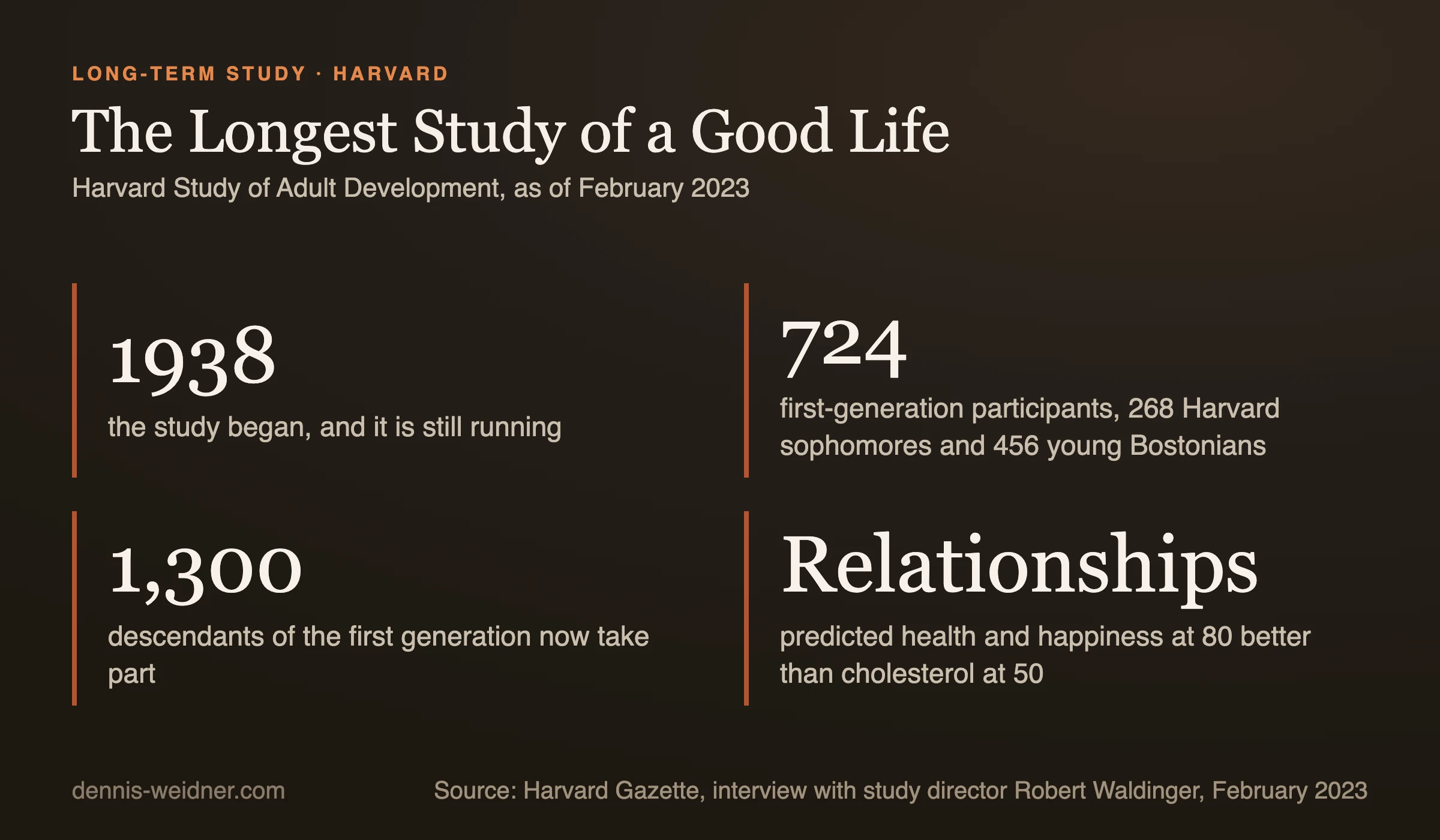
At thirty, the lesson about shared success still sounded to me like a line off a calendar. At forty, it is the foundation. Interestingly, the science says exactly the same thing. The Harvard Study of Adult Development, the longest longitudinal study of human life, has been following people since 1938. Its clearest finding over more than 85 years is not money, not career, not fame, but the quality of our relationships as the single best predictor of a long, healthy, contented life. Two decades in business taught me the same thing, only more expensively.
In concrete terms, that means I have long stopped measuring a good week only by what the company achieved, but also by whether I was home with my family in the evening and whether the people I build with enjoy building with me. This is not soft sentimentality. It is the most sober investment decision I know.
Why now is the most exciting time
I have lived through a few upheavals in my working life: the internet, the smartphone, crypto. But what is happening right now with AI and autonomous agents is on a different scale. For the first time, a single person with the right tools can build things that used to require an entire team. What that means in practice is something I describe in The Autonomous Organization. At twenty I could not have dreamed of this. At forty I get to build it.
What I am setting out to do
Chase less of whatever is loud at the moment, and build more of what I truly believe in. Choose more carefully who I work with. And use twenty years of experience to spare younger founders a thing or two. That is also the heart of what Gründerfreunde has become. In practice, "sparing" them usually means just one thing: telling a young founder early that a project will not carry, so they do not spend a whole year paying for that lesson themselves.
Thank you
Turning forty means, above all, being grateful. For my family, who carry the founder's daily life with me. For the companions who have stayed. And for the curiosity that grabbed me in front of that old budget PC and has not let go to this day. Here is to the next twenty years. I am ready.
Frequently Asked Questions
What are the most important lessons from twenty years in business?
Persistence beats cleverness, people matter more than ideas, your word has to stay your word, and success you cannot share stays empty. These four things run through every project I have built.
What was your most expensive mistake as a founder?
Not a wrong idea, but a decision made too late. I dragged one project along for more than a year even though I knew it would not carry, out of pride and because I did not want to write off the money and time. An early, clean cut would have been cheaper.
Why is right now an especially exciting time to start a company?
Because AI and autonomous agents make it possible, for the first time, for a single person with the right tools to build things that used to require an entire team. The possibilities for individuals and small teams are greater than ever before.
What ends up mattering more than success itself?
The people you share it with. That lines up with the Harvard Study of Adult Development, which over 85 years found the quality of our relationships to be the single most important factor for a good life. Two decades in business taught me the same thing.
Warm regards,
Dennis Weidner
Note: AI tools supported me in writing this article, and some images were edited with AI. I stand behind its content and every statement with my name.