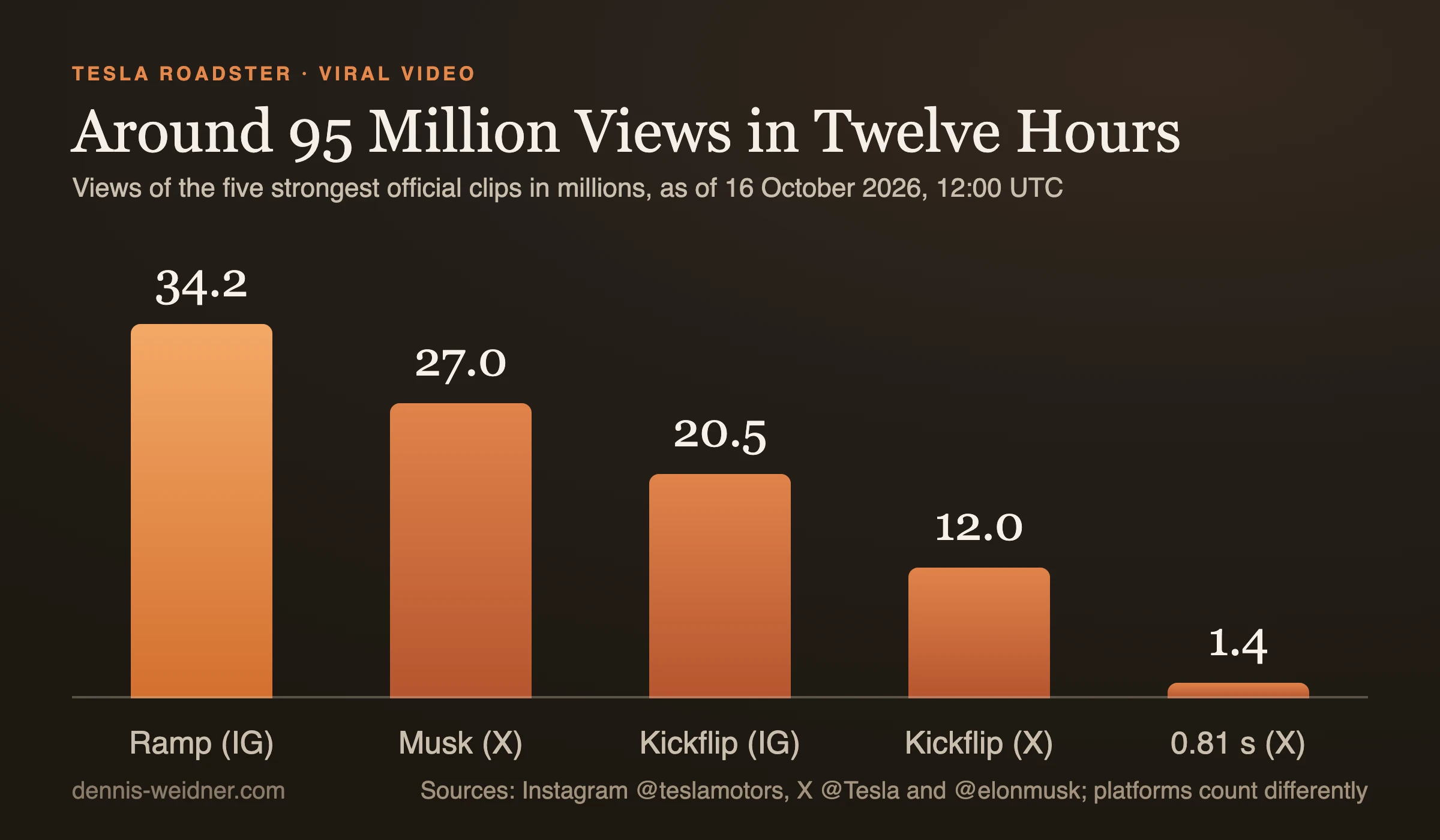
In the early hours of 16 October 2026, German time, Tesla unveiled the new Roadster at SpaceX's test site in McGregor, Texas, with two stunts. The car drove up a curved ramp until it hung upside down, jumped off, turned in the air and landed. It then lifted off on compressed-air thrusters over five Teslas, the Semi truck among them, and spun a kickflip like a skateboard. Within twelve hours the five strongest official clips reached around 95 million views on Instagram and X. Is it real or AI? The stunts took place in front of an audience and Tesla explained the technology, but nothing has been measured independently yet. Here is what was shown, what is documented, and what I take away as a founder from this kind of video marketing.
As of 16 October 2026, 12:00 UTC.
More on this topic: AI in the Founder's Working Day – background, practice and every article in one place.
What Tesla Showed With the Roadster: Ramp, Kickflip and 0.81 Seconds
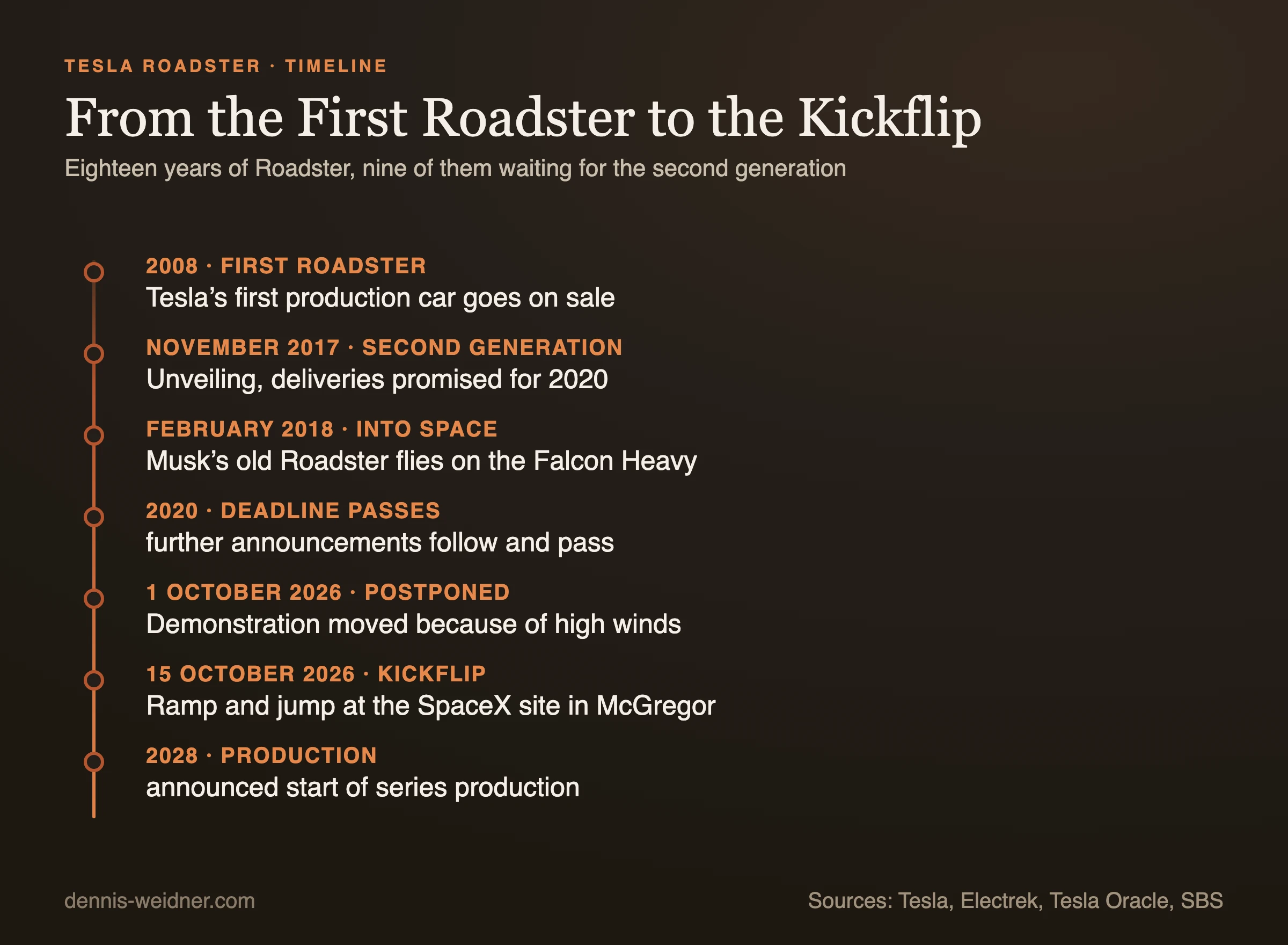
On stage were Elon Musk, chief designer Franz von Holzhausen and Lars Moravy, Tesla's vice president of vehicle engineering. The unveiling was originally planned for 1 October and was postponed because of high winds, reports Tesla Oracle. The livestream was scheduled for 7:55 pm Texas time on 15 October, just before three in the morning in Germany.
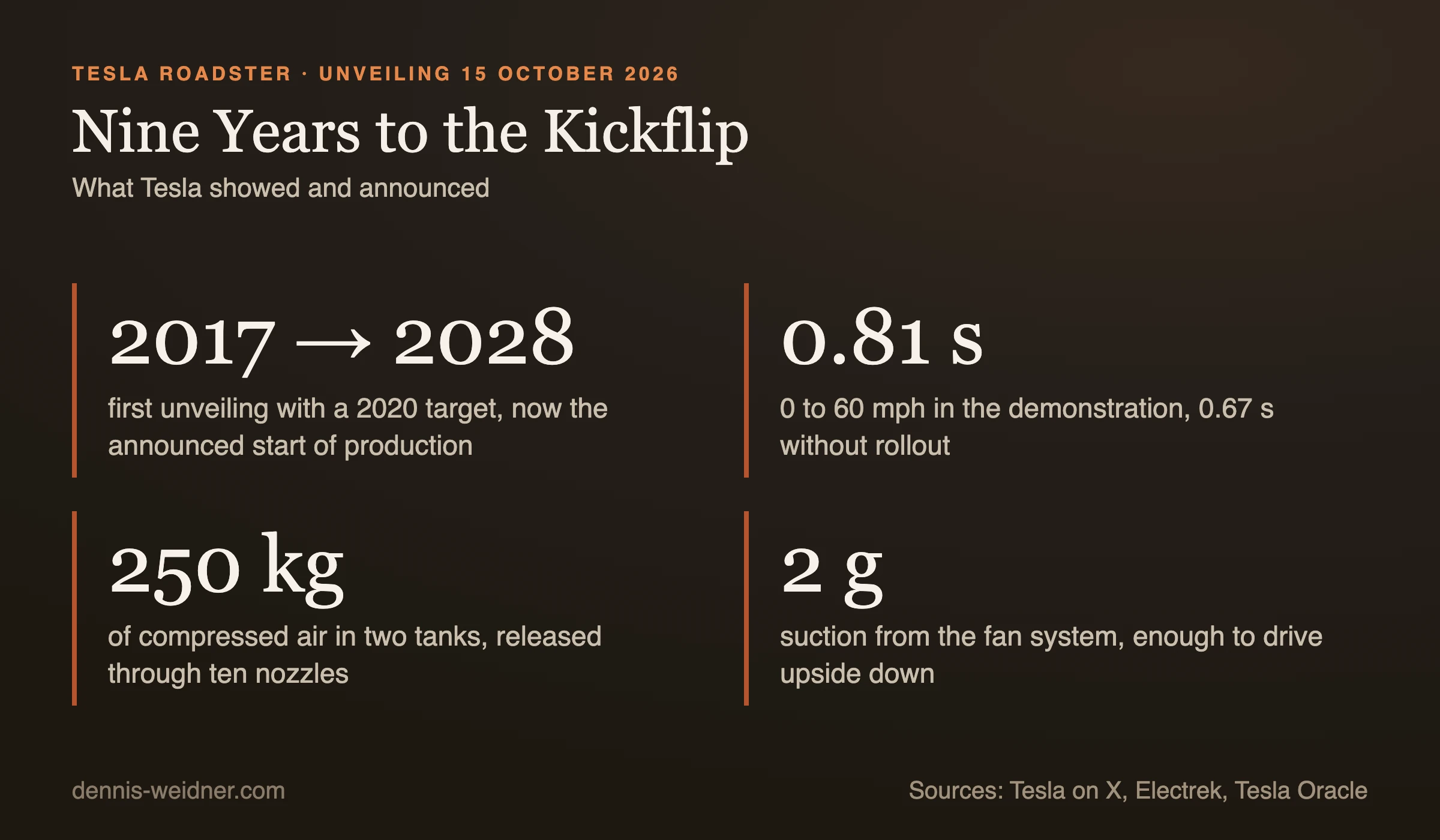
In the first stunt the Roadster drove up a concrete arch behind the stage, held on upside down at the curve, jumped from around 20 metres, rolled back onto its wheels and landed at no more than 3.2 g. In the second it rolled at normal speed towards a row of five Teslas, including a Model 3, a Model Y, a Cybercab and, in the middle, a Semi. Thrusters underneath lifted it, side thrusters rotated it once around its long axis, and the lower thrusters fired again for the landing. The whole manoeuvre took about three seconds. Tesla captioned the clip on X simply: "Do a kickflip!"
There was also an acceleration run: 0.81 seconds from zero to 60 miles per hour, and 0.67 seconds without the usual rollout, as Tesla added on X. The Roadster is to come in three versions.
| Version | 0 to 60 mph per Tesla | Seats | Access |
|---|---|---|---|
| Performance | under 1.6 seconds | 2 | reservation with a $50,000 deposit |
| Thrust, with acceleration thrusters | under 0.9 seconds | 2 | limited, $250,000 deposit |
| Rocket, with full flight system | under 0.59 seconds | 1 | invite only, not for public roads |
Tesla gave no price. Production is to start in 2028 and the range is to exceed 300 miles. That is how Electrek and Fox Business sum it up.
When Tesla Posted the Roadster Videos and How Fast They Went Viral
Tesla did not hide the stunts in one long film. It cut them into short clips and published them minutes apart on different accounts. Musk went first, then came the ramp, the kickflip and the numbers. Each clip tells exactly one thing.
| Time (UTC) | Account | Clip | Views on 16 Oct, 12:00 UTC |
|---|---|---|---|
| 01:57 | X, @elonmusk | "Turns out the future does have flying cars" | 27m, 505,000 likes |
| 02:31 | Instagram, @teslamotors | "Real life, baby", the ramp | 34.2m, 2.0m likes |
| 02:49 | X, @Tesla | "Do a kickflip!" | 12m, 139,000 likes |
| 03:00 | Instagram, @teslamotors | "The Kickflip" | 20.5m, 1.2m likes |
| 05:19 | X, @Tesla | "0-60 mph in 0.81 seconds" | 1.4m |
Together that is around 95 million views in twelve hours. Instagram counts plays and X counts impressions, so the figures show the order of magnitude, not an exact total. At the same time the two Instagram reels carried 72,000 comments and more than 160,000 reposts. X listed the topic in its news section with 1.2 million posts. The ramp reel overtook the kickflip in views, even though the kickflip is the more spectacular stunt. My explanation: the ramp is the bigger puzzle. A car clinging upside down to a wall immediately raises the question of how that can work, and that is exactly what people ask in the comments.
Is the Tesla Roadster Video Real or AI?
Based on everything documented, the stunts are real: a physical prototype performed them in front of an audience. What remains open is whether every shot in the stream was live, and how much of it will reach the production car. The reasons in detail:
- An audience on site. Musk told the guests on stage they were there to prove it was not AI, reports Not a Tesla App. Tesla investor Sawyer Merritt attended and wrote on X afterwards that he had seen it with his own eyes and was still asking how it wasn't AI. He is an avowed Tesla fan, but he was not the only witness.
- The technology is explained and physically consistent. Fans in the rear diffuser pull the car onto the surface with up to 2 g, more than enough to drive upside down. According to Moravy, two SpaceX-style pressure vessels with carbon overwrap hold 250 kilograms of compressed air, released through ten nozzles. That is enough for seconds, not for a flight. Tesla also holds a patent for an "Electric Fan Car".
- No driver on board. According to the Korean broadcaster SBS, the stunts ran without a driver.
- What remains open. The author at Autonocion believes parts of the broadcast were pre-recorded, such as the acceleration run in a dark area away from the stands. That is not documented; she relies on her impression of the editing. Nobody has measured the 0.81 seconds independently, and the clips on Instagram and X are edited, with several cameras and music.
My conclusion: real, but staged. That is not a contradiction, it is craft. A kickflip you see for three seconds from the right angle needs cameras, lighting and editing. The car does not fly, it hops in a very controlled way on a great deal of compressed air. And regardless of that question: it is brilliantly done.
Knight Rider, Turbo Boost and the Dream of a Flying Car
Anyone who grew up in the eighties has an instant picture in mind when watching the kickflip: Michael Knight presses the "Turbo Boost" button in the cockpit of KITT, and the black Pontiac Firebird Trans Am leaps over an obstacle. "Knight Rider" with David Hasselhoff ran in the US from 26 September 1982 and in Germany from 28 August 1985 on RTL plus, 90 episodes in four seasons, according to Wikipedia. A whole generation dreamed of having that one button in a traffic jam.
Tesla has now demonstrated that dream, and the internet made the connection at once: a German user on X wrote that Knight Rider and the flying DeLorean from "Back to the Future" were finally becoming reality. Musk played with that film himself and paraphrased it on stage: where we're going, you don't need tires. Then there is a story Tesla has been telling for years. In 2018 SpaceX launched Musk's old Roadster into space on the Falcon Heavy, where it still orbits today. After the unveiling Tesla wrote that the Roadster in a rocket had become a rocket in a Roadster.
What the Internet Makes of the Roadster: Memes, Traffic Jams and Flying Coffee
The comments under the reels are a piece of marketing in themselves. The most liked one under the ramp video reads "China, you have 24 hours to respond", with 109,531 likes. The question about the right insurance drew 23,097 likes, "We got flying cars before GTA 6" 41,035. Under the kickflip, Red Bull Gaming asked for the controller inputs for the trick, as if it were a video game, a nod to Rocket League.
A few hours later came the memes, and many of them really are made with AI: Roadsters taking off out of a traffic jam, hopping over police checks, drivers whose coffee flies through the car when they press the button. One such clip, labelled as AI-made, reached 127,000 views on X, and 9GAG contributed its own version. There is a nice twist in that. The original is real, and precisely because of that, thousands recreate it with AI to put themselves into the scene. Every one of those copies carries the Roadster further without Tesla paying for it.
What I Learn as a Founder From Tesla's Video Marketing
We drive Teslas ourselves, and professionally I work on how content gains reach, most recently with the launch of SLABHIT with live shows. I take five things away from that night:
- Address the doubt yourself. At a time when every spectacular video is first taken for AI, authenticity is the scarcest asset. Tesla did not wait for the question; it invited an audience as proof and called the reel "Real life, baby". Anyone showing something real today should deliver witnesses, raw footage and measurements along with it.
- One action, three seconds, no sound needed. Car jumps over a truck and spins: anyone understands that, in any language, with the phone on mute on the train. The first second decides whether someone keeps scrolling.
- Use cultural codes. The kickflip comes from skateboarding, the comments talk about Rocket League and GTA, older viewers think of Knight Rider. One clip speaks to three generations because it docks onto images already in people's heads. I have described how platforms reward such triggers in my piece on social media algorithms.
- Cut it up and release it in sequence. Musk, ramp, kickflip, numbers: five posts in just under three and a half hours, each with its own punchline, all on Tesla's own channels. @teslamotors alone has ten million followers on Instagram. It is the same logic live commerce runs on: one event, many snippets, all leading back to the product.
- Hype is a loan. In 2017 Tesla promised deliveries for 2020. Reservations cost $50,000 at the time, the Founders Series $250,000, and Musk had to apologise to those waiting. Now it says 2028. Analyst Gene Munster, according to Yahoo Finance, called the demonstration an engineering flex with no commercial value beyond embarrassing traditional car makers. Attention has to be repaid with delivery at some point.
The stock liked it anyway: after closing at $362.44 on Thursday, it traded 4.4 percent higher at $378.50 before Friday's open, reports Benzinga. Tesla reports its quarterly results on 21 October.
And China? What the Roadster Says About Competition in Electric Cars
The comment with 109,531 likes is more than a joke. In volume, China has long been ahead: in 2025 BYD sold more pure electric cars than Tesla for the first time, 2,256,714 against 1,636,129, as compiled by CnEVPost. In the first quarter of 2026 Tesla was briefly ahead again; in the third quarter Tesla delivered 486,532 vehicles while BYD sold 762,478 battery electric passenger cars.
| Period | Tesla | BYD, pure electric passenger cars |
|---|---|---|
| Year 2025 | 1,636,129 | 2,256,714 |
| Q1 2026 | 358,023 | 310,389 |
| Q3 2026 | 486,532 | 762,478 |
Tesla is not currently winning this race on price and volume. The Roadster is therefore an answer on a different level: it shows what a brand can do that has rockets and cars under one roof, and it gives the customers of the cheaper models a story to pass on. For founders that means: if you cannot lead on cost, you have to lead on the story, and the story has to be true.
What the Roadster Means for Tesla's Communication
With this night Tesla sets a new standard for how to launch a product. A livestream alone is nothing special any more, and neither is a stage. What is new is the combination of a real stunt, an audience as proof, flight data on screen as at a rocket launch, and clips cut for every platform within an hour. Sawyer Merritt found it remarkable that Tesla managed to keep the development secret for so long. That is part of it too: if you show nothing in advance, you get the full effect on the night.
Whether the Roadster really reaches the road in 2028 and what it will cost, nobody knows today. What the videos have achieved, on the other hand, can already be measured. For me that is the real lesson: a good video does not replace delivery, but it decides whether anyone is waiting for the delivery at all. How we build content and reach with AI tools ourselves is in my piece on our website relaunch with AI agents, and more on video and retail in the overview of e-commerce and live commerce.
Frequently Asked Questions
Is the Tesla Roadster video real?
According to all reports from the site, yes: on 15 October 2026 in McGregor, Texas, a physical prototype drove upside down on a ramp in front of an audience and jumped over five Teslas on compressed-air thrusters. The published clips are edited, and figures such as the 0.81 seconds have not yet been measured independently.
How does the new Tesla Roadster fly?
It does not really fly, it jumps. Two pressure tanks with 250 kilograms of compressed air provide thrust for seconds through ten nozzles, and fans in the underbody pull the car onto the surface with up to 2 g. That lets it drive upside down and lift off briefly.
When is the Tesla Roadster coming and what does it cost?
Production is to start in 2028. Tesla has not named a price. It asks a $50,000 deposit for the Performance version and $250,000 for Thrust; the Rocket version is invite only.
When did Tesla post the kickflip videos?
Overnight on 16 October 2026: Musk's post at 01:57 UTC, the ramp reel on Instagram at 02:31 UTC, the kickflip on X at 02:49 UTC and on Instagram at 03:00 UTC. By 12:00 UTC the five strongest clips had around 95 million views.
What does Knight Rider have to do with the Roadster?
In the series "Knight Rider", the car KITT jumps over obstacles at the press of the "Turbo Boost" button. The Roadster's kickflip looks like the real version of it, and many viewers drew exactly that comparison.
Best,
Dennis Weidner
Note: AI tools supported me in writing this article, and some images were edited with AI. I stand behind its content and every statement with my name.