When founders ask me which AI tools I use, my answer is that the tool question is the wrong question. I stopped thinking in tools a while ago. I think in tasks. Which work do I hand to agents, with which guardrails, and which work do I deliberately keep for myself? That is exactly how this article is organized. My stack as a founder in 2026, sorted by category, including the things no agent will ever decide for me.
Why I think in categories, not tools
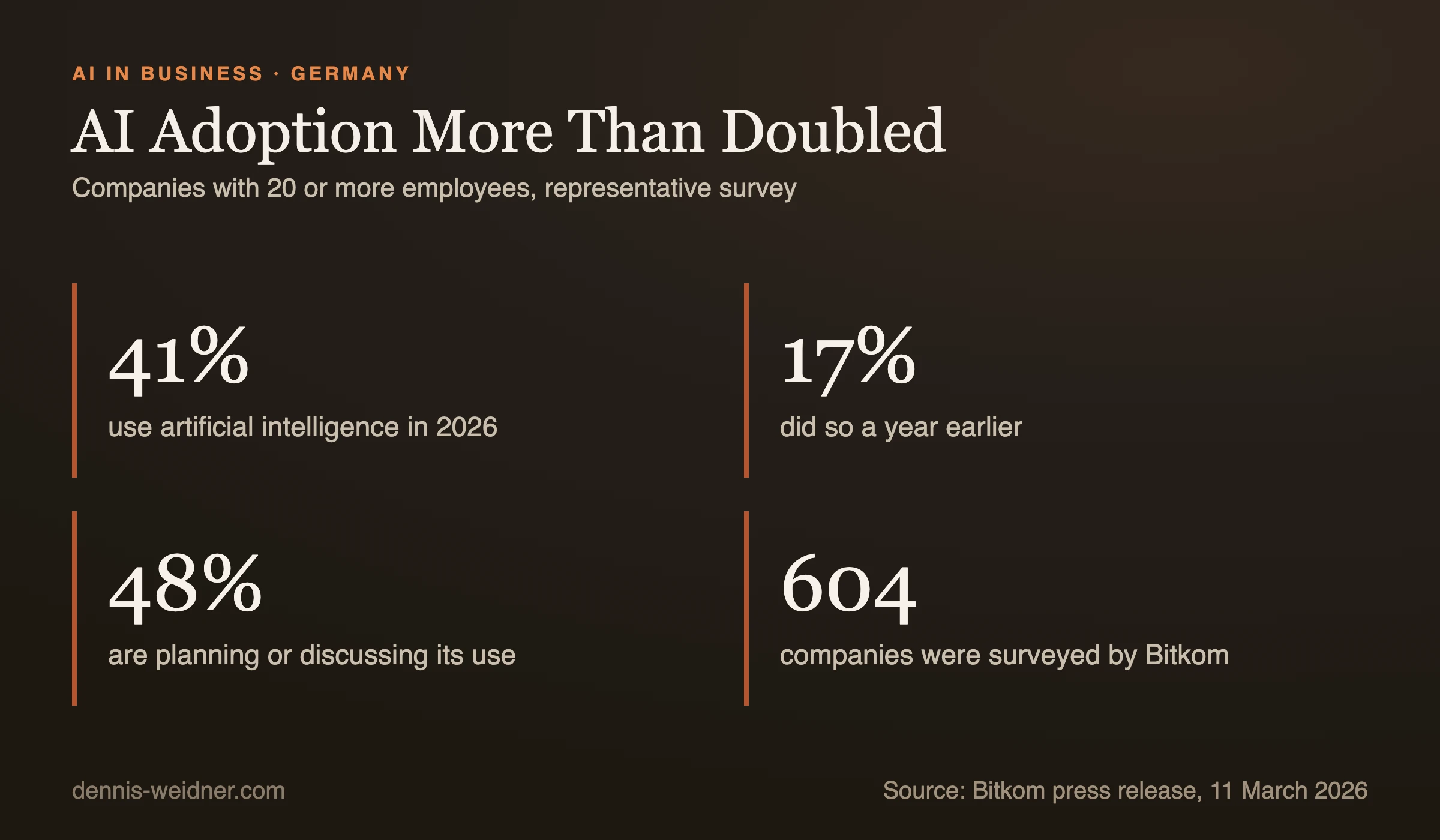
Every tool list is outdated three months after you publish it. The tasks behind the tools stay the same: research, write, build, administer, decide. So the category tells you more than the logo. There is a second reason too. According to Bitkom, 41 percent of German companies with 20 or more employees now use AI, and another 48 percent are planning or discussing it. But "using AI" often just means someone types into a chat window now and then. That is an assistant, not an agent. The difference is fundamental, and if you want the foundations first, start with my primer on what an AI agent actually is.
More on this topic: AI in the Founder's Working Day, with background, practice and every article in one place.
An assistant answers, an agent works. It gets a goal, plans its own steps, uses tools, and delivers a result. Anthropic puts it well in its guide Building effective agents: agents shine on open-ended problems where you cannot predict the steps in advance, and they work best when the outcome is verifiable. Those two sentences explain my entire stack.
Research and analysis: my early warning system
The first category is the least glamorous one, and it has freed up more of my time than anything else. Market and competitor monitoring used to be a Monday ritual: two or three hours of working through sources, copying, assessing. Today I have defined once, and precisely, which competitors matter, which signals count, and what the threshold is for "you need to see this". An agent collects the sources overnight, filters out the noise, writes a summary with links, and flags anything unusual. In the morning I read one page instead of twenty tabs.
The crucial point: the agent observes and condenses, but it does not react. Whether we respond to a competitor's price move, whether a new topic belongs on our roadmap, that is my call. The research is delegated. The judgment is not.
Content production: agents write, guardrails protect quality
The articles on this site are produced in a pipeline where agents do most of the work: topic research, source checking, drafting, translation, publishing in two languages. That sounds like losing control. Set up properly, it is the opposite. Without hard rules, a content pipeline produces interchangeable mush. With rules, it gets genuinely good.
My guardrails are simple and strict. No article goes live without a cover image. No number appears without a linked, credible source, and whatever cannot be verified gets cut. After every publish, a QA step checks links, formatting, and rendering on the real page, not just in a draft. And at the end I look at it myself before anything carries my name. The agent produces, I define the quality bar. Reverse that order and you get volume instead of a brand.
Code and infrastructure: deploys that verify themselves
This is the category that surprises people most: this website was built by agents, from the relaunch to day-to-day operations. An agent changes code, deploys, and then verifies live that everything works. It actually opens the pages, checks status codes and rendering, and only then reports done. That is exactly why it works so well. Code is the most grateful agent task there is, because the result is verifiable. Either the page loads or it does not. Either the test is green or it is not.
What matters to me here is the emergency brake. My agents operate within clear boundaries, with defined checkpoints and one standing rule: when in doubt, escalate instead of guessing. Autonomy without verification is not efficiency. It is risk on a time delay.
CRM and back office: the quiet workhorses
The fourth category is unsexy, and that is why it is so valuable. Incoming leads land in the CRM in a structured way, and an agent enriches the context instead of me copying data by hand. First drafts of proposals and support replies are waiting before I even open the case. And once a week I get a digest: what happened, what is stuck, what needs my decision. If you are building several companies in parallel, as I am, you know how much leadership time normally evaporates in exactly this kind of small stuff.
The same principle applies here: the agent prepares, the human closes. No proposal goes out, no substantial support answer leaves the building, without a person signing it off.
What deliberately stays human
Now for the most important part, because autonomous does not mean leaderless. There are four things I never hand over. Decisions: strategy, priorities, investments, people. Agents give me the best decision basis I have ever had, but the decision itself is my job. Relationships: partners, customers, the team. I grew up with a handshake mentality, and trust is built between people, not between API endpoints. If you want to know how I think about that, my about page tells the longer story. Accountability: if an agent messes up in my name, that is my mess. Holding that view changes how carefully you build guardrails. Final quality sign-off: the last pair of eyes before anything ships is always human.
The numbers show that this is precisely where the game is decided. According to McKinsey's State of AI report, 62 percent of organizations are at least experimenting with AI agents, but only 23 percent are scaling them in even one function. The gap between the two is rarely about technology. It is unclear processes and missing checkpoints, because automating a broken process just gives you faster chaos. What a company looks like when humans set direction and agents handle execution is something I have laid out in detail in my article on the autonomous organization.
My conclusion after years in the engine room: in 2026, a founder's AI stack is no longer a tool collection. It is a leadership decision. You define which work agents take on, which guardrails apply, and where the human remains non-negotiable. Get that separation right and you win back time for what actually counts: deciding, building relationships, carrying responsibility.
Frequently asked questions
Which tasks do AI agents typically handle for founders in 2026?
Mainly four categories: research and analysis (for example competitor monitoring delivered as a daily digest), content production under strict quality rules, code and infrastructure including deploys with live verification, and CRM and back-office work such as lead capture and weekly digests.
What should you not delegate to AI agents?
Strategic decisions, relationships with customers, partners, and your team, accountability for outcomes, and the final quality sign-off. Agents prepare and execute, but judgment and approval stay with a human.
What is the difference between an AI tool and an AI agent?
A tool or assistant responds to individual prompts. An agent receives a goal, plans its own steps, uses tools such as a browser or code, and delivers a finished, verifiable result.
How should a founder start with AI agents?
With one clearly defined process that already works today and produces a verifiable outcome. Describe the process precisely, set guardrails and checkpoints, then automate. A broken process only breaks faster once you automate it.
Warmly,
Dennis Weidner
Note: AI tools supported me in writing this article, and some images were edited with AI. I stand behind its content and every statement with my name.