Since 2 November 2026, supermarkets in up to ten European countries have reported refrigeration systems that heat instead of cool, presumably manipulated remotely. The German federal cyber security office BSI confirms such interference in Germany too, with reports from Reisbach, Wuppertal, Wetter and Lilienthal, where the owner puts the loss of goods at more than €360,000. Three weeks earlier, up to 700 stores in France were hit. The operator carries the loss first, and even cyber insurance does not automatically pay for spoiled goods under the German industry's model terms. My view as an entrepreneur: from what is known so far, this attack was no dark art, the door was often wide open, and that is exactly why it matters to anyone running connected equipment. Here is how the attack works, who pays, who to call and what you can do this week.
As of 3 November 2026, 20:00 UTC. Investigations are ongoing and the attackers are unknown.
More on this topic: AI in the Founder's Working Day, with background, practice and every article in one place.
Supermarket Fridge Cyberattack: Key Points
- 12 October 2026: Up to 700 stores in France are affected, units run at around 50°C for hours, and small fires break out in some branches.
- 2 November 2026: A new wave in up to ten countries. In Germany, an Edeka in Reisbach reports up to 50°C and an owner in Lilienthal more than €360,000 in losses.
- €15,000 to over €360,000 is the range of losses reported per business so far.
- 2,765 controllers of a single Danfoss model were found openly reachable on the internet by security researchers in August 2026.
- 5 percent of companies in Germany have cyber insurance according to the insurers' association GDV, and an insured claim averaged €43,186 in 2025.
- 9 October 2026: The BSI guidance for small installations carries this date, two days before the first wave. The top measure: take controllers off the internet.
Cyberattack on Supermarkets: What Has Happened Since October
The attacks came in waves, often at night and aimed at operational technology rather than tills or inventory systems. Whether they are linked remains open. The timeline so far:
| Date | Where | What happened |
|---|---|---|
| 9 October | Germany | The guidance BSI-CS 154 on internet-connected controllers carries this date |
| Night to 12 October | France | Up to 700 stores, including Intermarché, Coopérative U, E.Leclerc, Carrefour and Monoprix; small fires in some branches, and Paris prosecutors investigate |
| 12 to 16 October | France | The French agency CERT-FR warns of attacks on Danfoss, Copeland and Dixell controllers; Dixell devices are hit in addition shortly after the first night (franceinfo) |
| 13 October | Germany | BSI president Claudia Plattner warns of copycats and says such entry points practically invite sabotage |
| Night to 2 November | Europe | Cases in Belgium, Luxembourg, Sweden, Ireland, Estonia, the Netherlands, Finland, Portugal and Italy, among them Delhaize, Carrefour Belgium, Coop Sweden and SuperValu in Ireland |
| 2 November | Germany | Edeka in Reisbach and CAP-Markt in Wuppertal throw away goods, along with Wetter, Lilienthal, Raesfeld and the Westpfalz region, where a food processor is also affected |
| 2 and 3 November | EU and Germany | The European Commission calls crisis meetings with Enisa and Europol; the BSI sees no risk to food supply in Germany |
Who is behind it remains open. Nobody has claimed responsibility and no ransom demand is known. Belgium's Centre for Cybersecurity says the culprits may never be identified. A SentinelOne researcher reads the missing demand as a sign of sabotage (Reuters via CNBC). The cause is not settled everywhere either: Delhaize speaks of an IT incident, Finland is still investigating, police in Lower Bavaria have not yet confirmed a cyberattack (heise), and Raesfeld is still being checked.
Supermarket Refrigeration: How the Cyberattack Works
There really is a central management system, and that is the heart of the matter. Larger stores have a system manager in the plant room that coordinates every refrigeration controller on site. Through a web interface, staff can read temperatures, set alarm thresholds and change schedules (Claroty Team82 on the AK-SM 800A). So that the refrigeration engineer does not have to drive out for every alarm, this box is connected to the internet. It is practical and has been common for years.
The attackers did not switch the cooling off, they turned it around. Every unit has to defrost regularly and briefly warms its evaporators to do so. According to the Belgian service firm Sabcobel, the units were remotely put into this defrost mode (CBS News). In France, many units ran like this at about 50°C for around six hours (AFZ). Nobody is in the store at night: at an ICA in Stockholm it began around 2 a.m. and was only noticed hours later (Reuters via CNBC). Estonia shows how much a quick response matters: a freezer there was also set to 50°C, the temperature rose by only two to three degrees and it was fixed within ten minutes (The Hacker News).
Does an attack like this take expertise?
Less than you would hope. In August, Claroty used an internet search engine to find 2,765 reachable devices of the AK-SM 800A model alone. It contained a hidden login whose password derives from the current date; the flaw is tracked as CVE-2025-41450 and had been public since spring 2025. Whether exactly this flaw was used is not confirmed. Danfoss itself says systems in the Netherlands were not on a secure network and still used default passwords, and that most units hit in France were older models without updates, the AK-SM 800 and AK-SC 355 (The Hacker News).
French specialists therefore do not consider the attack particularly sophisticated. Another expert counters that hitting hundreds of devices at once does take some skill (franceinfo). The BSI writes in its guidance that with AI, such attacks need less or even no expert knowledge. For me, that is the real news: the barrier is falling while the number of connected installations is rising.
Cyberattack Costs: What the Damage Means for One Store
For small shops, the figure that circulated in the first reports fits: a few tens of thousands of euros. Larger sites are far above that. In Germany, only the owner in Lilienthal has named a sum so far, more than €360,000, with his units reportedly reaching 30°C (dpa via t3n). The chart shows the cases with public figures; these are statements by those affected, not audited sums.
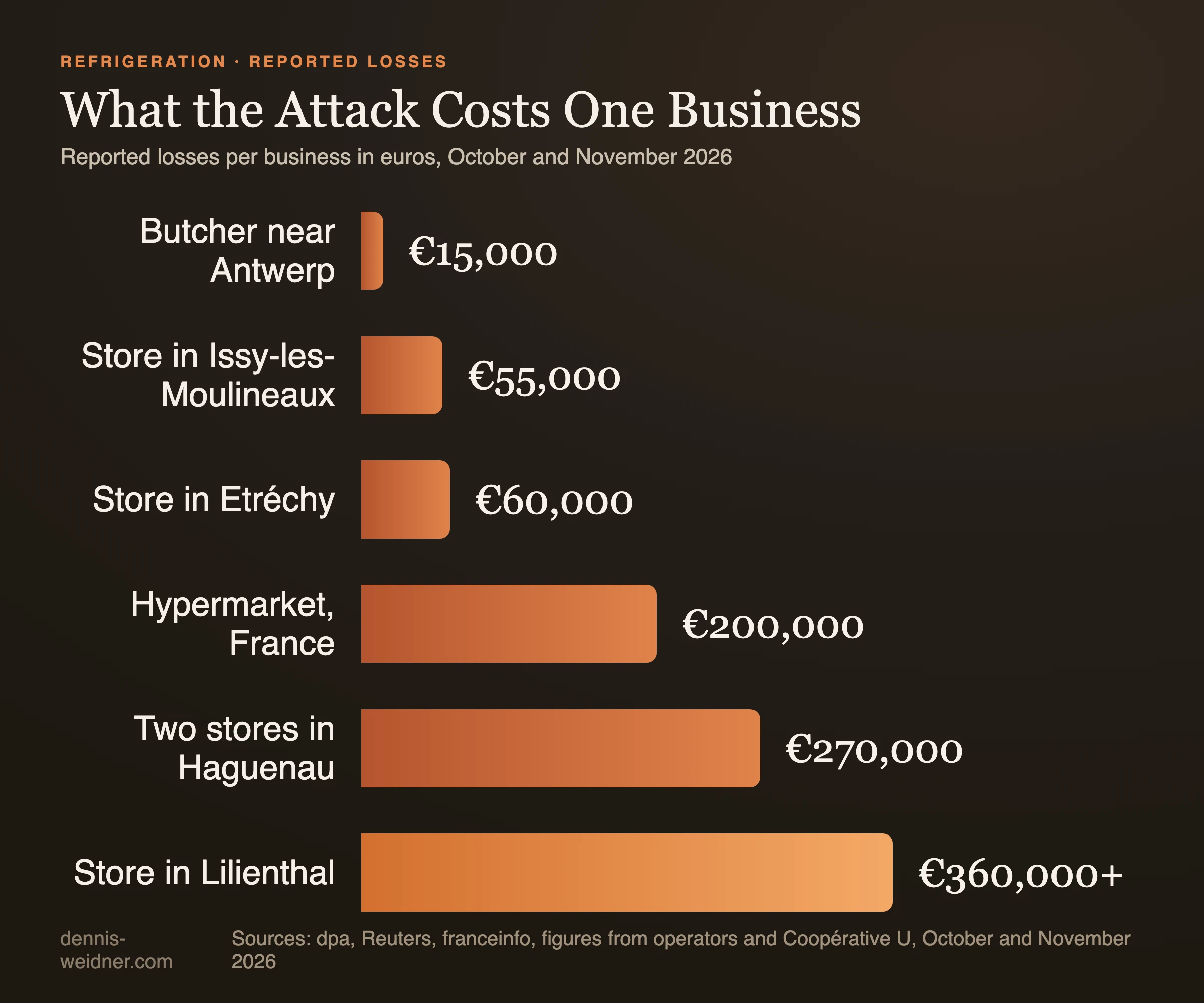
On top of that comes what these figures often leave out: disposal, cleaning, closed departments, lost sales and sometimes destroyed equipment. France saw fires. The trade press assumes a double-digit million sum there, but no audited total exists.
Cyber Insurance: Who Bears the Damage
First, you do. Who steps in after that depends on three contracts, and none of them can be taken for granted. The key point sits in the GDV's model terms: they insure financial losses. Property damage is excluded, explicitly including the spoilage of goods (AVB Cyber, A1-3, February 2024). Under this model, the spoiled yoghurt is precisely not a cyber loss. The terms are non-binding and any insurer may deviate.
| Who | What they can cover | Where it gets difficult |
|---|---|---|
| Operator | everything nobody else covers: goods, disposal, cleaning, downtime | carries the risk first and has to prove the loss |
| Cyber insurance | investigation and recovery costs, business interruption, liability | no property damage under the model terms; exclusion for war and certain state attacks; duties on updates and protection |
| Contents or refrigerated goods insurance | spoiled goods, depending on the contract | cyber clauses may apply; for transport, the GDV already has such an exclusion |
| Maintenance firm | damages if it secured remote access poorly | fault and liability caps in the maintenance contract; French stores are reportedly considering lawsuits |
| Manufacturer | updates and warnings | old models no longer get updates; the new product liability applies from 9 December 2026 and protects consumers, not companies |
| State | advice, investigation, warnings | no compensation fund; ordinary retail is not on the NIS2 list in Germany's BSI Act |
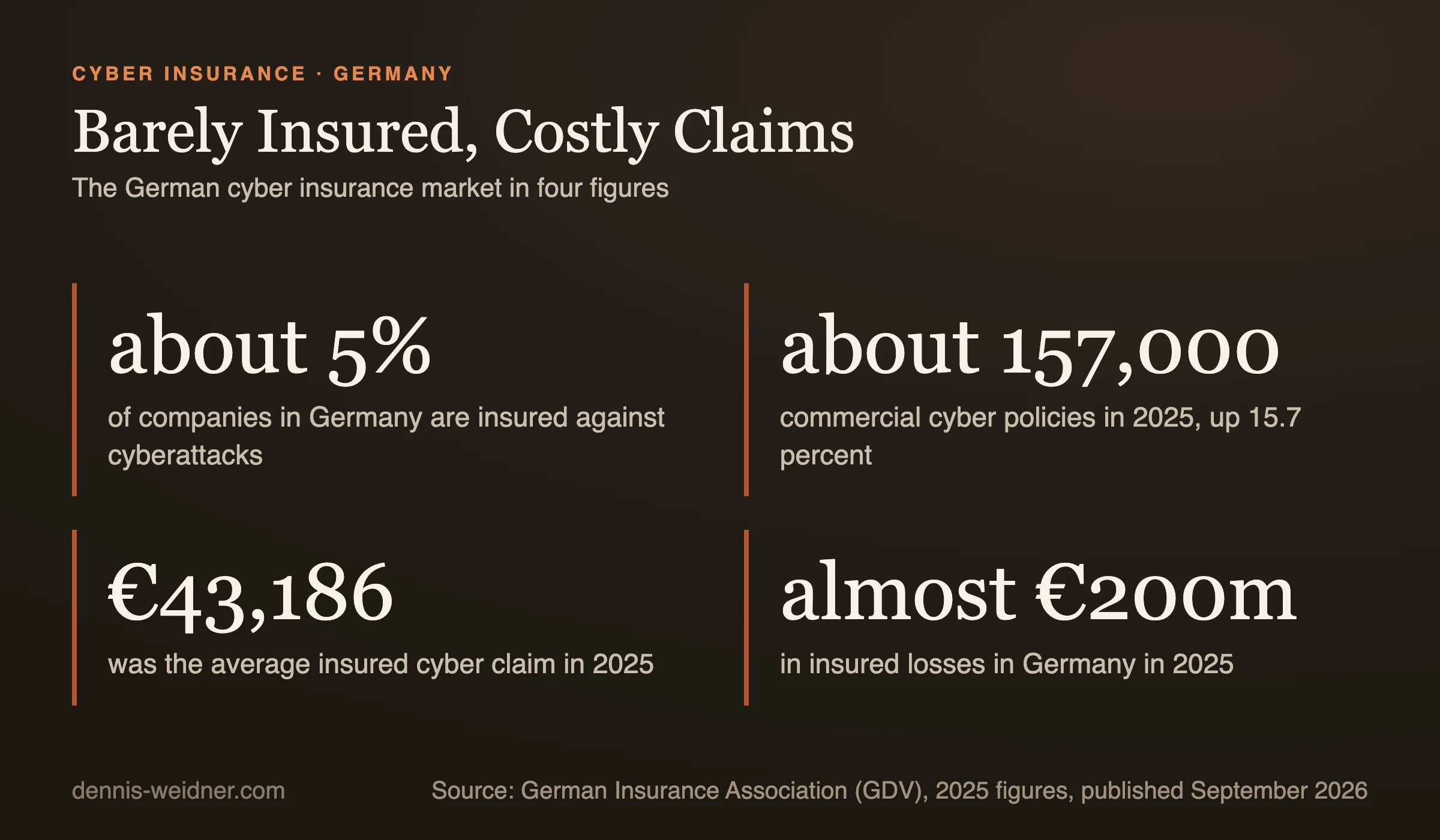
The GDV estimates that only about a third of companies are adequately protected, and protective measures are generally a precondition for a policy. Default passwords can become expensive in a claim. The GDV model requires individual logins and additional protection for devices reachable over the internet; anyone grossly negligent in breaching such duties risks a reduced payout (A1-16 and B3-4.2.1). Outside this model, Section 81 of the German Insurance Contract Act may apply in cases of gross negligence, and the trade press sees factory passwords as a candidate. Attribution matters too: state attacks are excluded under the model terms if critical infrastructure is also impaired, with the burden of proof on the insurer. One more practical detail: the French agency advises checking your insurance terms before cutting the data link to your refrigeration engineer. Remote monitoring can be part of the contract.
That leaves management's own duty. According to the trade press, no specific IT security rules apply to small installations, and in the food sector the NIS2 rules only name wholesale and industrial production (BSI Act, Annex 2); only very large retail chains may fall under the critical infrastructure ordinance. Even so, the BSI writes in its guidance that anyone running such systems openly on the internet without protection is in principle in breach of duty. That is not a court ruling. But it is the sentence any opposing party will read out to you in a dispute, and for managing directors of a German GmbH the duty of care in Section 43 of the GmbH Act sits right beside it. After the warnings of October, it is hard to claim you did not know. This is my view as an entrepreneur, not legal or insurance advice.
Update of 4 November 2026: How Many Policies Cover Spoiled Stock
The Berlin insurtech Cyberdirekt checked 21 cyber insurance tariffs, as Versicherungswirtschaft heute reports (in German). Six of them cover spoiled refrigerated goods in principle, one provider pays up to the full sum insured, and five work with sublimits of 50,000, 100,000 or 250,000 euros. When you review a policy, look at the refrigerated-goods clause and at the duties for securing remote access.
Cyberattack: Who to Contact in Germany
The short answer: first the service provider who takes the system offline, then the police and your insurer, all on the same day. Document everything from the first minute: temperature curves, times, photos of the goods, disposal receipts. Resetting alone is not enough. CERT-FR warns that a device that is reset but still exposed will probably be taken over again, and advises checking the defrost schedules in particular.
| Contact | What for | How |
|---|---|---|
| Refrigeration engineer or IT provider | take the system offline, check settings, restore access only through a secured network | your maintenance contract |
| Central Cybercrime Contact Point (ZAC) of the police | report and investigation, the right desk for companies in each federal state | list on polizei.de |
| BSI and Cybersicherheitsnetzwerk | first assessment, referral to digital first responders | 0800 274 1000, Mon to Thu 8:00 to 17:00, Fri 8:00 to 16:00 |
| CYBERsicher emergency help | online assessment for mid-sized companies, referrals to service providers | Transferstelle Cybersicherheit, which also lists state services |
| Your insurers | notify immediately, for both cyber and property cover | claims hotline in your policy |
| Data protection authority of your federal state | report without undue delay and where feasible within 72 hours of becoming aware, if personal data is affected and there is a risk to the people concerned (Art. 33 GDPR) | the authority's website |
| Food safety authority | if you cannot judge whether goods are still safe | district or city |
Anyone covered by NIS2 also has fixed deadlines towards the BSI: early warning within 24 hours, follow-up after 72 hours, final report after one month. Baden-Württemberg runs a round-the-clock hotline with its Cyberwehr, and Berlin has its own cyber hotline.
Cyberattacks in Germany: The Statistics
According to Bitkom's Wirtschaftsschutz study, 67 percent of companies were definitely hit by data theft, espionage or sabotage in 2026, and a further 29 percent suspect they were. The damage comes to €211 to €270.8 billion, 76 percent of it from cyberattacks; in 2021 that share was still 59 percent (Bitkom study report). All of this is an extrapolation from a survey of 1,003 companies with ten or more staff, not a count of individual incidents.
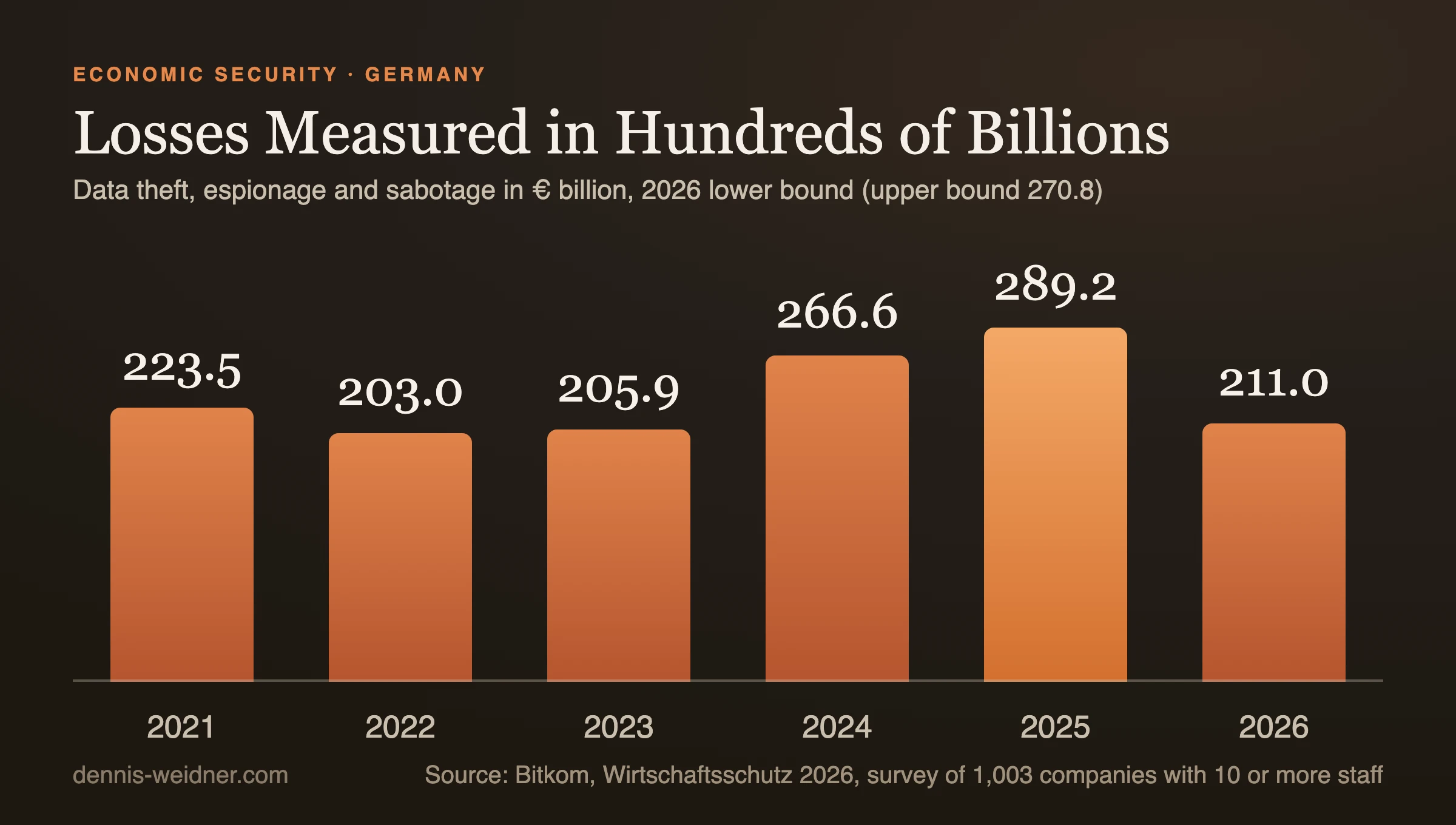
So has it increased? The total fluctuates, and the lower bound for 2026 is well below last year. What has risen is the share of cyberattacks and the role of states: 37 percent of those affected attribute at least one incident to a foreign intelligence service, up from 7 percent in 2023. 52 percent name China as a source and 49 percent Russia. 57 percent report definite or suspected digital sabotage of systems or operations, and 82 percent assume attackers are increasingly using AI.
What makes me think most: only 43 percent still consider themselves very well prepared, down from 50 percent a year earlier. At the same time, only 45 percent see their existence threatened, down from 59 percent in 2025. Less prepared and less worried do not fit together. On average, 18 percent of IT budgets go to security. Only about 3 percent of insured companies report a cyber incident according to the GDV, and just under €200 million in insured losses stand against a three-digit billion figure in Bitkom's extrapolation. The two numbers measure different things, yet the direction is clear: companies carry most of it themselves.
Penetration Testing and Daily Reality: What We See at Cryptoticker
For me, this is not abstract. At Cryptoticker.io, a company I hold a stake in, we have experienced attacks ourselves in recent weeks: automated requests from foreign servers, around the clock, often at night. In October came the security incident at our hosting provider Railway. Once you have seen this in your own logs, you read such reports differently. And I know the feeling many entrepreneurs have: you can hardly defend yourself.
Against a well-funded attacker who wants exactly you, that is true. Nobody can buy absolute security. But from what Danfoss, authorities and specialists say so far, that is not the situation with these refrigeration systems. They were about openly reachable controllers, old devices and default logins, and in Wetter and Portugal apparently also the route through the maintenance firm. That is the mass someone picks up in passing. There is plenty you can do about that, which is why I recommend two things to everyone.
The first is a penetration test, a break-in you order yourself: independent specialists attack your systems under your mandate and write down how far they got. The BSI's practical guide describes what such a contract should include. The order matters: close the obvious gaps first, then have it tested, or you pay for a list you could have written yourself. That is how we approach it too, and we are working through such a checklist right now.
The second is a watchman. Since late October, a small automated system has been alerting us within minutes when someone unknown tries to log in or a new access appears. It is no major project, and it changes daily life: you hear it from your own watchman and not days later from a customer. At Weidner & Friends we show how this kind of automation can be built with agents. I describe my own setup in my AI stack.
Sockets, USB and Wi-Fi: How Movement Profiles Really Emerge
The good news first: you can keep plugging into almost any socket, as long as your own charger sits in between. Clips are circulating online, allegedly from China, in which gigabytes supposedly drain away after plugging in. One such video caught my attention too. But a normal wall socket delivers power, not files, and a charger does not pass data through. A data counter that climbs after plugging in may also have a simple explanation on the device itself: an iPhone with iCloud Backup switched on backs up automatically when it is on power, locked and on Wi-Fi.
Juice jacking: USB is the real attack path
USB ports in hotels, trains and airports, and rental power banks, are a different matter, because data lines may be live there too. In 2025, researchers at TU Graz showed with their ChoiceJacking technique that a manipulated charger can reach photos, documents and app data on devices from eight vendors, and on locked phones from two of them (USENIX Security 2025). Most vendors have since made fixes. Chinese police warned years ago about rental power banks of unknown origin. For perspective: security vendor ESET knows of no confirmed real-world case up to July 2026. Your own charger or power bank solves the problem, and at "Trust this computer?" on an unknown port, the answer is always no.
Wi-Fi hotspots and the trail in your apps
The question "Do you want to join this network?" also comes from your phone, not from the hotspot. On the move, the phone searches for networks itself and sends small requests into its surroundings. Vendors now disguise the device address for this, but researchers at KU Leuven were still able in 2016 to recognise up to half of devices for at least 20 minutes. If you do not want that, switch off Wi-Fi when out and delete old saved networks.
Your biggest trail lies elsewhere. In the Databroker Files investigation, netzpolitik.org and Bavarian Broadcasting received from a US data broker, as a free sample, about 3.6 billion location points from Germany, tied to about 11 million advertising IDs, from just two months. They revealed homes, workplaces and clinic visits, and in some cases identified individuals. So movement profiles emerge mainly in the apps on your phone. Limiting location access to what is necessary and switching off tracking in your settings does more than avoiding every socket.
Industrial AI in Germany: Why Data Is Also Attack Surface
Germany is betting on its industrial strength. Deutsche Telekom and Nvidia have built an Industrial AI Cloud in Munich with up to 10,000 GPUs, around 50 percent more AI computing power for the country. I think that is right and I work with AI every day myself; if you want to keep data in-house, my article on local AI for SMEs shows one way. But a machine does not become more valuable when anyone can reach it. If you connect every installation to feed models with its data, you also widen the surface on which you can be hit.
The refrigeration system is the harmless example. In the same guidance, the BSI cites coordinated attacks in Poland in December 2025 on numerous wind farms and two combined heat and power plants, based on default logins and reused passwords. In August 2026, more than 30 municipal water utilities in the US were hit through openly reachable controllers. The guidance explicitly also covers solar, biogas and drinking water. Connectivity is not the mistake, open doors are. So my order is: first the doors, then the data.
I would like three things from politics, and I have written about entrepreneurs and politics before. First, a public end-of-support date: anyone buying a controller should know until when it gets updates, starting today. The main obligations of the Cyber Resilience Act only apply from 11 December 2027, and it does little for devices already hanging in the plant room. Second, active warnings: when search engines find open controllers, authorities and providers can call the operators instead of hoping they read PDFs. Third, a simple way for small businesses to replace old equipment. The Belgian firm Sabcobel says many installations need physical changes and an update alone is not enough (The Hacker News). That costs money a single store does not simply have lying around.
Preventing a Cyberattack: Five Steps for This Week
The first three steps follow the BSI guidance, the last two are my addition. The list fits refrigeration, photovoltaics, ventilation and building services alike.
- Take inventory. What in your business is connected to the internet? Refrigeration, inverters, ventilation, cameras, access control. Ask your refrigeration engineer and electrician in writing whether their controller can be reached directly from the internet.
- Cut direct access. The BSI calls this the most important and simplest protection. After that, remote access runs only through a VPN, and port forwarding on the router goes.
- Check logins and updates. Change default passwords, add a second factor where possible, update firmware. Replace devices without vendor support or take them offline.
- Add an independent alarm. Temperature monitoring should also trigger if someone deliberately changes the settings, and it should reach someone at night. Ideally through its own sensor that does not hang on the same controller.
- Read your contracts. Does your policy cover spoiled goods after a cyberattack? Who is liable for remote access under the maintenance contract? The GDV offers a free cyber security check for this. The emergency numbers from the table above belong on paper in the plant room.
What Kind of World Are We Heading Into?
One in which a refrigerated counter is part of the security situation. I do not want to go back to a world without connected technology, it saves us trips, energy and money. But every connection to the internet is also a door, and anyone who installs a door should know who has the key. The owner in Lilienthal had to throw away goods worth more than €360,000 because someone presumably could reach a box most customers do not know exists. You can read more of my thoughts on politics and society in my other articles.
Were you affected, and what did your insurer say? Write to me through the contact form, I answer every message. These answers are exactly what the debate has been missing.
Frequently Asked Questions
How could hackers manipulate supermarket refrigeration systems?
The attacks targeted central controllers reachable from the internet, mainly older Danfoss devices, as well as Copeland and Dixell units. The systems were remotely put into defrost mode, so they heated instead of cooled. According to Danfoss, default passwords and missing updates played a role. The exact method is not confirmed in every case.
Which supermarkets are affected in Germany?
Reports so far include an Edeka in Reisbach, a CAP-Markt in Wuppertal, an AWO store in Wetter-Volmarstein and a store in Lilienthal near Bremen, plus cases in Raesfeld and the Westpfalz region. The BSI confirms manipulation at individual supermarkets in Germany and sees no risk to supply.
Does cyber insurance pay for spoiled goods?
Not automatically. The GDV's model terms insure financial losses and exclude property damage, explicitly including spoilage. Individual contracts may differ. So review your cyber policy and your contents or refrigerated goods cover together and ask in writing which of them covers this case.
Who should I contact after a cyberattack in Germany?
First your own IT or maintenance provider, to take the system offline. Then the police's Central Cybercrime Contact Point and your insurer. The BSI offers a first assessment on 0800 274 1000. If personal data is affected and there is a risk to the people concerned, the data protection authority must be told without undue delay and where feasible within 72 hours.
What is a penetration test?
A penetration test is a commissioned attack on your own systems. Independent specialists look for weaknesses, exploit them under agreed rules and document how far they got. It makes sense once obvious gaps such as default passwords and missing updates have been closed.
Can a public power socket read my phone?
A normal wall socket only delivers power, and your own charger does not pass data through. The risk lies with unknown USB ports, cables and rental power banks, also known as juice jacking. Your own charger or power bank protects you reliably. Movement profiles emerge mainly through apps and their location data.
Warm regards,
Dennis Weidner
Note: AI tools supported me in writing this article, and some images were edited with AI. I stand behind its content and every statement with my name.