From Clawdbot to Moltbot – and from managing teams to orchestrating systems
2024 and 2025 were years of recalibration for many founders.
Growth slowed, capital became more selective, and efficiency replaced expansion as the primary metric of success.
But heading into 2026, something more fundamental is shifting – not just in technology, but in how entrepreneurial leadership itself is defined.
More on this topic: AI in the Founder's Working Day – background, practice and every article in one place.
One recent example makes this shift unusually visible: Moltbot, formerly known as Clawdbot.
Moltbot was created by Austrian entrepreneur Peter Steinberger, who previously founded PSPDFKit, now known as Nutrient SDK. His background as a repeat founder and experienced builder adds important context to why the project resonated so quickly across the developer and founder ecosystem.
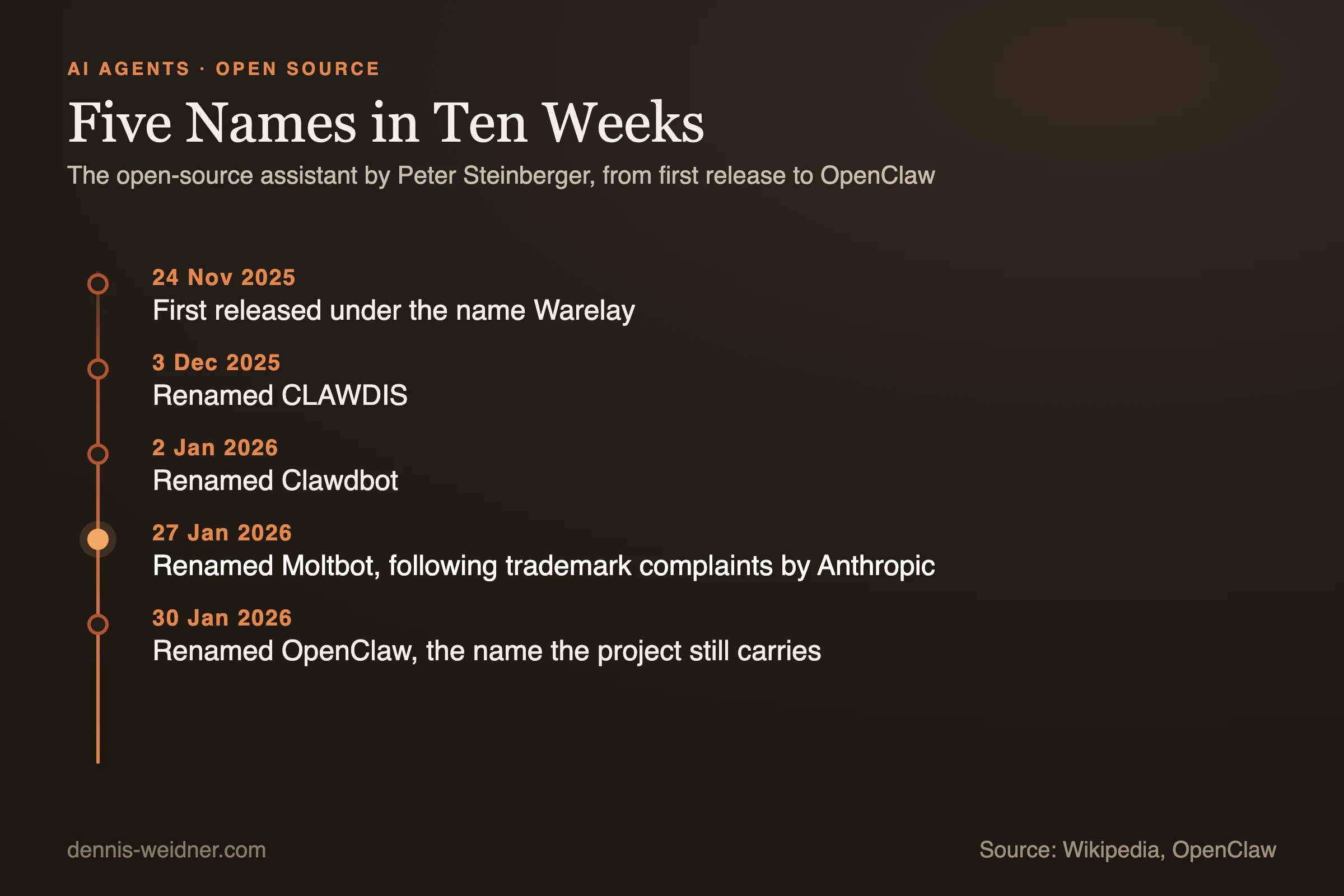
In January 2026, an open-source AI assistant called Clawdbot went viral almost overnight. Developers, founders, and operators across X shared demos, setups, and workflows. The project gained traction at remarkable speed.
Within 24 hours, however, the name had to change.
Due to trademark concerns raised by Anthropic, Clawdbot was rebranded to Moltbot – a name that turned out to be unintentionally symbolic.
To molt means to shed an old skin.
And that is exactly what this moment represents: not just a rename, but a transition to a new phase of how software is built, deployed, and led.
Why Moltbot resonated so strongly
Moltbot isn’t just another AI interface. It represents a different philosophy of work.
What made it stand out:
- It runs locally or self-hosted – your hardware, your data
- It is agent-based, not chat-based
- It executes tasks instead of just responding
- It integrates naturally into messaging and automation workflows
- It attracted real community momentum within hours
Founders and developers began sharing their Mac Mini setups, letting Moltbot handle tasks like research, code generation, documentation, monitoring, and content preparation.
This wasn’t a polished enterprise launch.
It was a builder shipping something useful, and the internet reacting in real time.
When narratives move faster than products
The momentum didn’t stop with developers.
The broader narrative spilled into infrastructure discussions – particularly around Cloudflare, edge computing, and secure connectivity. Public market movements followed, not because Moltbot directly generates revenue, but because narratives signal platform shifts.
Agents → more automation
Automation → more traffic and infrastructure
Infrastructure → security, edge, and connectivity
This is how new cycles begin: not with revenue forecasts, but with directional clarity.
What this means for entrepreneurial leadership
The real lesson of Moltbot is not technical.
It’s organizational.
1. Leadership shifts from managing people to orchestrating systems
In a world where one builder can trigger global attention, leadership is no longer primarily about headcount or hierarchy.
It becomes about:
- Designing workflows
- Defining outputs
- Connecting tools into systems
- Maximizing leverage
Founders increasingly act as architects, not supervisors.
2. Speed beats scale
Shortly after Moltbot’s rise, DigitalOcean released a one-click droplet to deploy it – removing the need for terminal knowledge or deep technical skills.
This is the new competitive baseline:
The fastest teams win, not the biggest ones.
Execution velocity is now a strategic moat.
3. Technology becomes deeper – and more accessible at the same time
With tools like:
- Claude Code
- ChatGPT Codex
- Gemini
- Cursor
- GitHub AI
- OpenAI’s Image APIs
…the barrier to entry keeps dropping, while complexity moves into the background.
Founders don’t need to write every line of code anymore.
But they do need to understand what systems can do – and how to combine them intelligently.
Practical implications for founders and team leads
This isn’t theoretical. These patterns are already usable today.
Examples:
- Personal AI research agents for market and competitor analysis
- Automated content pipelines (text, images, distribution)
- Internal AI operations for documentation and knowledge management
- Monitoring agents for KPIs, logs, and community signals
The biggest impact isn’t productivity.
It’s decision quality.
Better inputs, faster feedback loops, and higher leverage per person.
The bigger question for 2026
If a single builder can ship an agent that reshapes conversations across communities, infrastructure providers, and markets:
- What happens when teams design products agent-first by default?
- How do hiring, roles, and org charts change?
- What does leadership look like when output is no longer linear with headcount?
We’re seeing the early blueprint of a new category:
lean, system-driven, globally distributed software companies.
Not necessarily one-person unicorns –
but one-mind organizations with disproportionate leverage.
A personal takeaway
After more than a decade as a founder, I’m convinced:
2026 won’t reward the loudest ideas.
It will reward the clearest thinkers.
Leadership becomes:
- clarity over control
- systems over status
- leverage over volume
Moltbot isn’t important because it’s perfect.
It’s important because it shows what’s changing – right now.
And founders who understand this shift early will define the next cycle.
Best regards, Dennis Weidner
Frequently Asked Questions
What is Moltbot?
Moltbot, formerly Clawdbot, is an open-source AI agent that runs locally or self-hosted: your hardware, your data. It does not just respond, it executes tasks. Integrated into messaging and automation workflows, it handles research, code generation, documentation, monitoring and content preparation. It was created by Austrian entrepreneur Peter Steinberger, who previously founded PSPDFKit, now known as Nutrient SDK.
Why was Clawdbot renamed to Moltbot?
Clawdbot went viral on X as an open-source project almost overnight in early 2026. Due to trademark concerns, the name had to change within 24 hours, and Clawdbot became Moltbot.
What does Moltbot mean for leadership in 2026?
Leadership shifts from managing teams to orchestrating systems. It is no longer primarily about headcount and hierarchy, but about designing workflows, defining outputs and connecting tools into systems. Speed beats scale, and 2026 will not reward the loudest ideas but the clearest thinkers.
Which AI agents can founders use today?
Usable today are personal AI research agents for market and competitor analysis, automated content pipelines for text, images and distribution, internal AI operations for documentation and knowledge management, and monitoring agents for KPIs, logs and community signals. Tools like Claude Code, ChatGPT Codex, Gemini, Cursor and GitHub AI keep lowering the barrier to entry. The biggest impact is not productivity but decision quality.
Note: AI tools supported me in writing this article, and some images were edited with AI. I stand behind its content and every statement with my name.