
On a trip through China in 2024, I understood how central battery storage will be. Battery Energy Storage Systems (BESS) are units of every size that store electricity from photovoltaics, wind and other sources – making it predictable and tradable. Since then I have been deep in this market and keep building my network.
What a battery storage system actually is
A BESS is not a device, it is a system of four parts: the cells that hold the energy; the inverter that translates between direct and alternating current; the battery management that monitors and protects every single cell; and the control layer that decides when to charge and when to discharge. The cells set the price, the control layer sets the return. I consider that the single most important sentence in this market.
Two numbers describe every storage system. Capacity in kilowatt or megawatt hours says how much energy fits in. Power in kilowatts or megawatts says how fast it goes in and comes back out. A system with 1 MW of power and 2 MWh of capacity delivers two hours at full load, which the industry calls a two-hour system. Which ratio is right is decided not by the technology but by the revenue source: supporting grid frequency needs power, capturing price differences across the day needs duration.
Then there is ageing. A cell loses a little capacity with every cycle, and how fast depends on temperature, depth of discharge and charging speed. That is why every serious offer carries a warranty over cycles and remaining capacity, and why cooling is not an accessory but part of the economics. Run a system hard and you earn earlier, then not for as long.
The size classes run from a home unit of 5 to 15 kWh in the basement, through commercial systems at charging infrastructure and production sites, up to grid-scale containers at a substation holding double-digit megawatt hours. Same physics, entirely different business models.
A market only just gaining speed
Storage is the missing piece of the energy transition: without it, green power stays tied to weather and time of day. Global additions have recently nearly doubled year over year.
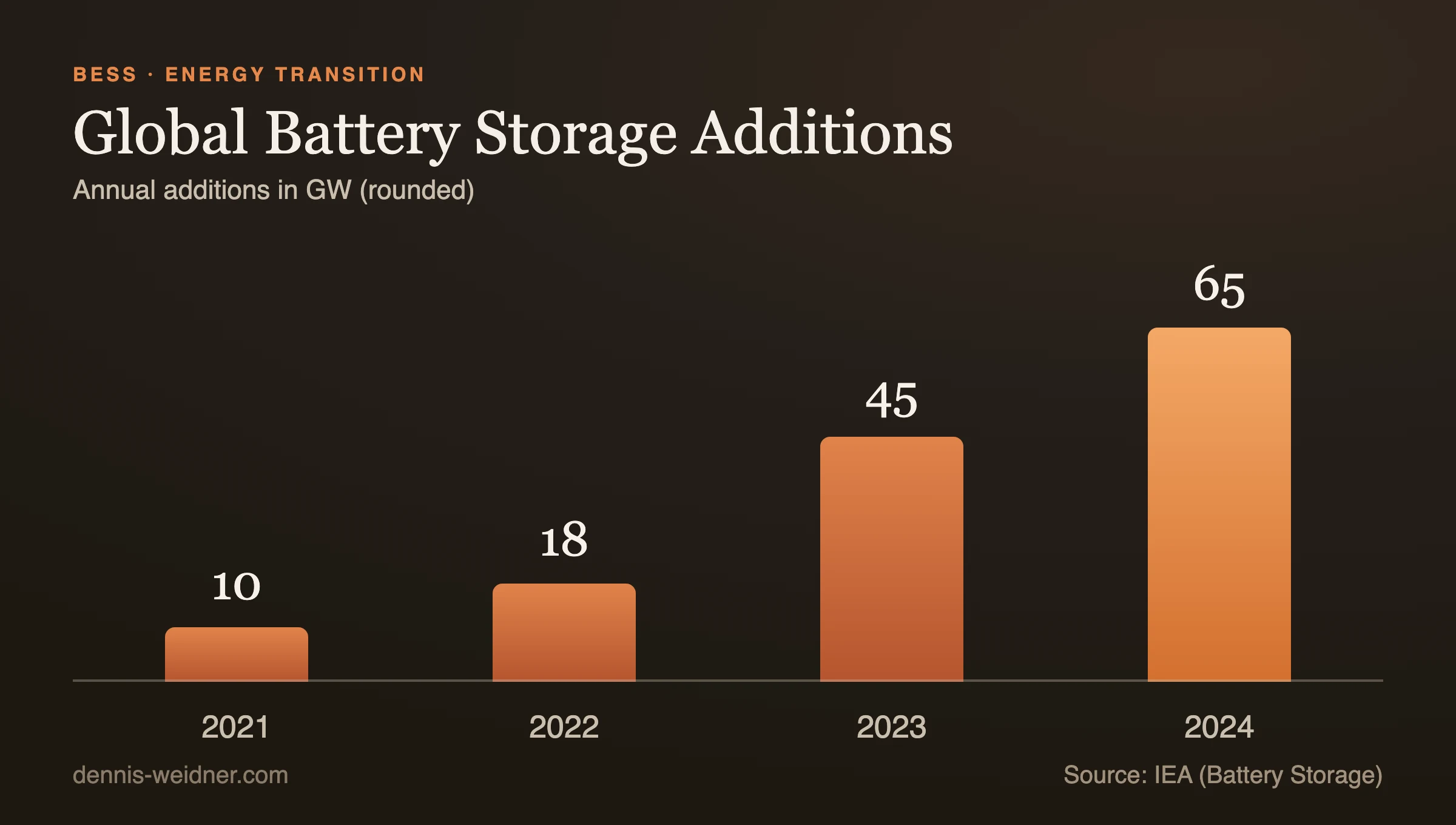
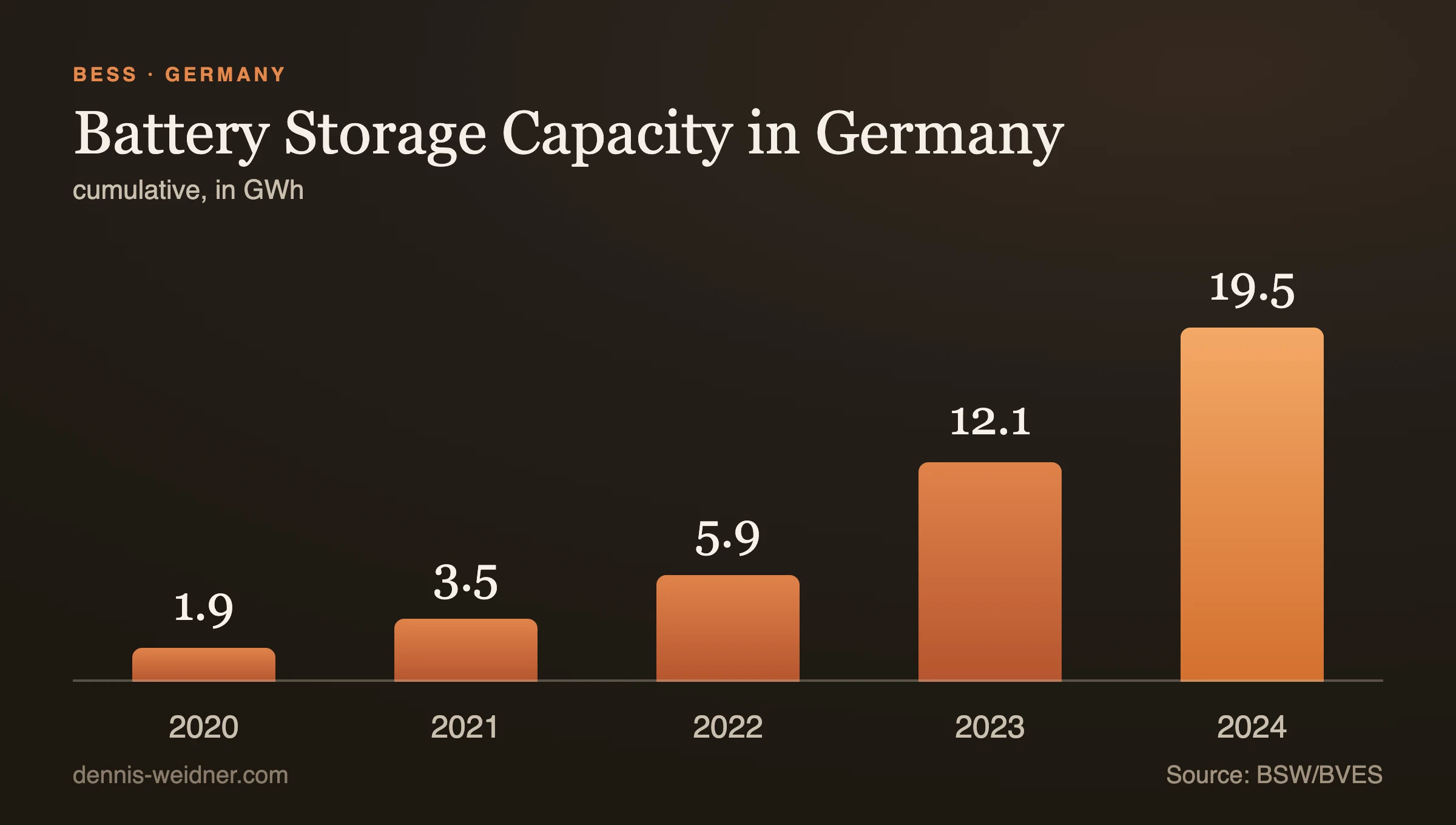
Germany is picking up strongly too: installed storage capacity has multiplied since 2022, driven by home storage and, increasingly, grid-scale systems.
How a storage system earns money
There are four revenue sources, and most viable projects combine several of them.
Self-consumption: power you generate is stored instead of exported and later replaces expensive purchases. It is the simplest case and carries home and commercial systems above all. Trading: charge in cheap hours, discharge in expensive ones. The return is the price spread on the day-ahead and intraday markets, less round-trip losses and cost. System services: balancing power stabilises grid frequency and is paid for, but it requires prequalification and dependable availability. Grid cost: shaving peak load reduces network charges, and at weak connection points storage can replace an expensive grid upgrade.
The return rarely comes from one source alone. Multi-use means running the same asset in several markets without selling the same kilowatt hour twice. That is an optimisation problem, and it is exactly where good operations part ways with mediocre ones.
Does storage pay off? The honest answer
It depends on three numbers, and none of them is the technology: the purchase price per kilowatt hour, the number of cycles the system genuinely runs over its life, and the price spread it captures while doing so. If one of the three comes out clearly worse than planned, the case tips.
My rule: do not model the spread of the best year, model a corridor, and the project has to carry itself in the weak scenario too. Cell prices have fallen sharply over recent years, which is what made many projects possible in the first place. That is precisely why competition for good grid connection points is now tougher than competition over technology. A storage system that only works at record prices is a bet, not an investment.
Home, commercial or grid-scale: which case fits
The three size classes answer three different questions. A home system is a decision about your own electricity purchase: it lifts self-consumption from a solar array from roughly a third to well over half, and it pays off through the gap between the retail tariff and the feed-in rate. The wider that gap, the better the case, which is why it depends more on power prices than on technology.
A commercial system is a decision about peak load and availability. It pays off where expensive demand peaks occur, where charging infrastructure needs more power than the connection provides, or where an outage costs money. Here storage is often the cheaper alternative to a grid upgrade, an argument that rarely appears in the quote and regularly decides the economics.
A grid-scale system is a business in its own right, with trading, marketing and operations. Anyone entering here is not buying hardware, they are buying a position in several markets, permits, grid connection and contracts included. This is not a bigger home battery, it is a different trade.
Where projects actually fail
Almost never on the batteries. They fail on the grid connection, on the timeline between application and commissioning, on connection cost contributions that shift the calculation after the fact, on land and permits with zoning, fire protection and clearance rules, and on regulation that changes mid-project. Get the order wrong and you buy hardware before the connection exists, then finance a year of standstill.
On top of that comes something regularly underestimated: metering. Running an asset in the market requires meters that deliver quarter-hourly values and can be controlled remotely. Germany is still a long way from its own target.
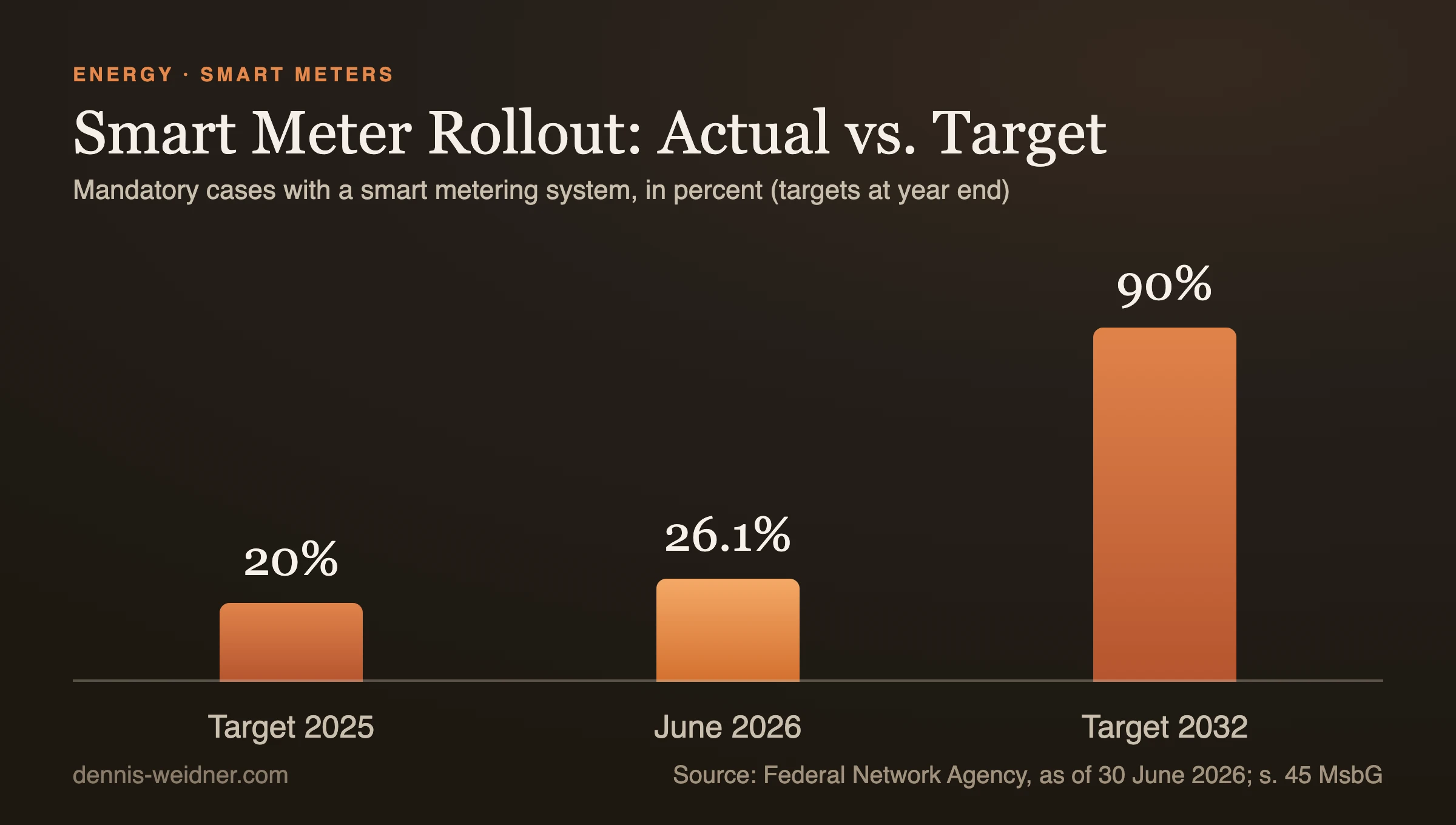
For operators that means one thing in practice: settle metering operations early, not at the end. And read regulation as part of the project economics rather than as paperwork. How deeply it reaches is visible in the MiSpeL determination, which I go through in detail in its own piece.
What I cover
I think technology, trading and regulation together – from EPC contractor through procurement and operation to power trading. I am in weekly exchange with lawyers on current regulation, work with partners holding an energy-supplier licence (power trading and arbitrage on the EEX Leipzig, PPAs and long-term contracts) and support several advisory mandates – all the way to site acquisition. I regularly attend industry trade fairs and speak the language of the people who actually build and run these systems.
How I work
With the same attitude as in everything I do: practice before theory, honest about opportunities and risks, and with a network grown over years through real collaboration. I do not talk about the market, I am in it.
Frequently Asked Questions
What is a BESS?
A Battery Energy Storage System is a storage unit that buffers electricity from photovoltaics, wind or the grid and releases it later. This makes volatile green power predictable and tradable.
Why is battery storage so important for the energy transition?
Sun and wind do not deliver evenly. Storage decouples generation and consumption, stabilizes the grid and enables trading power across time – the missing piece between renewable generation and reliable supply.
Does battery storage pay off?
Three numbers decide it: price per kilowatt hour, the number of cycles genuinely run, and the price spread captured. Modelling the spread of the best year is modelling it wrong – the case has to carry itself in the weak scenario too.
In what role are you active in energy?
As an advisor and strategist across the whole chain: EPC, procurement, operation, power trading (EEX, PPAs), regulation and site acquisition – in close exchange with lawyers, operators and licensed energy suppliers.