Some developments barely register with the general public, yet under the hood they change everything. The Model Context Protocol, MCP for short, is one of them. Anyone who wants to understand why AI agents are moving from novelty to genuine tool cannot avoid this topic.
The problem MCP solves
A language model is, at first, a clever text generator. It can phrase, plan, and reason, but it sits inside a box. It cannot reach your customer database, your calendar, your accounting system. That was the limit for a long time: the models kept getting better, but without a connection to the real world they stayed advisors without hands.
More on this topic: AI in the Founder's Working Day – background, practice and every article in one place.
MCP is essentially a shared language through which an agent talks to tools and data sources. Instead of building a separate custom solution for every system, there is one standard that both sides adhere to. That sounds technical, but it is the difference between an agent that only talks and one that acts.
An everyday example: if you want an agent to pull invoices from your inbox, reconcile them against your CRM, and prepare a payment run, you used to need three separately coded interfaces, each with its own login, its own data format, its own failure modes. With MCP, the inbox, the CRM, and the accounting system all speak the same protocol, and the agent coordinates them without anyone writing new glue code for every combination.
How MCP works under the hood
You do not have to be a developer to grasp the principle. MCP follows a simple client-server pattern with three roles. The host is the application you talk to, such as a chat window or a coding assistant. The client lives inside the host and manages the connections. The server is the building block that exposes a data source or a tool, for example your CRM or your file system.
Each server offers the agent three kinds of capabilities. Tools are actions the agent can take, such as creating an order. Resources are data it is allowed to read, such as a document or a table. Prompts are prepared templates that show how a tool is best used. Because everything runs over an open, JSON-based interface, any host can talk to any server, no matter who built it. Important for trust: a server never sees the full conversation history, and the host decides which access is allowed.
Why a standard matters so much
Standards are boring, and they are the reason entire industries suddenly speed up. Without a standard electrical socket, no mass market for appliances. Without a standard container, no global logistics. MCP is that kind of socket moment for AI agents: when tools and models connect through a shared interface, an ecosystem emerges in which building blocks can be combined freely.
For companies that means the connection of AI to existing systems becomes cheaper, faster, and less error-prone. What was a months-long integration project yesterday becomes a matter of days. An MCP server built once for your inventory system then works with any agent that speaks the standard, instead of starting from scratch for every new tool.
Why everyone is suddenly on board
A standard is only worth as much as the number of people who use it. And this is exactly where something remarkable happened in a short time. Anthropic released MCP as an open protocol in November 2024. A few months later, in the spring of 2025, its direct competitors followed: OpenAI supports MCP across its products and its Agents SDK, and Google DeepMind confirmed support for its Gemini SDK, calling it a rapidly emerging open standard. Microsoft is on board too.
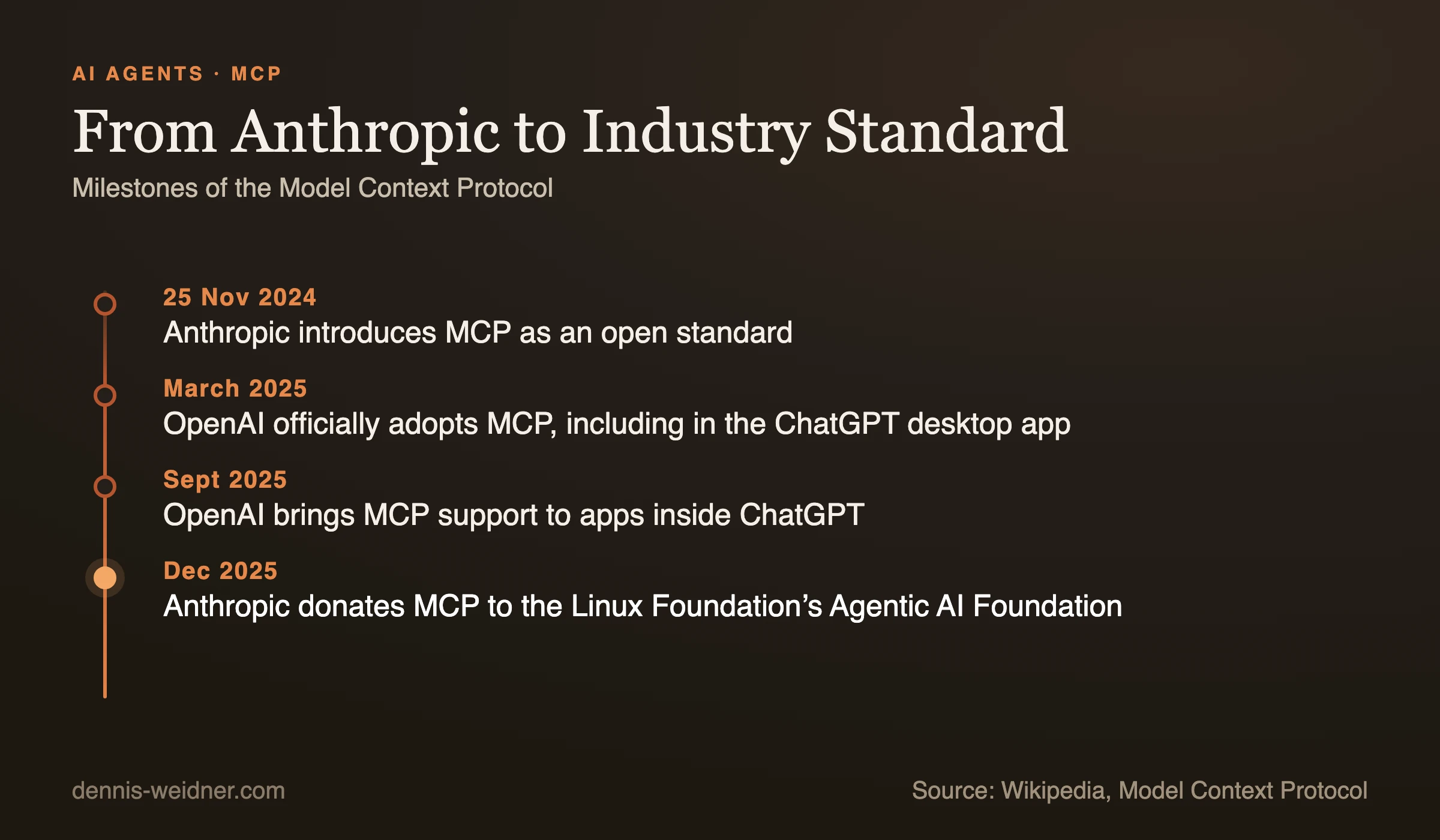
Competing vendors agreeing on the same interface is rare, and it is a strong signal. It means MCP is not one vendor's bet but common infrastructure in the making, much like HTTP for the web or SQL for databases. The details are laid out in the public documentation of the protocol. Betting on MCP today is not a bet on a niche format, but on the path the industry has already taken.
What MCP means for your business
You do not have to implement MCP yourself to benefit from it. But with every AI solution you should ask: how does this connect to our real systems? An agent that lives only in its own world stays a demo. Only the connection to your data and processes makes it productive. And when it comes to the model itself, it is worth looking at which AI model fits the job. The standard for plugging in is here, and whoever uses it builds on foundation rather than sand.
Frequently Asked Questions
What is the Model Context Protocol (MCP)?
An open standard through which AI agents talk to tools and data sources in a uniform way, instead of building a separate interface for every system.
How does MCP work technically?
Through a client-server pattern: a host connects to servers that offer the agent tools (actions), resources (data), and prompts (templates) over an open, JSON-based interface.
Who supports MCP?
Anthropic released the standard in late 2024, and in 2025 OpenAI, Google DeepMind, and Microsoft, among others, followed. That broad support makes MCP common infrastructure rather than one vendor's bet.
What does this mean for companies?
Connecting AI to existing systems becomes a matter of days instead of months. What is decisive is that an agent plugs into the real data and processes.
Warm regards,
Dennis Weidner
Note: AI tools supported me in writing this article, and some images were edited with AI. I stand behind its content and every statement with my name.