There is one field where my three interests converge like almost nowhere else: energy, finance, and AI. The modern power market has long since become a trading floor, and anyone who wants to succeed there needs fast, data-driven decisions of the kind agentic systems make.
Electricity has become a traded commodity
Many people still picture electricity as a simple wire running from the power plant to the socket. In reality, electricity is traded on exchanges, at prices that change every fifteen minutes. Sometimes energy is abundant and cheap, sometimes scarce and expensive. This constant movement happens because generation from sun and wind fluctuates, and so does consumption.
More on this topic: AI in the Founder's Working Day, with background, practice and every article in one place.
Anyone trading here has to keep countless factors in view at the same time: weather forecasts, consumption patterns, grid load, storage levels, prices. And they have to decide in real time. For one person alone, that is barely manageable anymore. In the end the price is just the compressed sum of hundreds of signals, all moving at once.
How extreme the market really swings
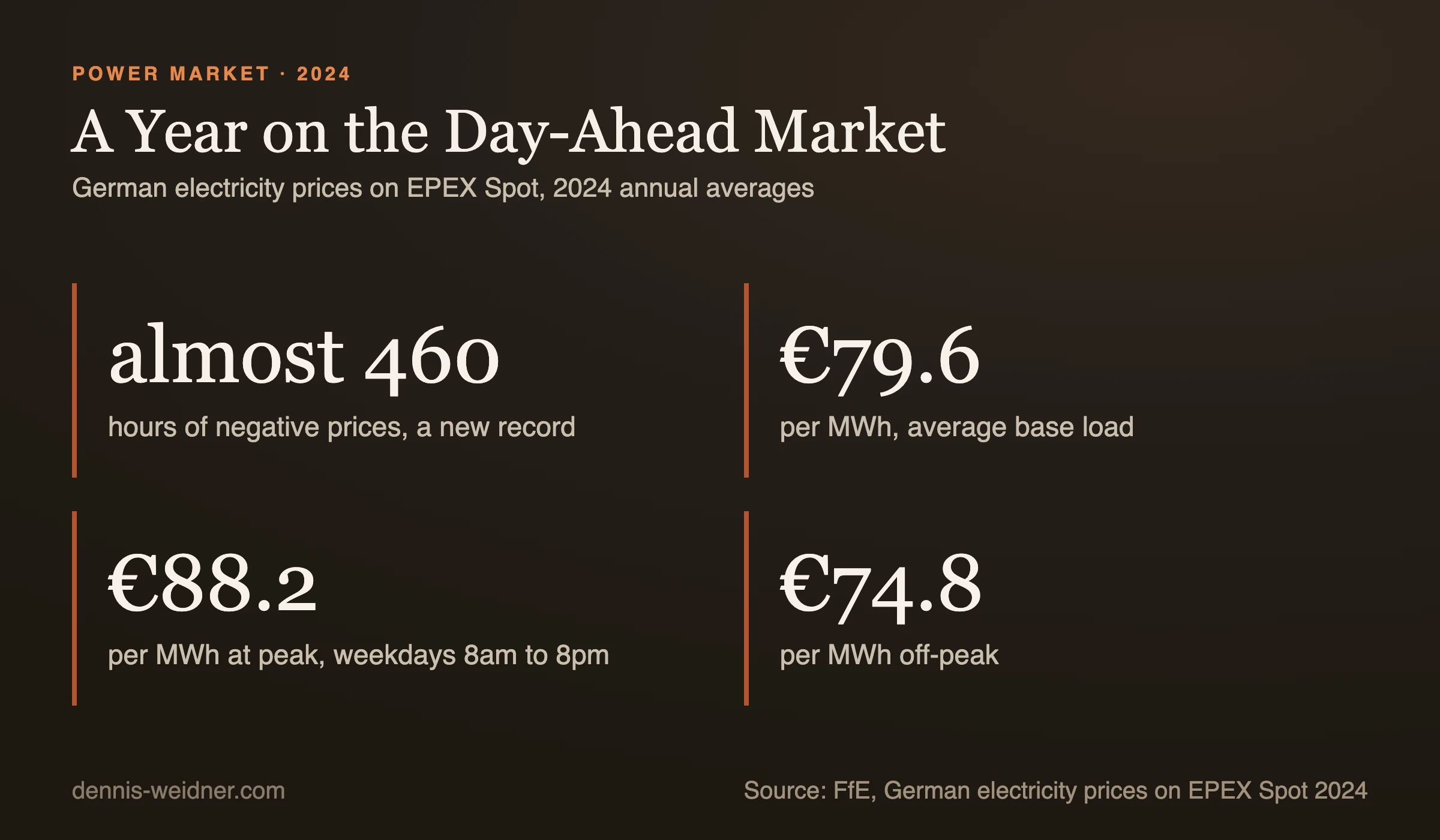
To make clear what I mean, look at some real numbers. According to an analysis by the German Research Center for Energy Economics (FfE), the German day-ahead market saw around 459 hours of negative electricity prices in 2024, windows in which buyers were effectively paid to consume power. At the same time, the average base-load price sat at roughly 79.6 euros per megawatt hour, and in individual hours in November and December prices spiked to as much as around 936 euros per megawatt hour.
Between those extremes lies the actual trading room. A spread from a negative price at sunny midday to several hundred euros on a dark winter evening is no longer an exception, it is the normal state of a grid full of wind and sun. This volatility is exactly what makes the market both hard and lucrative. Whoever forecasts the movement cleanly and trades at the right second earns on the difference. Whoever is late pays for it.
Where AI agents come in
This is exactly where agentic systems play to their strengths. An agent can continuously evaluate data, generate forecasts, and offer recommendations or, in clear-cut cases, act on its own. When do I store cheap electricity, when do I feed expensive power back in, when do I buy, when do I sell? These are optimization problems with many variables and constantly fresh data, made for AI.
A human can work through one or two assets in their head at most. An agent keeps hundreds of price signals, weather runs, and schedules in view at once and adjusts the strategy the moment the forecast changes. It never gets tired, never misses a fifteen-minute window, and has no gut call on a Friday evening. That is no magic trick, it is consistent pattern recognition plus execution at a pace that is simply out of reach for people.
My core principle still holds here too: the human sets the strategy and the boundaries, the agent executes within those guardrails. Precisely when real money and critical infrastructure are on the line, you need clear checkpoints, not blind trust. I define how much risk is allowed and where the hard stops sit. The agent optimizes inside that, but it never breaks the frame.
A battery storage system as a trading machine
This gets most tangible with a battery storage system. Simplified, it works like a trader with a warehouse: it buys cheap when the sun floods the grid at midday and the price falls toward zero or into the negative, and it sells expensive when demand climbs in the evening and little renewable generation is available. The margin is the price difference between charging and discharging, and that is exactly what the agent wants to maximize.
The art is in the timing. Charge too early, and the battery is full before the cheapest hour arrives. Sell too early, and you miss the evening peak. An agent runs through these scenarios continuously, watching the current state of charge, the weather forecast for the next hours, and the expected prices. A battery that merely buffers electricity turns into an asset that actively earns on the market. That is exactly what makes every new battery storage system more than just a buffer.
Why this is only the beginning
With every additional storage system and every extra solar installation, the power market grows more complex and more dynamic. That dramatically increases the value of intelligent control. The International Energy Agency (IEA) now describes grid-connected large batteries as a central source of short-term flexibility in the power system, and digital, AI-driven tools as key to making better use of existing infrastructure. More flexibility means more decisions per day, and more decisions means more room for automation.
I am convinced that the combination of energy infrastructure and agentic optimization is one of the most underrated growth areas of the coming years. Value is created at the intersection, exactly where I most like to build.
Frequently Asked Questions
Is electricity really traded?
Yes, on power exchanges like EPEX Spot, at prices that change every fifteen minutes, depending on generation from sun and wind and on consumption. In 2024 Germany saw around 459 hours with even negative prices.
What does AI do in energy trading?
It evaluates weather, consumption, grid, and storage levels in real time and decides when to store, buy, or sell, an optimization problem with a great many variables and on a fifteen-minute cadence.
How does a battery storage system make money?
It buys cheap when there is plenty of power in the grid and the price drops, and sells expensive during the evening peak. The margin is the price difference, and an agent optimizes it through precise timing.
Who makes the decision?
The human sets the strategy and the boundaries, the agent executes within those guardrails. When real money and critical infrastructure are involved, control is what counts.
Warm regards,
Dennis Weidner
Note: AI tools supported me in writing this article, and some images were edited with AI. I stand behind its content and every statement with my name.