After a company registration in Germany, eight bodies with a genuine legal basis will write to a new GmbH: the registry court, the tax office, the trade office, the chamber of commerce, the statutory accident insurer, the transparency register, the broadcasting fee office and, later, the company register. Together their fees cost a small GmbH in Berlin about 345 euros up to its first filed accounts. In between arrive offers from private directories that look like invoices and can charge more for a single listing than all statutory fees combined.
As of 25 September 2026. Not legal advice, see the note at the end.
More on this topic: AI in the Founder's Working Day, with background, practice and every article in one place.
Letters after company registration in Germany: why the mailbox fills up
The cause is simple: every incorporation creates public data. The German commercial register (Handelsregister) can be searched by anyone free of charge, and the local trade office is required by Section 14(8) of the Trade Regulation Act (GewO) to pass on the data from each trade registration, among others to the Chamber of Industry and Commerce (IHK) and, via the German Social Accident Insurance umbrella body, to the responsible statutory accident insurer. A founder therefore receives mail within weeks from bodies they never contacted themselves.
Private providers exploit exactly this. They read the same register data and send letters that contain a file number, the register number and a pre-filled bank transfer slip. Anyone who does not know which authority actually writes can barely tell genuine from non-genuine mail. If you run several companies, as I describe in How I Build Several Companies at Once, the wave returns with every new entity.
Which letters after incorporation trigger real obligations
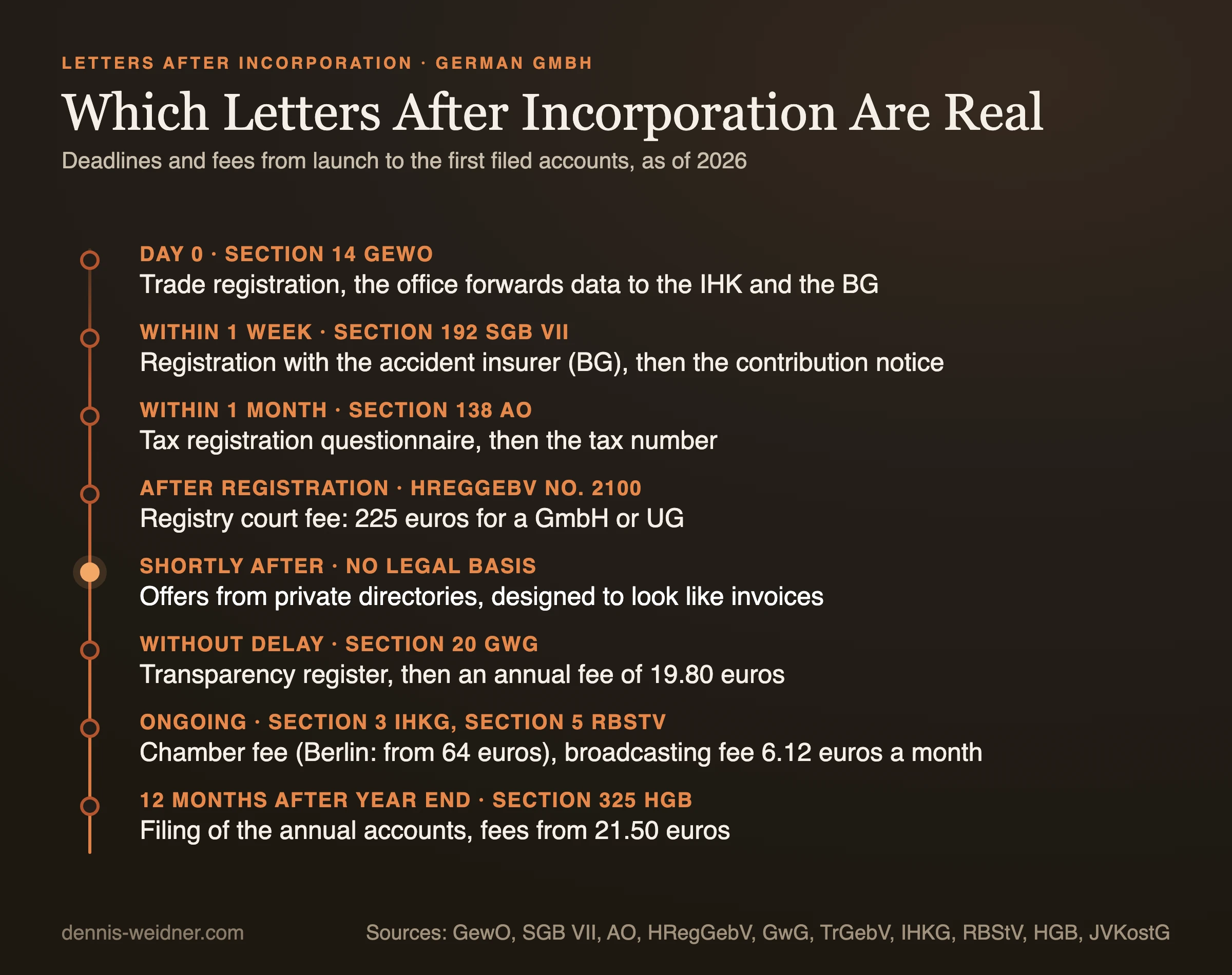
A letter is genuine if it rests on a statute that sets a deadline or a fee. For a German GmbH (private limited company) there are eight stations, most of them in the first year:
- Trade office (Gewerbeamt): The trade registration is due "at the same time" as the business starts, Section 14(1) GewO. In Berlin it costs 15 euros online and 31 euros in person for a legal entity.
- Accident insurer (Berufsgenossenschaft, BG): Registration is required within one week of the start of the business, Section 192(1) of Social Code Book VII. The contribution depends on payroll and hazard class, Section 153.
- Tax office (Finanzamt): The tax registration questionnaire is filed electronically via the ELSTER portal under Section 138(1b) of the Fiscal Code (AO), within one month under Section 138(4). The tax number follows.
- Registry court: After the entry comes the court's fee invoice, 225 euros for a GmbH or UG (the mini-GmbH).
- Transparency register: The beneficial owners must be reported "without delay" under Section 20(1) of the Anti-Money Laundering Act (GwG), followed by an annual fee notice.
- IHK: Under Section 2 of the IHK Act every trade business with premises in the district is a member, and the chamber sends a contribution notice.
- Broadcasting fee office (Beitragsservice): A business premises owes its own licence fee under Section 5 of the Broadcasting Fee Treaty (RBStV).
- Company register (Unternehmensregister): Annual accounts must be filed no later than one year after the balance sheet date, Section 325(1a) of the Commercial Code (HGB).
Two points are often misjudged. The chamber fee exemption for new founders in Section 3(3) of the IHK Act only covers natural persons who are not entered in the commercial register. A GmbH pays from year one. And for the broadcasting fee, an office inside your own home that is already registered with the fee office does not trigger a second fee.
Invoice after commercial register entry: real or an offer?
The only genuine invoice for the entry comes from the justice system, and its amount is set in the Commercial Register Fee Ordinance (HRegGebV): 225 euros for a GmbH or UG under item 2100, 360 euros with a contribution in kind, 105 euros for a sole trader. Apart from that, only the notary who filed the application sends a bill. Anything else with the word Handelsregister in the letterhead is either an offer or a forgery.
The state justice administrations and the Federal Ministry of Justice warn on the joint justice portal of the federal government and the states against offers, payment requests and invoices that do not come from judicial authorities, some of them designed to look official. Such letters, the warning says, have no legal effect on their own. Several local courts in North Rhine-Westphalia list concrete signs: senders such as "Handels- und Gewerberegister" or "RegisterPortal", a federal eagle instead of the state coat of arms, links to sites whose address differs only slightly from handelsregister.de. Genuine register fees there go exclusively to accounts of the central justice payment office at the Deutsche Bundesbank.
The safest check takes a minute: compare file number and amount with the letter you received from your own registry court or via your notary. If they do not match, do not pay.
Transparency register fee: why the 19.80 euro notice is real
Of all the letters, the one that looks most like a private vendor is genuine. The transparency register is run by Bundesanzeiger Verlag GmbH, a private company entrusted by the federal government as the official register operator. The annual fee under item 1 of the Transparency Register Fee Ordinance (TrGebV) has been exactly 19.80 euros since fee year 2024, down from 20.80 euros.
The filing itself is mandatory as well. The current Section 20 GwG no longer contains a rule under which the commercial register entry replaces the report. Founders therefore report their beneficial owners themselves. What is not genuine are letters offering a filing "service" at a multiple of the fee. Filing in the portal costs nothing extra.
Letters after incorporation at a glance: real or offer
The table summarises who writes, on what basis and how to recognise the letter. Amounts are the statutory fees as of 2026.
| Sender | Legal basis | Typical amount | Real or offer | How to recognise it |
|---|---|---|---|---|
| Registry court, justice cash office | HRegGebV item 2100 | 225 euros (GmbH, UG) | Real | File number of your own court, state coat of arms, justice account |
| Tax office | Section 138 AO | No fee | Real | Tax number, notices also via ELSTER |
| Trade office | Section 14 GewO | Berlin: 15 euros online, 31 euros in person | Real | Fee notice from the municipality |
| IHK | Sections 2, 3 IHKG | Berlin: base fee 64 euros plus 0.17 percent levy | Real | Contribution notice, your own chamber in the letterhead |
| Accident insurer (BG) | Sections 150, 192 SGB VII | Depends on payroll and hazard class | Real | Notice of responsibility, then contribution notice |
| Broadcasting fee office | Section 5 RBStV | 6.12 euros a month (up to 8 employees) | Real | Fee number, waived for an office in a registered home |
| Transparency register (Bundesanzeiger Verlag) | Section 24 GwG, TrGebV item 1 | 19.80 euros a year | Real | Fee notice for exactly this amount |
| Company register (Bundesanzeiger Verlag) | Section 325 HGB, JVKostG items 1410, 1420 | 21.50 euros (micro company) | Real | Only after your own filing |
| Private directories | None | In BGH case VII ZR 262/11: 650 euros net a year | Offer | "Offerte" in the small print, no statute cited |
| Forged "local courts" or payment offices | None | Any amount | Forgery | Federal eagle, sender and payee do not match |
What this adds up to is shown by a calculation for a micro GmbH in Berlin with an office at home, from trade registration to the first filed accounts:
| Item | Basis | Amount |
|---|---|---|
| Trade registration online | Berlin fee schedule | 15.00 euros |
| Commercial register entry | HRegGebV item 2100 | 225.00 euros |
| Transparency register, first fee year | TrGebV item 1 | 19.80 euros |
| IHK base fee | IHK Berlin | 64.00 euros |
| Filing: submission plus annual fee | JVKostG items 1420 and 1410 | 21.50 euros |
| Total | 345.30 euros |
With a separate office outside the home, twelve months of broadcasting fee at 6.12 euros add 73.44 euros, for a total of 418.74 euros. Not included are the notary, the accident insurance contribution and the IHK levy, which depends on trade income. The comparison is still clear: the directory listing in BGH case VII ZR 262/11 cost 650 euros net a year, almost twice as much as all statutory fees in this calculation.
What German law says about offer letters designed as invoices
Case law has been clear for two decades, on three levels. Under unfair competition law, the Federal Court of Justice (BGH) ruled on 30 June 2011 (I ZR 157/10) that a form suggesting it merely corrects existing data breaches the ban on misleading practices in Section 5 of the Unfair Competition Act (UWG). Under contract law it held on 26 July 2012 (VII ZR 262/11) that a fee clause placed so inconspicuously in a form that no one would expect it there does not become part of the contract at all, Section 305c(1) of the Civil Code (BGB).
Under criminal law it becomes serious when the design is meant to deceive. As early as 2001 (4 StR 439/00) the BGH listed typical invoice features such as a highlighted payment deadline and a pre-filled transfer slip. On 28 May 2014, in 2 StR 437/13, it confirmed deception under Section 263 of the Criminal Code for offer letters sent after commercial register entries, even though the small print mentioned that they were offers. That a careful reader could have spotted the trick does not change this, according to the judgment.
Already paid an offer letter: rescission, objection, recovery
If you only received a letter and did not react, you need to do nothing. Without a signature there is no contract, the letter is advertising.
If you signed or paid, you have three levers. First, object in writing and rescind your declaration for fraudulent misrepresentation under Section 123 BGB. The deadline under Section 124 BGB is one year from the moment you discover the deception. Second, reclaim money already paid under Section 812 BGB (unjust enrichment). Third, if the transfer is recent, ask your own bank at once whether it can still be recalled. The IHK reviews such letters for its members and works with the German Association for Protection against Economic Crime. Forwarding the letter there is worthwhile even if no money has changed hands.
How I sort the mail after an incorporation
I have the mail of my companies scanned. Scanning does not change the check, it only makes it faster, because every letter sits as a file next to the file number already on record. My rule: I do not pay an invoice whose legal basis I cannot name in one sentence. I know the eight genuine senders above, everything else goes to review first.
Two more things help. The genuine fee is almost always an exact amount set in an ordinance, while private offers use round or conspicuously high sums. And genuine authorities cite the provision they rely on. If you add a holding GmbH, you get the whole wave twice, once per company. And once invoices arrive in structured form under Germany's e-invoicing rules, a paper letter that wants to bill a service will stand out even more. More on costs and structures for entrepreneurs is collected under Crypto and Finance.
Frequently Asked Questions
Is the invoice I received after my commercial register entry real?
Only the justice cost invoice for the fee set in the Commercial Register Fee Ordinance is genuine, 225 euros for a GmbH or UG. It carries the file number of your own registry court. Letters from "registers" or "central offices" with other amounts are offers or forgeries.
Do I have to pay the German transparency register fee?
Yes. The annual fee of 19.80 euros is charged by Bundesanzeiger Verlag GmbH as the entrusted register operator under Section 24 GwG and the Transparency Register Fee Ordinance. Only tax-privileged organisations are exempt.
Does a new GmbH have to pay the IHK chamber fee?
Yes. The founder exemption in Section 3(3) of the IHK Act only applies to natural persons not entered in the commercial register. At IHK Berlin every registered company pays at least the base fee of 64 euros.
What should I do if I already paid an offer letter?
Declare rescission for fraudulent misrepresentation in writing under Section 123 BGB, reclaim the money under Section 812 BGB and ask your bank whether the transfer can still be recalled. The rescission deadline is one year from discovering the deception.
Does a GmbH run from home need its own broadcasting fee?
No, if the office is in your own home and that home is already registered with the fee office. A separate business premises with up to eight employees costs 6.12 euros a month.
Note: This article is not legal advice. It describes the legal situation in Germany as of 25 September 2026, using a GmbH as the example. Fees charged by municipalities, chambers and accident insurers vary by location and industry, the Berlin figures are an example. If you cannot place a letter, ask your IHK or the registry court before paying.
Best,
Dennis Weidner
Note: AI tools supported me in writing this article, and some images were edited with AI. I stand behind its content and every statement with my name.