Sooner or later, an agent working on your behalf runs into a paywall. No cart, no checkout, just an interface asking two cents for the next call. That is where our familiar payment system falls apart, because it was built for humans who click, confirm, and get an invoice at month end. This summer produced the first serious answers, and they come from two very different camps.
Why cards, PayPal and bank transfers do not fit
The first problem is mundane and still fatal: the fixed fee per transaction. For a standard domestic card in the European Economic Area, Stripe charges 1.5 percent plus 25 cents according to its published pricing. On an 80 euro basket, nobody notices. On a two cent API call, the fixed part alone is twelve times the price of the thing being bought. A rail where the courier costs more than the parcel is not a rail.
More on this topic: AI in the Founder's Working Day, with background, practice and every article in one place.
The second problem is authorization. Card and account payments in Europe assume strong customer authentication, meaning a human confirming something at the moment of payment. An agent making a thousand tiny purchases at three in the morning has no such human. Law firm Ashurst laid out the stack of open legal questions in November 2025: does consent given to an agent's provider count as consent under PSD2? Who is liable when an agent exceeds its mandate? Does the operator of a paying agent need a license of its own?
The third problem is speed. Bank transfers settle in batches and business days, card payments carry chargeback windows measured in months. An agent buying compute for the next ninety seconds cannot wait for money to land on Tuesday.
What an agent actually needs: a budget, a limit, a trail
When I hire someone new, they do not get signing authority over the company account. They get a corporate card with a ceiling, a rule about what it covers, and every charge lands in the books. Budget, limit, trail. An agent needs the same thing, and it is striking how long that piece went missing from the conversation about AI agents.
The budget is the easy layer. An agent gets its own wallet holding a defined amount, not access to the company treasury. If something goes wrong, the damage is capped.
The limit is the more interesting layer. Not just how much, but on what, with whom, and how often. A research agent should be able to buy search queries, not spin up servers. Those rules have to be enforced by the system, not written into a prompt, because a prompt is a request and not a barrier.
The trail is the layer that ends up mattering most. Every payment needs a verifiable link back to a human intention. Otherwise you finish the month with a list of charges and nobody who can explain why any of them happened.
Coinbase gets serious: paying over HTTP
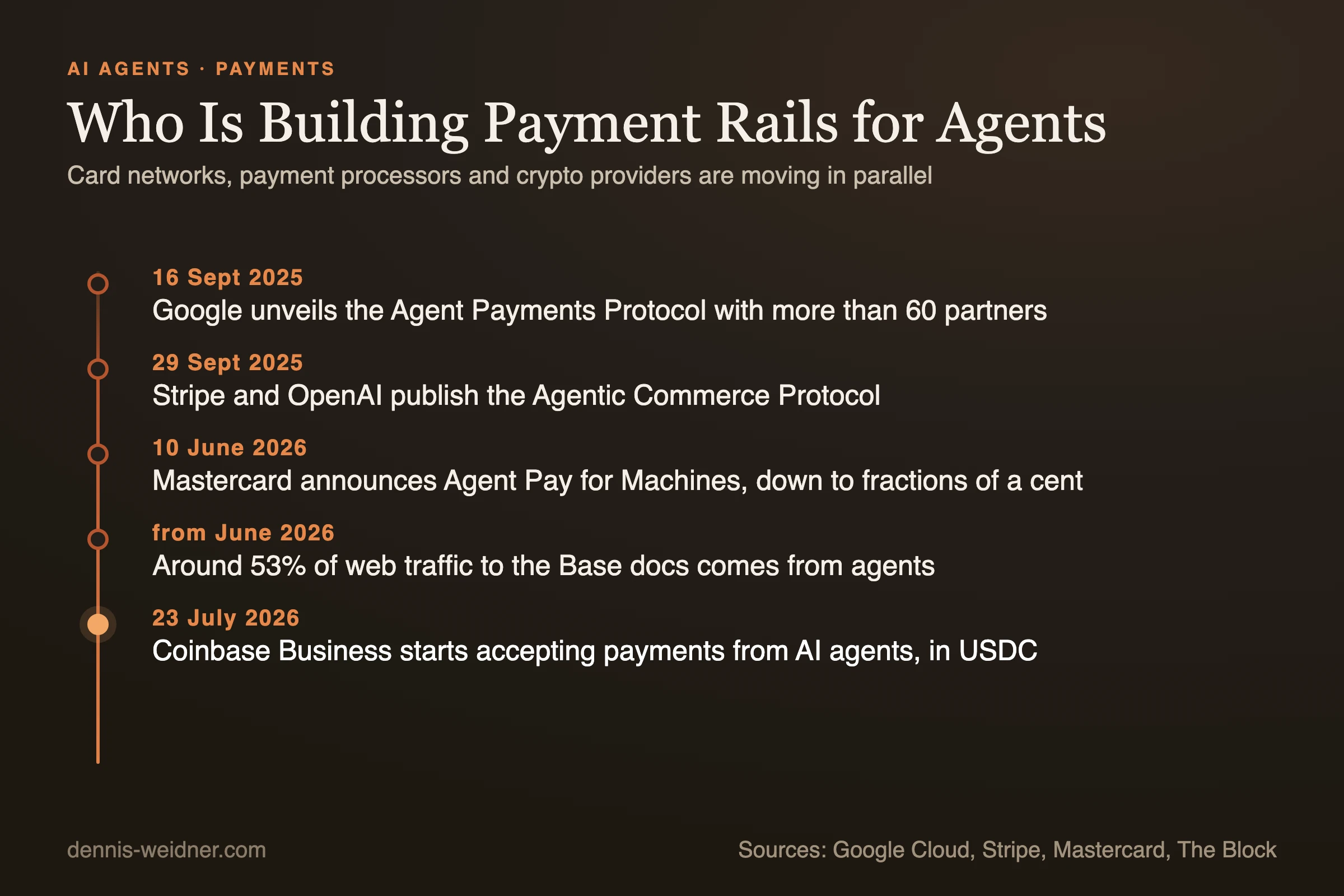
On 23 July 2026, Coinbase enabled its business customers to accept payments from AI agents, settled in USDC. This runs on x402, a protocol Coinbase has pushed since 2025. The trick is charmingly old fashioned. HTTP has carried status code 402, "Payment Required", since the nineties and never really used it. x402 wakes it up.
The flow is simple. The agent requests a resource, the server answers with a 402 and puts the payment terms in a header, the agent signs a payment and repeats the request, a facilitator settles it, the server delivers. No account, no signup, no session. According to the Coinbase documentation, the first 1,000 transactions per month are free and each one after that costs 0.001 US dollars. That is a different universe from a 25 cent floor.
One number shows how real this already is. The Block reports that from June 2026 roughly 53 percent of traffic to the Base documentation came from agentic visitors rather than people. If you run an interface, it is worth asking whether your customers still all have hands.
The card networks are building their own answer
It would be wrong to tell this as a pure crypto story. In September 2025, Google introduced the Agent Payments Protocol with more than sixty partners including Mastercard, PayPal, American Express and Adyen. At its core sit three cryptographically signed mandates: what the user wanted, what the agent assembled, and what actually gets charged. That maps onto the three hard questions of authorization, authenticity and accountability. Shortly afterwards, Stripe and OpenAI published the Agentic Commerce Protocol under an Apache 2.0 license, built around delegated payment tokens whose use is programmatically controlled and logged.
Mastercard went further in June 2026 with Agent Pay for Machines, announced as support for values down to fractions of a cent, settlement across cards, accounts or stablecoins, programmatically enforced spending rules, and a credential for every agent. Strip away the competing brand names and the same pattern appears everywhere. An identity, a scoped mandate, a signed trail. Budget, limit, trail.
Stablecoins as a settlement layer for AI agents
I have been in crypto since 2017 and have watched enough cycles to flinch at the word revolution. Even so, this case is unusually clear. Settling very many very small amounts instantly and finally requires a layer without a fixed minimum fee and without chargeback exposure. Stablecoins deliver exactly that, not as something to speculate on but as boring infrastructure. I wrote about why that unglamorous role is the interesting one in my piece on stablecoins in payments.
Finality is a feature right up until the agent buys the wrong thing. No chargeback, no goodwill window, no support desk that pulls the money back. Which is why the limit and the trail are not paperwork around the payment. They are the payment system.
Liability and regulation: my advice for getting started
The regulation here is not finished yet, and this piece is not legal or tax advice. It is unresolved who carries liability when an agent goes beyond its mandate, how strong customer authentication works when no human is present at the moment of payment, and what anti money laundering checks look like when a piece of software opens its own wallet. Anyone running paying agents in production today is working in a field where practice is ahead of legislation.
My practical advice: start small, with a narrow use case and a wallet whose loss you could absorb. Enforce limits in the system, not in the prompt. Log every payment with the instruction that produced it. And build a kill switch from day one. It is the same reflex I bring to the autonomous organization: automation is only grown up once you can stop it at any moment.
Frequently asked questions
Why can't AI agents simply pay by credit card or PayPal?
Because of the fixed fee per transaction and the authorization model. Stripe charges 1.5 percent plus 25 cents for a standard domestic EEA card, which is uneconomic at amounts measured in cents. European payment rules also assume strong customer authentication, meaning a human confirming each payment.
What is x402?
An open protocol from Coinbase that activates the long dormant HTTP status code 402, "Payment Required". The server states its price in a header, the client signs a stablecoin payment and repeats the request. No account, session or signup required.
What is Google's Agent Payments Protocol?
A protocol introduced in September 2025 with more than sixty partners. It breaks every agent payment into three signed mandates: the user's intent, the cart the agent assembled, and the actual charge. It supports cards, stablecoins and real time bank transfers.
Who is liable when an AI agent buys the wrong thing?
That is not settled law yet. Open questions include whether consent given to an agent's provider counts as payment authorization, and who answers for an agent that exceeds its mandate. For now, hard limits and a complete audit trail are your best protection.
Warmly,
Dennis Weidner
Note: AI tools supported me in writing this article, and some images were edited with AI. I stand behind its content and every statement with my name.