There is a term I have been thinking about a lot lately: the autonomous organization. What I mean is a company in which people set the direction and make the decisions, while AI agents carry out the actual work. Sounds like a distant future? It is not. This is exactly how we build.
What defines an autonomous organization
The difference from classic automation is decisive. An automation script runs a fixed step. An agent, by contrast, assesses the situation, decides what the next sensible step is, and adjusts its plan when new information comes in. It works in the gray zones where a human once had to sit by necessity. Where exactly the line runs between a true agent and a clever script is something I wrote down here.
More on this topic: AI in the Founder's Working Day – background, practice and every article in one place.
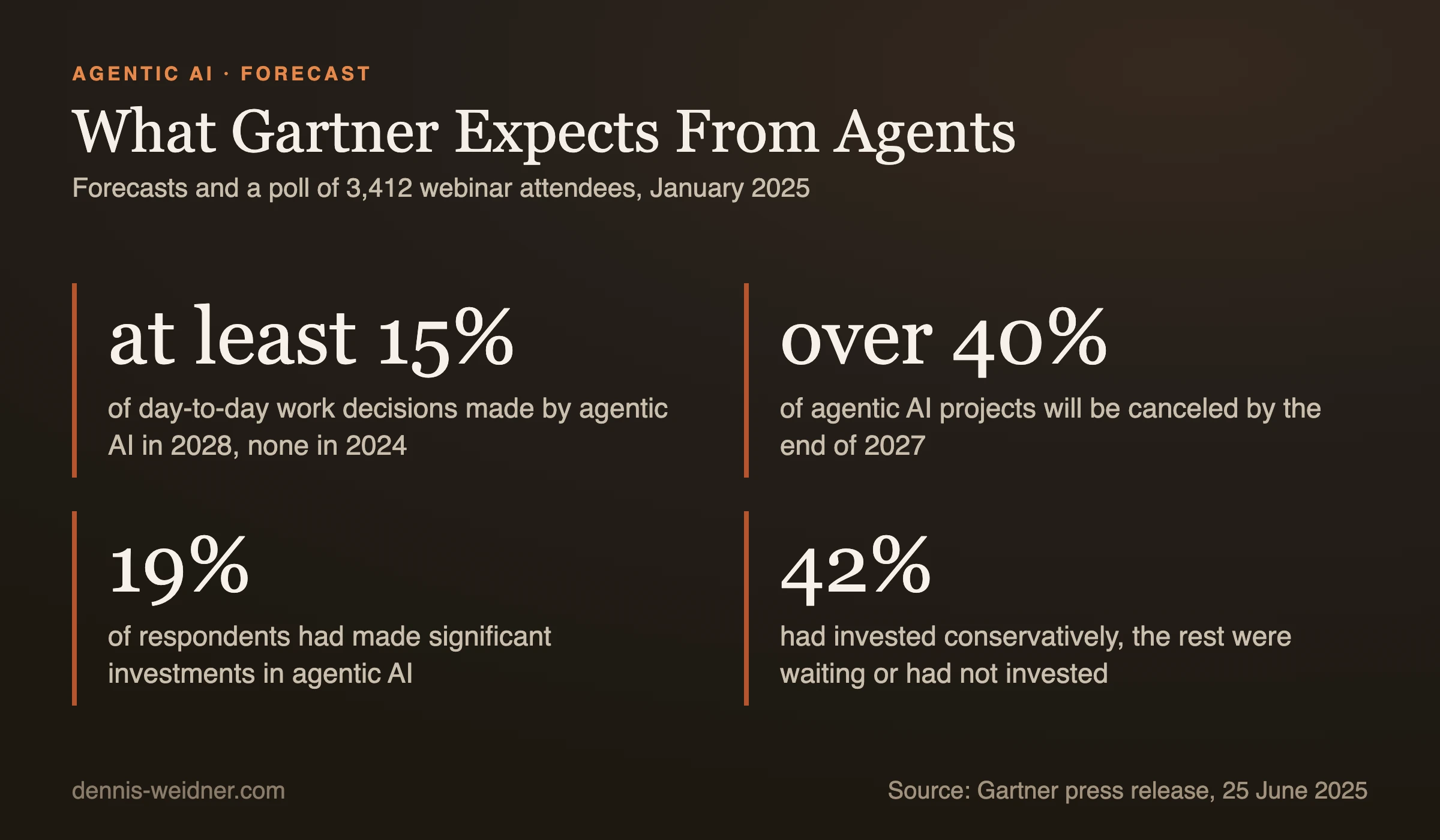
In an autonomous organization, the human sets the intent, and the system takes over the rest: coordination, sequencing, follow-through. Gartner expects that by 2026 around 40 percent of enterprise applications will include task-specific AI agents, up from less than 5 percent the year before. By 2028, another Gartner forecast says, at least 15 percent of day-to-day work decisions will be made agentically, up from zero percent in 2024. That curve is steep, and it is real.
What an autonomous organization actually looks like
So this does not stay abstract, an example from our own week: the weekly market and competitor scan for one of our companies. It used to work like this. Monday morning, a person clicked through sources, copied what mattered, poured it into a document, and shaped it into an assessment. Two to three hours, every week, from someone good who really had better things to do.
Today it works like this: I define once what counts, which competitors, which signals, which threshold for "you need to see this." Overnight the agent gathers the sources, filters out the noise, writes a summary with links back to the originals, and flags anything that deviates from the norm. In the morning I read one page instead of twenty tabs. I decide what needs a response, and that is exactly where I step in, not in the busywork before it. The human decides, the agent executes. This split runs through almost every process we have converted: reporting, research, proposal drafts, the first support reply.
The most important sentence: the human stays at the wheel
Autonomous does not mean leaderless. The successful implementations I see work with clear control points: the agent drafts, recommends, and executes, but on sensitive decisions it pauses and obtains a human sign-off. Governance here is not a brake, it is part of the architecture: decision logs, escalation paths, reliability monitoring, and clear emergency stops.
That is exactly how we run our companies. Reporting, research, routine work, and a large part of support run agentically in the background. I decide what we build, who we work with, and where we are headed. Execution is handled by the system, monitored and within clear limits.
Where it (still) breaks down
The clearest data point comes from McKinsey: in its latest State of AI survey, 39 percent of organizations say they are experimenting with agents, but only 23 percent are actually scaling them, and within any single function it is usually under 10 percent. Between "we are testing something" and "it carries the operation" lies a wide gap.
What breaks is rarely the technology. It is unclear processes, missing control points, and the expectation that an agent will create order on its own where there was chaos before. Gartner even expects that over 40 percent of agentic AI projects will be canceled by the end of 2027, because of excessive costs, unclear value, or inadequate controls. The forecast shows that the winners are not the ones with the most agents, but the ones with the cleanest processes behind them. Automate a broken process and all you get in the end is faster chaos.
What this means for founders
The biggest opportunity is not cutting headcount, that is the wrong lens. The biggest opportunity is speed and focus. A small team can build several companies in parallel today, because the repetitive work disappears and more time is left for what matters: strategy, customer relationships, the right decisions.
Anyone starting a company today should not ask which tasks a new hire will take on, but which ones an agent can handle reliably and where the human makes the difference. That order changes everything.
And one more thing that tends to get lost in all the excitement: an autonomous organization is not a state you reach once, but a way of working that you build up step by step. You start with one process, give it clear limits, learn from the mistakes, and expand it. Whoever practices this early will have a head start in two years that you can no longer simply buy in.
Frequently Asked Questions
What is an autonomous organization?
An autonomous organization is a company in which people set the direction and make the decisions, while AI agents carry out the actual work. Humans define the intent, and the system handles coordination, sequencing, and follow-through within clear limits.
How is an AI agent different from an automation script?
An automation script runs a fixed, predefined step. An agent assesses the situation, decides on the next sensible step, and adjusts its plan when new information arrives. It works in the gray zones where a human previously had to intervene.
Why do so many agent projects fail?
Rarely because of the technology, mostly because of unclear processes and missing control points. Gartner expects over 40 percent of projects to be canceled by the end of 2027. Automate a broken workflow and you only get faster chaos. Fix the process first, then put the agent on top of it.
Does an autonomous organization mean replacing people?
No. The biggest opportunity is not cutting headcount but gaining speed and focus. Humans stay at the wheel, setting intent and approving sensitive decisions, while agents take over repetitive work so a small team can achieve much more.
Warm regards,
Dennis Weidner
Note: AI tools supported me in writing this article, and some images were edited with AI. I stand behind its content and every statement with my name.