Since 1 January 2025, companies in Germany only have to keep accounting vouchers such as invoices and bank statements for eight years instead of ten. Books, annual accounts and inventories stay at ten years, business letters at six. On 1 January 2027, that means vouchers from 2018, business letters from 2020 and books from the 2015 financial year may be destroyed, as long as no tax audit, open assessment or legal dispute stands in the way.
As of 25 September 2026. Not tax advice, see the note at the end.
More on this topic: AI in the Founder's Working Day, with background, practice and every article in one place.
Record Retention Periods in Germany: 8, 10 and 6 Years
German retention rules appear twice, once in tax law and once in commercial law, and since the Fourth Bureaucracy Relief Act (Viertes Bürokratieentlastungsgesetz, Federal Law Gazette 2024 I No. 323) the two match again. Section 147 (3) of the Fiscal Code (AO) and Section 257 (4) of the Commercial Code (HGB) set three tiers:
- Ten years for books and records, inventories, annual accounts, management reports, the opening balance sheet and the procedural documentation needed to understand them.
- Eight years for accounting vouchers (Buchungsbelege), meaning anything that supports a bookkeeping entry: incoming and outgoing invoices, bank statements, receipts, till slips. For invoices, Section 14b (1) of the VAT Act (UStG) repeats the eight years explicitly.
- Six years for business letters received and sent (Handels- und Geschäftsbriefe), such as quotes, order confirmations and business emails, and for other documents relevant to taxation.
What counts is the function, not the form. A contract that supports a bookkeeping entry is a voucher and stays for eight years. Delivery notes that are not vouchers may go as soon as the invoice has been received or sent, under Section 147 (3) sentences 3 and 4 AO.
When Does the Retention Period Start? At the End of the Calendar Year
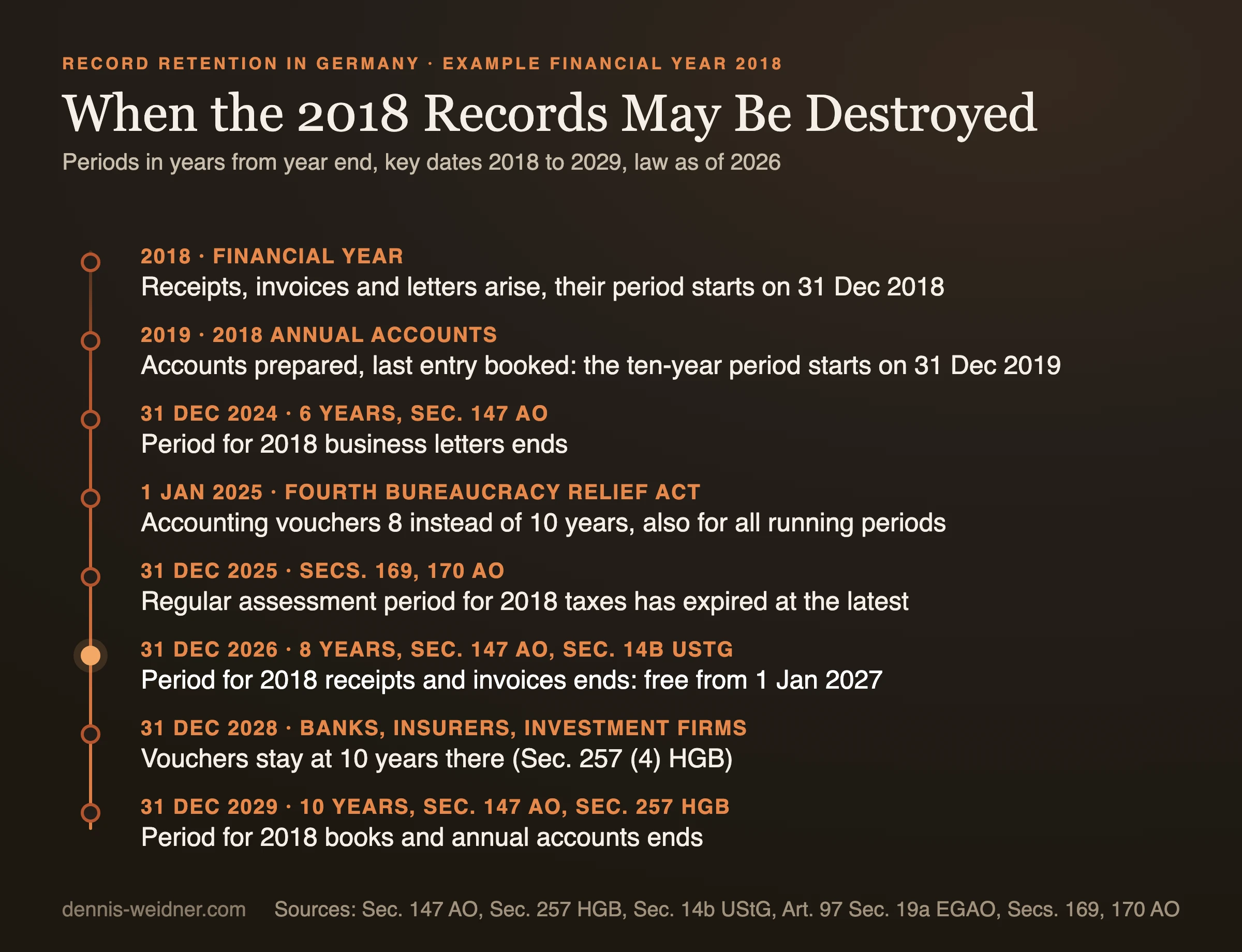
The retention period always starts at the end of the calendar year in which the document came into being (Section 147 (4) AO). An invoice from March 2018 and one from December 2018 therefore both start running on 31 December 2018 and both expire on 31 December 2026.
For books and annual accounts, the trap is in the wording. What matters is the year of the last entry and of preparation, and commercial law even refers to the year the accounts are formally adopted (Section 257 (5) HGB). A company that prepares its 2018 accounts in 2019 and books the last closing entries there only starts the ten-year period on 31 December 2019. Books and accounts for 2018 therefore stay until the end of 2029, even though the vouchers from the same year become free at the end of 2026. The timeline shows this for one financial year.
Retention Periods After the Fourth Bureaucracy Relief Act: the Transition
The eight years do not only apply to new vouchers. Under Article 97 Section 19a (2) of the Introductory Act to the Fiscal Code (EGAO), the new period applies to all documents whose period under the old law had not yet expired on 31 December 2024; Article 95 of the Introductory Act to the Commercial Code does the same for commercial law. That is why three years of vouchers became free at once on 1 January 2025:
| Vouchers from | Old end (10 years) | New end (8 years) | May be destroyed from |
|---|---|---|---|
| 2014 | 31 Dec 2024 | no longer relevant | 1 Jan 2025 |
| 2015 | 31 Dec 2025 | 31 Dec 2023 | 1 Jan 2025 |
| 2016 | 31 Dec 2026 | 31 Dec 2024 | 1 Jan 2025 |
| 2017 | 31 Dec 2027 | 31 Dec 2025 | 1 Jan 2026 |
| 2018 | 31 Dec 2028 | 31 Dec 2026 | 1 Jan 2027 |
| 2019 | 31 Dec 2029 | 31 Dec 2027 | 1 Jan 2028 |
Banks, insurers supervised under the Insurance Supervision Act and investment firms are excluded. Originally they were meant to get the eight years one year later. The Act to Modernise and Digitalise the Fight Against Undeclared Work (Federal Law Gazette 2025 I No. 369 of 29 December 2025) turned that into a permanent rule: for them, vouchers stay at ten years, as Section 257 (4) sentence 2 HGB and Article 97 Section 19a (3) EGAO now read.
Record Retention Calculated: Which Records May Be Destroyed on 1 January 2027?
On 1 January 2027, vouchers from 2018 and earlier, business letters from 2020 and earlier, and books and accounts whose period started in 2016 or earlier may go. The table works this through for a company whose financial year equals the calendar year and which prepares its accounts in the following year.
| Record | Period | Period starts | Free on 1 Jan 2027 |
|---|---|---|---|
| Accounting vouchers: invoices, bank statements, receipts, including e-invoices | 8 years | End of the year the voucher arose | from 2018 and earlier |
| Books: journal, general ledger, accounts | 10 years | End of the year of the last entry | last entry in 2016 or earlier, usually financial year 2015 |
| Annual accounts, inventory, management report, opening balance sheet | 10 years | End of the year of preparation, in the HGB of adoption | prepared and adopted in 2016 or earlier, usually financial year 2015 |
| Business letters, including emails | 6 years | End of the year of receipt or dispatch | from 2020 and earlier |
| Other tax-relevant documents | 6 years | End of the year they arose | from 2020 and earlier |
| Accounting vouchers at banks, insurers, investment firms | 10 years | End of the year they arose | from 2016 and earlier |
The arithmetic is the same every time: the year the record arose plus the period gives the year at whose end the period expires. 2018 plus eight is 2026, 2020 plus six is 2026, 2016 plus ten is 2026. A founder who set up a GmbH in 2020 therefore has nothing to destroy on 1 January 2027 apart from a few business letters from the founding year. Which letters actually arrive in that first year, and which of them are genuine, is covered in Letters After Company Registration in Germany.
When Records Must Stay Despite an Expired Retention Period
The period does not expire as long as the documents matter for a tax whose assessment period (Festsetzungsfrist, the window in which the tax office may still issue or change an assessment) is still running (Section 147 (3) sentence 5 AO). Normally that is not an issue: the assessment period is four years and starts at the latest at the end of the third year after the tax arose (Sections 169 and 170 AO). For 2018 taxes, it therefore ended no later than 31 December 2025, one year before the voucher period. The eight years cover the regular case.
It gets risky when something suspends the assessment period. The cases are listed in Section 171 AO; the most relevant in practice:
- Ongoing or announced tax audit. If it began before the period expired, the period for the audited taxes only runs out once the resulting assessments are final (Section 171 (4) AO). An audit order in the mailbox is the stop signal for any destruction run.
- Open assessment. An objection, a lawsuit or an application for amendment keeps the period open for that year (Section 171 (3) and (3a) AO).
- Loss carryforward. Anyone still carrying forward a loss from an old year must be able to prove its amount. Under Section 10d (4) sentence 6 of the Income Tax Act (EStG), the determination of the remaining loss carryforward does not end before the assessment period of the year for which it is determined. I would keep the vouchers of a loss year until the loss is used up and the last affected year is final.
- Legal dispute. Not a tax rule, but the burden of proof: anyone in a dispute with a customer, supplier or former co-shareholder, or expecting one, needs the documents until it is settled.
The extended assessment periods for tax evasion, by contrast, do not extend retention: Section 147 (3) sentence 5 AO explicitly excludes Section 169 (2) sentence 2 AO. And destroying commercial records early risks more than an estimated assessment: if the company later stops paying or becomes insolvent, it is a criminal offence under Section 283b of the Criminal Code (StGB). How quickly a crisis reaches the managing director personally is explained in Managing Director Liability in a German GmbH.
Digital Record Keeping Under the GoBD and E-Invoices in Their Original Format
Almost all records may be kept digitally, provided they remain available, readable and machine-evaluable for the whole period (Section 147 (2) AO). The law names two exceptions: annual accounts and the opening balance sheet. They belong in the archive as originals, the annual accounts signed and dated under Section 245 HGB.
For incoming electronic vouchers, the GoBD apply, the tax administration's principles for proper electronic bookkeeping and record keeping. The Federal Ministry of Finance letter of 14 July 2025 adapted the GoBD to e-invoicing: vouchers must be kept in the format in which they were received (margin no. 131). For an e-invoice, the structured part, the XML file, is sufficient. The PDF of a hybrid ZUGFeRD invoice only has to be archived as well if it contains tax-relevant information missing from the data set, such as booking notes. The timetable for issuing e-invoices from 2027 is in E-Invoicing in Germany 2027.
There is one relief when switching systems: anyone who changes accounting software or moves data out of the live system may, after the end of the fifth calendar year following the switch, keep the old data on a machine-evaluable data carrier instead of running the old system (Section 147 (6) AO), provided no tax audit has started.
My View: What the Shorter Retention Period Really Delivers
The reform is right, but smaller than it sounds. For anyone who books digitally, two fewer years of vouchers save a few gigabytes, not work. The real gain goes to businesses with paper archives, storage basements and external record stores, and only for vouchers: books and accounts stay at ten years, and because of preparation in the following year often effectively eleven.
I would therefore not start a clear-out campaign but set a fixed destruction date each January, preceded by three questions. Is a tax audit running or looming? Is an assessment for any of the years still open, or a loss not yet used up? Is there a dispute for which the records could serve as evidence? Only when all three answers are no does the year go to the shredder. Anyone running several companies does this per company, since each has its own assessments and audits. More tax and finance topics for founders are collected under Crypto and Finance.
Frequently Asked Questions
How long do I have to keep invoices in Germany?
Eight years, counted from the end of the year in which the invoice was issued (Section 14b UStG, Section 147 (3) AO). An invoice from 2018 may therefore be destroyed from 1 January 2027, unless a tax audit or open assessment stands in the way.
Does the reduction to eight years also apply to old vouchers?
Yes. It applies to all records whose period had not yet expired on 31 December 2024 (Article 97 Section 19a (2) EGAO). On 1 January 2025, vouchers from 2015 and 2016 therefore became free alongside the regular 2014 batch.
How long must bank statements be kept?
Bank statements are accounting vouchers and stay for eight years. If you receive them as PDFs, keep them as PDFs; a printout does not replace the file.
Can I throw away paper receipts after scanning them?
In principle yes, if keeping them as files complies with proper bookkeeping principles, the file matches the original visually and remains readable for the whole period (Section 147 (2) AO). Annual accounts and the opening balance sheet are excluded and stay as originals.
Does the eight-year period apply to emails?
Only if the email is an accounting voucher, for example an invoice in the body text. Business correspondence counts as a business letter and stays for six years.
Note: This article is not tax or legal advice. It describes the legal position in Germany as of 25 September 2026 and deliberately simplifies: it assumes a financial year equal to the calendar year and leaves out special periods outside tax and commercial law, such as payroll accounts, customs records or industry-specific records. Before destroying a year's records, a short check with a tax adviser on whether anything is still open for that year is worthwhile.
Best,
Dennis Weidner
Note: AI tools supported me in writing this article, and some images were edited with AI. I stand behind its content and every statement with my name.