From January 1, 2027, businesses in Germany must issue invoices to other businesses as e-invoices if their total turnover in 2026 exceeded €800,000. Those below the threshold may still send paper or, with the customer's consent, a PDF during 2027. From 2028, the obligation applies to everyone. Every business has already had to be able to receive e-invoices since January 2025. The real question is therefore not whether but when, and the answer depends on a turnover figure that many businesses define incorrectly. The worked example below shows it for five companies.
As of September 11, 2026.
More on this topic: AI in the Founder's Working Day, with background, practice and every article in one place.
What an E-Invoice Is in Germany: A Structured Format Instead of a PDF
Under Section 14(1) of the German VAT Act (UStG), an e-invoice is an invoice that is issued, transmitted and received in a structured electronic format and enables electronic processing. The format must comply with the European standard EN 16931, which is based on Directive 2014/55/EU. Everything else, including a well-designed PDF file, is legally an "other invoice".
According to the Federal Ministry of Finance's questions and answers (in German), two formats in particular meet the requirements: XRechnung and ZUGFeRD from version 2.0.1, with the exception of the MINIMUM and BASIC-WL profiles. ZUGFeRD is a hybrid format, a PDF file with embedded data. Recipients see a familiar invoice layout, but for tax purposes the structured data part is what counts. XRechnung, by contrast, consists only of data and requires software to be read.
The difference is more than technical. A PDF invoice has to be typed in or scanned, while an e-invoice can be imported directly into accounting: supplier, amount, tax rate and date of supply sit in fixed fields. That is the purpose of the reform, and it is also the benefit for any business that already keeps its books digitally.
Germany's E-Invoicing Mandate Timeline: 2025, 2027 and 2028
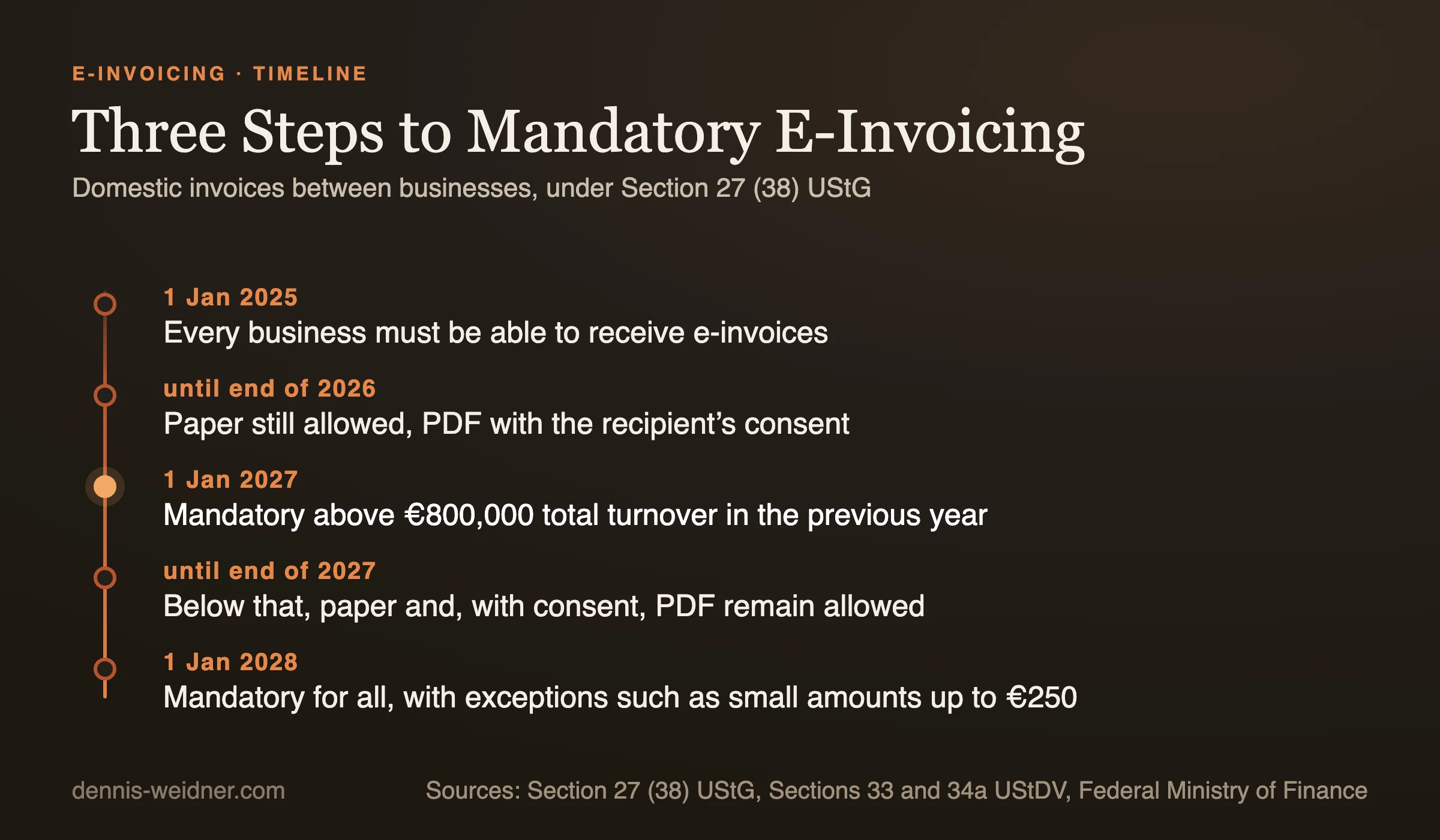
The mandate arrives in three stages. It covers domestic transactions between businesses; invoices to consumers are not included. The transitional rules are set out in Section 27(38) UStG.
| Period | Receiving | Issuing |
|---|---|---|
| since January 1, 2025 | mandatory for all businesses | paper still allowed, PDF and other formats with the recipient's consent |
| January 1 to December 31, 2027 | mandatory for all businesses | e-invoice mandatory if total turnover in 2026 exceeded €800,000. Below that, paper or, with consent, PDF. EDI procedures with consent for everyone until the end of 2027 |
| from January 1, 2028 | mandatory for all businesses | e-invoice mandatory for everyone, with the exceptions listed below |
The obligation to receive is often overlooked because it no longer has a deadline: it already applies. According to the Federal Ministry of Finance, an email inbox is generally sufficient for this. But a business that can receive e-invoices without being able to read or process them has only postponed the problem.
The €800,000 Threshold: Which Turnover Counts for E-Invoicing
The law refers to the total turnover of the business issuing the invoice in the previous calendar year. For invoices issued in 2027, the year 2026 is decisive. Three points determine whether the calculation is right:
- Total turnover, not B2B turnover. The relevant figure is total turnover for VAT purposes under Section 19(2) UStG. Sales to consumers count, even though they do not require e-invoices. An online retailer with €700,000 in consumer sales and €150,000 in business sales is above the threshold.
- The taxable person, not the business unit. A sole proprietor running two businesses is a single entrepreneur for VAT purposes, and the turnover is added together. Each GmbH, by contrast, is a separate entrepreneur and is assessed on its own.
- The previous year, not the current one. Anyone above the threshold in 2026 must switch in January, even if 2027 turns out weaker. Anyone just below it in 2026 has all of 2027 to prepare.
A special case affects entrepreneurs with a holding structure. In a VAT group (umsatzsteuerliche Organschaft), there is only one entrepreneur for VAT purposes: the controlling company. Following that logic, the turnover of the entire group counts. Two subsidiaries with €500,000 each would then be above the threshold together, although each is below it on its own. Anyone running a structure like the one described in the article on the holding company in Germany for founders should clarify this point explicitly with a tax adviser.
Worked Example: Five Companies, Five E-Invoicing Deadlines
The companies are fictitious; the thresholds and deadlines come from Section 27(38) UStG and the Federal Ministry of Finance.
| Company | Total turnover 2026 | Must issue e-invoices from | Why |
|---|---|---|---|
| A: consulting GmbH | €1.3 million | January 1, 2027 | above €800,000 |
| B: craft business | €650,000 | January 1, 2028 at the latest | paper or PDF with consent still allowed in 2027 |
| C: sole proprietor with an online shop (€500,000) and consulting (€400,000) | €900,000 | January 1, 2027 | one entrepreneur, both turnovers are added |
| D: small business under Section 19 UStG | €22,000 | no obligation | exemption for small businesses, receiving still mandatory |
| E: controlling company with two subsidiaries of €500,000 each | €1.0 million in the VAT group | probably January 1, 2027 | the VAT group counts as one entrepreneur, check with a tax adviser |
The table holds two lessons. First, cases C and E are above the threshold, although no single business reaches it. Anyone building several companies at once has to calculate the threshold per entrepreneur, not per brand. Second, company B may wait another year but should not. Large customers will switch their incoming invoices to structured data in 2027 and are likely to reject paper and PDFs more and more often or exclude them by contract. Anyone who only starts looking then will switch under time pressure.
Exemptions From the German E-Invoicing Mandate
The Federal Ministry of Finance lists several cases in which no e-invoice has to be issued, even where an invoice is required:
- Small-amount invoices of up to €250 gross under Section 33 of the VAT Implementing Ordinance (UStDV), such as a fuel receipt or a purchase at a hardware store.
- Tickets that count as invoices under Section 34 UStDV.
- Supplies by small businesses under Section 34a UStDV.
Invoices to consumers are outside the scope anyway. On the receiving side, however, there are hardly any exceptions: small businesses, freelancers and landlords must also be able to accept e-invoices when a supplier sends them.
What the Switch Means in Practice: Receiving, Issuing, Archiving
Receiving. An inbox is legally sufficient, but in practice it is not. An XRechnung is a file full of field names. Accounting software and tax firms import it directly; a person needs a viewer. Anyone who currently forwards incoming invoices to their accountant by email should check whether e-invoices arrive there and are processed.
Issuing. Most invoicing tools can generate XRechnung or ZUGFeRD. Three things need checking: the ZUGFeRD version, the profile and the mandatory details that must end up in the data set, such as the description of the supply and its date. A tool that only produces a nice PDF with a data attachment in the MINIMUM profile does not meet the requirement.
Archiving. Under Section 14b UStG, invoices must be kept for eight years. For an e-invoice, that means the structured file itself, not a printout and not just an image of the file.
The real gain. Once incoming invoices arrive as data, pre-coding, matching against purchase orders and approval can be automated. These are exactly the routines that agents take over today, as described in the overview on AI in daily work. The e-invoice is the prerequisite for that, not the goal.
Input VAT Risk: Why Recipients Need to Pay Attention Too
Deducting input VAT requires a proper invoice. If a supplier that is obliged to issue e-invoices in 2027 sends a PDF anyway, the form is wrong. How strictly the tax authorities treat such cases is set out in the Federal Ministry of Finance's letters of October 15, 2024 and October 15, 2025. In practice: from 2027, check incoming invoices not only for amount and tax rate but also for format, and ask high-turnover suppliers for e-invoices early.
Checklist: Prepare for E-Invoicing by December 2026
- Project total turnover for 2026 per entrepreneur, and for the whole group in a VAT group.
- Check whether e-invoices already arrive today and who reads them: inbox, accounting software, tax firm.
- Check that your invoicing tool supports XRechnung or ZUGFeRD from version 2.0.1, not MINIMUM or BASIC-WL.
- Complete customer master data: who needs a routing ID (Leitweg-ID), who needs a purchase order number in the data set?
- Send a test invoice to a large customer and wait for feedback.
- Set up archiving of the structured files for eight years.
Frequently Asked Questions About E-Invoicing in Germany in 2027
When does the e-invoicing mandate apply?
All businesses have had to be able to receive e-invoices since January 1, 2025. Businesses with total turnover above €800,000 in the previous year must issue them from January 1, 2027, all others from January 1, 2028 (Section 27(38) UStG).
Which turnover counts for the €800,000 threshold?
The entrepreneur's total turnover in the previous year under Section 19(2) UStG, including sales to consumers. Several businesses run by a sole proprietor are added together; each GmbH is assessed on its own.
Is a PDF invoice an e-invoice?
No. A PDF file is an "other invoice". An e-invoice requires a structured format under EN 16931, such as XRechnung or ZUGFeRD from version 2.0.1 without the MINIMUM and BASIC-WL profiles.
Do small businesses have to issue e-invoices?
No, there is an exemption for supplies by small businesses (Section 34a UStDV). Small businesses must still be able to receive e-invoices.
How long must e-invoices be kept?
Eight years under Section 14b UStG, as a structured file in the form in which it was received or issued.
Note: This article is not tax advice. The examples are simplified; for VAT groups, several companies and cross-border transactions, the question belongs with a tax adviser. Next review of this article: January 2027.
Best,
Dennis Weidner
Note: AI tools supported me in writing this article, and some images were edited with AI. I stand behind its content and every statement with my name.