For twenty years the question was simple: how do I get to page one of Google? That question is quietly losing its meaning. More and more people no longer type a query into a search box, they ask ChatGPT, Gemini or Perplexity instead. And those tools hand back a finished answer with a small set of sources. So the new question is not whether you rank. It is whether you get cited.
Why search is reshuffling right now
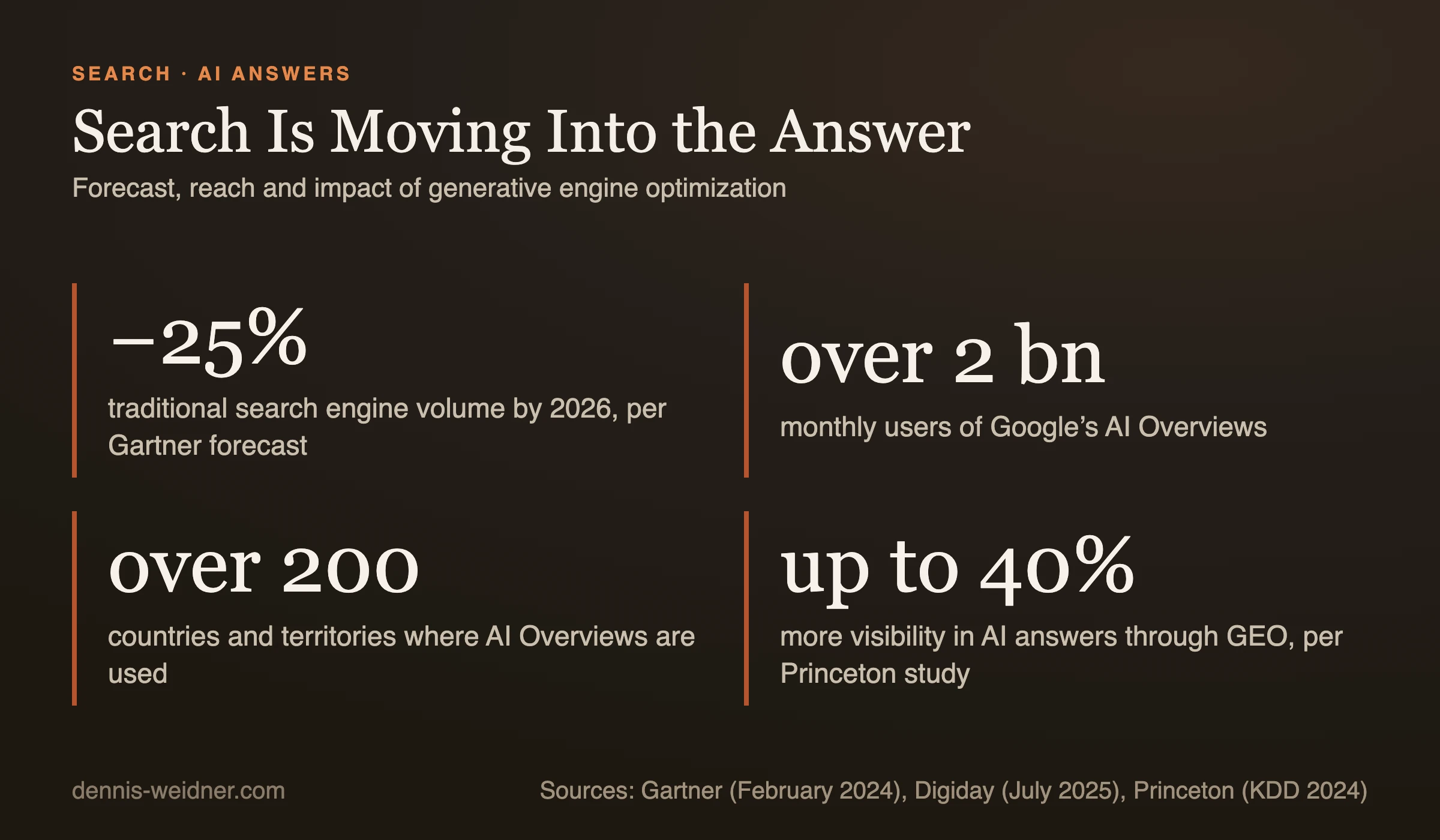
This is not a forecast for some distant year, it is happening today. Back in 2024, Gartner predicted that traditional search engine volume would fall by roughly 25 percent by 2026, as AI assistants replace classic search as the place people go for answers. You can read it in the official Gartner prediction. What matters is the direction, not the exact percentage.
More on this topic: AI in the Founder's Working Day, with background, practice and every article in one place.
And the direction is unmistakable. Google's own AI answers, the AI Overviews, now reach more than two billion users a month according to Digiday. For a growing share of people, the AI answer is the end of the journey, not the beginning. They do not click through, they read and move on. If you are not inside that answer, you simply do not exist for that user.
What GEO actually means
This new world has a name, and the name is Generative Engine Optimization, or GEO for short. SEO was about earning a place among the top ten blue links. GEO has a different goal: to be one of the two to seven sources a language model cites in a single answer. It sounds like a small shift, but it is a different game. The definition of GEO puts it plainly: what counts is no longer the click on a results page but being mentioned inside the generated answer.
The good news is that GEO is no longer guesswork. A widely cited academic study from researchers at Princeton University tested nine concrete tactics across thousands of queries. The finding: preparing content the right way can lift visibility in AI answers by up to 40 percent. And the strongest factors were not tricks but plain, solid craft.
The three GEO factors that really matter
When I combine that study with my own practice, three things stand out as the real difference makers. They sound unspectacular, and that is the good news, because anyone can do them.
First, back up what you say. Content that supports its claims with real sources and concrete statistics gets cited far more often. A language model trusts a text with evidence more than a bare assertion, much like a human does.
Second, make it easy for the machine. Structured data, meaning schema markup based on the schema.org standard, tells an AI unambiguously what on the page is an author, what is a question, what is an answer. Clear headings, genuine FAQ blocks, plain facts in simple sentences. A model that does not have to guess is a model that prefers to cite.
Third, give the models a map. An emerging standard called llms.txt, proposed by Jeremy Howard, is a small text file at the root of your site. It tells a language model, in curated form, which content on your site actually matters. Adoption sits at roughly one in ten websites today, so it is early. That is precisely why it is an edge.
Proof by doing, this blog leads by example
I do not like writing about something I do not do myself. That is why this very blog you are reading is a living example of GEO. The facts here are sourced and linked. The structure is marked up so a machine can read it. There is an llms.txt that shows the models what this is about. The FAQ block below is not decoration, it is exactly the kind of clean question and answer structure an AI likes to pick up.
To me this is more than a technical exercise, it is an attitude. If you want machines to understand you, you have to think more clearly and write more honestly anyway. That same logic, building systems so they run without constant hand holding, is something I describe in more depth in my piece on the autonomous organization. GEO is really the same idea, just applied to content.
What I would tell you
Do not start with the technology, start with the substance. Write something that is genuinely true, that you can back up, and that someone is actually looking for. Then layer the craft on top: sources, clear structure, schema, an llms.txt. In that order. Dress up an empty claim and the AI will see through it just as a reader would.
And stay calm. SEO is not dead, classic search will not vanish overnight. But a second channel has opened up, one that almost nobody is tidying yet. That is the opportunity for anyone who starts early. If you want to know how I approach topics like this, and why I would rather build than talk, you will find it on my about page.
Frequently asked questions
What is the difference between SEO and GEO?
SEO aims to rank as high as possible in a search engine's list of results and win a click. GEO, or Generative Engine Optimization, aims to be named and cited as a source inside the finished answer of ChatGPT, Gemini or Perplexity. One rewards ranking, the other rewards being citable.
How do I get cited by ChatGPT and Perplexity?
Most reliably through three things: evidenced facts with real sources and statistics, a clear machine-readable structure with schema markup and unambiguous headings, and genuine authority on the topic. A Princeton study shows these factors can raise visibility in AI answers by up to 40 percent.
Do I need an llms.txt file?
It is not mandatory, and the major AI crawlers do not read it consistently yet. But it is an emerging standard that shows language models, in curated form, which content on your site matters. Because only about one in ten websites has one, it is a cheap early-mover advantage.
Has AI search made SEO obsolete?
No. Classic search is losing volume, but it is not disappearing. Good GEO builds on good SEO, clean content, clear structure and trust signals pay off in both. The difference is that a second channel has appeared, one that hardly anyone is tending to yet.
Warmly,
Dennis Weidner
Note: AI tools supported me in writing this article, and some images were edited with AI. I stand behind its content and every statement with my name.