The first Invest in Germany Summit in Berlin on 19 and 20 October 2026 ended with a big number: investors had pledged around 230 billion euros, said Chancellor Friedrich Merz. The Ministry for Economic Affairs counts 228.6 billion euros in the largest projects, a good 95 billion of it from foreign companies. The hosts were Merz, six of his ministers and his investment commissioner Martin Blessing, a former Commerzbank chief executive. The star guest was Nvidia CEO Jensen Huang. My take as an entrepreneur: a pledge is not a signature, a large part of the sum was planned anyway, and the room was filled mostly with corporations and financial investors. If Germany wants to move forward, it has to bring founders and their backers to the same table.
As of 20 October 2026.
More on this topic: AI in the Founder's Working Day, with background, practice and every article in one place.
Invest in Germany Summit: What Was Pledged in Berlin
The summit opened on Monday evening with a reception at Kraftwerk Berlin, the conference itself ran on Tuesday at ESMT. Around 200 chief executives and large investors attended, and meetings with cabinet members were scheduled at roughly 15 minutes each. The federal government named energy, industrial AI, semiconductors, data centres and infrastructure as its priorities (government programme).
The most tangible announcements: Amazon plans to invest more than 16 billion euros in Germany in 2027, 4.8 billion of it in its AWS data centres in Frankfurt. Nvidia signed a declaration of intent on industrial AI with the federal government and plans to invest in four German startups. Brookfield plans tens of billions over five years, and Microsoft, Blackstone, the Schwarz Group, RWE and Sanofi made commitments without amounts (tagesschau, Reuters). Finance Minister Lars Klingbeil said: “Germany is back.” Economy Minister Katherina Reiche was more cautious: “The competition never sleeps.”
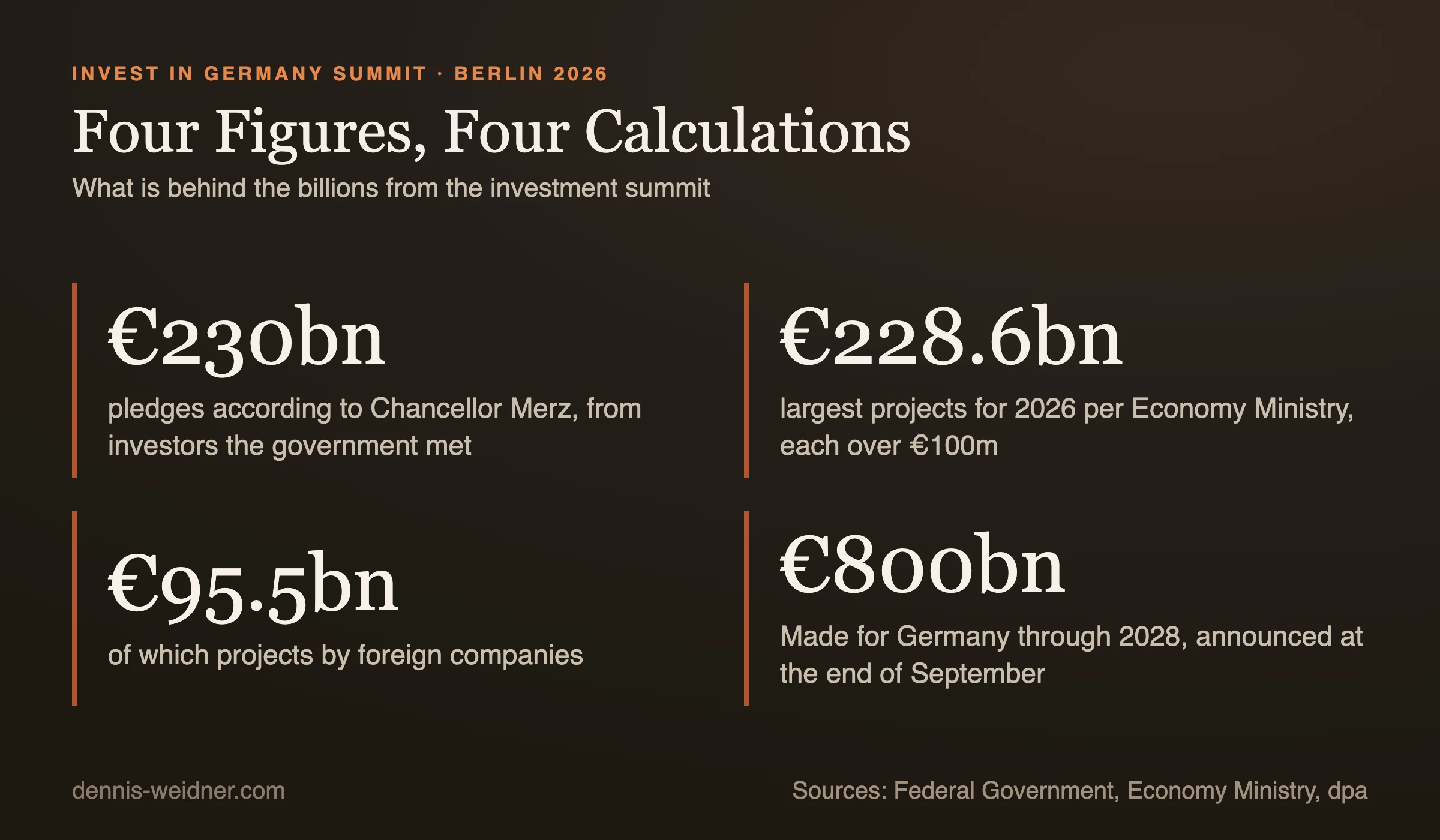
230, 228.6 or 800 Billion: What Each Figure Measures
Anyone reading Tuesday’s reports finds at least three totals. They measure different things and cannot be added up. Whether the pledges have anything to do with the summit, or would have come anyway, remained unclear according to the German news agency dpa (Tagesspiegel).
| Total | Who cites it | What it counts |
|---|---|---|
| around €230bn | Chancellor Merz | pledges from the investors the government met |
| €228.6bn | Economy Ministry | more than 70 projects for 2026 worth over €100m each |
| €95.5bn | Economy Ministry | of which projects by foreign companies |
| over €800bn | Made for Germany initiative | investments by the more than 140 participating companies through 2028, announced at the end of September |
The largest figure is the oldest. The Made for Germany initiative launched in July 2025 with 61 companies and 631 billion euros, even then with the note that it included investments, research and development that had already been planned (Euronews). A company that modernises factories it would have modernised anyway shows up in this total.
How much of it is actually new was put into perspective on the evening of the summit by one of the initiative’s founders himself. On the German news programme tagesthemen on 20 October 2026, Roland Busch, CEO of Siemens AG, said they did not know the exact figure either. New investments were included, he said, amounting to a three-digit million sum. Even at the upper end, that is barely more than one per mille of the 800 billion. A pledge is therefore not new money; for the most part it bundles what was planned anyway. Busch himself stressed that what matters is that pledged investments are actually made.
I know this from the startup world. Anyone who watches “Die Höhle der Löwen”, the German version of Dragons’ Den, knows that a handshake in the studio is not a contract. Due diligence follows the show, and some deals never close. An investment is done only once everyone has signed at the notary. Investment pledges are no different. A sum that has been announced but not signed is an intention.
Failed Subsidy Projects: Intel, Wolfspeed and Northvolt
At the press conference, journalists asked what had become of the big plant projects of recent years. The record is sobering: two chip factories that were never built, and a battery plant whose Swedish parent went bankrupt.
| Project | State commitment | Status October 2026 |
|---|---|---|
| Intel, Magdeburg | €9.9bn in subsidies for a plant worth around €30bn (2023) | cancelled for good in July 2025, no budget funds were paid out |
| Wolfspeed and ZF, Ensdorf (Saarland) | around half a billion euros in federal and Saarland funding in prospect for a chip factory worth around €2.75bn (2023) | ZF withdrew in October 2024 according to Handelsblatt, project on ice, Wolfspeed went through Chapter 11 in the US in 2025 |
| Northvolt, Heide | around €600m convertible bond via KfW, split between federal and state government; plus around €700m in approved direct aid, not paid out | Northvolt insolvent in Sweden since March 2025, takeover by Lyten not yet completed |
Sources: on Intel the dpa report on the cancellation, on Wolfspeed electrive, on ZF’s withdrawal t-online, on Northvolt the review by the Federal Court of Auditors and the status of the Lyten takeover and Lyten’s memorandum of understanding.
The answer from the podium was, in essence: in the long run, far more money has to come from private hands, for roads, for infrastructure, even for military barracks. Blessing had already called for more public-private partnerships in Handelsblatt in June and admitted a certain disillusionment among investors. Private capital for infrastructure can make sense. As an answer to a question about failed subsidies, I still find private barracks remarkable. The lesson from Magdeburg, Ensdorf and Heide is a different one: billions for individual corporations do not replace a good business location. How much day-to-day conditions weigh is shown by Eli Lilly in Alzey: in June the company roughly halved its planned investment of 2.3 billion euros, citing the healthcare savings plans and poor conditions. tagesthemen picked up the case on the eve of the summit (tagesthemen, 19 October).
Nvidia at the Investment Summit: Who Benefits from the AI Partnership
A few days before the summit, Jensen Huang had warned that Germany was falling behind in the AI race (Euronews). In Berlin he sounded more conciliatory: the next wave of AI is physical, meaning robots, factories and cars, and Germany’s manufacturing data is a natural resource that belongs to the nation (AP). According to media reports, the federal government plans to spend a three-digit million sum, among other things on computing capacity in Deutsche Telekom’s Industrial AI Cloud, which runs on Nvidia chips (tagesschau). The four startups Nvidia plans to invest in are Agile Robots, Avelios Medical, Mirelo and Reflex Aerospace.
I am glad about every startup that raises money. Still, it is worth asking who gains the most. Germany provides factories, data and taxpayers’ money for computing power. Nvidia provides the chips and the software everything runs on, and sells both. A German product does not automatically emerge from this. Dependency grows, at a time when Washington has changed its rules on chip exports and tariffs several times. Anyone who sees manufacturing data as a national resource should process it on their own infrastructure. I have described how small and mid-sized companies are already doing this in my article on local AI for SMEs.
Nvidia is not a new name. The company was founded in 1993, the first GeForce graphics card came out in 1999. My generation grew up with these cards, and my first computer was a budget PC from Aldi. That this very partner is being sold as a great success for Germany in 2026 says a lot about how long the country stood by while chips and AI moved on.
Merz and the Towels: Why Predictability Alone Is Not Enough
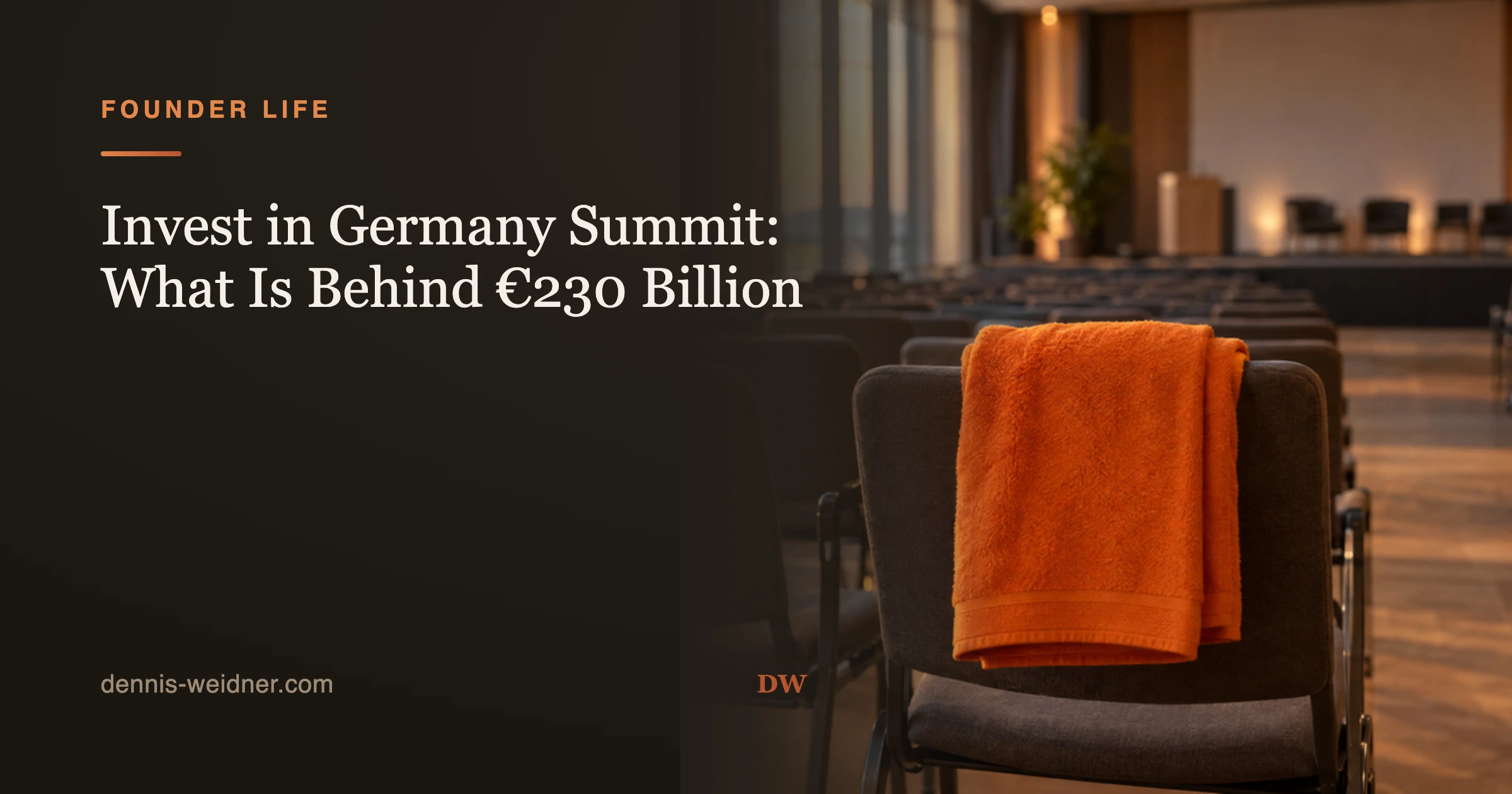
The Chancellor opened his speech with German clichés. Germans, he said, lay out their towels before breakfast, and when they agree on delivery dates, they keep them. Germans, he said, are reliable, predictable, precise and good for no surprises. “In short: we are exactly what investors value most,” dpa quoted him.
Reliable rules, stable taxes and courts that work are a genuine advantage for a business location. But a predictable state is not the same as uniform people. In the age of AI, markets shift from quarter to quarter. Anyone building something today has to adapt, throw plans away, get up earlier and work weekends when it matters. I am a father first and an entrepreneur second, and still I know that in the build-up phase, work-life balance has to step back for a while. The young people founding companies today do not lay towels on sun loungers. They build products. The joke shows how far political imagery is from the reality of founders.
Who Was Missing from the Investment Summit: Founders and Venture Capital
According to the federal government’s answer to a parliamentary question by Die Linke, around 550 invitations went mainly to international companies and financial investors, plus leading German companies and startups. Members of parliament were not included, the guest list is not public, and the budget sets aside five million euros for the conference and new location marketing (Bundestag, hib). Many founders and startup investors I asked had not been invited. The daily taz described a meeting behind closed doors (taz).
Yet this is exactly where the problem lies. German startups raised around 5.1 billion euros in venture capital in the first half of 2026, and less than a third of it came from German investors. According to the German Venture and Growth Forum, pension funds and insurers manage around 2.8 trillion euros and put about 0.1 percent of it into venture capital (Dealroom). Innovation often comes from the small players because they move faster, a point I explore in startups, corporates and innovation. If you want to know who speaks for entrepreneurs in Berlin, the associations are listed in the lobby register. At the summit, their voice was noticeably absent.
Choose France in Versailles: What France Has Shown Since 2018
The model for the Berlin summit is in Versailles. Emmanuel Macron has invited international chief executives to the palace every year since 2018. At the ninth edition on 1 June 2026, 71 projects worth 93 billion euros and more than 15,600 jobs were announced. According to the Élysée, around 87 billion euros from more than 230 projects have actually been delivered from the summits since 2018. SoftBank alone plans 45 billion euros for data centres in northern France (France 24, Bpifrance).

There is criticism in France too. Economist Sylvain Bersinger pointed out that overall business investment remains weak despite the record figures. France is still ahead: nine years of continuity, a fixed date and a president who courts investors in person. Germany starts its first summit eight years later. An analysis by Allianz Research shows why speed matters: investment in Germany fell by 6.4 percent from 2019 to 2025, while it rose by 20.2 percent in the US (Dealroom).
What the Next Investment Summit Should Do Better
The federal government wants to hold the conference again. That is good, because a signal alone is not enough, as economists also told tagesschau on the evening of the summit. Five suggestions from an entrepreneur’s point of view:
- Track the pledges. Publish every total with its status: new or already planned, signed or intended. And report a year later on what was actually built.
- Bring founders and venture capital to the table. A dedicated track for startups, funds, business angels and the German Startups Association, which calls for tripling venture capital investment by 2030.
- Mobilise domestic capital. Pension funds and insurers should be allowed and encouraged to invest more in growth. Blessing himself calls pension reform a litmus test.
- Reforms before red carpets. According to a KfW survey, 92 percent of companies need to invest. They are waiting for cheaper energy, less bureaucracy and faster permits, not for a conference. A start is the 30 percent declining-balance depreciation.
- Partnerships with sovereignty. Working with Nvidia, yes, but with our own data centres, open models and data processed in Europe.
Germany has strong companies, skilled people and factories full of data. What is missing is the bridge to those who turn this material into the products of tomorrow. You will find more of my view on politics and society in the overview. How did you experience the summit, were you invited? Write to me via the contact form, I answer every message.
Frequently Asked Questions
What is the Invest in Germany Summit?
An investment summit hosted by the German federal government, held for the first time in Berlin on 19 and 20 October 2026. Around 200 chief executives and large investors met Chancellor Friedrich Merz, cabinet ministers and investment commissioner Martin Blessing. The government plans to repeat the meeting.
How much money was pledged at the investment summit?
Merz cited around 230 billion euros. The Economy Ministry counts 228.6 billion euros across more than 70 projects for 2026 worth over 100 million euros each, 95.5 billion of it from foreign companies. How much of it is new and how much was planned anyway remained unclear.
Who is Martin Blessing?
Blessing was chief executive of Commerzbank from 2008 to 2016. Since September 2025 he has been the Chancellor’s personal commissioner for investment, tasked mainly with bringing private capital from abroad to Germany.
What did Nvidia announce at the investment summit?
Nvidia and the federal government signed a declaration of intent on industrial AI. According to media reports, the government plans to spend a three-digit million sum, among other things on computing capacity in Deutsche Telekom’s Industrial AI Cloud. Nvidia also plans to invest in the German startups Agile Robots, Avelios Medical, Mirelo and Reflex Aerospace.
Were startups invited to the investment summit?
According to the federal government, around 550 invitations went mainly to international companies and financial investors, plus leading German companies and startups. The guest list is not public, and members of parliament were not invited.
What is Choose France?
The investment summit of French President Emmanuel Macron, held every year since 2018 at the Palace of Versailles. At the ninth edition on 1 June 2026, investments of 93 billion euros were announced.
Best,
Dennis Weidner
Note: AI tools supported me in writing this article, and some images were edited with AI. I stand behind its content and every statement with my name.