Germany runs one of the densest public funding systems for founders in Europe, and yet a lot of that money goes unclaimed every year. Not out of pride, but because the funding jungle scares people off: hundreds of programs, bureaucratic German, unclear responsibilities. I will walk you through the pots that genuinely matter in 2026, who each one is built for, and where the traps sit. And I will tell you honestly when funding distracts from the real work.
Sort first, search second
A quick orientation for anyone not steeped in the German system: the state supports startups not through tax breaks, as in the US, but through direct programs. They come in four forms. Grants you never pay back. Low-interest loans, mostly via KfW, the state-owned development bank. Guarantees for when you lack the collateral a bank wants. And equity capital, where the state invests directly or indirectly. Most founders only think of the first pot, when loans and equity are often the bigger lever for a scaling company.
More on this topic: AI in the Founder's Working Day – background, practice and every article in one place.
The most important rule up front: Almost every program requires you to apply before you start. If you incorporate, order or sign first and apply afterwards, you fall through the cracks. The complete overview of federal, state and EU programs lives in the federal funding database, complemented by the economics ministry's founder portal existenzgruender.de. Both are free and more reliable than commercial guides that earn commissions on individual programs.
Money to live on: EXIST and the start-up subsidy
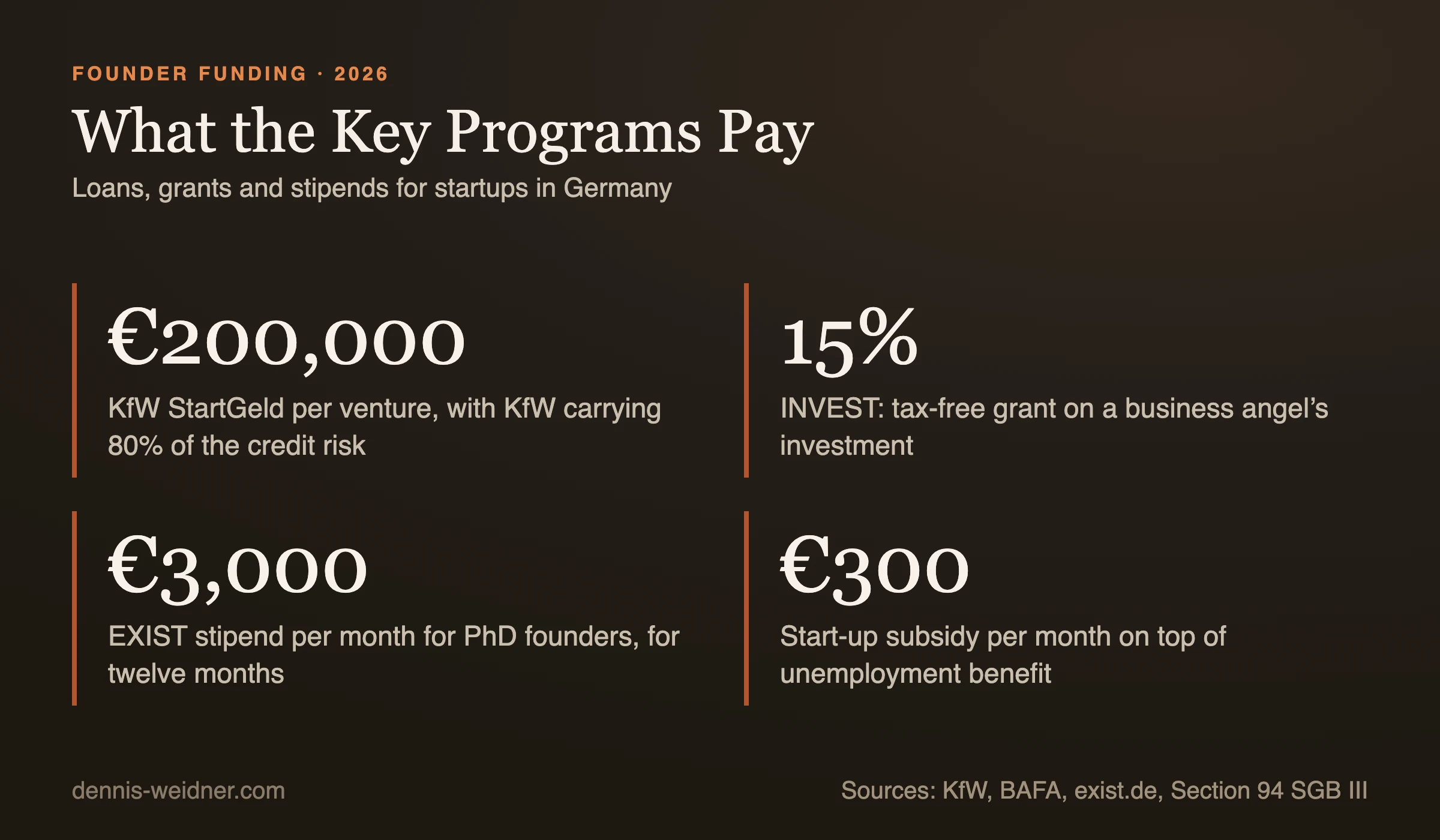
If your idea comes out of a university or research institution, the federal EXIST founder grant is the classic. It covers your living costs for twelve months: 1,000 euros per month for students, 2,500 euros for graduates, 3,000 euros for PhDs, plus 150 euros per child and material expenses of up to 30,000 euros for teams. In return, you work full time on your venture, attached to your university. The typical mistake: being too late. You are only eligible up to five years after graduation, and the application runs through your university's startup network, which needs months of lead time, so talk to the founder office before anything official happens.
The second living-cost pot is the start-up subsidy from the Federal Employment Agency, the Gründungszuschuss. If you start a company while receiving unemployment benefits and still have at least 150 days of entitlement left, you keep your full benefit for six months plus a 300 euro monthly allowance for social insurance, then another nine months of the 300 euros on request. The typical mistake: treating the subsidy as automatic. It is discretionary, placing you in a job takes priority, and without a solid business plan plus an expert opinion, say from the chamber of commerce, you will not get it. Prepare it as seriously as a bank meeting.
KfW StartGeld: the loan when your bank hesitates
For everyone who is not spinning out of academia and not founding out of unemployment, the KfW's ERP founder loan StartGeld is usually the most practical entry point. Since late 2025 it offers up to 200,000 euros per venture, of which up to 80,000 euros for working capital; the previous cap was 125,000 euros. You need no equity of your own, and KfW takes 80 percent of the default risk off your local bank. Without that risk transfer, many German banks would not lend to a founder without a track record at all. You can apply up to five years after founding.
The typical mistake: walking into the bank branch unprepared. The application always runs through your own bank, which decides whether to pass it on to KfW. A clean business plan with a realistic liquidity forecast is not a formality here, it is the ticket in.
INVEST and High-Tech Gründerfonds: when investors enter the picture
As soon as you look for business angels, you should know the INVEST grant for venture capital, run by the federal office BAFA. Formally it targets your investors, but it helps you: an angel who puts 10,000 euros or more into your startup gets 15 percent of the amount back as a tax-free grant, up to 100,000 euros per person in total, with convertible loans treated the same as direct equity. If the angel sells the shares at a profit after at least three years, an exit grant of 25 percent of the gain comes on top, capped at the size of the first grant. That makes your round noticeably more attractive. The typical mistake: your company needs an eligibility certificate from BAFA, and it must be in place before the angel invests. If you discover this at the notary appointment, you are giving your investors' money away. The program currently runs until the end of 2026; an extension is still open.
One level up plays the High-Tech Gründerfonds, Germany's most active seed investor, a public-private fund with more than three billion euros under management and first tickets of up to around one million euros. The typical mistake here is a misunderstanding: HTGF is not a subsidy, it is real venture capital with equity, due diligence and return expectations. Treat it like any other professional investor, just one that comes in very early.
State programs, and what no longer exists
Beyond the federal level, each of Germany's sixteen states funds its own priorities. A good example is the Gründungsstipendium.NRW, a founder stipend of 1,200 euros per month for up to twelve months for innovative startups in North Rhine-Westphalia. It also shows the reality of such pots: demand in 2026 is so high that the jury sessions are temporarily paused. State programs are attractive, but capacity and deadlines change fast, so always check the current status directly with the state.
Just as important is what no longer exists. The popular digitalization grants go-digital and Digital Jetzt have expired; go-digital ended on December 31, 2024 with no federal successor. Anyone selling you a go-digital application in 2026 is working with outdated information. What remains for digitalization projects are mainly the states' digital bonus programs and subsidized consulting through BAFA.
When funding distracts instead of helps
Now the investor lens. I have seen a lot of pitches in recent years, and one pattern always makes me skeptical: founders who build their entire funding slide out of government programs. A grant proves you can write applications. It does not prove anyone wants your product. No funding body replaces your first paying customer, and a grant application is the most elegant form of procrastination I know. If you spend three months polishing an EXIST application instead of talking to twenty potential customers, you are optimizing the wrong metric. I value trust and execution speed over paperwork; more on that in my piece on the handshake mentality in tech.
My rule of thumb: funding is good when it accelerates something you would do anyway. It is bad when it deforms your venture, for example because you start building milestones for the funding body instead of for the market. Take half a day, go through the funding database, pick at most two programs that fit your stage, and call the free funding advisory service of your state. Then get back to the product. That is how I have run things for more than twenty years as an entrepreneur, and you can read more about me here.
Frequently asked questions
What funding exists for founders without a university background?
The KfW's StartGeld loan is open to almost all startups, up to 200,000 euros with no equity required. Add the start-up subsidy when founding out of unemployment, state programs and guarantee banks. EXIST, by contrast, is tied to universities and research institutions.
Can I combine several funding programs?
Often yes, for example an EXIST grant for living costs and later a KfW StartGeld loan, or INVEST-backed angels alongside an HTGF investment. What matters are each program's cumulation rules; your state's free funding advisory service checks this with you.
Do I have to pay German startup funding back?
Grants like EXIST, the start-up subsidy or INVEST are not repaid as long as you meet the conditions. Loans like the KfW StartGeld are low-interest but repayable. Equity capital, such as from HTGF, means the investor receives shares in your company.
What has changed recently in German founder funding?
The KfW StartGeld cap rose from 125,000 to 200,000 euros in late 2025. The digitalization grants go-digital and Digital Jetzt expired without a successor. INVEST runs in its current form until the end of 2026, with an extension still open.
Warmly,
Dennis Weidner
Note: AI tools supported me in writing this article, and some images were edited with AI. I stand behind its content and every statement with my name.