A managing director of a German GmbH is normally not personally liable for the company's debts: under Section 13(2) of the Limited Liability Companies Act (GmbHG), only the company's assets answer to its creditors. That changes in a crisis. A director who keeps paying bills after the company has become illiquid must refund impermissible payments out of his own pocket under Section 15b of the Insolvency Code (InsO), and unpaid taxes and employee social security contributions lead to direct personal claims from the tax office and the health insurance fund.
As of 25 September 2026. Not legal advice, see the note at the end.
More on this topic: AI in the Founder's Working Day, with background, practice and every article in one place.
Managing Director Liability in a GmbH: the Rule and Seven Exceptions
The GmbH, Germany's standard limited liability company, is a legal person in its own right. The managing director (Geschäftsführer) is its officer, not its guarantor. The Federal Court of Justice (BGH) put it plainly in its judgment of 26 April 2018 (IX ZR 238/17): the duties under Section 43 GmbHG are owed to the company only and do not protect creditors. External liability requires a separate legal basis, typically in tort law.
Those separate bases are what director liability in Germany is really about. The official English translation of the GmbHG covers the company law side; the overview shows all seven cases.
| Liability case | Legal basis | Owed to | Typical trigger | What protects you |
|---|---|---|---|---|
| Breach of the duty of care | Sec. 43(1), (2) GmbHG | The GmbH | Poor decision taken without adequate information | Documented basis for decisions, D&O cover |
| Payout from share capital | Sec. 43(3) with Sec. 30 GmbHG | The GmbH | Withdrawal or loan to a shareholder when capital is impaired | Capital check before every payout |
| Late insolvency filing | Sec. 15a(1), (4) InsO | The state (criminal law) | Carrying on beyond three or six weeks | Liquidity planning, early advice |
| Payments after insolvency | Sec. 15b InsO | The GmbH, in practice its insolvency administrator | Suppliers and rent are still being paid | Timely filing, D&O policy naming Sec. 15b |
| Unpaid taxes | Secs. 34, 69 Fiscal Code (AO) | Tax office | Payroll tax or VAT left unpaid | Tax deadlines before other creditors |
| Withheld social security contributions | Sec. 266a Criminal Code (StGB) with Sec. 823(2) Civil Code (BGB) | Health insurance fund as collecting agency | Employee share of contributions not paid over | Contributions paid first |
| Existence-destroying interference | Sec. 826 BGB | The GmbH (targets the shareholder) | Assets stripped without consideration | Arm's-length contracts between group companies |
When Is a Managing Director Liable to the GmbH? Section 43 and the Business Judgment Rule
Towards the company itself, the director is liable for failing to apply the care of a prudent businessperson. Several directors are jointly and severally liable, and claims become time-barred after five years (Section 43(2) and (4) GmbHG). Where money is paid out of the capital needed to preserve the share capital, a shareholder resolution does not help, as far as the money is needed to satisfy creditors (Section 43(3) GmbHG).
Not every bad decision is a breach of duty. For the management board of a stock corporation, the business judgment rule is written into Section 93(1) sentence 2 of the Stock Corporation Act (AktG): there is no breach if the member could reasonably assume to be acting on the basis of adequate information for the benefit of the company. For GmbH directors, the Federal Court of Justice has spelled out what that means: the director must exhaust all available sources of factual and legal information in the specific situation and carefully weigh the pros and cons of the options (BGH order of 14 July 2008, II ZR 202/07, in German). A director who can prove that basis is in the stronger position in any dispute.
Insolvency Filing Duty Under Section 15a InsO: Three Weeks for Illiquidity, Six for Overindebtedness
If the GmbH becomes illiquid or overindebted, the director must file for insolvency without culpable delay, and at the latest three weeks after illiquidity and six weeks after overindebtedness set in (Section 15a(1) of the Insolvency Code, official English translation). These are maximum periods, not a buffer. Failing to file, or filing late, carries up to three years' imprisonment, or up to one year if negligent (Section 15a(4) and (5) InsO).
The crisis rules of 2022 and 2023 have expired. A temporary crisis act (SanInsKG) had shortened the going-concern forecast for overindebtedness from twelve to four months and extended the filing period from six to eight weeks, from 9 November 2022 until 31 December 2023 (Sections 4 and 4a SanInsKG). Since 1 January 2024 the standard model applies again: a twelve-month forecast under Section 19(2) InsO and a six-week filing period.
When exactly a GmbH is illiquid follows a rule of thumb set by the Federal Court of Justice (BGH judgment of 24 May 2005, IX ZR 123/04, in German): a funding gap that cannot be closed within three weeks and amounts to 10 percent or more of the liabilities due regularly means illiquidity. The table applies this to a GmbH with 180,000 euros of liabilities due.
| Item | Case A | Case B |
|---|---|---|
| Liabilities due | €180,000 | €180,000 |
| Funds available within three weeks | €165,000 | €150,000 |
| Funding gap | €15,000 = 8.3% | €30,000 = 16.7% |
| Regular assessment | liquid, unless the gap is foreseeably growing | illiquid, the filing clock is running |
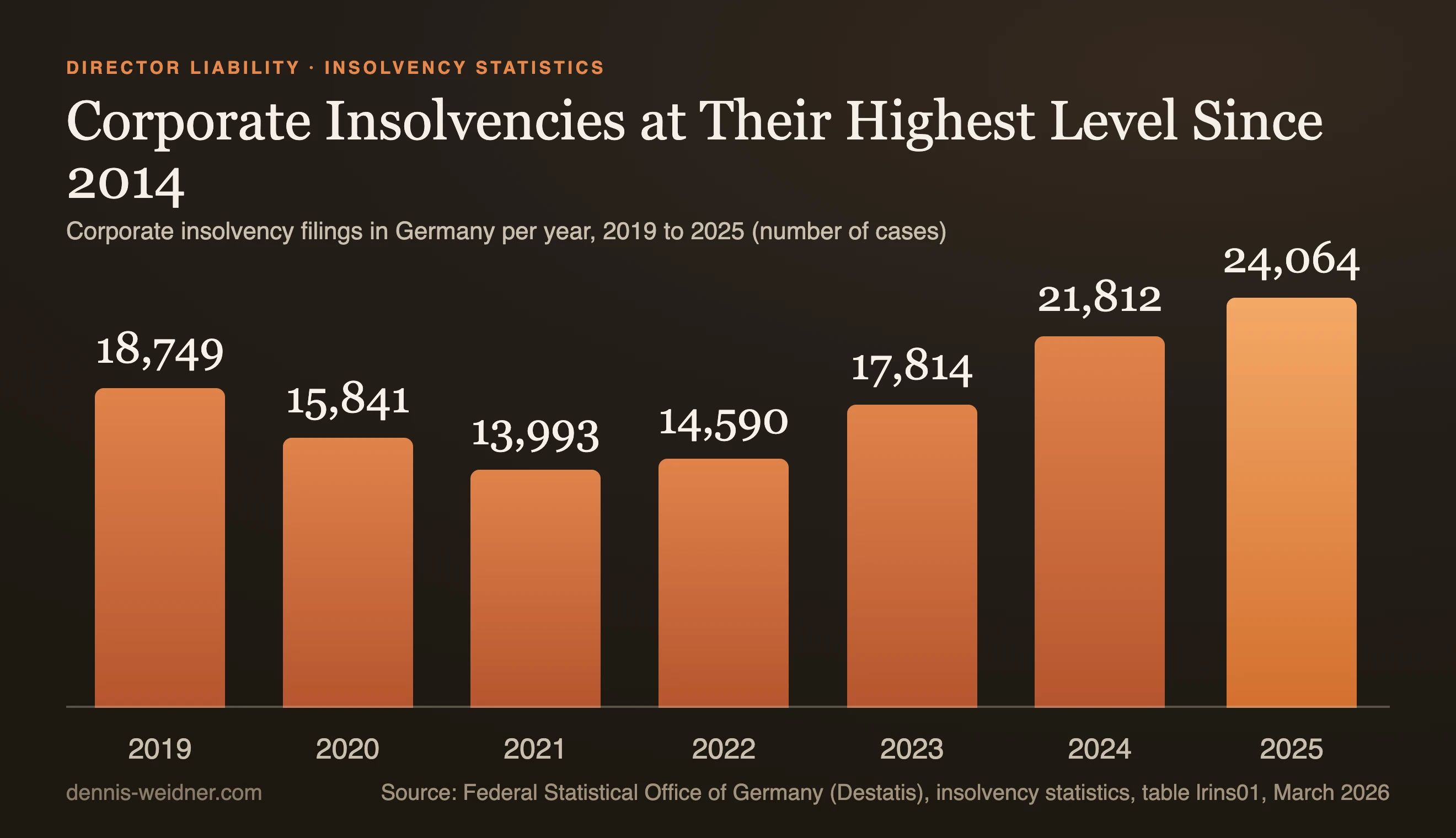
How many companies reach that point shows in the official figures. In 2025, German local courts registered 24,064 corporate insolvency filings according to the Federal Statistical Office (Destatis, in German), 10.3 percent more than in 2024 and the highest number since 2014. In the first half of 2026 there were 12,812, after 12,009 in the same period a year earlier.
Section 15b InsO: Liability for Payments Made After the Company Is Insolvent
The most expensive exposure hits directors who keep paying after illiquidity or overindebtedness. Since 1 January 2021, Section 15b InsO governs this, replacing the former Section 64 GmbHG. From the moment of insolvency, payments are prohibited unless they are compatible with the care of a prudent manager. Payments in the ordinary course of business, such as wages, power or materials, count as permissible during the three or six-week filing period only while the director is seriously pursuing a restructuring or preparing the filing (Section 15b(2) InsO). After the period has expired, payments are generally impermissible (Section 15b(3)).
Every prohibited payment must be refunded to the GmbH, in practice at the demand of the insolvency administrator, capped at any lower loss suffered by the creditors. A shareholder resolution does not help, a waiver by the company is void, and the limitation period is five years (Section 15b(4) and (7) InsO). Payments to shareholders that were bound to cause illiquidity are covered too (Section 15b(5)). There is one relief for taxes: a director who files on time does not breach tax payment duties by stopping payments between insolvency and the court's decision (Section 15b(8)).
When Is a Managing Director Personally Liable to the Tax Office and Social Security?
With taxes and social security, the creditor goes straight to the director. Under Sections 34 and 69 of the Fiscal Code (Abgabenordnung, AO), the legal representative must ensure that taxes are paid from the funds he manages. If they go unpaid through intentional or grossly negligent breach, he is personally liable, including late-payment surcharges, and the tax office claims against him by liability notice (Section 191 AO).
Social security is stricter still. An employer who withholds the employee share of contributions from the collecting agency commits a criminal offence under Section 266a(1) StGB, expressly regardless of whether wages were actually paid. Because that provision protects the funds, it triggers civil liability under Section 823(2) BGB, and the director answers to the health insurance fund with his private assets. The fund has to prove intent (BGH judgment of 3 May 2016, II ZR 311/14).
Shareholder-directors also face existence-destroying liability (Existenzvernichtungshaftung). A shareholder who strips the GmbH of assets without consideration and thereby drives it into insolvency is liable to the company under Section 826 BGB (BGH judgment of 16 July 2007, II ZR 3/04, known as "Trihotel"). Anyone who holds companies through a holding GmbH and charges services between them therefore needs contracts on terms an outsider would accept.
D&O Insurance: What It Covers in Managing Director Liability, and What It Doesn't
The GmbH takes out directors' and officers' insurance for its officers. Under the model terms of the German Insurance Association GDV (May 2020, in German), it covers financial losses from breaches of duty: it examines the claim, defends unfounded ones and pays justified ones. The insured event is the first written claim during the policy period (claims-made basis, clause A-2). Excluded are, among others, intentional and knowing breaches of duty (A-7.1) and fines and contractual penalties (A-7.10).
Three points decide what the policy is worth to a founder. First, the deductible: it is mandatory only for management board members of a stock corporation, at least 10 percent of the loss up to one and a half times the fixed annual salary (Section 93(2) sentence 3 AktG). In a GmbH it is freely negotiable. Second, the shareholding clause (A-6.3), where the policy adopts it: if the GmbH itself sues a director who holds shares, the portion matching his stake is not covered. With a 60 percent stake and a 200,000 euro loss, the insurer pays only 80,000 euros. Third, insolvency liability: in 2020 the Federal Court of Justice held that the refund claim under the former Section 64 GmbHG is an insured damages claim (IV ZR 217/19). I would still insist that the policy names Section 15b InsO explicitly.
Avoiding Managing Director Liability: Three Routines From Day One
Since 2021, Section 1 of the Corporate Stabilisation and Restructuring Act (StaRUG) requires every director to monitor continuously any developments that could threaten the company's survival and to take countermeasures. The tax adviser must point out a possible ground for insolvency when preparing the annual accounts if the signs are obvious (Section 102 StaRUG). That kicks in once a year, which is too rarely. In my view, every GmbH needs three routines before the first revenue arrives:
- A 13-week liquidity plan, updated every week. The courts test in three-week windows, and the filing deadline ends after six weeks at the latest. Looking 13 weeks ahead shows a gap before the clocks start. Grants and loans, which I sorted in Funding Programs for Founders, only belong in the plan once approved in writing.
- Contributions first. The employee share of social security and payroll tax are paid before any other creditor, because this is where personal liability sits. A supplier can wait; behind the health insurance fund stands criminal law.
- Documented decisions. Larger investments, contracts with shareholders and every payment in a tight spot get a short note: which figures, which advice, which alternatives. That is exactly the basis the Federal Court of Justice asks for. How I organise this across several companies is described in How I Build Several Companies at Once.
Together they turn the question of when a director is personally liable into a number you see every week. More finance topics for entrepreneurs are collected under Crypto and Finance.
Frequently Asked Questions
Is a GmbH managing director personally liable for company debts?
Normally not: only the company's assets answer for its debts (Section 13(2) GmbHG). The director becomes personally liable for breaching his own duties: payments after insolvency (Section 15b InsO), unpaid taxes (Section 69 AO), withheld social security contributions (Section 266a StGB with Section 823(2) BGB) or breaches of duty towards the GmbH (Section 43 GmbHG).
How long does a managing director in Germany have to file for insolvency?
Without culpable delay, and at the latest three weeks after illiquidity and six weeks after overindebtedness (Section 15a(1) InsO). The extended eight-week period applied only until 31 December 2023.
What does liability under Section 15b InsO mean?
The director must refund to the GmbH any payments made after illiquidity or overindebtedness set in, unless they were compatible with the care of a prudent manager. The claim becomes time-barred after five years.
Does D&O insurance pay for a late insolvency filing?
For the refund claim under the former Section 64 GmbHG, the Federal Court of Justice said yes in 2020 (IV ZR 217/19). Knowing breaches of duty are excluded; the wording of the individual policy decides.
Does a shareholder resolution protect the managing director?
Only to a limited extent. It does not protect against payouts from the capital needed to preserve the share capital, as far as creditors need the money (Section 43(3) GmbHG). For payments after insolvency, a resolution does not exclude the refund duty either, and a waiver by the company is void (Section 15b(4) InsO).
Note: This article is not legal advice. It describes the law in Germany as of 25 September 2026 and simplifies deliberately: whether a company is illiquid depends on the individual case, D&O policies deviate from the model terms, and special rules apply to de facto directors, supervisory boards and partnerships. Anyone who sees a funding gap should consult a lawyer specialising in insolvency and company law early.
Best,
Dennis Weidner
Note: AI tools supported me in writing this article, and some images were edited with AI. I stand behind its content and every statement with my name.