By the close of the signing period on 15 September 2026, 44,439 people had signed the Bundestag petition to preserve Germany's crypto holding period online, and the quorum is met. Does that achieve anything, or is it hot air? Neither: a petition buys a hearing, not a decision. How rare that hearing is, why the quorum counts for less than it did in 2009, and where the real timing problem lies in this case.
Petition 201716 on Germany's crypto holding period: quorum met, now what?
The question I am asked most often right now is not „should I sign?“. It is: does this actually achieve anything?
The answer is neither yes nor no: a petition buys a hearing, not a decision. Expect more and you will be disappointed. Use the hearing well and you have a means of pressure that would not otherwise exist.
I looked at what the instrument can really do, using the Petitions Committee's annual report, the committee's own procedural rules and two cases that went in opposite directions.
The position on the Bundestag platform on 12 August 2026: 41,242 online signatures, quorum met, 34 days left. The petition was filed on 30 May and only cleared for signing on 4 August. Admissibility review therefore took a good two months rather than the usual two to three weeks.
The substance of the tax question is covered separately, with the wording of the bill: Crypto holding period: what the bill actually says. This piece is about the instrument only.
What meeting the quorum actually triggers in the Petitions Committee
Reaching 30,000 signatures triggers exactly one thing: the possibility of a public hearing in the Petitions Committee. The petitioners may attend, the responsible ministry has to give its position, and the session is broadcast.
That is more than it sounds. It is the only routine route by which citizens without an association, a mandate or a lobbying budget can force an item onto the agenda of the German parliament.
It is also less than many assume. A public hearing is not a vote, it does not suspend an ongoing legislative procedure, and it obliges nobody to do anything.
How rare that is: ten out of 12,399 petitions a year
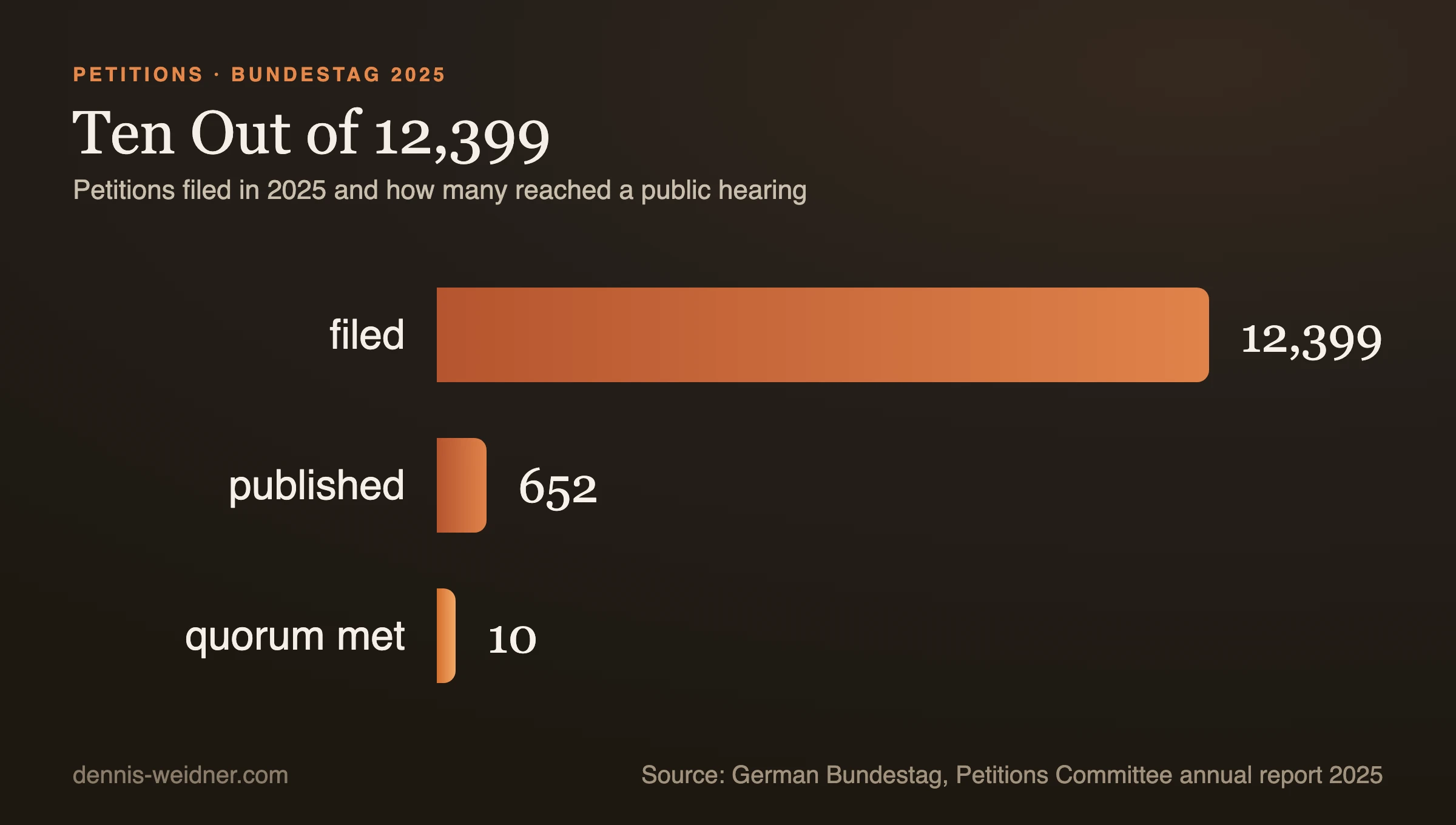
The 2025 reporting year puts this in proportion. The committee received 12,399 petitions, up by 3,139 or 34 per cent on 2024. Of those, 652 were published online. And of those, ten passed 30,000 signatures.
Ten out of 12,399 is 0.08 per cent. Ten out of 652 published petitions is 1.5 per cent. Four public sessions were held in the entire year.
Petition 201716 therefore sits in the top one per cent of what this instrument can deliver. That is good news, and not trivial. More than 40,000 people registered for something that requires a real name, a postal address and a confirmation email, far more than a click.
Why the quorum is worth less today than it was in 2009
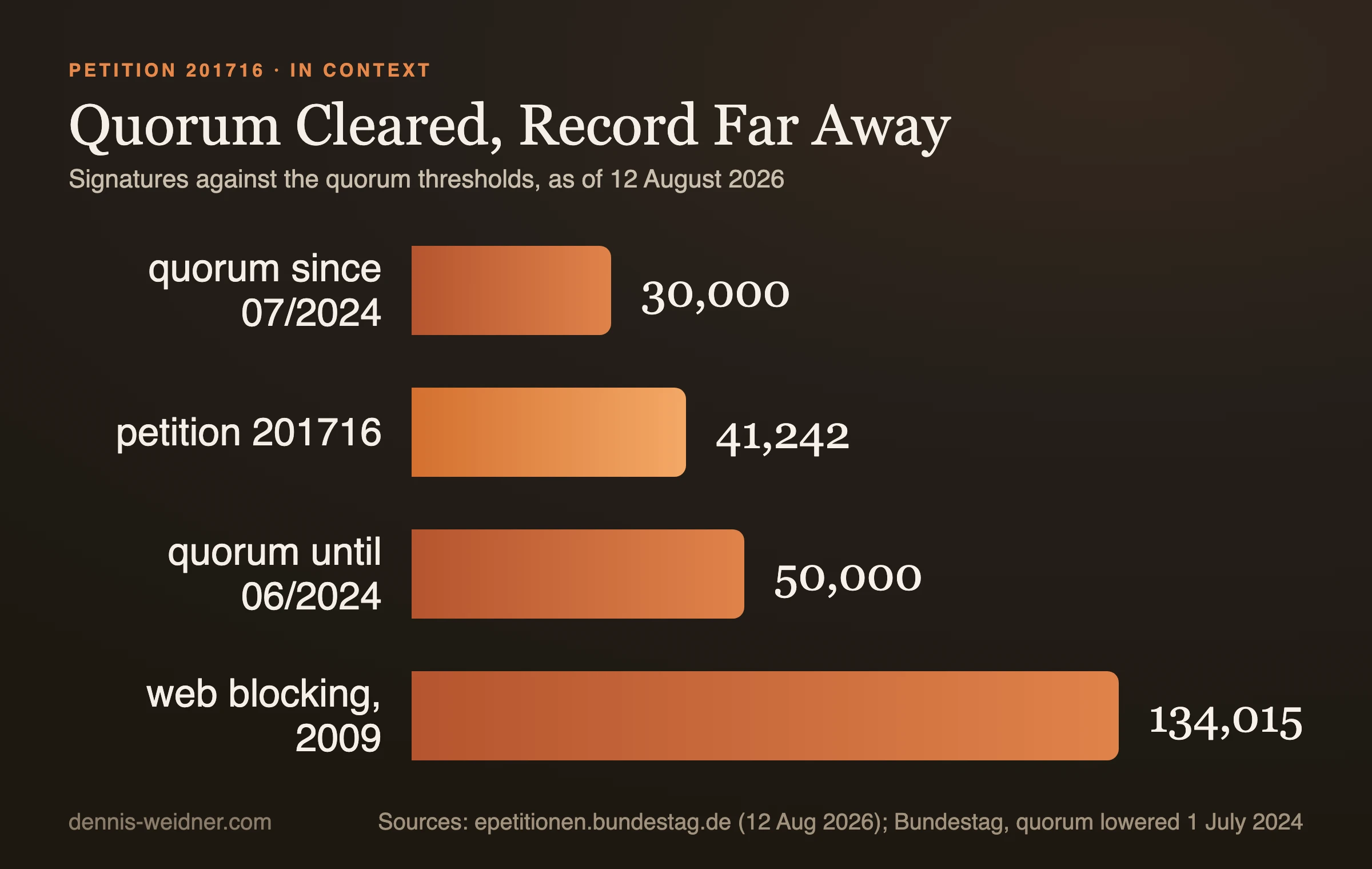
The quorum for a public hearing has stood at 30,000 signatures since 1 July 2024. Before that it was 50,000, and within four weeks. At the same time the signing period was extended from four to six weeks. The bar was lowered and the run-up lengthened.
Two things follow. First, „quorum cleared in 48 hours“ is a weaker claim than it sounds, because it is measured against a bar that did not exist in that form two years ago. Second, the 41,242 signatures of 12 August would have missed the old threshold of 50,000, and the final count of 44,439 is below it as well.
For scale, the record: the 2009 petition against web blocking gathered 134,015 signatures, more than three times as many. Anyone selling the current figure as a landslide is overselling.
None of this argues against the petition, only for weighting it correctly.
What the Petitions Committee can actually recommend
After a public hearing comes a recommendation. The procedural rules provide a graded scale, and the gap between the top and the bottom of it is considerable.
Where a petition is referred, the federal government normally has six weeks to respond. Source: Rules of the Bundestag Petitions Committee on handling requests and complaints, no. 7.14.
The decisive column is the third one. None of these decisions is legally binding. Parliament can refer a petition to the government with the highest possible vote, and six weeks later the government can respond, in substance, that it sees things differently.
This is where expectation and reality part company. A petition is not a veto but a procedure that generates publicity and pressure to justify.
When a petition becomes law: the maternity protection case
That it can work is documented, and by a recent case.
Natascha Sagorski filed a public petition in the summer of 2022. Her case: women who suffer a miscarriage should be entitled to statutory maternity protection, which they were not under the law as it stood. In November 2024 the Petitions Committee referred the petition to the federal government unanimously, with the highest vote, „for consideration“. On 30 January 2025 the Bundestag adopted staggered maternity protection periods after a miscarriage from the 13th week of pregnancy.
From filing to statute: about two and a half years.
Two things helped, and both transfer. The cause was ultimately uncontested across party lines, so no group had anything to lose. And it had a face: one person who told the story for years, rather than a number under a form.
When a petition arrives too late: the web blocking case
The second case is the uncomfortable one, and for the present situation it is the more instructive.
On 22 April 2009 Franziska Heine filed a petition against Germany's planned internet blocking law. By the end of June it carried 134,015 signatures, the largest Bundestag petition up to that point.
Parliament passed the law anyway, in June 2009. The public hearing in the Petitions Committee took place on 22 February 2010, several months after adoption. The law was never applied and was repealed at the end of 2011.
Three times the signatures did not stop the law. What the petition produced was a political price. The subject became expensive enough that the statute was scrapped two years later. Petitions rarely act as a brake inside a running procedure, mostly as a cost afterwards, and not at all if the hearing comes too late.
What this means for the crypto holding period: a timing conflict
That pattern is at risk of repeating. The signing period runs until 15 September 2026. First reading in the Bundestag is scheduled for 7 to 11 September. No date has been set for the public hearing in the Petitions Committee.
In the unfavourable case, parliament debates the subject at first reading while the petition is still collecting signatures, and the committee gets to it some time afterwards. That is the 2009 constellation with different dates on it.
Addendum of 13 September 2026: that first reading did not take place. In the sitting week of 8 to 11 September the Bundestag debated the 2027 budget, and no bill on the taxation of crypto-assets was on the agenda. Whether the Petitions Committee holds its hearing before or after such a bill decides whether the petition can still influence the procedure.
Addendum of 18 September 2026: The signing period closed on 15 September with 44,439 online signatures. Up to that point no bill on the taxation of crypto-assets had been introduced in the Bundestag. The petition therefore reaches the Petitions Committee ahead of such a bill rather than after it, as in 2009, and that sequence is what gives it weight.
One further point matters and gets lost in the noise: the petition asks for the holding period to be preserved. It says nothing about grandfathering. It demands that the one-year period stays and that crypto-assets remain „other assets“ under section 23 of the Income Tax Act. What happens to purchases already made, should the period fall anyway, is not addressed in its text.
That is not a criticism of the petitioners. A petition needs one cause, not five. But it is the gap into which an individual voice fits without contradicting the petition.
What achieves more than a signature
Four things, in this order.
First: keep following the procedure. Signing closed with 44,439 signatures. On the petition page you can subscribe to every change in the petition's status, so you will know when the committee sets a date for the public hearing. The session is broadcast.
Second: write to your own constituency member. That works differently from a signature because it is attributable. On 7 July I wrote to several members of parliament, without much expectation. One replied, a member of the Finance Committee, in full sentences and with arguments. A signature is anonymous; a letter has a sender and an address in the constituency.
Third: keep an eye on the consultation of associations. It only comes after a ministerial draft from the Finance Ministry. That draft was expected for the end of August; as of 13 September none had been published on bundesfinanzministerium.de. That is where submissions go on the record, and where it is decided whether the cut-off date sits in the past or on the date of promulgation. That is the real point of influence, and it has not been used up.
Fourth: stay factual, especially now. Parts of this debate are being conducted with figures nobody substantiates. Anyone who wants to be taken seriously in a committee room or an MP's office should not adopt the same methods. The text of petition 201716 gets this right, incidentally: it argues from legitimate expectations, locational competition and administrative burden, not from returns.
We track how the procedure develops on CryptoTicker. And if you work on this in politics, in advisory work or as a founder in the crypto space: I am happy to talk, and I share the underlying data openly.
This article is a personal assessment of the petition procedure, not legal or tax advice. Every procedural status is dated.
Frequently Asked Questions
Does a Bundestag petition actually achieve anything?
It buys a hearing, not a decision. If the quorum of 30,000 signatures is met, the Petitions Committee can hold a public hearing, the petitioners may attend and the responsible ministry has to state its position. It does not suspend an ongoing legislative procedure, and none of the possible recommendations is legally binding.
How many signatures does petition 201716 have?
When the signing period closed on 15 September 2026, the petition had 44,439 online signatures. The quorum of 30,000 had been met since 5 August 2026, and on 12 August the count was 41,242. Since then the petition has been listed on the Bundestag platform as under review.
What happens next with petition 201716?
The petition is listed on the Bundestag platform as under review. Because the quorum was met, the Petitions Committee can hold a public hearing on it; as of 18 September 2026 the petition page gives no date yet. After the hearing the committee issues a recommendation, on which the Bundestag votes.
What is the quorum for a public hearing?
Since 1 July 2024 it has been 30,000 signatures; before that it was 50,000 within four weeks. At the same time the signing period was extended from four to six weeks. A quorum met today is therefore not comparable with one met before 2024.
How many petitions actually reach the quorum?
In 2025 the Petitions Committee received 12,399 petitions, 652 were published online, and ten of those passed 30,000 signatures. That is 0.08 per cent of all petitions and 1.5 per cent of the published ones. Four public sessions were held in the whole year.
Has a petition ever turned into a law?
Yes. Natascha Sagorski filed a petition on maternity protection after miscarriage in 2022. In November 2024 the Petitions Committee referred it unanimously to the federal government with the highest vote, and on 30 January 2025 the Bundestag adopted staggered maternity protection periods from the 13th week of pregnancy. From filing to statute took about two and a half years.
Has a petition ever stopped a law?
Directly, hardly ever. The 2009 petition against internet blocking set a record with 134,015 signatures, parliament passed the law regardless, and the public hearing only took place in February 2010, after adoption. The law was never applied and was repealed at the end of 2011. Petitions tend to work as a political price afterwards rather than as a brake during the procedure.
What decisions can the Petitions Committee take?
Graded from strong to weak: for consideration, for review, as material, simple referral, notice to the parliamentary groups, or closing the file. Where a petition is referred, the federal government normally has six weeks to respond. None of these recommendations is legally binding.
Can anyone tell that I hold Bitcoin because I signed?
No. Registration on the Bundestag platform requires truthful details, but neither name nor address nor email address nor telephone number is published. At most a self-chosen pseudonym appears in the petition forum. A signature does not reveal whether, or how much, crypto someone holds.
Can I still sign petition 201716?
No, the signing period closed on 15 September 2026. The right of petition under Article 17 of the German Basic Law applies to everyone, however, without German citizenship or residence in Germany. Anyone with a concern of their own can file a petition with the Bundestag at any time after a one-off free registration on epetitionen.bundestag.de.
Warm regards,
Dennis Weidner
Note: AI tools supported me in writing this article, and some images were edited with AI. I stand behind its content and every statement with my name.