Companies that acquire machinery, vehicles or equipment in Germany by December 31, 2027 may depreciate them on a declining-balance basis at up to 30 percent a year instead of straight-line. That first brings liquidity, because tax becomes due later. Because corporate income tax falls step by step from 2028, the deferral also turns into a real advantage for a GmbH: in the worked example below, just over 1,700 euros per 100,000 euros invested.
As of September 11, 2026. Not tax advice, see the note at the end.
More on this topic: Finance & Crypto Assets, with background, practice and every article in one place.
What Declining-Balance Depreciation Is and What Germany's Investment Program Changed
Under straight-line depreciation, a company spreads the acquisition cost evenly over the useful life. Under declining-balance depreciation, a fixed percentage of the remaining book value is deducted each year, so a lot at the start and little later on. Germany's Act on an Immediate Tax Investment Program of July 2025 (Federal Law Gazette 2025 I No. 161) reintroduced declining-balance depreciation for movable assets: up to three times the straight-line rate, capped at 30 percent (Section 7 (2) EStG). In the political debate, the package is called the investment booster.
Requirements for Declining-Balance Depreciation From 2025 to 2027
- Movable fixed assets: machinery, vehicles, operating and office equipment. Buildings and intangible assets are excluded.
- Acquired or produced after June 30, 2025 and before January 1, 2028. What counts is delivery, meaning the transfer of economic ownership, not the order.
- Rate: at most three times the straight-line rate and at most 30 percent. With a ten-year useful life that is 30 percent. With five years it is also 30 percent, because three times 20 percent exceeds the cap.
- Pro rata in the year of acquisition: anyone buying in October deducts only three twelfths in the first year.
- Switching to straight-line is permitted (Section 7 (3) EStG) and pays off as soon as the straight-line amount on the remaining value exceeds the declining-balance amount. There is no way back.
Special Depreciation for Electric Cars: 75 Percent in the First Year
For newly acquired, fully electric vehicles held as business assets, the same act contains its own, even steeper rule: 75 percent of the acquisition cost in the year of acquisition, followed by 10, 5, 5, 3 and 2 percent. It also applies to acquisitions after June 30, 2025 and before January 1, 2028. In addition, the price cap up to which an electric company car is taxed on only a quarter of its list price has been 100,000 euros instead of 70,000 euros since then.
Worked Example: a 100,000 Euro Machine, Straight-Line or Declining-Balance
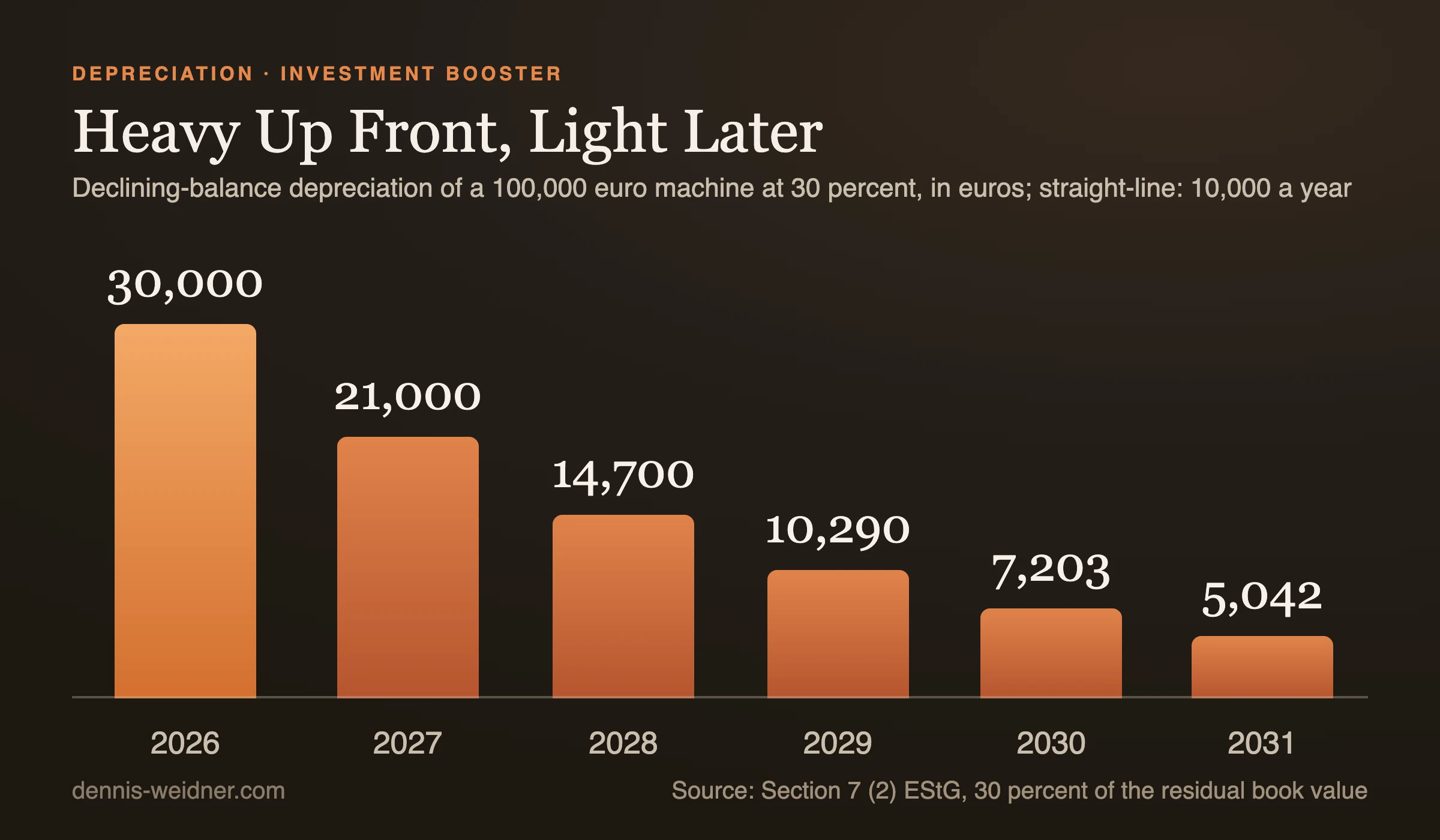
Assumptions: GmbH, acquisition in January 2026, useful life of ten years, trade tax multiplier of 400 percent (14 percent trade tax), sufficient profit in every year. The combined rate of corporate income tax, solidarity surcharge and trade tax is 29.825 percent in 2026 and 2027 and then falls with corporate income tax: 28.77 percent (2028), 27.715 percent (2029), 26.66 percent (2030), 25.605 percent (2031) and 24.55 percent from 2032. The declining-balance variant switches to straight-line in 2033, because the straight-line amount is higher by then.
| Year | CIT rate | Straight-line | Declining-balance | Tax saved, straight-line | Tax saved, declining-balance |
|---|---|---|---|---|---|
| 2026 | 15% | €10,000.00 | €30,000.00 | €2,982.50 | €8,947.50 |
| 2027 | 15% | €10,000.00 | €21,000.00 | €2,982.50 | €6,263.25 |
| 2028 | 14% | €10,000.00 | €14,700.00 | €2,877.00 | €4,229.19 |
| 2029 | 13% | €10,000.00 | €10,290.00 | €2,771.50 | €2,851.87 |
| 2030 | 12% | €10,000.00 | €7,203.00 | €2,666.00 | €1,920.32 |
| 2031 | 11% | €10,000.00 | €5,042.10 | €2,560.50 | €1,291.03 |
| 2032 to 2035 | 10% | €40,000.00 | €11,764.90 | €9,820.00 | €2,888.28 |
| Total | €100,000.00 | €100,000.00 | €26,660.00 | €28,391.44 |
The table contains two effects. First, liquidity: in the first two years the GmbH pays just over 9,200 euros less tax than under straight-line depreciation. Second, a real advantage: because the high deductions fall into years with 15 percent corporate income tax and the low ones into years with 10 percent, the declining-balance variant saves 1,731.44 euros more over the full term. Without the tax cut, both columns would add up to the same total, and declining-balance depreciation would only have an interest advantage.
Declining-Balance Depreciation for Sole Proprietors and Partnerships
Declining-balance depreciation also applies to sole proprietors and partnerships. The extra advantage from the falling corporate tax rate does not apply there, because the personal income tax rate counts. Anyone expecting high profits in 2026 and 2027 and lower ones afterwards still benefits, because progression bites harder on high profits. If you are thinking about bundling stakes and investments in a corporation, the calculation is in Holding Company in Germany.
What Business Owners Should Plan Before the End of 2027
- Bring forward investments that are coming anyway. What matters is delivery by December 31, 2027. An order in December with delivery in January 2028 falls outside.
- Leave out computers and software. Since the Federal Ministry of Finance letter of February 22, 2022, they have a useful life of one year anyway, so declining-balance depreciation adds nothing there.
- Deduct small purchases immediately. Low-value assets up to 800 euros net can be written off in full in the year of acquisition (Section 6 (2) EStG).
- Factor in grants. Investment grants can reduce the acquisition cost and thus the depreciation base. Which programs exist for young companies is covered in Funding Programs for Founders.
More finance topics for entrepreneurs are collected under Crypto and Finance.
Frequently Asked Questions
Until when does the 30 percent declining-balance depreciation apply?
For movable assets acquired or produced after June 30, 2025 and before January 1, 2028. What counts is delivery, not the order.
Which assets qualify for declining-balance depreciation?
Movable fixed assets such as machinery, vehicles and operating equipment. Buildings and intangible assets such as licenses are excluded.
Can I switch from declining-balance to straight-line depreciation?
Yes, Section 7 (3) EStG permits the switch, and it pays off as soon as straight-line depreciation on the remaining value is higher. Switching back to declining-balance is not allowed.
How are electric cars depreciated since July 2025?
Newly acquired, fully electric vehicles held as business assets can be depreciated by 75 percent in the first year, followed by 10, 5, 5, 3 and 2 percent. The rule applies to acquisitions until the end of 2027.
How far does German corporate income tax fall from 2028?
In five steps of one percentage point each: 14 percent in 2028, 13 percent in 2029, 12 percent in 2030, 11 percent in 2031 and 10 percent from 2032.
Note: This article is not tax advice. It describes the legal situation in Germany as of September 11, 2026 and deliberately simplifies: loss years, other trade tax multipliers, the interest effects of the deferral and special rules for individual industries all change the result. Before a larger investment, the planning belongs with a tax advisor. Next review of this article: October 2027, before the deadline.
Best,
Dennis Weidner
Note: AI tools supported me in writing this article, and some images were edited with AI. I stand behind its content and every statement with my name.