On 6 August 2026, roughly 911.5 million SpaceX shares became tradable in a single moment, worth about 100 billion US dollars at the market price. It was the first lockup expiry since the June listing. Anyone who skimmed the news knows the headline: shares below the offer price. What actually happened on the day is more interesting, because it contradicts the headline. And more interesting still is what this one trading session says about the valuations currently being passed around in private markets.
What actually happened that day
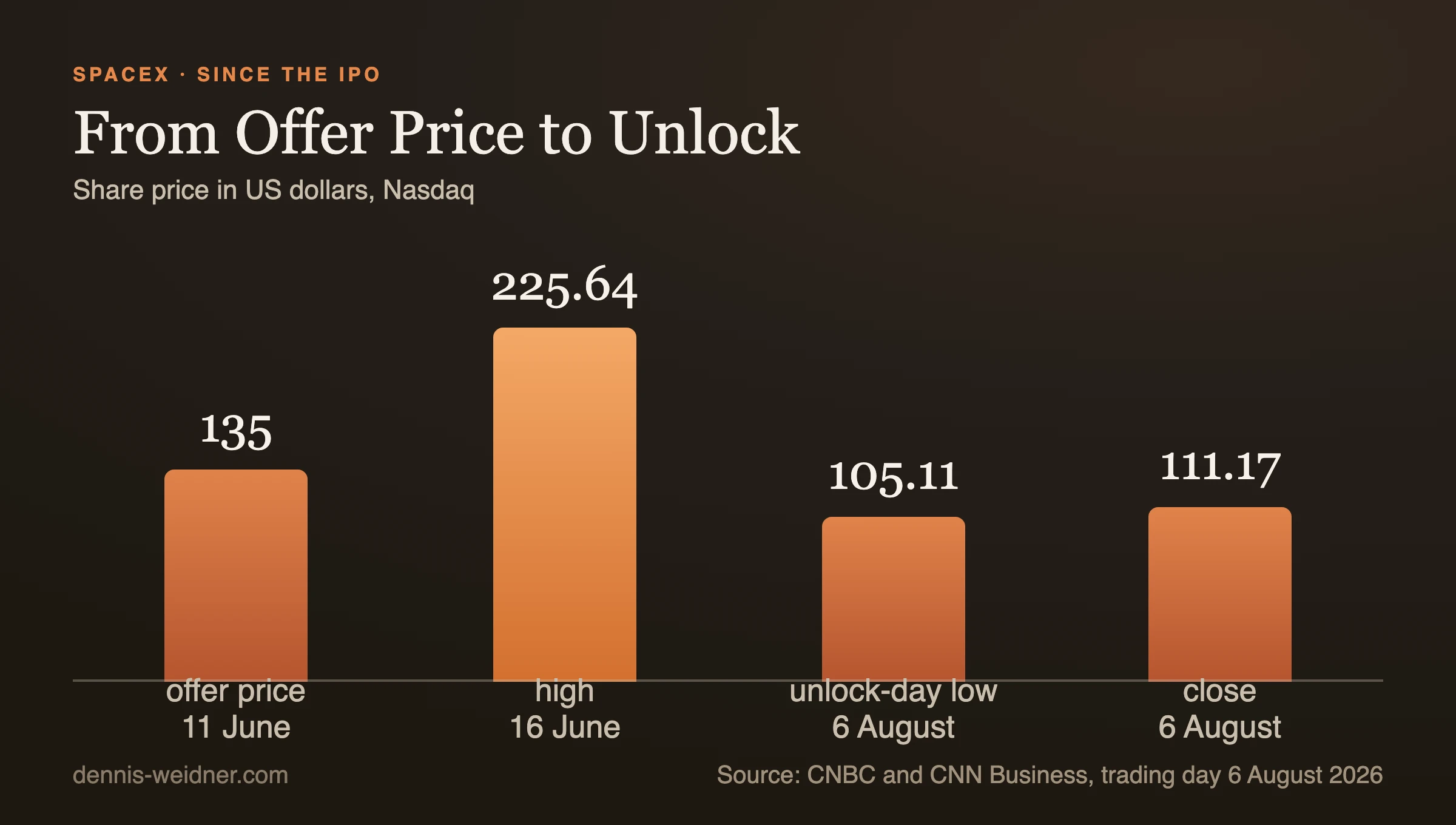
SpaceX priced its shares at 135 US dollars on 11 June 2026 and started trading the following day. After allocation, the offering raised roughly 85.7 billion US dollars. That single deal accounts for about a third of everything brought to market in the United States through the end of July 2026. It was not a listing, it was a market event in its own right.
More on this topic: Finance & Crypto Assets – background, practice and every article in one place.
On 16 June the stock reached 225.64 US dollars. From there it fell almost without interruption. Ahead of the lockup expiry it traded more than half below its June high and around 20 percent below the offer price. That is the situation into which 911.5 million shares were released.
And then the stock did the opposite of what everyone expected. It dropped to 105.11 US dollars in early trading, turned, and closed at 111.17, up 2.6 percent. The day the supply was supposed to break the price was a green day.
Why lockups exist at all
A lockup is a contractual promise from existing shareholders to the underwriting banks not to sell their holdings for a set period. Ninety to a hundred and eighty days is standard. The purpose is unglamorous: without it, the market would have to absorb new and existing shares at the same moment, and nobody would know what price that produces.
The arrangement only postpones the question, though. It does not answer it. On the day it expires, the question returns at full size: at what price do the people who were there before the listing want to sell? At SpaceX, filings with the securities regulator show up to 1.37 billion shares becoming accessible in the days following the quarterly results. The 911.5 million on 6 August were the first tranche, not the last.
Available to sell is not the same as sold
This is where the reasoning usually goes wrong, and I have read the mistake many times in recent weeks. "911 million shares become tradable" turns, in the comment sections, into "911 million shares hit the market". Those are not the same thing, and the difference is the entire point.
Tradable means a sale is permitted. Whether it happens is decided by each holder individually, mostly on the basis of what they paid. An employee whose shares come from an early round is sitting on a multiple of their entry price even at 111 US dollars. An investor from the last private round, who came in close to the public valuation, would be selling at a loss at that price. The first may well sell. The second almost certainly will not.
So the number of shares released tells you very little on its own. What would tell you something is the distribution of entry prices underneath it, and no outsider has that. What the market did on 6 August was therefore not a verdict on the company. It was a test of how many holders actually wanted out. On that day the answer was: fewer than the price had assumed.
The group that has to sell regardless
There is one group for whom that arithmetic does not hold, and coverage almost always overlooks it: employees holding shares from schemes where tax falls due not on sale but at the moment the shares vest.
Anyone in that position receives a tax bill on a value they have not yet seen as money. It is assessed against the price at vesting. If the price then falls, the proceeds shrink while the tax liability stays where it was. In that situation a sale is not an opinion about the company, it is an obligation, and it happens at whatever price is available.
That is precisely why the first session after an unlock is often the most volatile. What you see there is not what the holders believe, it is what they owe. Reading a verdict on the company out of it confuses two entirely different things.
What this says about private valuations
Now to the part that genuinely occupies me as someone who takes equity stakes, and that reaches well beyond SpaceX.
In private markets, a valuation comes into being when one investor buys a specific stake for a specific sum. From those two numbers, a value for the whole company is extrapolated. That is a useful convention, but a convention is what it is. It says: this price was paid for this one percent. It does not say: this price would be paid for all hundred percent.
A listing replaces that convention with something less comfortable. It asks, every single day, what someone is willing to pay for the next share. And a lockup expiry is the moment that question is put to every holder at once for the first time. That makes unlock day the most honest day in the life of a newly listed stock. It separates the price at which people bought from the price at which people sell.
At SpaceX that separation looks like this: a valuation that circulated in private markets above a trillion US dollars for months stands, after eight weeks of public trading, at a fraction of its June high. The company is unchanged. The rockets fly as before. The only thing that changed is how many people get a vote.
Why a holding structure sees this differently
I invest through a holding company using its own balance sheet, not out of a fund with a fixed life. That sounds like an accounting footnote, but it changes the view of this particular day completely.
A fund has a date by which it has to deliver. When that date approaches and the price sits where it sits, the problem has a calendar entry. A holding company has no such entry. I can hold a stake because the business works rather than sell because a schedule demands it. That is not a virtue, it is a structural choice, and it has a cost too: anyone who never has to deliver examines themselves less rigorously.
For my own work, 6 August boils down to two sentences. First, a valuation on paper is yesterday's offer, not today's price. Second, if I can only hold a stake as long as nobody asks what it is really worth, I do not own an investment, I own a hope. Both sound obvious. Both are reliably forgotten in a boom, and I do not exempt myself from that.
What to watch next
The 6 August tranche was the first. Filings indicate more will follow, and the market will ask the same question several times over. Anyone following it should watch two things rather than the headline.
First, volume rather than price. A decline on thin volume means something different from a flat session on very heavy volume. In the second case large holdings change hands without the price giving way, and that is a stronger signal than any percentage figure.
Second, who is selling. Sales by executives and larger shareholders are reported to the securities regulator. Those filings are duller to read than any market commentary and considerably more informative.
And for the wider picture: why the record issuance year of 2026 is still not an open window for many companies is covered in 251 Billion and Still Pulling Out. Why I regard valuations as the least reliable number in any funding round runs through my look back at the crypto market, in Crypto 2026: What Really Remains After the Euphoria.
Frequently Asked Questions
What is a lockup period?
A contractual promise by existing shareholders to the underwriting banks not to sell their holdings for a set period after the listing, typically 90 to 180 days. Without it, the market would have to absorb new and existing shares simultaneously.
How many SpaceX shares were released on 6 August 2026?
Around 911.5 million shares, worth roughly 100 billion US dollars at the market price. Filings with the US securities regulator indicate up to 1.37 billion shares may become accessible in the days following the quarterly results.
Did the share price fall on unlock day?
No. The stock dropped to 105.11 US dollars in early trading, turned, and closed at 111.17, up 2.6 percent. The decline had already happened in the preceding weeks: ahead of the unlock the stock traded more than half below its June high of 225.64 US dollars and around 20 percent below the 135 dollar offer price.
Why does a stock not automatically fall when a lockup expires?
Because being tradable and being sold are two different things. Whether a holder sells depends largely on their entry price. Anyone from an early round remains in profit even after a decline; anyone who entered near the public valuation would be selling at a loss.
What does the episode say about private valuations?
A private valuation is created when one investor pays a price for a small stake, which is then extrapolated across the whole company. A lockup expiry asks every holder at once, for the first time, at what price they would sell. The two numbers can be far apart.
This text is a personal assessment, not investment advice. It contains no recommendation to buy or sell any particular security.
Warm regards,
Dennis Weidner
Note: AI tools supported me in writing this article, and some images were edited with AI. I stand behind its content and every statement with my name.