Around 40,000 European companies dropped out of a reporting duty in February that they had spent three years preparing for. Anyone concluding that sustainability data is therefore settled has skipped the least conspicuous paragraph of the reform. It is called the value chain cap, and it turns an obligation for the few into a standard for the many.
What the Omnibus actually decided
The European Parliament approved the agreement in December 2025 and the Council finally adopted the act on 24 February 2026. On 26 February it appeared in the Official Journal as Directive (EU) 2026/470 and entered into force on 18 March 2026. Member states have until 19 March 2027 to transpose it.
More on this topic: Finance & Crypto Assets, with background, practice and every article in one place.
Two numbers sit at the centre. Only companies with more than 1,000 employees and more than 450 million euros in net turnover remain subject to CSRD reporting. Both criteria have to be met together. Parliament originally wanted a threshold of 1,750 employees, the Council 1,000, and the Council prevailed.
For the supply chain directive CSDDD the threshold is more than 5,000 employees and more than 1.5 billion euros in turnover, with a transposition deadline of 26 July 2029.
On top come simplifications that made fewer headlines: streamlined reporting standards within six months, around 70 percent fewer data points under the taxonomy, and a ten percent materiality threshold.
Back where it started
How far the reform goes back only shows once you put three numbers side by side.
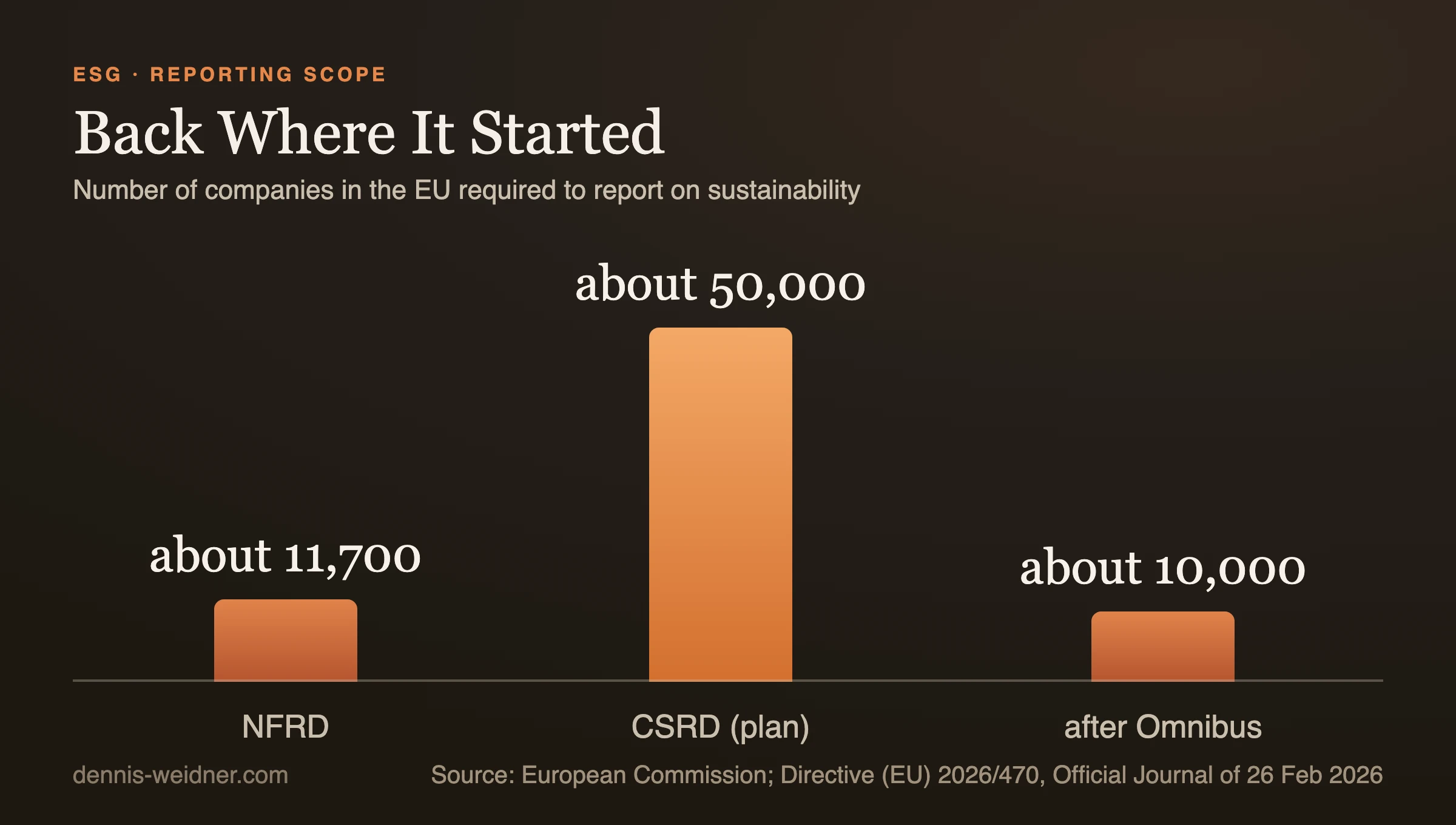
Under the previous reporting directive, the NFRD, around 11,700 companies were in scope across Europe. The CSRD was meant to lift that to roughly 50,000. After the Omnibus the European Commission expects a reduction of around 80 percent, and other estimates go as high as 90 percent. Depending on the calculation, somewhere between 8,000 and 10,000 companies remain.
Europe therefore lands roughly where it started in 2014. Three years of preparation, software purchases, hiring and consulting contracts sit in between. For Germany the original estimate was around 13,000 affected companies; under the new thresholds industry estimates put the remainder well below one thousand.
The value chain cap is the actual news
Now the paragraph missing from almost every summary. The Omnibus explicitly protects smaller companies from being pulled back into scope through the supply chain. From business partners with up to 1,000 employees, reporting companies may in principle no longer demand information going beyond the scope of the voluntary SME standard.
That voluntary standard is called VSME and EFRAG is currently developing it into the Voluntary Standard. It is therefore no longer merely an offer. It is a ceiling. And a ceiling everyone aligns to is, in practice, the same thing as a standard.
A similar logic applies to the CSDDD: risk assessments have to be based on publicly available data, direct supplier enquiries are limited to identified risk areas, and additional protections apply to suppliers below 5,000 employees.
Why demand persists anyway
The reporting duty is only one of four reasons anyone asks for sustainability data. The other three are untouched by the Omnibus.
Banks. Credit institutions need the data for their own disclosures and their risk models. They ask not because their customer is in scope, but because they are.
Large customers. A carmaker with 1,500 suppliers stays in scope and needs data from the chain. The cap limits what it may demand, not whether it asks.
Tenders. Public buyers and corporate procurement have sustainability criteria in their award processes. Those criteria do not disappear because a directive narrows its scope.
The result is a rather precise market shift: fewer very laborious reports, and far more lean data sets. Five hundred thick reports become ten thousand thin ones.
Where this becomes a business
Software for the small data set. The existing ESG software market is built for the big reports, with pricing and implementation projects to match. A tool that lets a 200 person company assemble its VSME data set in two days and deliver it to five customers is a different product in a different price bracket. That bracket has just come into existence.
The data set as a product. More interesting than the report is the delivery. Providing an audited set of figures once a year that customers can take over directly saves work on both sides. That is a subscription, not a project.
And the place I work on myself: the data source. A substantial part of a VSME data set consists of consumption figures and the emissions derived from them. Those values do not live in accounting. They live with the utility, in the meter and in the contracts. Anyone already holding that data in structured form, because they want to make offers comparable, delivers half of the reporting as a by-product. That is exactly why I am building a comparison platform for the entire energy world, from solar through storage and heat pumps to the circular economy, in which every figure has a source. The technical side of it is in my overview of battery storage and energy systems.
Advisory work, but lean. The classic audit and consulting market loses mandates here. What emerges is something different: standardised, affordable support for companies that owe no report but still have to answer.
How to get in
The mistake would be to found an ESG consultancy now. The market for explanation is saturated. The market for getting it done is not.
The question I would ask is: which number in this data set do I already hold? Anyone managing energy contracts holds consumption. Anyone running fleets holds kilometres. Anyone handling waste holds tonnages. Each of those positions becomes a metric, and the distance from your own database to a finished field in the standard is short.
The second route is the channel. Tax advisors, house banks and trade associations sit with the same mid-sized companies now receiving tens of thousands of data requests. They have the relationship and no product. That is a partnership, not customer acquisition.
And Germany?
One point worth knowing when planning: Germany has still not transposed the CSRD. The government bill dates from 3 September 2025, the coalition parties tabled an amendment on 31 March 2026 to align it with the new European rules, and the public hearing in the legal affairs committee took place on 13 April 2026. Completion was targeted for the summer months. By early August 2026 the act had not been promulgated.
In practice that means companies reporting voluntarily under the European standards in Germany today do so without a national legal basis, while those who wait still have the old commercial code provisions behind them. Both are unsatisfying, and both are a good reason to follow actual customer demand rather than the legislative calendar.
How regulation creates new markets
Reforms like this follow a reliable pattern. A rule appears, it creates a task, and between rule and task a market appears. With the GDPR it was consent banners and privacy software. With the EU AI Act it is documentation and classification, see The EU AI Act from August 2026. And with the new German retirement account it is subsidy administration, see Germany's New Retirement Account.
What makes the Omnibus unusual is that the market emerges not from a new obligation but from its withdrawal. That is rare and instructive: demand for data does not disappear when the duty does. It only changes sender.
Frequently Asked Questions
Who still has to produce a sustainability report after the Omnibus?
Only companies with more than 1,000 employees and more than 450 million euros in net turnover. Both criteria have to be met together. The basis is Directive (EU) 2026/470, published on 26 February 2026 and in force since 18 March 2026.
How many companies fall out of the CSRD?
The European Commission expects around 80 percent fewer companies in scope, with some estimates reaching 90 percent. Of the originally planned 50,000 companies, roughly 8,000 to 10,000 remain, about as many as under the predecessor directive NFRD.
What is the value chain cap?
A protective rule: companies in scope may in principle no longer demand information from business partners with up to 1,000 employees that goes beyond the voluntary SME standard. That standard therefore becomes the effective ceiling for data requests along the supply chain.
What is the VSME standard?
A voluntary reporting standard developed by EFRAG for small and medium-sized companies. It is currently being extended into the so-called Voluntary Standard and serves as a common framework for data requests from banks, customers and investors.
Does the CSRD already apply in Germany?
No. The government bill for the implementing act dates from 3 September 2025 and the hearing in the legal affairs committee took place on 13 April 2026. By early August 2026 the act had not been promulgated. The transposition deadline for the Omnibus changes runs until 19 March 2027.
Warm regards,
Dennis Weidner
Note: AI tools supported me in writing this article, and some images were edited with AI. I stand behind its content and every statement with my name.