Crypto ETFs that pay out staking rewards sound like the best of both worlds: upside from the asset plus a running yield, wrapped in a boring, regulated exchange-traded product. Since late 2025 these products actually exist in the US, and in Europe they have been around longer than most people realize. Still, the story is messier than the marketing. Here is what actually works in 2026, what you can buy from Germany and the EU, and where the numbers differ from the brochure.
How staking made it into ETFs
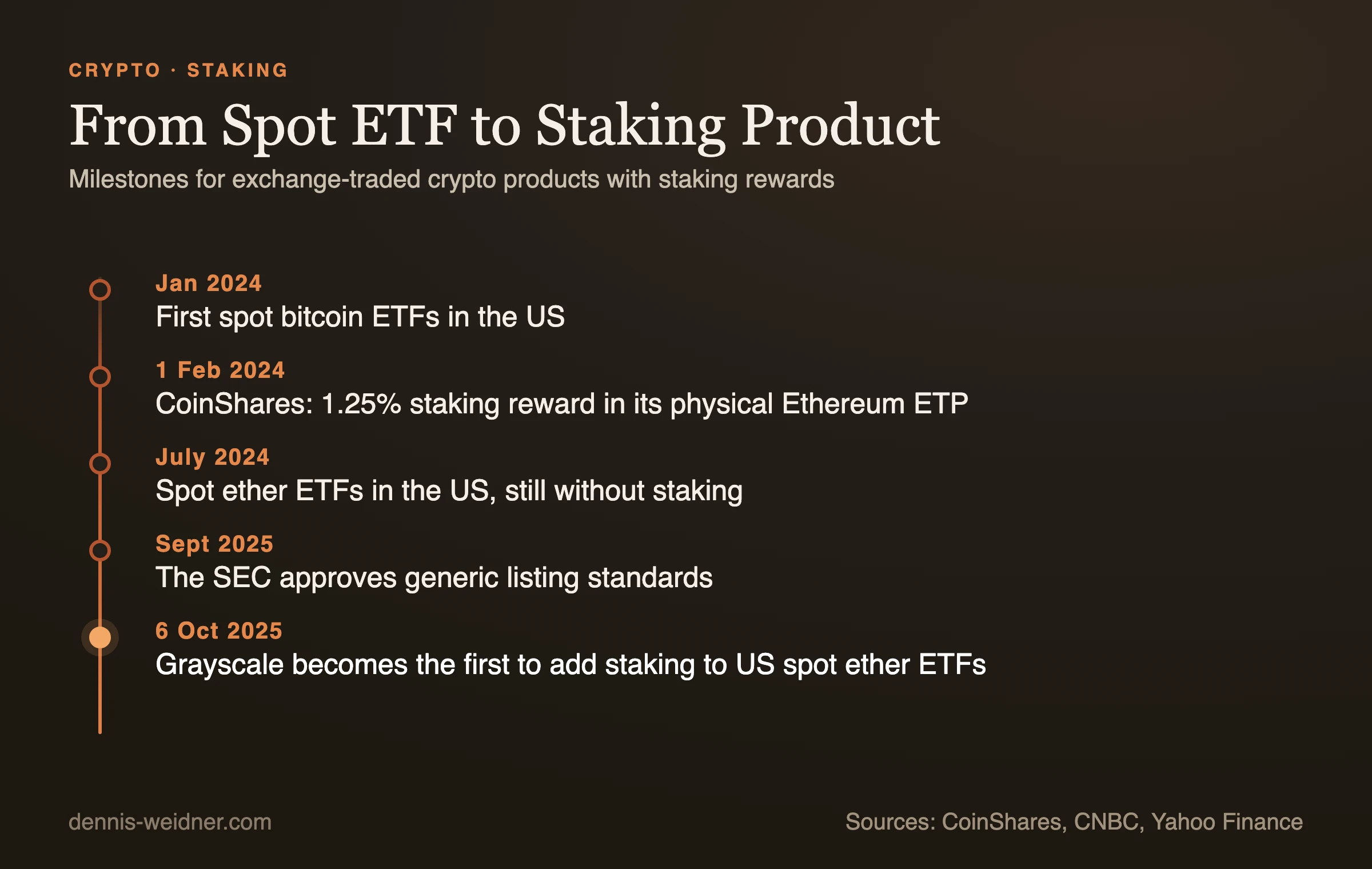
A quick timeline, because order matters. US spot Bitcoin ETFs launched in January 2024, spot Ethereum ETFs followed in July 2024, both without any yield component. For a long time the SEC wanted nothing to do with staking inside an exchange-traded product. That changed through 2025. In September 2025 the SEC approved generic listing standards for crypto ETFs, which according to CNBC cut the approval process from more than 240 days to roughly 75. That broke the dam.
More on this topic: Finance & Crypto Assets, with background, practice and every article in one place.
Grayscale set the first milestone: in October 2025 it became the first issuer to activate staking in its US-listed Ethereum products, as reported by Yahoo Finance among others. At the end of October 2025 the first US spot Solana ETFs went live with staking built in from day one, and other large issuers have filed staking amendments for their Ethereum funds. In the US, staking is moving from exception to standard feature for proof-of-stake ETFs.
Why a Bitcoin ETF will never pay staking rewards
A point that sales pitches like to blur: Bitcoin cannot be staked. Bitcoin runs on proof of work, its security comes from miners and their computing power, not from locked-up coins. There is no protocol yield an ETF could pass through. So if someone offers you a Bitcoin product with a "staking yield", it is not staking. It is some form of lending arrangement or a derivative, with very different risks. Staking rewards in the strict sense only exist on proof-of-stake networks like Ethereum or Solana. This is not pedantry, it decides what risk you actually hold.
What you can actually buy in Germany and the EU
The question I get most often: can I buy those US ETFs from here? As an EU retail investor, practically no, the funds lack the investor documents required for distribution in Europe. A true crypto ETF under European rules does not exist either, since UCITS regulation requires diversification and a single-asset fund does not qualify. What you get instead are ETNs, also called ETPs, collateralized debt securities that trade on an exchange just like an ETF. justETF explains the structure well.
Europe got to staking years before the US. The 21Shares Ethereum Staking ETP has existed since 2019, and CoinShares added a 1.25 percent annual staking reward to its zero-fee physical Ethereum product in February 2024, per the company's own announcement. There are also low-cost options like the 21Shares Ethereum Core Staking ETP with a 0.10 percent fee, all tradable on European exchanges through a normal broker. Whoever celebrates 2026 as the year "crypto with yield finally arrives in a brokerage account" is ignoring years of European product history.
The math: what actually reaches you
On paper, Ethereum staking currently yields roughly three percent per year. Inside a wrapped product, considerably less reaches the investor, for three reasons. First, the issuer keeps a share of the rewards, and the split is in the fine print. Second, a product rarely stakes its entire holdings, because it needs a liquidity buffer for redemptions, and staked coins cannot be unlocked at the push of a button. Third, on expensive products the management fee eats part of the yield right away. Net of everything, many products land closer to one or two percent than three.
That is not a scandal, but it is not interest on a savings account either. It is a protocol reward with full market risk on top. If Ethereum drops twenty percent in a year, the staking yield will not console you. So compare products by the net rate after all fees and by what share of the holdings is actually staked, not by the advertised gross yield.
Taxes: the wrapper is not neutral
For German taxpayers, direct ownership is surprisingly attractive. Hold coins yourself and gains are tax free after a one-year holding period, and the current guidance from the German Federal Ministry of Finance, the BMF letter of March 6, 2025, makes clear that staking does not extend that period to ten years. I took the details apart in my article on the crypto holding period in 2026.
For ETNs, the treatment depends on the structure. Physically backed products with a right to delivery of the underlying coins are, under the prevailing reading, treated like direct ownership, analogous to the German precedent on physical gold notes, so gains become tax free after one year. Bitwise explains this for the German market. Without a delivery right, the flat capital gains tax applies regardless of holding period. The highest German tax court has not conclusively ruled on crypto ETNs yet, so every wrapper carries residual tax uncertainty. If you are comfortable with self-custody, you often have the better tax position. If not, you pay a price for the convenience of the wrapper, and you should know it before you buy.
Risks that live in the prospectus, not the marketing
Three things belong on your list. First, slashing: if a validator misbehaves or fails, the protocol can confiscate part of the staked coins, and depending on the product terms, investors share that loss. Second, custody: an ETN is legally a debt security of the issuer, collateralized, but not a segregated fund like a classic UCITS vehicle. Third, staking liquidity: Ethereum has entry and exit queues, and in stressed markets that can slow down redemptions. None of this is reason to panic, but all of it belongs in the assessment.
I have been working in this market since 2017, among other things through our portal CryptoTicker, and my verdict for 2026 is unspectacular: staking ETPs are real progress for anyone who wants crypto sitting in a normal brokerage account next to ETFs and stocks. But they are not a fixed-income product, and no substitute for understanding the mechanics underneath. This is my personal perspective and explicitly not investment advice, so check any product and your tax situation for yourself. The bigger picture of how I think about crypto in long-term wealth building is on my page about crypto and finance.
Frequently asked questions
Can I buy a crypto ETF with staking in Germany or the EU?
Not as a true ETF, because UCITS funds cannot track a single asset. What you can buy are exchange-traded ETNs or ETPs with a staking component, for example on Ethereum from issuers like 21Shares or CoinShares, through normal European brokers.
Why is there no Bitcoin staking ETF?
Because Bitcoin runs on proof of work and has no staking mechanism. Products promising a running yield on Bitcoin rely on lending or derivatives, which carry different risks than a protocol-level staking reward.
How much staking yield does an ETP actually pass on?
Noticeably less than the network's gross yield. Issuers keep a share of the rewards, usually not all holdings are staked, and the product fee comes off as well. Many products net out closer to one or two percent per year.
How are crypto ETNs taxed in Germany?
Physically backed ETNs with a delivery right are, under the prevailing view, treated like direct ownership, so gains are tax free after a one-year holding period. Without a delivery right, the flat capital gains tax applies. The highest German tax court has not conclusively settled the question.
Warmly,
Dennis Weidner
Note: AI tools supported me in writing this article, and some images were edited with AI. I stand behind its content and every statement with my name.