If you sell a stake in a company through a German holding GmbH, the tax on the gain is roughly 1.5 percent. Selling from private assets at the top rate costs roughly 28.5 percent. The gap is not a gift, though: as soon as the money leaves the holding, the flat withholding tax takes almost all of it back. A holding therefore pays off for founders who reinvest their profits, and hardly for anyone else.
As of September 11, 2026. Not tax advice, see the note at the end.
More on this topic: Finance & Crypto Assets – background, practice and every article in one place.
What a Holding Company Is and Why Founders in Germany Set One Up
A holding GmbH is a corporation that runs no operating business of its own but holds shares in other companies. The founder owns the holding, the holding owns the operating GmbH. Anyone building several companies in parallel faces the question early, because every new stake, every sale and every dividend flows through this structure. What that looks like day to day is described in How I Build Several Companies at Once.
The reason for the structure sits in a single section of German law: Section 8b of the Corporate Income Tax Act (KStG). It largely exempts profits that one corporation earns from its stakes in other corporations.
Holding Company Tax: How the 95 Percent Exemption Under Section 8b KStG Works
When the holding sells shares in a GmbH, the gain is exempt under Section 8b (2) KStG. Five percent of it, however, is treated as a non-deductible business expense (Section 8b (3) KStG). Only 5 percent of the gain is taxed, at a combined rate of roughly 30 percent for corporate income tax, solidarity surcharge and trade tax. The effective burden is therefore about 1.5 percent, regardless of the size of the stake.
Ongoing dividends from the subsidiary to the holding follow the same principle, but with two thresholds. For corporate income tax, the holding must own at least 10 percent at the start of the calendar year (Section 8b (4) KStG), otherwise the dividend is fully taxable. For trade tax, it needs at least 15 percent at the start of the assessment period, the so-called participation exemption under Section 9 No. 2a GewStG. Holding 100 percent of the operating company through the holding meets both.
Selling From Private Assets: the Partial Income Method
If the founder holds the GmbH shares directly and owns at least 1 percent, a capital gain is taxable under Section 17 of the Income Tax Act (EStG). Under the partial income method (Section 3 No. 40 EStG), 60 percent of the gain is taxed at the personal rate. At the top rate of 45 percent plus solidarity surcharge, that comes to roughly 28.5 percent of the entire gain.
Worked Example: an Exit With a One Million Euro Gain, Private or Through the Holding
The table calculates a capital gain of 1,000,000 euros. Assumptions: top income tax rate of 45 percent, solidarity surcharge of 5.5 percent, trade tax multiplier of 400 percent, no church tax, and the shares have sat in the holding since formation, so no lock-up period applies.
| Item | Held privately | Through the holding |
|---|---|---|
| Capital gain | €1,000,000.00 | €1,000,000.00 |
| Taxable portion | 60% = €600,000.00 | 5% = €50,000.00 |
| Tax on the sale | €284,850.00 (income tax 45% plus soli) | €14,912.50 (CIT 15% plus soli, trade tax 14%) |
| Available for immediate reinvestment | €715,150.00 | €985,087.50 |
| Tax if everything is paid out to the founder | none | €259,816.83 (flat tax 25% plus soli) |
| Net in private hands if everything is spent | €715,150.00 | €725,270.67 |
The table shows both sides of the holding. As long as the money stays in the structure, roughly 270,000 euros more capital works for the founder: for the next stake, for a property owned by the holding or for a portfolio. If everything is paid out, the lead shrinks to just over 10,000 euros, about one percent. The holding does not save the tax, it defers it to the day the money leaves the structure. How a holding looks at IPOs and stakes is covered in 251 Billion and Still Pulling Out.
The Lock-Up Period on a Share Contribution: Why the Holding Has to Come Before Success
If you contribute an already valuable GmbH to a holding later, you can do so tax-neutrally at book value as a share exchange under Section 21 of the Reorganization Tax Act (UmwStG). But if the holding sells the contributed shares within seven years, the gain is taxed retroactively in the founder's hands as a so-called contribution gain II under Section 22 (2) UmwStG. The amount drops by one seventh for every full year since the contribution.
The practical consequence: the holding pays off most when it founds the operating GmbH itself, before there is any value that would have to be contributed. Anyone who thinks about a holding only once a purchase offer arrives is usually too late.
What a Holding GmbH Costs and When It Does Not Pay Off
The holding is a second GmbH with all the obligations: share capital of at least 25,000 euros, half of which must be paid in for a cash formation, notary and commercial register, its own bookkeeping, annual financial statements, tax returns and disclosure. Depending on the tax advisor, ongoing costs in the low four figures per year add up.
It will not pay off in three cases:
- The money is needed privately. Anyone paying out profits for living costs or a private home pays the flat tax anyway and carries the extra costs of the second company for nothing.
- The profits are small. With a few tens of thousands of euros in dividends per year, administration eats the advantage.
- A move abroad is planned. Germany's exit tax under Section 6 of the Foreign Tax Act (AStG) also covers the founder's shares in his holding. What matters there is described in Emigrating as an Entrepreneur.
Holding Companies and Germany's Falling Corporate Tax Rate From 2028
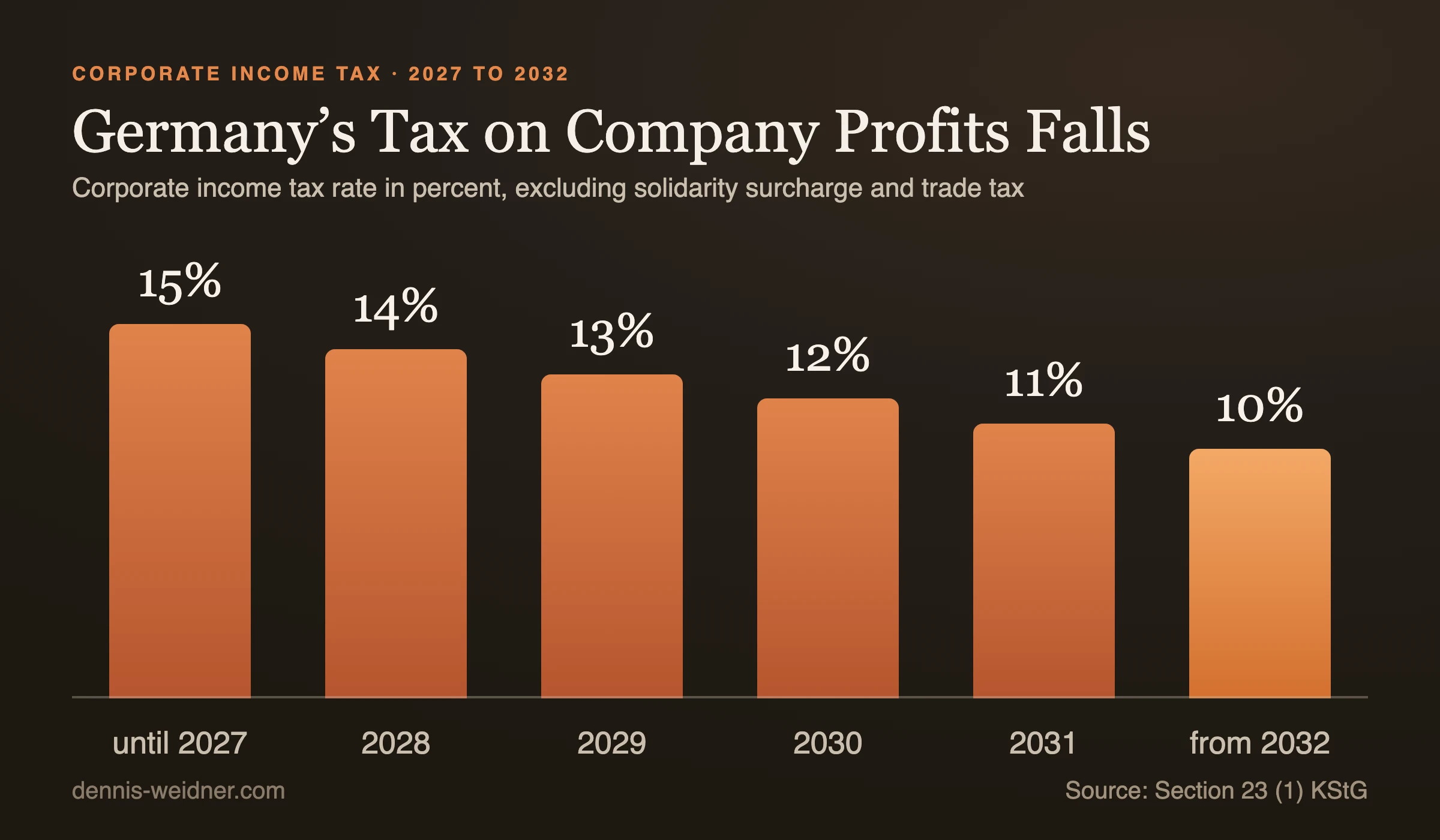
An additional argument comes from the Act on an Immediate Tax Investment Program of July 2025 (Federal Law Gazette 2025 I No. 161): from 2028, the corporate income tax rate falls by one percentage point per year, from 15 percent to 10 percent in 2032. Profits retained in corporations become cheaper. For a structure whose purpose is reinvestment, that is a tailwind. More finance topics for entrepreneurs are collected under Crypto and Finance.
Frequently Asked Questions
When does a holding GmbH pay off?
When profits or sale proceeds are meant to be reinvested and the amounts clearly exceed the ongoing costs of the second company. Anyone who spends profits privately gains almost nothing after the flat tax.
How much tax is due when a holding sells a stake?
Roughly 1.5 percent of the gain. 5 percent is treated as a non-deductible business expense and taxed with corporate income tax, solidarity surcharge and trade tax at a combined rate of roughly 30 percent (Section 8b (2) and (3) KStG, trade tax multiplier 400 percent).
What stake does the holding need for tax-exempt dividends?
For corporate income tax at least 10 percent at the start of the calendar year, for trade tax at least 15 percent at the start of the assessment period. Below that, the dividend is fully taxable.
Can I contribute an existing GmbH to a holding?
Yes, as a share exchange at book value under Section 21 UmwStG. If the holding sells the shares within seven years, however, the gain is taxed retroactively in the founder's hands, reduced by one seventh per full year.
What does it cost to take money out of the holding privately?
A dividend to a private individual is subject to the flat tax of 25 percent plus solidarity surcharge, 26.375 percent in total, plus church tax where applicable.
Note: This article is not tax advice. It describes the legal situation in Germany as of September 11, 2026 and deliberately simplifies: church tax, loss carryforwards, tax groups, other trade tax multipliers and the question of whether the holding counts as commercially active all change the result. Before setting up a holding, the specific structure belongs with a tax advisor. Next review of this article: January 2028, when the first step of the corporate tax cut takes effect.
Best,
Dennis Weidner
Note: AI tools supported me in writing this article, and some images were edited with AI. I stand behind its content and every statement with my name.