Businesses with a profit of no more than 200,000 euros may deduct up to 50 percent of a planned investment under Section 7g EStG up to three years before they buy, even retroactively for years whose tax return is still open. Combined with the 40 percent special depreciation and declining-balance depreciation, a 100,000 euro machine delivered in January 2027 is 85,000 euros written off by the end of 2027, against 10,000 euros straight-line. Sole proprietors, partnerships and GmbHs can use it, private individuals and spouses only through a business of their own, such as a larger solar installation.
As of 7 October 2026. Not tax advice, see the note at the end.
More on this topic: Finance & Crypto Assets, with background, practice and every article in one place.
What Germany's Investment Deduction Under Section 7g EStG Is
The investment deduction, Investitionsabzugsbetrag or IAB in German, pulls depreciation forward in time. A business that plans to buy a machine, a vehicle, a solar installation or equipment within the next three years may, under Section 7g(1) EStG, deduct up to 50 percent of the expected cost from its profit today. Tax falls in a year in which nothing has been bought yet.
Nothing is given away. In the year of purchase the deduction is added back and the depreciation base falls by the same amount. Over the full useful life, total deductions stay the same. The benefit is liquidity: tax not paid today funds the down payment or the cushion for the investment. A real saving only arises when the deduction lands in a year with a higher tax rate than the later add-back, for a sole proprietor through progression, for a GmbH through corporate tax falling from 2028.
Where the Investment Deduction Comes From and How Long It Applies
The investment deduction has no expiry date. It has been in the Income Tax Act since 2007, replacing the savings depreciation (Ansparabschreibung) that businesses had been allowed to set up as a reserve for future purchases since the mid-1990s. The aim has always been to help small and medium-sized businesses save up for investments. Three changes shape it today:
- Since 2016 without naming the asset. The Tax Amendment Act 2015 removed the requirement to describe the planned asset. Since then, the amount is enough.
- Since the Annual Tax Act 2020, 50 instead of 40 percent. It also brought a uniform profit limit of 200,000 euros, letting as a qualifying use, and a brake on retroactive claims explained in the section on retroactivity. Under Section 52(16) EStG the new version applies to financial years ending after 31 December 2019.
- Since 2024, special depreciation of 40 instead of 20 percent. The Growth Opportunities Act (Federal Law Gazette 2024 I No. 108) doubled the rate for purchases after 31 December 2023. Section 7g has not changed since, as of October 2026.
Only the third building block is temporary: declining-balance depreciation of up to 30 percent. It applies to movable assets bought between 1 July 2025 and 31 December 2027. Anyone who can time an investment should time it into this window.
Requirements for the German Investment Deduction: Profit Limit and Cap
The investment deduction is available to businesses whose profit in the year of the deduction, before the deduction itself, is no more than 200,000 euros (Section 7g(1) sentence 2 no. 1(b) EStG). Since the Annual Tax Act 2020, the limit applies equally to businesses that draw up a balance sheet and to those using cash-basis accounting. Three further rules:
- Cap of 200,000 euros per business. All deductions from the current and the three previous years that have not yet been released count towards it (Section 7g(1) sentence 4).
- Losses allowed. The deduction may create or increase a loss (Section 7g(1) sentence 3).
- Electronic, no justification. The amounts are transmitted with the tax return as a data record. Under margin number 17 of the Federal Ministry of Finance circular of 15 June 2022, no proof of an intention to invest is required.
The most important sentence for planning is margin number 13 of the circular: the profit limit is determined separately for each business, not per person. Someone running a company with 500,000 euros of profit cannot claim the deduction there, but can in a second, separate business with a smaller profit. Many solar and tiny house offers are built on exactly this, and it is exactly where the tax office looks more closely. Both are covered below.
Who Can Use the Investment Deduction: Sole Proprietors, GmbHs, Private Individuals, Spouses
The deduction is only available to businesses that determine a profit. Sole proprietors, freelancers, partnerships and corporations qualify, employees, private landlords and investors do not. A private individual who wants in needs a business of their own.
| Who | Deduction possible? | What counts for the profit limit |
|---|---|---|
| Sole proprietor, freelancer, farmer or forester | Yes | Profit of each business, separately |
| Partnership (GbR, OHG, KG, GmbH & Co. KG) | Yes, at partnership level | Partnership profit plus special business profits (margin number 4) |
| GmbH, UG, AG | Yes | Taxable profit including off-balance-sheet adjustments (margin number 13) |
| Business being set up | Yes | The start-up phase must be documented (margin numbers 2 and 3) |
| Employees, private landlords, investors | No | Section 7g only covers business income |
| Spouse | Yes, with their own business | Own limit per business; with joint assessment a loss reduces the joint income |
GmbH and holding. A GmbH can use the investment deduction too, margin number 1 of the circular names corporations explicitly. What counts is its taxable profit, including non-deductible expenses. A GmbH with 180,000 euros of book profit and 25,000 euros of non-deductible expenses is therefore over the limit. In a holding structure every GmbH is a separate business with its own limit and cap, and in a fiscal unity both parent and subsidiary may claim deductions. When a second company is worth it at all is calculated in Holding Company in Germany for Founders. The tax saving in a GmbH, at around 30 percent, is smaller than for a sole proprietor at the top rate, but the deduction hits years at today's corporate tax rate and part of the add-back hits the lower rates from 2028.
Private individuals. An employee, or a shareholder living on a managing director's salary, has no business and therefore no deduction. They can, however, start one, for example a sole proprietorship running a larger solar installation. The start-up phase already qualifies: anyone who can show a trade registration, quotes, a loan request or concrete orders may claim the deduction before the first sale (margin numbers 2 and 3). The loss the deduction creates in the new business can be offset against salary, other profits and rent, but not against capital income taxed at the flat withholding rate. A shareholder who mainly takes dividends from their GmbH has less to offset than they think. Which loans and grants can support a new business is covered in Funding Programs for Founders.
Spouses. Each spouse is a separate taxpayer. If a spouse runs their own business, it has its own profit limit and cap. With joint assessment, incomes are added up, so a loss from that business reduces the couple's joint taxable income. This only holds if the business really is theirs: contract, invoice, account and financing in their name. If the roof belongs to both, couples often run the installation as a GbR, and the limit then applies to the GbR. A structure that only exists to multiply limits is examined by the tax office as an abuse of legal arrangements.
Which Assets Qualify for the Investment Deduction
Movable, depreciable fixed assets qualify, new or used, including low-value assets. Buildings and intangible assets such as software are excluded (margin number 6 of the circular).
The asset must be used exclusively or almost exclusively for business purposes in a domestic establishment at least until the end of the year after the purchase. The tax authorities set this at a business use of at least 90 percent (margin numbers 35 and 41). Since the Annual Tax Act 2020, letting the asset is also sufficient (margin number 36). For a company car this means: more than 10 percent private use disqualifies it, and anyone using the 1 percent rule is treated as harmful use without further evidence (margin number 43). Only a logbook holds up.
Claiming the Investment Deduction Retroactively: Up to Three Years Before the Purchase
A deduction can be claimed for any of the three years before the investment, even after the investment has been made, as long as the tax return for the deduction year has not been filed or the first assessment can still be challenged. Once the first assessment is final, a deduction claimed later only counts for purchases made after the claim (Section 7g(2) sentence 2 EStG, margin number 25).
The investment period runs for three years from the deduction year. A deduction from 2023 must be used by 31 December 2026, one from 2025 by the end of 2028. For a purchase in 2026, the years 2023, 2024 and 2025 are therefore possible, and the 200,000 euro profit limit applies to each of them.
| Deduction year | Invest by | Deduction still possible after a purchase in 2026? |
|---|---|---|
| 2023 | 31.12.2026 | Only if the first assessment for 2023 is not yet final, meaning the return is missing or the first notice is less than a month old. Rare in practice. |
| 2024 | 31.12.2027 | If the 2024 return is filed after the purchase. The adviser-prepared return was due by 30 April 2026, many notices are already final. |
| 2025 | 31.12.2028 | Yes, in the 2025 return. Without an adviser it was due on 31 July 2026, with an adviser there is time until 1 March 2027. |
This gives the clean order for everyone whose notices have already arrived: claim first, then buy. If a notice is subject to review, which is common for business owners, the deduction can still be claimed years later by an amendment request. It then only counts for investments after that request. The circular gives an example: a deduction claimed for 2021 after a tax audit in May 2023 no longer fits a machine bought in 2022.
One expectation needs dampening, because I heard it myself in conversation: the deduction is not a tool for relieving a year with very high profit after the fact. If the business made more than 200,000 euros in that year, there is no deduction for it. The lever lies in years with good but not very high profit, or in a separate, smaller business.
Combining the Investment Deduction, 40 Percent Special Depreciation and Declining-Balance Depreciation
The investment deduction only shows its full effect in combination. Three rules interlock:
- Reduction. In the year of purchase the acquisition cost may be reduced by up to 50 percent, at most by the amount added back. Add-back and reduction cancel each other out, and the depreciation base falls accordingly (Section 7g(2) sentence 3).
- Special depreciation of 40 percent. On top of regular depreciation, up to 40 percent in total may be written off in the year of purchase and the four following years (Section 7g(5)), for purchases after 31 December 2023. Condition: profit in the year before the purchase did not exceed 200,000 euros (Section 7g(6)). The special depreciation does not require a prior deduction.
- Declining-balance depreciation up to 30 percent. Section 7(2) EStG allows up to 30 percent of the remaining book value for movable assets bought from 1 July 2025 to the end of 2027, at most three times the straight-line rate. How this works in detail is explained in Declining-Balance Depreciation in Germany Until 2027.
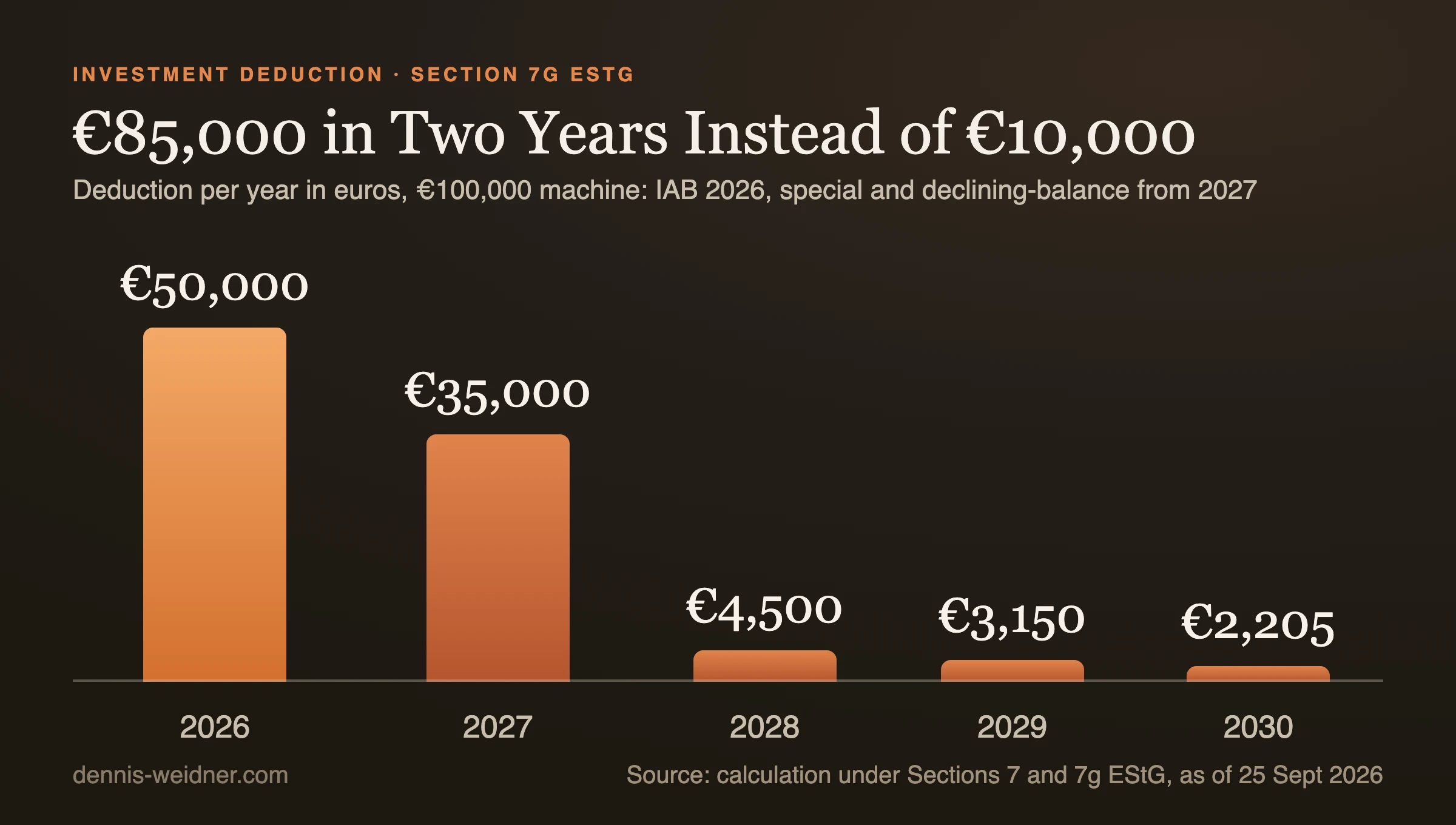
Under Section 7g(5) the special depreciation runs expressly alongside depreciation under Section 7(1) or (2), so also alongside the declining-balance method. The example: a machine for 100,000 euros net, useful life ten years, delivered in January 2027. The deduction of 50,000 euros is claimed in 2026. In 2027 it is added back, the base falls to 50,000 euros, and on that base come 40 percent special depreciation and 30 percent declining-balance depreciation. The comparison columns show straight-line and declining-balance depreciation alone.
| Year | Straight-line 10% | Declining-balance 30% only | IAB + special + declining-balance | Lead over straight-line, cumulative |
|---|---|---|---|---|
| 2026 | €0.00 | €0.00 | €50,000.00 (IAB) | €50,000.00 |
| 2027 | €10,000.00 | €30,000.00 | €35,000.00 (20,000 special, 15,000 declining) | €75,000.00 |
| 2028 | €10,000.00 | €21,000.00 | €4,500.00 | €69,500.00 |
| 2029 | €10,000.00 | €14,700.00 | €3,150.00 | €62,650.00 |
| 2030 | €10,000.00 | €10,290.00 | €2,205.00 | €54,855.00 |
| Total 2026 to 2030 | €40,000.00 | €75,990.00 | €94,855.00 | |
| Tax deferred by end of 2027 at 30% (GmbH) | Baseline | €6,000.00 | €22,500.00 | |
| Tax deferred by end of 2027 at 42% (sole proprietor) | Baseline | €8,400.00 | €31,500.00 |
After two years the combination has written off 85,000 of the 100,000 euros. Declining-balance alone reaches 30,000 euros, straight-line 10,000 euros. For a GmbH with a tax burden of around 30 percent, 22,500 euros of tax therefore reach the tax office later by the end of 2027 than with straight-line depreciation, for a sole proprietor at a marginal rate of 42 percent 31,500 euros. From 2028 the lead shrinks, because straight-line then deducts more each year. By the end of 2030 the depreciation lead is still 54,855 euros, or 16,456.50 euros of tax at 30 percent.
One detail often makes the difference: Section 7g(5) does not require special depreciation to be prorated, unlike regular depreciation under Section 7(1) sentence 4 EStG. Delivery in December still allows the full 40 percent in the same year, while declining-balance depreciation only counts one month.
The Investment Deduction for Solar Installations: What Applies and Where the Risk Lies
Small installations get no deduction, larger ones do. Since 2022, income from installations of up to 30 kWp per residential or commercial unit has been tax-exempt under Section 3 no. 72 EStG, with an exemption limit of 100 kWp per taxpayer. Tax-exempt income leaves nothing to deduct: the Ministry of Finance circular on Section 3 no. 72 EStG of 17 July 2023 rules out the deduction for exempt installations. Above that, the operator runs a commercial business with its own profit calculation, where the deduction, special depreciation and regular depreciation work as for any machine.
Three particularities of solar:
- 20 years of useful life. The tax authorities assume 20 years for solar installations, 5 percent a year straight-line. Declining-balance depreciation is capped at three times that and is therefore at most 15 percent, not 30.
- Own consumption is disputed. Under margin number 44 of the circular, electricity consumed privately is not harmful private use of the installation but a withdrawal of the electricity. The Hesse Finance Court took a different view on 22 October 2025 (case 10 K 162/24): a family had used more than 90 percent of the electricity itself, and the court cancelled the deduction because the installation had not been used almost exclusively for business. The appeal is pending at the Federal Fiscal Court under III R 39/25. Until it rules, high private consumption is a risk, even though the administration itself is more generous.
- VAT. Small installations have been bought without VAT since 2023. Larger ones carry 19 percent VAT, which the operator reclaims as input tax. Until then it has to be pre-financed, and how long that can take is covered below.
The example: an installation on a commercial roof for 400,000 euros net, operated by a sole proprietor in a separate business, commissioned in January 2026. The deduction of 200,000 euros is claimed in 2025, using the full cap. In 2026 it is added back, the base falls to 200,000 euros, and on that base come 40 percent special depreciation and 15 percent declining-balance depreciation.
| Year | Straight-line 5 % | Deduction + special + declining-balance 15 % | Lead over straight-line, cumulative |
|---|---|---|---|
| 2025 | 0 euros | 200,000 euros (deduction) | 200,000 euros |
| 2026 | 20,000 euros | 110,000 euros (80,000 euros special, 30,000 euros declining-balance) | 290,000 euros |
| 2027 | 20,000 euros | 13,500 euros | 283,500 euros |
| 2028 | 20,000 euros | 11,475 euros | 274,975 euros |
| Deferred tax end of 2026 at 30 % (GmbH) | Baseline | 87,000 euros | |
| Deferred tax end of 2026 at 42 % (sole proprietor) | Baseline | 121,800 euros |
By the end of 2026, 310,000 euros of the 400,000 euros are written off, against 20,000 euros straight-line. Because the separate business has hardly any profit in 2025, the deduction creates a loss there that reduces the sole proprietor's other income. This is the core of offers that sell solar as a tax saving model. It only holds if the installation makes a profit without the tax effect, because the tax office asks about the intention to make a profit, and the tax advantage is collected back over 20 years.
An entrepreneur I spoke to in early October bought an installation for a little over 400,000 euros net in early 2025 and used the deduction retroactively. His case also shows how much timing matters: the declining-balance depreciation from the Growth Opportunities Act only applied to purchases until the end of 2024, the new one only from 1 July 2025. Anyone who bought in the first half of 2025 fell into the gap and depreciates straight-line alongside the special depreciation.
The Investment Deduction for a Tiny House: Movable Asset or Building
A tiny house only qualifies if it is a movable asset and is used or let within a business. Neither is as obvious as the brochures suggest.
- A chassis alone does not make a movable asset. The Federal Fiscal Court classified a mobile home with a chassis, permanently placed on a campsite pitch and connected to utilities, as a building (judgment of 24 May 2022, IX R 22/21). Buildings are excluded from the deduction. Anyone who puts a tiny house on a fixed site, with foundations, fixed connections and no intention of moving it, must expect this classification.
- Private letting is not enough. A private individual letting a tiny house to holiday guests earns rental or other income, not business income. A business only exists with hotel-like services, as part of an existing trade, or in a GmbH, whose income is always commercial.
- Own use costs the deduction. Letting has been a qualifying use since 2020. If the family lives in it more than 10 percent of the time, the use is harmful.
- Packaged concepts fall under Section 15b. Losses from a tax deferral model may, under Section 15b EStG, only be offset against later profits from the same source if the projected initial losses exceed 10 percent of the equity. The law names individual investors explicitly. On 2 October 2025 the Federal Fiscal Court ruled that losses from an investment deduction count towards this (IV R 14/23). Anyone buying a package of tiny house, pitch, letting and tax forecast should have this checked first.
How the Investment Deduction Works, Step by Step
There is no application in the narrow sense. The deduction is declared in the profit calculation, and the tax office checks it with the assessment and later, when the investment is made. The process:
- Calculate in the fourth quarter. Estimate this year's profit, check the 200,000 euro limit and list the investments of the next three years.
- Set the amount. Up to 50 percent of the expected net cost, together with open deductions from the three previous years no more than 200,000 euros per business.
- Transmit with the return. With cash-basis accounting in the Anlage EÜR, for balance-sheet businesses and GmbHs in the E-Bilanz data record (margin number 20). What will be bought does not have to be stated.
- Finance the investment. The deduction brings liquidity before the purchase, it does not cover the purchase itself. Payment is gross, and input VAT comes back through the VAT pre-return once the tax office agrees. Section 7g does not require equity, and a loan does no harm.
- Add back in the year of purchase. Declare the add-back, reduce the acquisition cost, claim special and regular depreciation. Anyone who forgets the add-back and receives a final assessment for the investment year loses the deduction (margin number 29).
- Document use. Until the end of the following year at least 90 percent business use or letting, no sale, no withdrawal.
- Keep the records. Invoice, delivery note or commissioning report, logbook, rental agreements, feed-in statements.
Which Questions the Tax Office Asks About the Investment Deduction
Most questions do not come with the deduction but in the year of investment or during a tax audit. Preparing the answers beforehand saves months.
| Check | Typical question | What should be ready |
|---|---|---|
| Profit limit | Was profit before the deduction no more than 200,000 euros? | Profit calculation of the deduction year, for a GmbH with off-balance-sheet adjustments |
| Cap | How much deduction from the three previous years is still open? | Overview by year and amount |
| Business | Does the business exist, or is it being set up? | Trade registration, quotes, loan request, orders |
| Profit intention | Can the business make a profit over the years? | Forecast, for solar a yield forecast and grid contract |
| Asset | Movable, depreciable, fixed asset? | Purchase contract, technical description, for tiny houses site, foundations, connections |
| Timing | When was the asset bought, and when was the deduction claimed? | Delivery note, acceptance or commissioning report, date of the return or request |
| Use | At least 90 percent business use or let? | Logbook, rental agreements, feed-in and consumption statements |
| Retention | Is the asset still in the business at the end of the following year? | Fixed asset register |
| Concept | Does the investment follow a provider's concept with projected losses? | Prospectus, contract, forecast, amount of equity |
Investment Period: What Happens If the Investment Never Comes
If no investment is made by the end of the third year after the deduction, the deduction is cancelled retroactively in the year it was claimed (Section 7g(3) EStG). For a deduction from 2026 the period ends on 31 December 2029. The 2026 assessment is then amended, even if it is final. The Covid extensions no longer play a role. Under Section 52(16) EStG they only applied to deductions from 2017 to 2019 and expired at the end of 2023.
The back payment carries interest. Section 7g(3) sentence 4 excludes the favourable special rule for retroactive events, so under Section 233a(2) AO interest starts 15 months after the end of the deduction year, for a 2026 deduction on 1 April 2028. The rate is 0.15 percent per full month, 1.8 percent a year (Section 238(1a) AO). On a back payment of 15,000 euros that is 270 euros a year. Even if the investment falls through, the deduction was a tax loan, interest-free until interest starts and 1.8 percent after that. Claiming it without a real plan, however, risks the cushion coming back as a back payment in year three, just when the money is needed elsewhere.
Waiting for an Input VAT Refund: Inaction Objection, Security and Legal Action
Anyone buying a large investment pays the VAT first. It comes back through the VAT pre-return, but only once the tax office agrees (Section 168 sentence 2 AO). Until then the office may check, including with an unannounced on-site VAT inspection (Section 27b UStG). A new business with a high refund in its first month is exactly the pattern auditors look for. The entrepreneur mentioned above has been waiting since early 2025 for around 77,000 euros of input VAT, in October 2026 more than a year and a half.
What the tax office typically wants to see for a high input VAT refund: the invoice with all mandatory details, proof of payment, proof of delivery and commissioning, for solar the entry in the market master data register and the grid operator contract, the roof use or lease agreement, the financing and the declaration that the installation is assigned to the business. Sending all of this with the first pre-return takes the first round off the auditor's desk.
If the tax office still does nothing, the business owner has rights:
| Route | Legal basis | When | Effect |
|---|---|---|---|
| Written status request with a deadline | none | any time | No legal effect, but documentation for the next steps |
| Offer security | Section 18f UStG | if the tax office has doubts | Approval can be made subject to security, such as a bank guarantee |
| Inaction objection (Untätigkeitseinspruch) | Section 347(1) sentence 2 AO | if no decision is made within a reasonable period without sufficient reason | The tax office must decide or state the reason |
| Inaction action (Untätigkeitsklage) | Section 46(1) FGO | at the earliest six months after the objection | The Finance Court takes up the case |
| Supervisory complaint, petition | no deadline | any time | No right to a decision on the merits |
The law sets no fixed deadline for a reasonable processing time, the six months of Section 46 FGO often serve as a guide. If the tax office refuses the refund, that is a decision subject to the normal objection. Who supervises the tax office and what a complaint really achieves is covered in How German Tax Offices Are Supervised. No interest is paid for the waiting time on pre-returns. General interest under Section 233a AO only applies to the annual tax and starts 15 months after the end of the year, for 2025 on 1 April 2027.
Processing Times at the German Tax Office: Why Business Owners Should Not Accept the Wait
I understand that the tax office checks. VAT fraud is a real problem, and a high refund to a young business looks from the outside like the pattern fraudsters use. But a check has a beginning and an end. Someone who waits a year and a half for 77,000 euros they have long since paid to the state via their supplier is giving the tax office an interest-free loan. That is not an act of sovereignty, it is an entirely normal business transaction left lying on a desk. A company that treated its customers' money like this would quickly have a problem.
The Ministry of Finance's own figures show that objecting is not pettiness. According to its September 2025 monthly report, tax offices received 5.9 million objections in 2024, 4.1 million were settled, and in 68 percent of settled cases the tax office granted relief, changing the assessment in full or in part. At the end of 2024, 10.5 million objections were open, a large share of them on property tax. That does not mean the tax office was wrong in two out of three cases, documents are often submitted later. It does mean that pushing back pays. How long tax offices take to approve an input VAT refund is not in these statistics.
Three things would help, and none costs much: a statutory deadline for approving refunds, after which interest runs, publishing processing times for each tax office, and security as a standard offer rather than an exception. Why I think reform of the tax administration is overdue is set out in Entrepreneurs and Politics.
That is why I am collecting cases. Anyone who has waited more than six months for an input VAT refund or for the tax office's approval can write to me through the contact form: federal state, amount, since when, and whether there was a query. Please leave out tax numbers and the names of officials. Once enough cases come together, I will analyse them here anonymously.
When the Investment Deduction Pays Off
I would always claim the deduction when a concrete purchase is due within the next three years and the current year is good but below 200,000 euros of profit. It works particularly well in a high-profit year followed by a lower one, because for a sole proprietor the deduction then falls into the higher progression bracket. Until the end of 2027 declining-balance depreciation adds to it, after that the deduction and special depreciation remain. Watch out if profit exceeds 200,000 euros in the year before the purchase: special depreciation then falls away (Section 7g(6) no. 1), and the combination loses one of its strongest building blocks.
For solar, tiny houses and other real assets bought mainly for the tax effect, I reverse the order: calculate the return without tax first, then treat the deduction as a bonus. An installation that only pays because of the deferral is an expensive way of paying tax later. More finance topics for business owners are collected under Crypto and Finance.
Frequently Asked Questions
Can I claim the German investment deduction retroactively?
Yes, for any of the three years before the investment, as long as that year's return is still open or the first assessment can still be challenged. The investment may even have been made already. Once the first assessment is final, a deduction claimed later only counts for purchases after the claim (Section 7g(2) sentence 2 EStG). The 200,000 euro profit limit applies in each deduction year.
How high is the special depreciation under Section 7g EStG in 2026?
40 percent of the acquisition or production cost, spread at will over the year of purchase and the four following years. The rate applies to assets bought after 31 December 2023, before that it was 20 percent. Profit in the year before the purchase must not exceed 200,000 euros.
Can a private individual or a spouse use the investment deduction?
Only with a business of their own. Employees, private landlords and investors are excluded. Anyone who starts a business, for example for a larger solar installation, can claim the deduction during the start-up phase. A spouse with their own business has their own profit limit, and with joint assessment their loss reduces the joint income.
Is there an investment deduction for a solar installation?
Not for installations whose income is exempt under Section 3 no. 72 EStG, up to 30 kWp per unit and 100 kWp per taxpayer. Larger installations are a commercial business, where the deduction, 40 percent special depreciation and, until the end of 2027, at most 15 percent declining-balance depreciation apply. With high private consumption the deduction is disputed, the Federal Fiscal Court is deciding under III R 39/25.
Does the investment deduction apply to a tiny house?
Only if it is a movable asset used in a business or let within a business. If it stays permanently on one site and is connected to utilities, it can be a building even with a chassis (Federal Fiscal Court, IX R 22/21), and buildings are excluded. Packaged investment concepts also risk the loss restriction of Section 15b EStG.
What can I do if the tax office does not refund input VAT?
First ask in writing for the status and send all evidence, then offer security under Section 18f UStG. If the tax office does not decide without sufficient reason, an inaction objection under Section 347(1) sentence 2 AO is possible, and six months later an inaction action under Section 46 FGO.
Note: This article is not tax advice. It describes the legal situation in Germany as of 7 October 2026 and deliberately simplifies: the calculations assume constant tax rates of 30 and 42 percent, without solidarity surcharge, church tax, trade tax and its credit, and they assume delivery in January with a full year of depreciation. Case III R 39/25 on solar with own consumption was pending at the Federal Fiscal Court at the time of writing. Whether declining-balance depreciation will be extended beyond 2027 is open. Before claiming a deduction, buying an investment concept or filing an objection, the specific situation belongs with a tax adviser. Next review of this article: after the ruling in III R 39/25, at the latest in January 2027.
Warm regards,
Dennis Weidner
Note: AI tools supported me in writing this article, and some images were edited with AI. I stand behind its content and every statement with my name.