During the legislative process the cost cap on Germany's new retirement account was cut from 1.5 to 1.0 per cent. Coverage treated it as a footnote. From an entrepreneur's perspective it is the most important number in the law: a contract paying 150 euros a month yields around 50 euros of revenue per year in its first five years. What that means for distribution, for the provider landscape, and for the most heavily subsidised group of all.
Half a percentage point that decides a business model
During the legislative process for the German retirement reform act a cost cap of 1.5 per cent was on the table. What passed was 1.0 per cent. In the coverage that was a footnote, usually a subordinate clause about consumer protection.
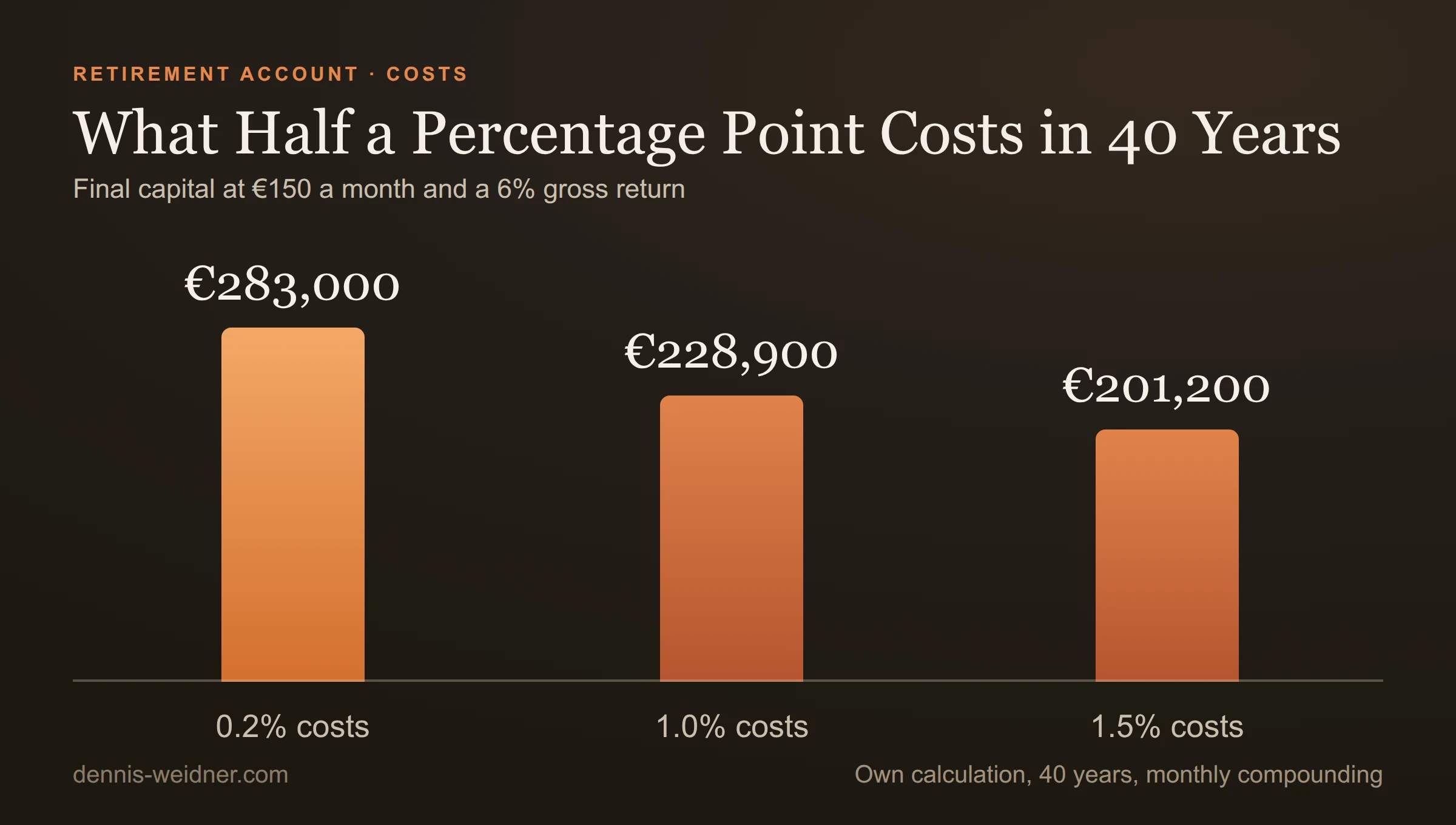
From an entrepreneur’s perspective it is the most important number in the whole law, because a third less revenue per customer does not mean a third less profit; in many models it is the difference between viable and not viable. The effect on savers’ final wealth is covered in the overview piece Germany’s New Retirement Account.
I have built companies for years and look at pricing models professionally. What is happening here is a textbook case: the legislator sets a price ceiling, and the ceiling selects who can serve the market.
What one per cent per customer actually yields
A cost ratio applies to the portfolio value, not to the contribution. That sounds technical and is the heart of the matter: in the early years the value is small, so the revenue is small. The large revenue arrives after twenty years, once the portfolio has grown.
Calculated with monthly contributions, a 6 per cent gross return, a cost ratio of 1.0 per cent a year on the portfolio value at the time and a 40-year term. Revenue means what the cost ratio yields over time, not profit.
The decisive column is the right-hand one. A contract paying €150 a month, well above average, yields around €50 of revenue per year in its first five years. That is the amount from which advice, contract conclusion, custody, subsidy administration and regulatory compliance all have to be paid.
Which business models still work at one per cent
Viable: the platform without advisers. Anyone running distribution digitally has acquisition costs in the low double digits and marginal costs near zero. At one per cent on a growing volume that is a very good business, provided the volume arrives. It is a scale model, not a margin model.
Viable: the incumbent with an existing book. Anyone with millions of customer relationships sells into a channel that already exists. Acquisition costs are effectively already paid. That is why direct banks and large fund houses will define this market.
Not viable: classic commission-based distribution. A model financing an up-front commission out of the first contributions does not work at one per cent, unless it targets high contributions exclusively, and therefore a small group.
Not viable: the small contract as a standalone deal. A minimum contract at €10 a month yields about €52 of revenue a year on average, but only a single-digit amount in the early years. Contracts like that can only be served fully automatically. Yet that is where the group sits for which the subsidy is arithmetically most attractive, namely small incomes with a 50 per cent rate on the first €360.
The contradiction the law creates
So the statute contains an unresolved conflict of aims. The subsidy is deliberately degressive and therefore favours small contributions most. The cost ceiling, however, makes exactly those small contracts unattractive for any provider offering advice.
The group with the best subsidy rate is thus the group nobody will court. Someone paying in €120 a year receives a 50 per cent subsidy on it and will never get a call from an adviser.
There are only two ways to resolve this: fully automated providers that do not lose money even at three euros of annual revenue, or a channel that delivers customers in bundles. The second is the more interesting one, and it already exists.
Where I see the business: the employer channel
From 2027 the early-start pension brings millions of children’s accounts into the system. Children have parents, and parents work in companies. An offer an employer can put in front of its workforce delivers hundreds of contracts in a single move. Acquisition cost per contract falls to a fraction, and only then does the small contract become calculable.
That is the real entrepreneurial opportunity in this reform, and it appears in none of the product brochures, because it is not a product but a distribution route. What the early-start pension actually delivers is calculated in Germany’s Child Pension Scheme, Calculated.
What could still shift the calculation
So far no provider has published prices. Whether the cap is used in full or competition pushes below it decides more money than anything written here. My calculations assume the full one per cent. If a large provider goes to 0.5 per cent, every revenue figure above halves, and the market sorts itself again.
Equally open is how subsidy administration will be handled. Under Riester the administrative burden was a substantial cost block, and it hit small contracts hardest. Unless that becomes markedly simpler, the calculation above shifts against precisely the contracts the law wants to promote.
My running commentary sits under crypto and finance.
This article is an entrepreneur’s assessment of the legal position and constitutes neither investment nor tax advice. Seek professional advice for your own situation.
Frequently Asked Questions
How high is the cost cap on Germany's new retirement account?
The standard product is capped at 1.0 per cent of costs per year, reduced from an initially planned 1.5 per cent. The ratio applies to the portfolio value rather than the contribution, which is why revenue is small in the early years and grows with the portfolio.
What does a provider earn on one of these accounts?
By own calculation, a contract paying 150 euros a month yields on average around 777 euros of revenue per year over 40 years, but only about 50 euros a year in the first five. Calculated with monthly contributions, a 6 per cent gross return and a 1.0 per cent cost ratio on the portfolio value at the time.
Why is the cost cap a problem for commission-based distribution?
Because personal advice costs a three-figure sum once and immediately, while the contract delivers only about 250 euros of revenue across its first five years. Acquisition costs are recovered after five years at the earliest, and only if the customer stays. That was the purpose of the cap.
Which providers will define this market?
Most likely digital platforms and incumbents with large existing customer books, meaning direct banks and large fund houses. Both have acquisition costs that are either very low or effectively already paid. It is a scale model rather than a margin model.
Is a small contract worthwhile for a provider?
As a standalone deal, barely. A minimum contract at 10 euros a month yields about 52 euros of revenue a year on average, and only a single-digit amount in the early years. Such contracts can only be served economically fully automatically or through a bundling channel.
What conflict of aims does the law create?
The subsidy is degressive and favours small contributions most, at 50 per cent on the first 360 euros. The cost ceiling makes exactly those small contracts unattractive for providers offering advice. The group with the best subsidy rate is therefore the one nobody will court.
What is the employer channel in retirement provision?
An offer an employer makes available to its workforce, delivering many contracts in a single move. Acquisition cost per contract falls to a fraction, which makes small contracts calculable. The early-start pension, bringing millions of children's accounts into the system from 2027, adds further weight to this route.
Warm regards,
Dennis Weidner
Note: AI tools supported me in writing this article, and some images were edited with AI. I stand behind its content and every statement with my name.