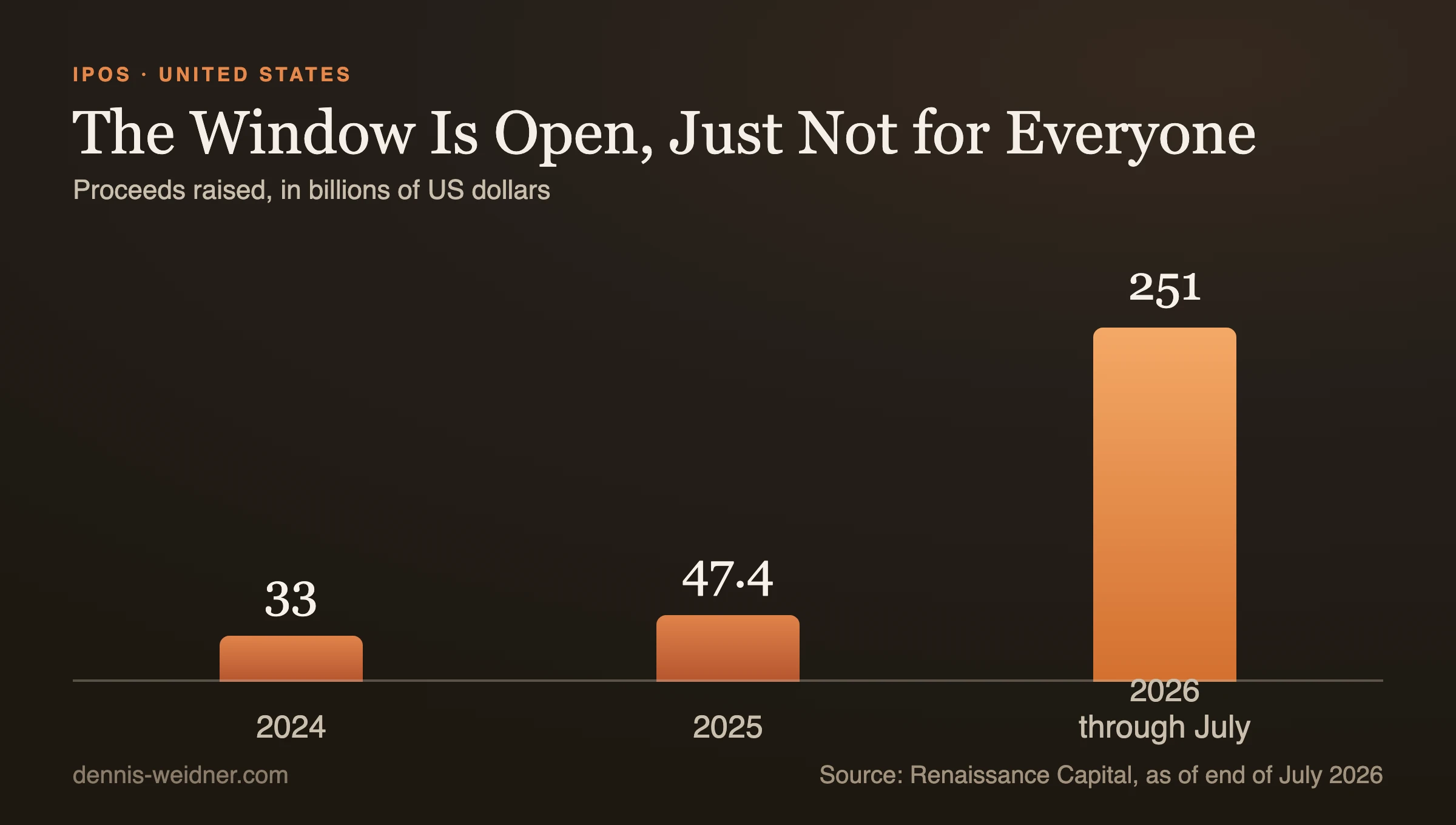
Through the end of July 2026, US listings raised 251 billion dollars across 86 deals, more than five times the whole of the previous year. Over the same period companies pulled, downsized and postponed their offerings, and that list is getting longer, not shorter. Explaining both at once is the actual task, and the answer changes how you look at equity stakes. I invest through a holding company using its own balance sheet, which grants an uncomfortable kind of freedom here.
Two numbers that appear to contradict each other
The first number is the one in the chart. 33 billion US dollars in 2024, 47.4 billion in 2025, then 251 billion through July 2026 alone. Globally, the first half came in at 178 billion dollars across 524 deals. By any conventional reading, that is a wide open window.
More on this topic: Finance & Crypto Assets – background, practice and every article in one place.
The second number appears in no statistic, because pulled offerings are not counted anywhere centrally. You find them one at a time. A Wall Street broker withdrew its listing after having already cut its target by 65 percent. A Brazilian fintech eventually priced at 12 dollars instead of the planned 15 to 18, with 20 million shares instead of 43.6 million, and was down almost 15 percent the following day. A Blackstone-backed provider postponed a week before its date. From the crypto sector, several companies suspended their plans outright.
The apparent contradiction dissolves as soon as you break the 251 billion apart. A single deal, SpaceX in June, accounts for roughly 85.7 billion of it, about a third of the entire year. What looks like a broad boom is to a considerable degree a handful of very large transactions. The market is not open. It is selective, in a way the aggregate figure cannot show.
What the withdrawals have in common
The stated reason is nearly always the same and says nearly nothing: market conditions. Lay the cases side by side and a more precise pattern emerges.
Companies do not postpone because there is no money. They postpone because the price at which money is available sits below the last private valuation. That distinction matters. In the first case there is no deal. In the second there is a deal, but it hurts the existing owners.
That pain threshold is not the same for everyone. An early-round investor still makes money at half the valuation. Someone who came in during the last round before the listing loses. And because late investors usually hold preference rights that are served first in a sale, founders and employees on ordinary shares absorb the difference. A withdrawal is therefore rarely a diagnosis of the market. It is usually a decision inside the cap table about who pays for a correction.
How harsh that correction can be when a company sees it through rather than avoiding it was on display at SpaceX in August. After eight weeks of public trading the stock sat well below its offer price, and on the day of the first lockup expiry it rose again. What that teaches about private valuations is set out in my piece 911 Million Shares in a Single Day.
Postpone or accept a lower valuation
When the achievable price sits below the last valuation, a company has two options, and each costs something different.
Listing at the lower price makes the correction public and final. From then on there is a number in the market against which everything can be measured, and it can no longer be argued away. That is uncomfortable and has an underrated advantage: from that point the valuation question is settled and the company can focus on its business again.
Postponing keeps the old number on paper and pushes the reckoning into the future. It costs time, however, and time is exactly what a company with a high valuation and limited cash does not have in unlimited supply. Whoever postpones has to finance the interim, usually through another private round whose terms in a weak market regularly turn out harsher than the listing they wanted to avoid.
In my observation, companies with a working business more often choose the lower price, because they can withstand the reckoning. Companies whose story carries the valuation, rather than the other way round, postpone. Which group a withdrawal comes from therefore often says more than the withdrawal itself.
Why a holding company sees this differently from a fund
Here is where my perspective departs from the usual one, and I think the difference is underrated.
A classic venture fund raises money from investors and promises to return it within a defined life, typically ten years with extension options. It is a good construction and it has carried an entire industry. But it has one built-in property: at the end sits a date by which assets must be sold. A fund in its eighth year sees a closed listing window differently from a fund in its third. Not because it thinks differently, but because its clock reads differently.
I invest through a holding company with its own balance sheet. There are no subscribers to whom I owe capital on a given date, so that date does not exist. A stake may sit for as long as the business holds up. A postponed listing is therefore not a missed deadline for me, it is information: the public market is currently paying less than the last private round.
The same structure does carry a rather unpleasant price. Anyone who never has to sell is never forced to face a price. A fund must periodically prove its numbers are real. A holding company can carry a stake at cost for years and feel excellent about it. That is the genuine danger in my construction, and I consider it larger than the risk of missing a window. So the discipline a fund receives from outside is, in my case, a question of self-organisation.
The question I have asked myself since
Out of that came a fixed and rather uncomfortable review. Once a year I ask, for every stake: if I had to sell this today, at what price would I find a buyer? Not what price I would ask. What price someone actually takes.
The gap between those two numbers is the only valuation gap that counts. It appears in no shareholders' agreement, shows up in no portfolio overview, and for most stakes it is wider than you expect. Once you have written it down honestly, you read news about pulled listings entirely differently. They stop being reports about the environment. They become reports about which valuations are currently real.
For founders in the middle of a round, there is a practical consequence: a high valuation is not free. It sets the bar against which every later round and every exit is measured. A company that closes a round at a lower valuation and then executes cleanly is often better placed than one that hits a record valuation and has to defend it two years later.
What I expect for the rest of the year
Three developments are taking shape.
The concentration stays. As long as a few very large deals carry the statistic, the total says nothing about the chances of a mid-sized company. Anyone judging their own window should look at the number of deals in their size bracket, not at the volume.
First-day performance is the wrong metric. A debut with a big pop mostly tells you the offering was underpriced. What is interesting is where the stock stands three months later, when the first lockups expire.
Secondary transactions matter more. When a listing takes longer to arrive as an exit route, pressure shifts to selling stakes between private investors. Those prices are a more honest indicator of what an unlisted company is worth than any funding round, because here someone who wants out sells to someone who wants in.
Why I regard valuations as the least reliable number in any round at all also runs through my review Crypto 2026: What Really Remains After the Euphoria. The mechanism there is the same, only faster.
Frequently Asked Questions
How many IPOs were there in the US in 2026?
Through the end of July 2026 there were 86 deals raising 251 billion US dollars. For comparison, 2025 saw 47.4 billion and 2024 around 33 billion. Globally, the first half of 2026 came to 178 billion dollars across 524 deals.
Why do companies postpone listings in a record year?
Because the volume is heavily concentrated. The SpaceX offering in June alone accounts for roughly 85.7 billion dollars, about a third of the year. For mid-sized issuers the window is considerably narrower. Postponements usually happen not because capital is unavailable but because the achievable price sits below the last private valuation.
Who bears the loss when a listing happens at a lower price?
Usually holders of ordinary shares, meaning founders and employees. Late investors typically hold preference rights that are served first in a sale. A withdrawal is therefore often less a diagnosis of the market than a decision about who pays for a correction.
What is the difference between a holding company and a fund here?
A fund has a fixed life and therefore a date by which it must return capital. A holding company with its own balance sheet has no such date and can hold a stake as long as the business holds up. The price of that freedom is weaker external discipline: anyone who never has to sell never faces a real price.
How do I tell whether a valuation is realistic?
By asking what price someone would actually pay today, not what price you would ask. Secondary transactions, where private investors sell stakes to one another, are a more honest indicator than the valuation set in the most recent funding round.
This text is a personal assessment, not investment advice. It contains no recommendation to buy or sell any particular security.
Warm regards,
Dennis Weidner
Note: AI tools supported me in writing this article, and some images were edited with AI. I stand behind its content and every statement with my name.