Between mid-December and early January the crypto market behaves differently, and it has nothing to do with Christmas spirit: tax selling, empty trading floors and balance-sheet dates are mechanics, not mood. I have watched these patterns since 2017, first privately, then through CryptoTicker. Here is what the statistics actually support, what 31 December means in German tax law, and why the end of 2026 raises a question that has never come up before.
Crypto at year-end: what the seasonality actually shows
Between mid-December and early January the crypto market behaves differently from the rest of the year. That has nothing to do with Christmas spirit and everything to do with tax law, balance-sheet dates and empty trading floors. Four mechanisms repeat every year, and one exists for the first time in 2026.
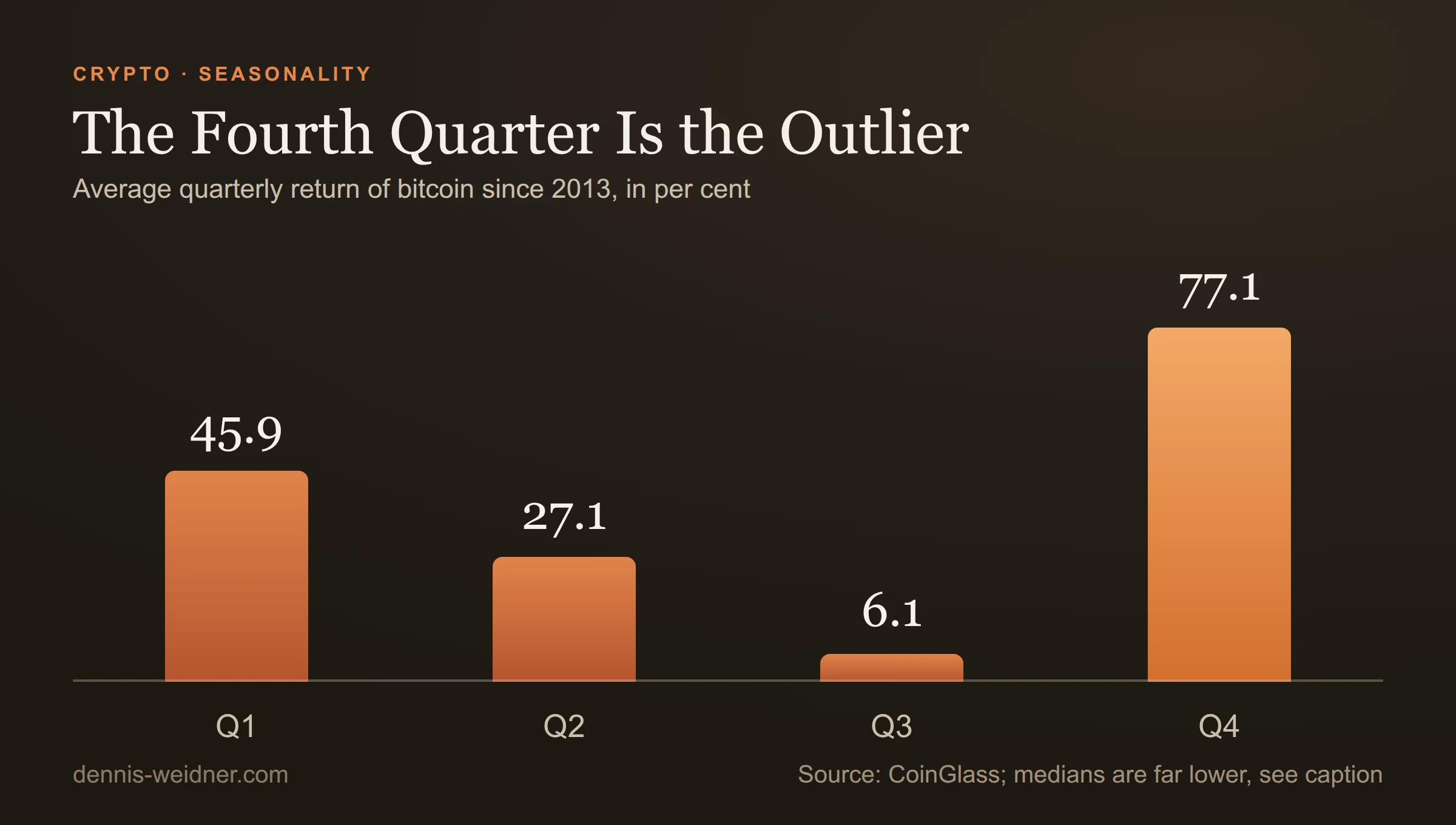
The fourth quarter is historically the strongest, and it closed green in eight of twelve years. But the number that matters is the distance between mean and median: in the first quarter a 45.9 per cent average meets a minus 2.26 per cent median. Translated: a handful of very good years carry the average, and the typical year looks different.
2026 provides the illustration. The first quarter closed at minus 23.21 per cent, the second at minus 14.09 per cent. Anyone who bet on seasonality in January paid for a statistic that says nothing about a single year.
December tax selling and the missing wash-sale rule
The first pattern with real mechanics behind it is tax-driven selling. In the United States this is tax-loss harvesting: positions in the red are sold so the realised losses can be set against gains. The cut-off is 31 December, so it concentrates in the final weeks of the year.
One detail amplifies the effect considerably. Crypto-assets are not covered by the wash-sale rule in the US, because they are treated as property rather than securities. Investors can sell, book the loss and buy back immediately. That makes the selling cheap and concentrates it in December. It also explains why part of the pressure unwinds in January.
Two points belong here that most articles omit. First, several bills in Congress would close the gap; none is law, but one draft would apply to tax years from 2026 onwards. Second, the rule does apply to shares in spot ETFs, because those are securities. Anyone invested through an ETF does not have the freedom they would have with the coin itself.
Thin holiday volume distorts every move
The second pattern is unspectacular and underestimated every year. Between Christmas and New Year the big desks are thinly staffed, volume drops and order books go flat.
The consequence: the same order that would barely have produced a candle in November moves the price by several per cent. Crypto trades through 25 December, just with almost nobody there. A five per cent swing on a fraction of normal volume is not a signal, it is an empty hall in which somebody coughs loudly.
Fund rebalancing is accounting, not opinion
The third pattern is purely mechanical. Funds and asset managers with fixed target weights have to return to their allocation at quarter and year end: what ran hot is trimmed, what fell is topped up. Since spot ETFs exist these flows can be watched almost in real time.
The key error of these weeks: not every December seller is a pessimist. Many sell because their rulebook says so: for tax, for the weighting, for the balance-sheet date. Reading sentiment into those flows means interpreting accounting as conviction.
31 December in German tax law: section 23 and loss relief
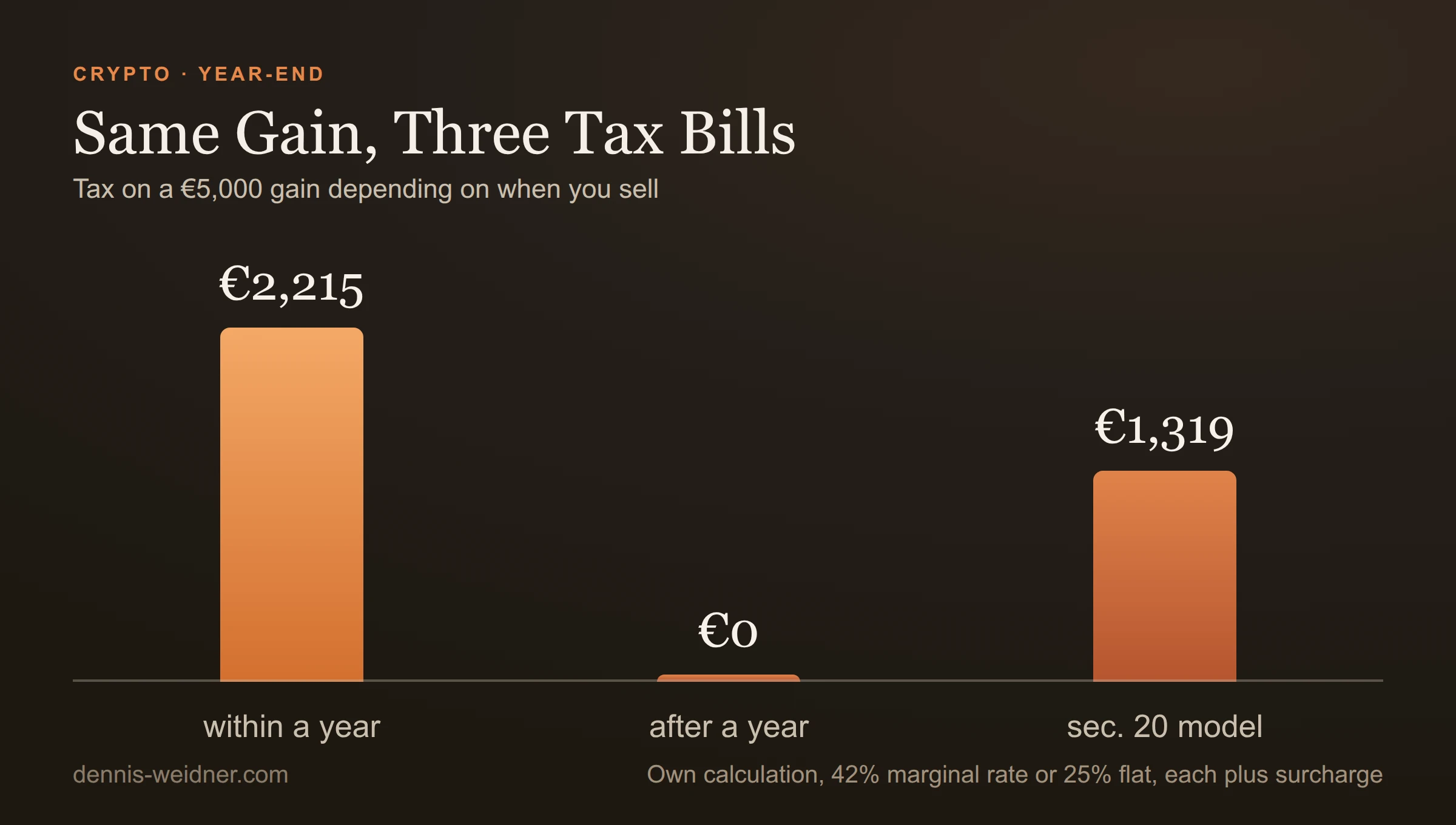
Germany adds a peculiarity. Gains on privately held crypto are tax-free under section 23 of the Income Tax Act once more than a year lies between purchase and sale. That holding period runs to the day and knows no turn of the year.
31 December is still a hard cut-off, for the loss side: losses from sales inside the one-year period can only be offset against gains from private disposals, and they count in the year they are realised. Anyone with taxable gains in 2026 has to sell matching loss positions before New Year’s Eve for them to fall into the same tax year.
On top of that sits the €1,000 exemption limit. Limit means exactly that: one euro above it and the entire gain becomes taxable. It is not an allowance, and the difference regularly costs money.
Why the end of 2026 differs from every year before it
The one thing that has never existed in this form: a question mark over the one-year period itself. On 6 July 2026 the German cabinet adopted the 2027 budget draft stating the intention to reclassify privately held crypto-assets as investment income. A budget draft is not a tax law, and so far there is neither a ministerial draft nor a consultation of associations.
For the turn of the year that yields no recommendation, only an observation task. Anyone holding a position whose one-year period expires during 2027 should know which cut-off date the eventual statute contains before deciding to sell in December, or not to. That cut-off, not the tax rate, is the real question; I showed why from the wording of the only bill tabled so far in Crypto Holding Period: What the German Bill Actually Says.
The process is moving, and anyone deciding in December should know where it stands in December.
Four rules for the turn of the year
I am not summarising these patterns in order to build a trading strategy. That would be the wrong conclusion: all of these effects are well known, and what everyone knows is already in the price. The value lies in the structure of your own behaviour.
First, plan liquidity. If you intend to buy or sell anyway, do not do it in the thinnest week of the year, when spread and slippage are at their most expensive.
Second, do not over-read thin-volume moves. A violent swing between the years is usually noise. Reacting to it in a panic means paying for somebody else’s nerves.
Third, put tax dates in October, not into the night of 31 December. Holding periods, exemption limits and loss relief can be sorted calmly while there is still time to ask your adviser.
Fourth, rules before forecasts. Nobody knows what the price does in December. What tax law requires on 31 December is fixed and can be planned.
The bigger frame matters more to me than any seasonal pattern. The real shift in digital finance runs in years, not calendar weeks: stablecoins are becoming infrastructure and real assets are moving on-chain. My running commentary sits under crypto and finance, and daily market coverage at my venture CryptoTicker.
This article is an entrepreneur’s assessment and constitutes neither tax nor investment advice. Seek professional advice for your own situation.
Frequently Asked Questions
Is the santa rally in bitcoin real?
As a tendency, yes: the fourth quarter closed green in eight of twelve years and is historically the strongest with an average return of 77.1 per cent. The median, however, is 47.7 per cent, and outlier years such as 2013, 2017 and 2020 carry the average. For any single year the statistic says nothing.
Why does bitcoin often fall in mid-December?
Two mechanical reasons: tax-driven selling before 31 December, above all tax-loss harvesting in the US, and year-end rebalancing by large funds returning to their target weights. Both are rulebooks, not a change of opinion about bitcoin.
Does the wash-sale rule apply to cryptocurrencies?
Not in the US so far, because crypto-assets are treated as property rather than securities. Investors can sell at a loss and buy back immediately. Several bills would change that; none has become law so far. The rule does apply to shares in spot ETFs, which are securities.
Why is the price so volatile between the years?
Because trading volume collapses over the holidays and order books are thin. Even small orders then move the price disproportionately. Such swings are usually noise rather than a reliable signal.
What does 31 December have to do with the German holding period?
The one-year period under section 23 of the Income Tax Act runs to the day and ignores the turn of the year. But 31 December is the cut-off for loss relief: losses only count in the year they are realised and only against gains from private disposals. On top of that sits the €1,000 exemption limit, where one euro above it makes the entire gain taxable.
Should I sell before year-end because of the planned German crypto tax reform?
No general recommendation follows from this, and this article gives none. The cabinet decision of 6 July 2026 states the intention to reclassify crypto-assets as investment income; so far no statutory text exists. What will matter is the cut-off date in the eventual law, not the tax rate. Anyone deciding in December should know December's status and take professional tax advice.
Warm regards,
Dennis Weidner
Note: AI tools supported me in writing this article, and some images were edited with AI. I stand behind its content and every statement with my name.