From 1 January 2027 no new Riester contract may be signed in Germany. What replaces it is the Altersvorsorgedepot: passed, published, with a 540 euro subsidy, a one per cent cost cap and permission to hold equities without a contribution guarantee. Two days before the first reading in parliament the cabinet also adopted the early-start pension. What both mean for employees, families, the self-employed, chamber professions and 14.66 million existing contracts, sorted by group.
Germany’s new retirement account: what the law actually says
From 1 January 2027 not a single new Riester contract may be signed in Germany. What replaces it is the Altersvorsorgedepot, a certified, state-subsidised retirement account that may for the first time do without a contribution guarantee and invest in shares, funds and ETFs.
The legal position is settled, and with this subject that is half the news. The Bundestag adopted the reform act on 27 March 2026, the Bundesrat approved it on 8 May, and it was published on 29 May 2026. This is not a draft but law in force.
Existing Riester contracts continue unchanged and are not converted automatically. So this is not a cut but a switch: the existing book stays, the new business moves.
The legal basis is the German retirement reform act, published in the Federal Law Gazette on 29 May 2026.
Every one of those rules is a business decision for somebody, and a question that millions of savers will have to answer in 2027. That is why this article is sorted by group rather than by paragraph.
The subsidy in the German retirement account: €540 and the formula behind it
The new subsidy is no longer a flat amount but a rate: 50 per cent on the first €360 of your own contributions each year, 25 per cent on the part between €360.01 and €1,800. The basic subsidy never exceeds €540.
That sounds technical, but it is a redistribution. Whoever pays in little gets proportionally the most. Whoever pays in a lot gets nothing on the larger part of their contribution.
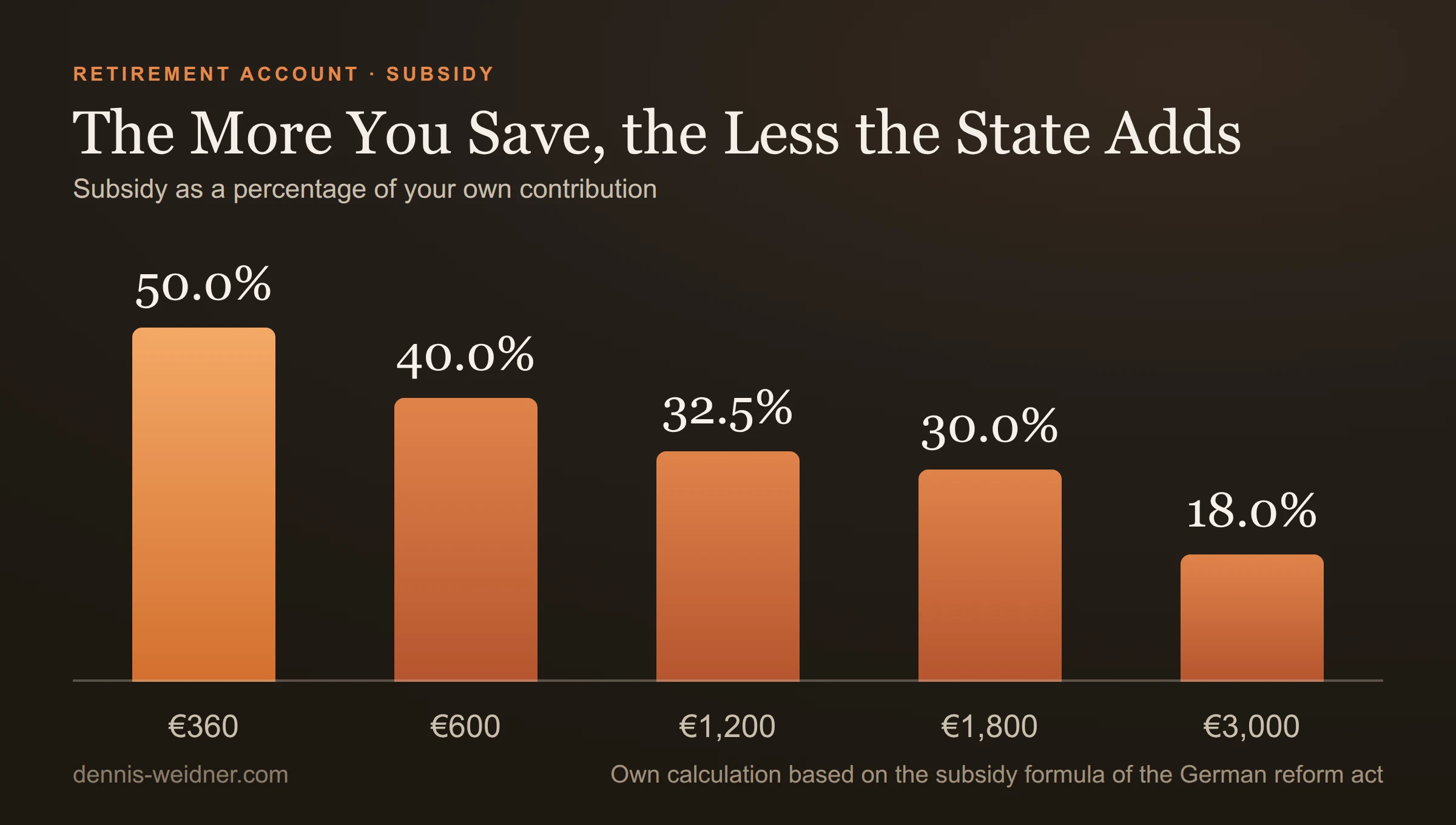
From that follows a rule of thumb that appears in no brochure: up to €1,800 a year this is a subsidy product, above it an ordinary account with withdrawal restrictions. Anyone saving €300 a month is well advised to put the first €150 into the subsidised account and the rest where they can reach it before 65.
Two components are easily overlooked. Each child brings 100 per cent on a contribution of up to €300 a year, a straight doubling. And anyone under 25 when the contract is signed receives a one-off €200 career-starter bonus.
Taxation is deferred, as before: returns are tax-free while you save, the payout is taxed. Whether that is an advantage depends on your own tax rate in retirement, not on the sales material.
The early-start pension: €10 a month for every child from 1 January 2027
A second law is running in parallel, and for the market question it matters almost more than the first. The German cabinet adopted the government bill for the early-start pension on 12 August 2026; the parliamentary process is meant to conclude by the end of the year, with the law taking effect on 1 January 2027.
The mechanism: for every child from the age of six until 18 the federal government pays €10 a month into an individual retirement account. The condition is a main residence in Germany. Parents open the account with a provider of their choice; if they do not, the Bundesbank invests the money collectively. The scheme starts retroactively from 1 January 2026 with the 2020 birth cohort, and one cohort is added every year.
The Finance Ministry sets out what the €1,440 of state contributions can become: roughly €2,200 by the child’s eighteenth birthday and roughly €53,000 by retirement at 65, assuming a 7 per cent annual return. With parents adding €10 a month it becomes roughly €107,000. The calculation shows the power of compound interest, but it is not guaranteed.
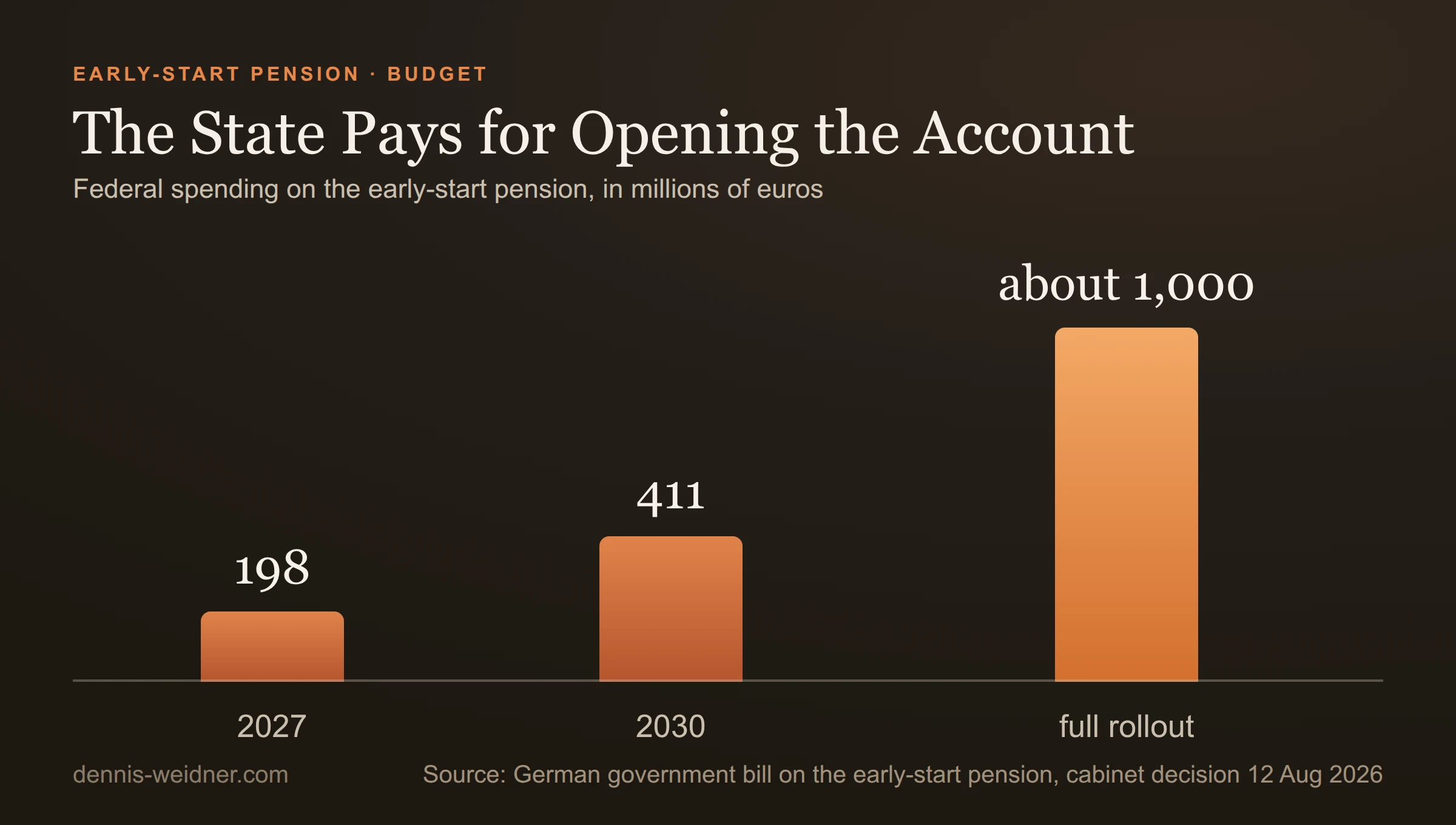
You can read this as education policy. You can also read it as what it is for providers: the state pays for opening millions of accounts and hands over the customer relationship. Whoever runs those accounts has a customer who may well stay for forty years.
The Riester book: 14.66 million contracts and no new business
The starting position shows why this is a market and not merely a reform.
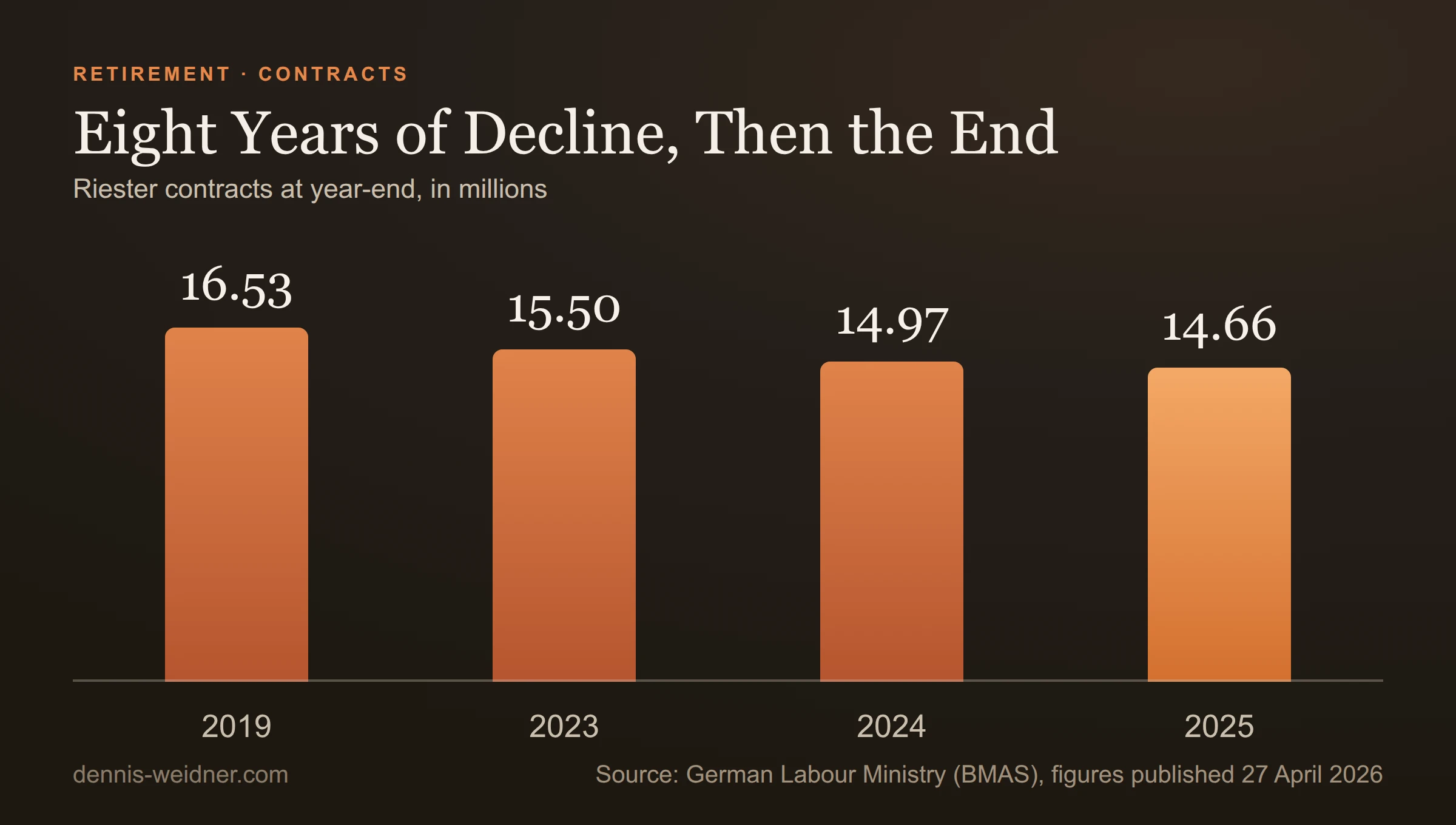
The peak was around 16.6 million contracts, at the end of 2017 or the end of 2018 depending on the source. Since then the direction has been down, and new business has all but disappeared: from about 139,000 new contracts in 2023 to about 63,000 in 2024.
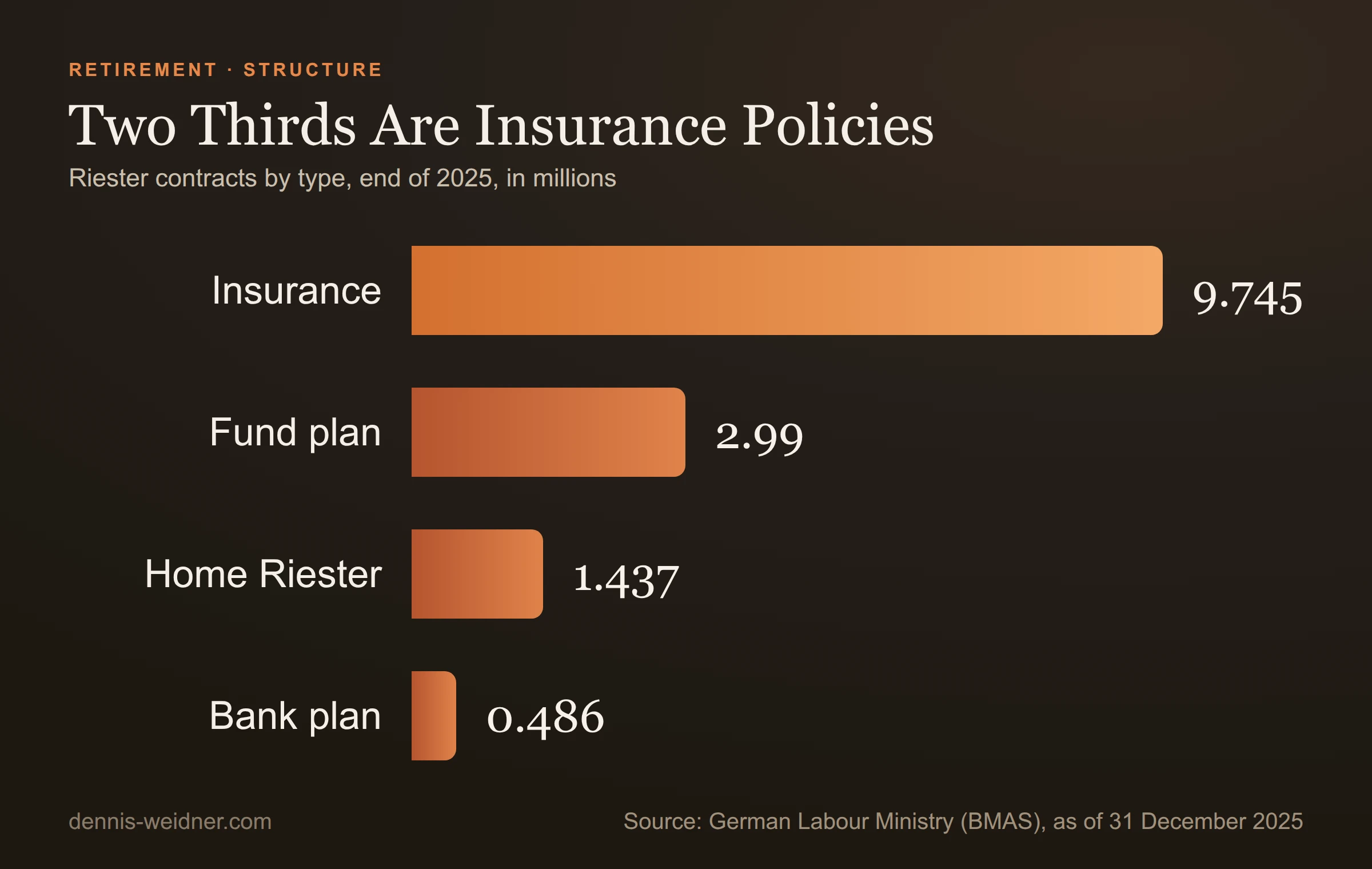
One detail decides the size of the task: the ministry estimates the share of dormant contracts, those without ongoing payments, at just over a fifth to just under a quarter. In plain terms that is roughly three million people holding a contract they no longer pay into. That is not a book of business, that is a waiting list.
What the retirement account means for employees and low earners
For employees one thing changes above all: the contribution guarantee disappears if you do not want it. That guarantee is where Riester failed economically. A promise to preserve every euro paid in at all times forces the provider into short-dated bonds and therefore into a return that barely beats inflation.
For small incomes the reform is better on the numbers than anything else on offer. The old route required 4 per cent of the previous year’s income as your own contribution, otherwise the subsidy was cut. The new route requires €120 a year. Pay in €360 and the state adds €180.
A product that pays 50 per cent on the first €360 assumes somebody has €360 to spare. For those who do not, this law changes nothing. That is why the question of a public standard product is more than a footnote: the government has been empowered to introduce a standard account offered by a public body. Whether it does so decides whether this becomes a reform for everyone or a reform for people who were saving anyway.
One practical note for anyone on an average salary: check first whether your employer offers an occupational pension with a subsidy. A 20 per cent employer contribution does not automatically beat the 25 per cent tier in the account, but the order in which you check matters more than the choice of provider.
What the retirement account means for families with children
Families are the group with the highest subsidy rate in the system, and from two directions at once.
First the child subsidy: 100 per cent on a contribution of up to €300 per child and year. With two children, €600 of contributions meet €600 of subsidy. There are few points in German tax and social law where the rate is this unambiguous.
Second the early-start pension, which runs separately: the child’s own account, own money. For parents that means a practical decision, and it falls earlier than most expect. If no account is opened by the start, the Bundesbank invests the money collectively. That is not a bad solution, but it is a decision somebody else then makes.
That table is the core of this article. If you take away one row, take the one describing your own situation, along with the insight that no single argument applies to all groups at once.
What the retirement account means for the self-employed and professional chambers
Here lies the biggest substantive change, and it is the least discussed. Self-employed people with income under sections 15 or 18 of the Income Tax Act, and mandatory members of professional pension schemes, become directly eligible from 2027. Under Riester both groups were only indirectly eligible or not eligible at all.
For the self-employed this is the first subsidised retirement product that works without an insurance wrapper. Anyone who previously had to choose between a lifetime-annuity product, property and an ordinary brokerage account now has a fourth option with a state match. The €540 basic subsidy is little money for a good year of consulting; the structure behind it is worth considerably more than the subsidy: capital-market based, cost-capped and without forced annuitisation, because a withdrawal plan to at least 85 is permitted.
For chamber professions a second pillar appears that did not exist in this form. The professional scheme remains mandatory and remains the core; the account is the part you steer yourself. A doctor, lawyer or architect who already runs a brokerage account simply moves part of it into the subsidised frame, with the difference that it is then locked until 65.
That lock is the question to settle before the first euro. For self-employed people with uneven income, liquidity is a harder argument than a 30 per cent subsidy on part of the contribution. Treat the account as what it is: the longest-dated part of your own financial planning. On the business side of such decisions I am happy to talk directly.
What Riester savers can do with an existing contract: three routes
The question affecting 14.66 million contracts: what happens to the old one? The short answer is nothing, as long as you do nothing. From 2027 the only change is that no new Riester contracts can be signed.
Dormant contracts (the labour ministry estimates just over a fifth to just under a quarter of the stock) are the case where doing the maths almost always pays.
The second route is the underrated one. Anyone with a running contract and a small contribution receives €180 on the first €360 under the new formula, more than the old flat subsidy of €175, without changing contract and without switching costs.
The third route needs a number before it needs an opinion: how high are the switching, set-up and distribution costs? Without them in writing the comparison cannot be calculated. Subsidies already received do not have to be repaid when moving into a new subsidised product.
The one per cent cost cap decides who serves this market
The bill originally provided for a cap of 1.5 per cent; it ended at 1.0 per cent. That half a percentage point sounds like a footnote and is the most important number in the whole act.
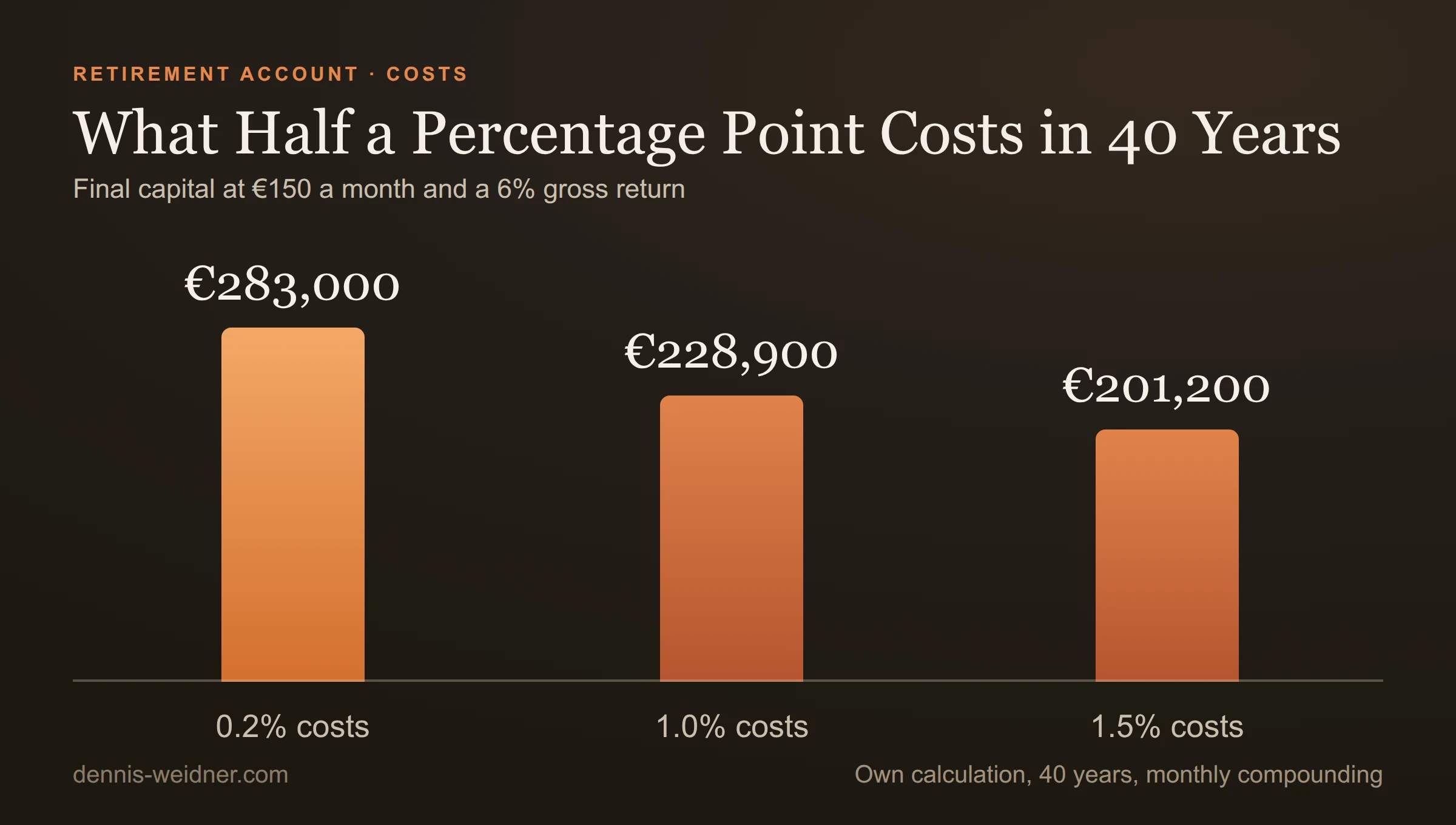
For savers the lesson is simple: the cost ratio is the only feature of a retirement product you know in advance. Return is a hope, costs are a fact.
For providers it means something else. With a one per cent cap and competition starting at zero account fees, nobody earns on the fee. The money is in volume and in everything that comes afterwards. That is a business for very large or very specialised houses and for nobody in between. Trade Republic has announced a launch for 1 January 2027, Scalable Capital and others have signalled interest.
Where the money in this market is actually made
It is the same question with every regulatory shift, and I answer it the same way every time: do not enter where the licence is, enter where the work is. With the GDPR the winners were not the law firms but the vendors of consent banners and compliance software. I described the same pattern for announced deadlines in what an announced deadline does to a market.
Subsidy logistics. Applications, evidence, changes in the household, clawbacks: with Riester this was the underrated source of error that pushed contracts into dormancy. Solve those processes as software and you sell to every provider instead of to end customers.
The comparison and advice layer. The striking thing about this market is that it already exists although the product does not. A search for „Altersvorsorgedepot“ on 12 August 2026 returns several portals on the first page comparing providers and offering calculators for a product that starts in 2027. That is not a coincidence but the recognition that visibility for a search term that does not yet exist is cheaper to build now than later.
The employer channel. The early-start pension arrives through families, and families sit inside companies. An offer an employer can hand to staff is a distribution channel with a thousand customers per deal.
The dormant book. Roughly three million dormant contracts are the worst-served asset in the German retirement market. Those people do not need a new provider, they need somebody to tell them what happens to the old contract. Whoever does that owns the relationship when the 2027 question arrives.
What the reform does not solve
The reform gets three things right that Riester got wrong: it permits equity risk, it caps costs, and it opens the subsidy to the self-employed. Those are the three criticisms repeated for twenty years.
What it does not solve is the real problem: the people who need private provision most are not the people who open investment accounts. As long as the public standard product is only an authorisation in the statute rather than an offer on the table, this remains an improvement for people who were saving anyway.
A second point stays open, and it was expensive under Riester: the payout phase. A withdrawal plan to at least 85 is better than annuitisation on poor terms, but anyone living beyond 85 needs something afterwards. What that transition looks like in practice appears in no brochure, because no product exists yet.
For the business side the conclusion holds: when a law sets a date on which one product stops and another starts, the year in between is when market share is redistributed. Those years are rare. My running commentary on this sits under crypto and finance.
This article is an entrepreneur’s assessment of the legal position and does not constitute investment or tax advice. Seek professional advice for your own situation.
Frequently Asked Questions
What is the Altersvorsorgedepot?
A state-subsidised private retirement account that replaces the Riester pension in new business from 1 January 2027. It may invest in shares, funds and ETFs and may do without a contribution guarantee. The legal basis is the German retirement reform act, adopted by the Bundestag on 27 March 2026 and published on 29 May 2026.
How large is the subsidy?
The basic subsidy is 50 per cent on contributions up to €360 a year and 25 per cent on the part between €360.01 and €1,800, capped at €540. Each child brings 100 per cent on a contribution of up to €300 a year, and people under 25 receive a one-off career-starter bonus of €200.
What happens to an existing Riester contract?
It continues unchanged and is not converted automatically. From 1 January 2027 only new contracts are ruled out. There are three routes: leave it, switch the subsidy regime only, or move to a new product. Subsidies already received are not clawed back when moving, but switching, set-up and distribution costs may apply.
Can self-employed people use the new account?
Yes, and that is the biggest substantive change. Self-employed people with income under sections 15 or 18 of the German Income Tax Act, and mandatory members of professional pension schemes, are directly eligible from 2027. Under Riester both groups were only indirectly eligible or not eligible at all.
What is the early-start pension and when does it start?
The federal government pays €10 a month into an individual retirement account for every child from the age of six until 18, beginning with the 2020 birth cohort. The cabinet adopted the government bill on 12 August 2026 and the law is intended to take effect on 1 January 2027. Payouts begin at 65 at the earliest.
When can the money be withdrawn?
From age 65 at the earliest. The options are a lifetime annuity or a withdrawal plan running to at least age 85; at the start of the payout phase up to 30 per cent may be taken as a lump sum. Taxation is deferred to the payout.
How much may the account cost?
The standard product is capped at 1.0 per cent a year. The bill originally provided for 1.5 per cent. The difference is material: at €150 a month, a 6 per cent gross return and 40 years, the two rates are roughly €27,700 apart in final capital.
Is the account worth it for low earners?
On the numbers, yes, because the subsidy rate is highest on small amounts: 50 per cent on the first €360. The old Riester route required 4 per cent of the previous year's income, otherwise the subsidy was cut; the new system requires €120 a year. It still assumes there is money to save in the first place.
How many Riester contracts are left?
At the end of 2025 the German labour ministry counted 14.663 million, down 318,000 on the year and the eighth consecutive annual decline. Around two thirds are classic insurance policies, and just over a fifth to just under a quarter of the book is dormant.
Warm regards,
Dennis Weidner
Note: AI tools supported me in writing this article, and some images were edited with AI. I stand behind its content and every statement with my name.