In July I wrote to several members of the German Bundestag asking them to preserve the one-year holding period for crypto-assets. One replied: a member of the Finance Committee, with arguments rather than boilerplate. His answer contradicts his own group's bill on two central points, the tax rate and grandfathering. Both can be shown from the wording itself.
Germany's crypto holding period: where the legislation actually stands
First things first, because almost every headline gets this wrong: there is no law. There is not even a ministerial draft.
On 6 July 2026 the German cabinet adopted the government's draft federal budget for 2027. It states the intention to reclassify privately held crypto-assets as investment income. But a budget draft is not a tax law. The tax amendment act that would implement it has to pass both chambers of parliament.
The timetable as it stands: the Finance Ministry is still drafting until the end of August 2026, followed by the consultation of associations. First reading is scheduled for 7 to 11 September, committee deliberations for October and November, the final vote for late November, the Bundesrat for 18 December. Announced entry into force: 1 January 2027.
The only real piece of legislative text on this subject is the bill tabled by the Green parliamentary group, Bundestag document 21/5752, introduced on 5 May and rejected on 20 May 2026. I read it in full. That is where the two points in this article come from. So that everyone can see for themselves, the document is available here for download:
Bundestag document 21/5752 as PDF
The full bill including the operative wording, the application rule and the explanatory memorandum, 8 pages, 174 KB. Official work, in the public domain under section 5 of the German Copyright Act. German language.
Download PDF dserver.bundestag.de →Taxing crypto like shares? What the German bill actually says
In July I wrote to several members of the Bundestag asking them to preserve the one-year holding period. One replied: Dr Moritz Heuberger of the Greens, a full member of the Bundestag Finance Committee, with arguments rather than boilerplate. That deserves acknowledgement, and it is why this piece is not a takedown.
I am not naming the others I wrote to. Whoever engages gets an answer.
His reasoning: why should crypto gains be tax-free after a year when gains on shares and funds are taxed as a matter of course?
A fair question, but it does not describe his own group's bill. Document 21/5752 explicitly does not move crypto-assets into investment income under section 20 of the Income Tax Act. It leaves them as an „other asset“ under section 23 and merely deletes the one-year period there. The explanatory memorandum spells it out: gains would be taxed „at the personal income tax rate, regardless of the holding period“.
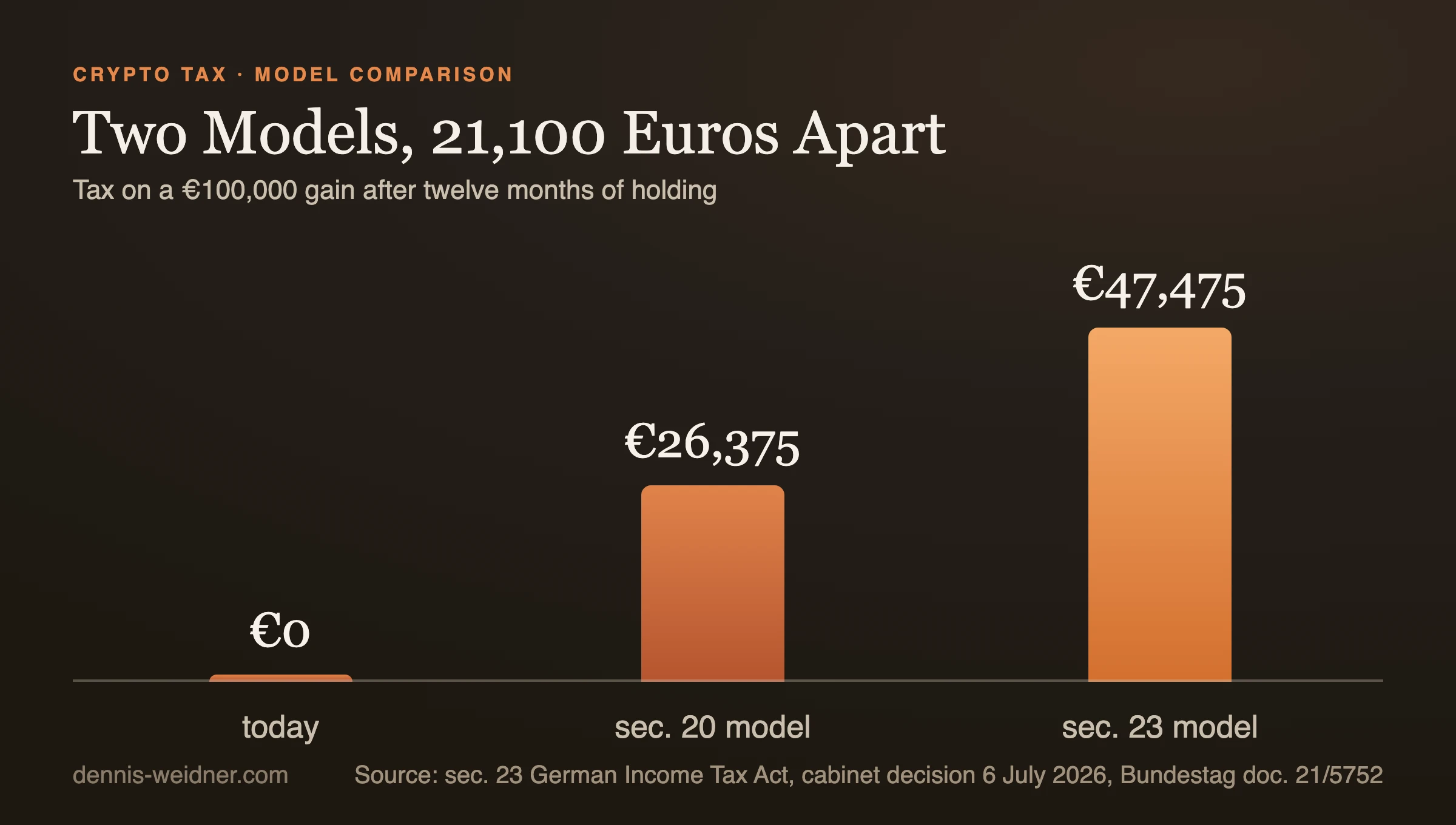
That is not parity with shares. It is a threefold disadvantage compared with shares: 26.375 per cent for shares against up to 47.475 per cent for crypto; loss relief inside the investment-income pool with unlimited carry-forward for shares, against an isolated ring-fence under section 23(3) for crypto; and withholding at source by the bank for shares, against a full self-declaration duty for crypto.
Someone earning €45,000 a year would pay their marginal rate on a crypto gain. The shareholder next to them pays 25 per cent. „Crypto will be taxed like shares“ only becomes true if the section 20 route is chosen, and the bill does not take it.
Gold, art and classic cars keep their holding period
My central argument in the original letter was equal treatment under Article 3(1) of the German Basic Law. The reply does not address it. The bill does, and it confirms the objection. The rule is appropriate, it says, „because other assets such as physical gold, antiques, works of art, historic vehicles or foreign currency are used for speculative gains to a considerably lesser extent“.
That is not the tidying-up of an unsystematic exemption but the removal of exactly one asset class from a rule that continues to apply to everything else, resting on an empirical claim about the „extent of speculation“ for which the bill offers no source, no yardstick and no threshold.
Germany's Federal Constitutional Court requires a specific substantive justification when a once-established taxation principle is broken; a purely fiscal motive expressly does not suffice. This is where the constitutional challenge will start.
My position is unchanged and fair: anyone who considers section 23 unsystematic should debate section 23 as a whole, gold, antiques and classic cars included. Then I will discuss systematics. As long as only crypto is carved out, it is a targeted levy wearing the label of fairness.
Where the measure sits in the budget fits that reading: crypto appears in the 2027 consolidation package alongside a sugar levy, a plastics levy and higher alcohol and tobacco duties. That is the neighbourhood of sin taxes, not of capital-income reform.
Illicit crypto transactions: what the 2025 figure actually says
The explanatory memorandum to Bundestag document 21/5752 does not rest the carve-out for crypto on tax systematics alone. It also invokes „systemic risks that have arisen“ and a „vanishingly small use as a means of payment“. The figure usually cited to support that is the share of illicit transactions. So let us look at it, and at the current one.
According to the Chainalysis Crypto Crime Report 2026, illicit addresses received at least 154 billion US dollars in 2025. That is 162 per cent more than in 2024, when the figure was 57.2 billion. The share of all attributed transaction volume rose slightly against 2024 and still sits below one per cent.
The widely quoted „0.14 per cent“ comes from the previous edition of the same report. I used it, as did most people in this debate, and the new edition has superseded it. Anyone still working with it today is working with yesterday's edition, whichever side they are on.
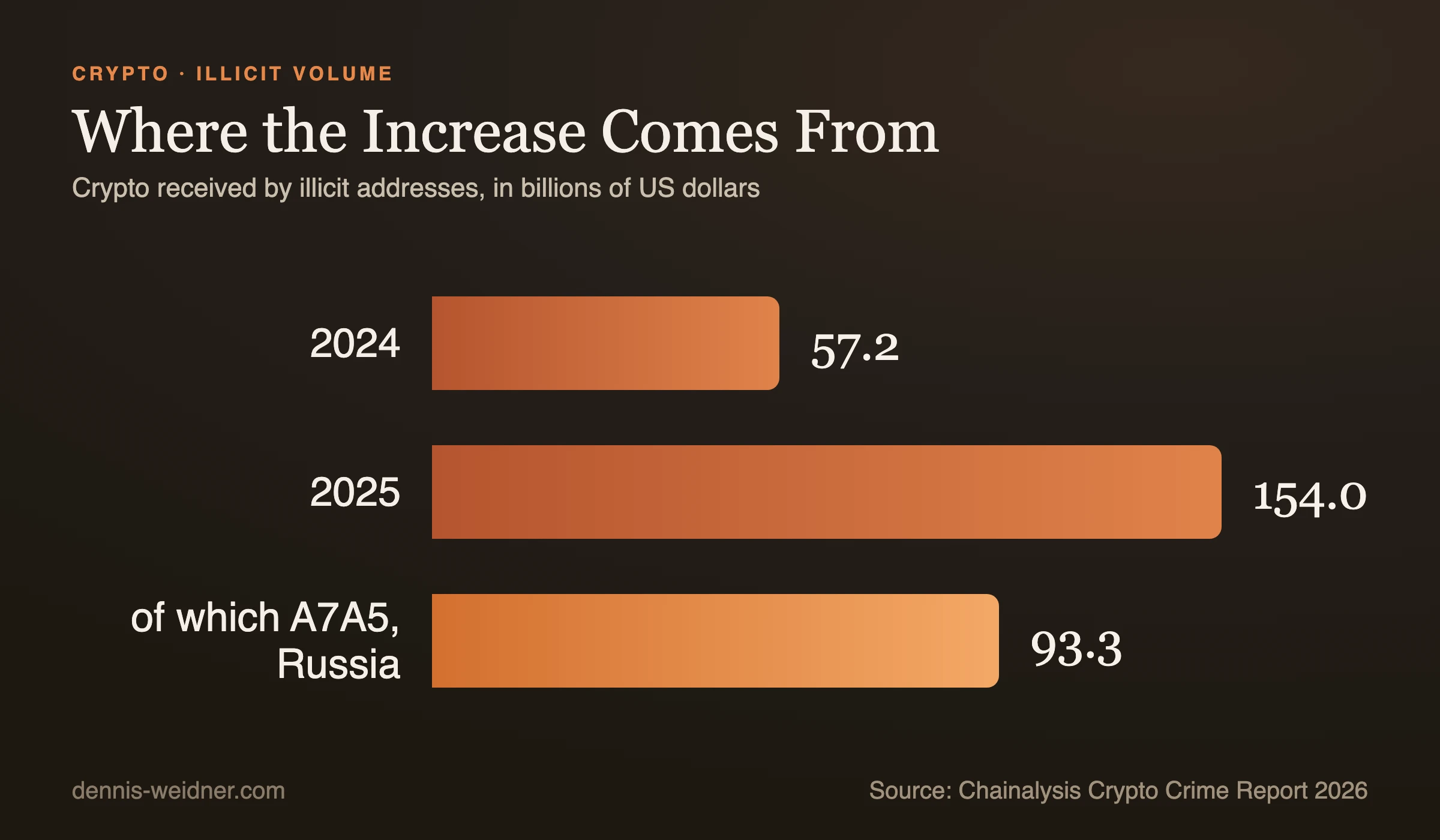
Now look inside the total, because a sum is not yet a finding. The increase is driven overwhelmingly by sanctioned entities, whose volume grew by 694 per cent. The Russian rouble-backed token A7A5 alone, launched in February 2025, moved more than 93.3 billion US dollars in under a year according to the report. Stablecoins now carry 84 per cent of illicit volume.
What is growing here is sanctions evasion by state and state-adjacent actors. It is not a saver in Brandenburg leaving Bitcoin untouched for twelve months.
The holding period touches none of it. Whether a private investor in Germany can sell tax-free after twelve months makes precisely no difference to a rouble-backed sanctions vehicle. The instruments against illicit flows are different ones, and they already exist: the reporting obligation for all centralised crypto service providers under DAC8, in force since 1 January 2026, supervision under MiCA, and sanctions enforcement.
So anyone campaigning for abolition on risk grounds has to explain why the answer to sanctions evasion is a tax on long-term savings in Germany. I have yet to see that explanation anywhere.
My position holds up against the new figure: the total rose, but what the rise describes is sanctions evasion, not the holding period.
Grandfathering and the cut-off date of 31 December 2025
This part deserves close reading, because tens of thousands of investors are asking this question.
Heuberger writes that the bill under discussion would apply only to crypto-assets acquired in future, and that existing holdings whose holding period has already been completed would not be affected.
The application rule in Article 1(2) of the bill attaches to something else entirely, solely to the moment of acquisition. Two divergences follow.
„Acquired in future“ does not hold. The cut-off date of 31 December 2025 already lay in the past when the bill was introduced on 5 May 2026. Everything bought since 1 January 2026 would be caught, purchases made under the law as it stood, confirmed by Germany's Federal Fiscal Court in 2023.
Running holding periods are cut off deliberately. The memorandum says so openly: the new rules apply to crypto acquired from 1 January 2026 onwards, and for those the one-year period has not yet expired. It relies on a Constitutional Court ruling holding that the mere possibility of realising gains tax-free later does not create a protected position of legitimate expectation.
My own case makes it concrete: I bought bitcoin in August 2026. The one-year period runs until August 2027. No law existed at the time of purchase, and none exists today, not even in draft. Under the application rule this purchase would be fully caught, the holding period is, after all, not „already completed“.
For comparison: when Germany abolished the speculation period for shares in 2009, existing holdings stayed tax-free permanently. Why a different standard should apply to crypto has not been answered. That is the question I put back to him.
Positions cut across the parliament: the conservatives promise grandfathering, the Left wants no transition at all, and the cabinet paper of 6 July contains no rule on the point whatsoever. Anyone claiming to know today how grandfathering will end up is overclaiming. We track the practical consequences for investors continuously at CryptoTicker.
Which purchases would be caught, and the unanswered question of disposal order
Because the cut-off attaches to acquisition, the purchase date decides everything. Four cases, measured against the application rule in document 21/5752:
Church tax not included. The €3,101 reflect a 42 per cent marginal rate plus solidarity surcharge, the €1,846 a flat 25 per cent plus surcharge.
Cases two and three show the sharp edge. Someone who bought on 20 December 2025 stays protected even though their one-year period runs into December 2026. Someone who bought on 5 January 2026 is caught. Two and a half weeks apart, under a legal position that existed in neither case at the time of purchase.
More important in practice is a question the bill does not answer: what happens when old and new holdings sit in the same wallet? Anyone who bought bitcoin in 2024 and topped up in spring 2026 holds protected and caught coins side by side. On sale, it has to be clear which tranche counts as disposed of.
The statute does not say. The disposal-order rule inside section 23(1)(1) no. 2 applies expressly to foreign currency amounts, not to crypto-assets. What would govern is therefore the tax administration's own guidance. The current Finance Ministry circular of 6 March 2025 on specific questions of the income tax treatment of certain crypto-assets, which superseded the version of 10 May 2022, works from individual identification. Where individual identification is not possible, the earliest acquired assets of a given trading designation count as disposed of for holding-period purposes, assessed wallet by wallet.
In plain terms: a sale would consume the old, protected holding first. That is the more favourable order at first glance, but it has a flip side. The protected legacy holding gets used up first. Anyone selling and rebuying over the years loses grandfathering piece by piece, without that ever having been decided as a matter of policy. It follows from an administrative circular written for an entirely different question.
Points like this belong in a statute, not in guidance that can be changed without a parliamentary vote. It is one of the five points I raised in my reply.
Here is my own case. The amounts are rounded and illustrative; the dates are not.
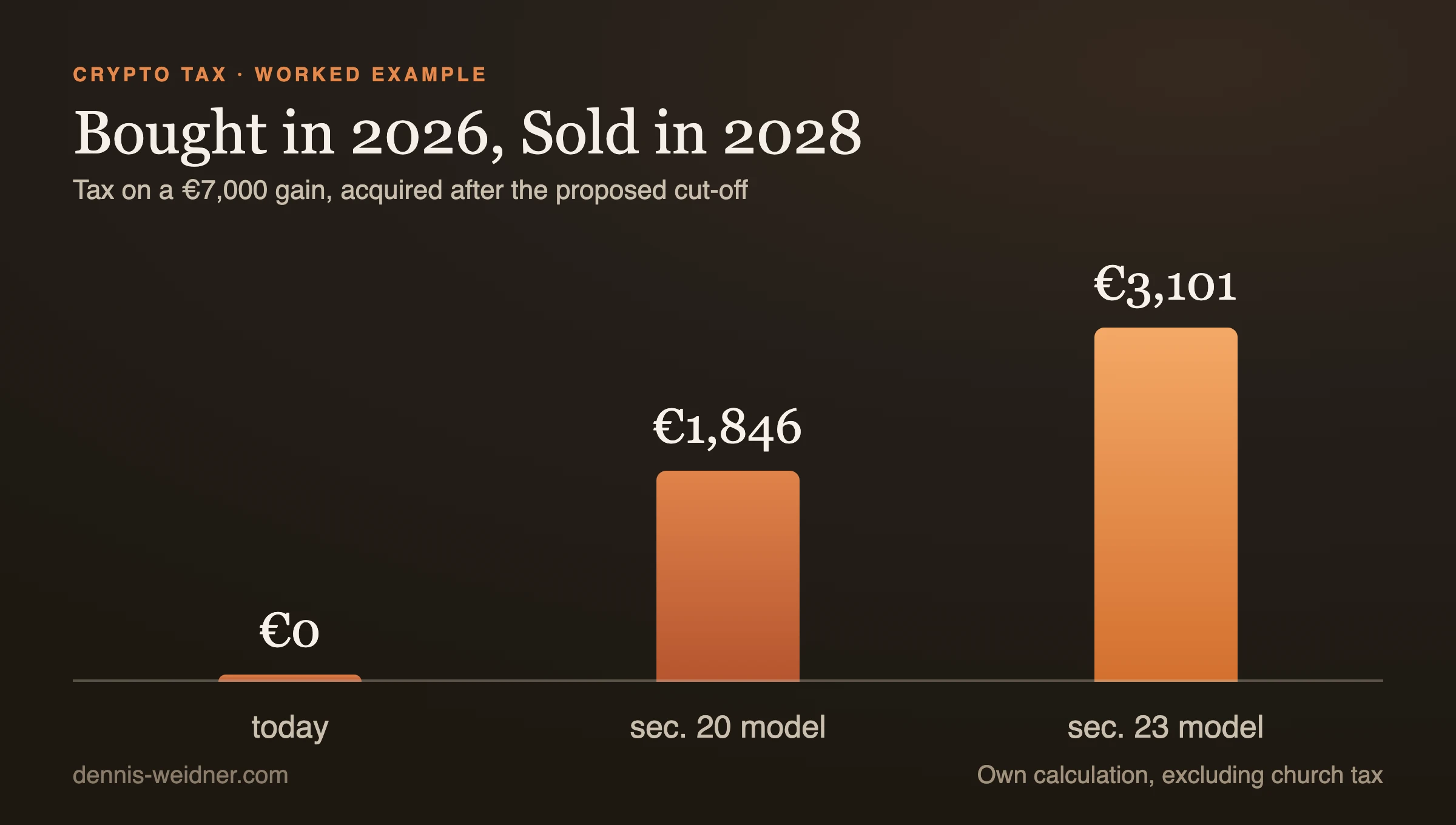
The two figures in the last column are the two models: €3,101 under the Green bill at a marginal rate of 42 per cent plus the solidarity surcharge where it applies, and €1,846 under the finance minister's model at 25 per cent plus surcharge. The €1,000 threshold in section 23(3) does not help here, because it is an exemption limit rather than an allowance: one euro above it and the entire gain becomes taxable.
Both purchases are in the past. Both were made while the one-year rule was settled law, confirmed by the Federal Fiscal Court. And both would be caught because they fall after 31 December 2025. Had I bought the same coins on 20 December 2025, none of it would be taxable.
This is not an edge case. It is the normal situation for anyone running a savings plan through 2026 or buying a dip. It is also why I consider the cut-off date the more important question, ahead of the tax rate.
Revenue from crypto taxation: 300 million or 11.4 billion?
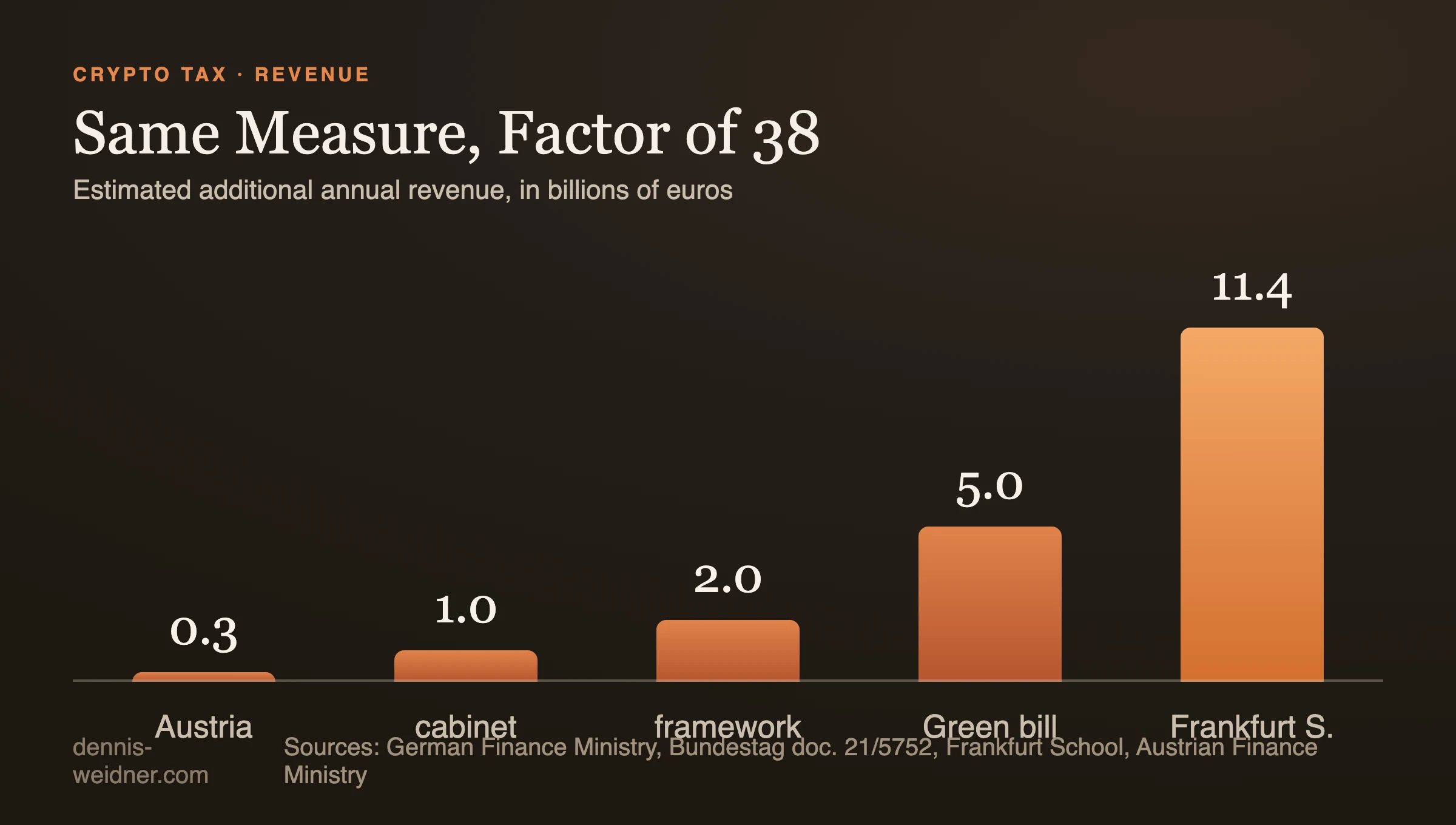
The Green bill puts the additional revenue at „at least around €5 billion“. The Frankfurt School analysis cited by the group arrives at up to €11.4 billion. The cabinet decision of 6 July names €1 billion for 2027, a figure that bundles crypto taxation with the fight against financial crime and does not break out the crypto share.
Against that stands the only real-world measurement available. Austria abolished its holding period in 2022 and in 2024 collected €33.84 million in capital gains tax on crypto, 0.57 per cent of its capital gains tax revenue. Scaled to Germany's population, that is roughly €300 million.
These €33.8 million are Austria's entire crypto tax revenue, not the isolated effect of abolishing the holding period, so the comparison is an upper bound. It still works as a reality check: if the total revenue of a comparable country sits at this level, a German expectation in the billions needs a justification.
The gap between €300 million and €11.4 billion is a factor of 38. Germany's Bitcoin industry association has put fifteen methodological questions to the authors of the highest estimate, on data provenance, representativeness, extrapolation, assumed behavioural responses and error margins. They remain unanswered. A number expected to carry a federal budget should survive that scrutiny.
Crypto tax across Europe: Portugal, Czechia and Luxembourg
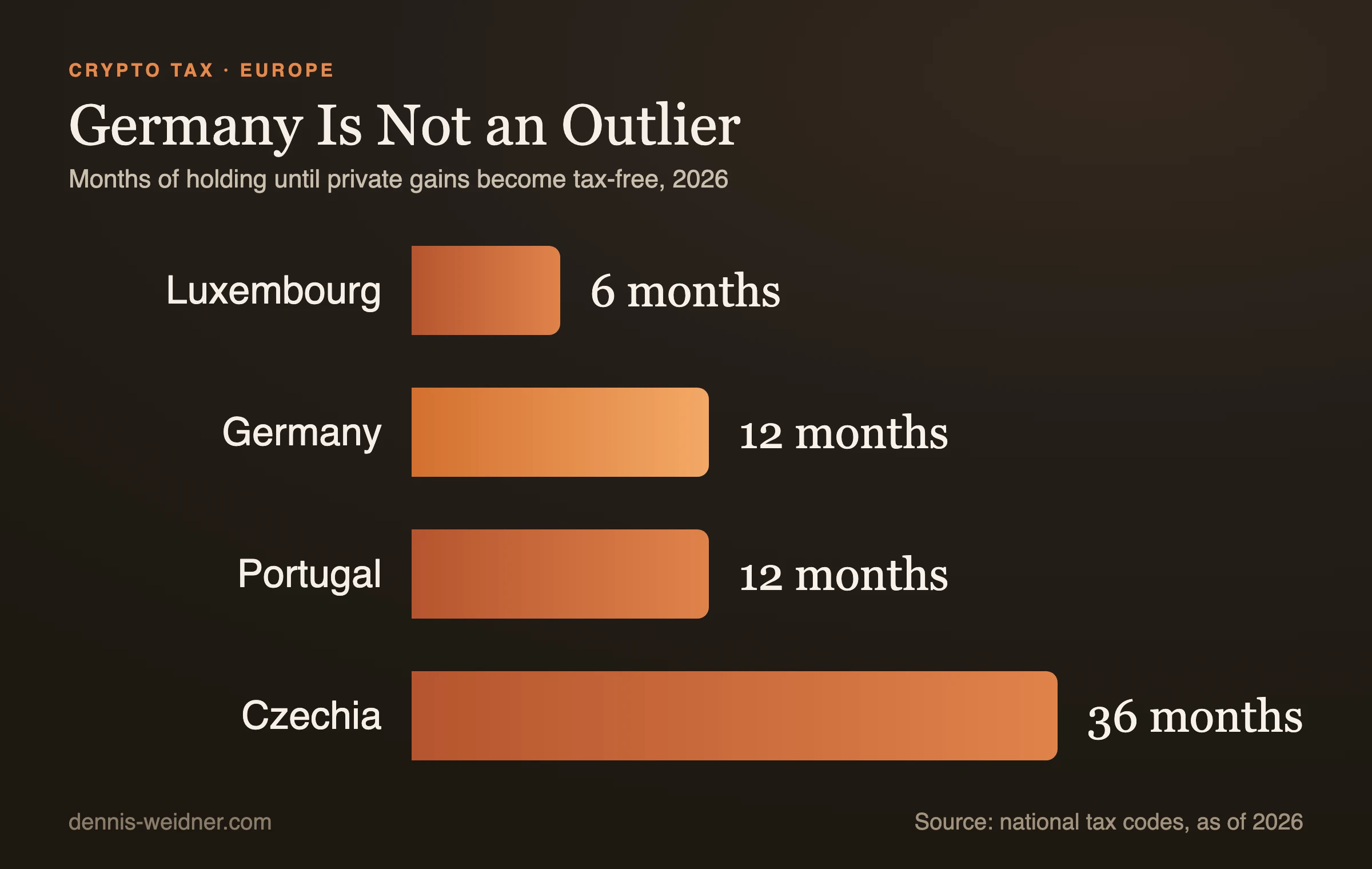
The memorandum to document 21/5752 claims Germany is „almost the only country within the European Union“ that exempts gains after a short holding period. That is not correct.
Luxembourg exempts after six months, Portugal after 365 days, Czechia after three years since the 2025 tax year; Slovenia and Malta have their own exemption regimes. Outside the EU, private capital gains in Switzerland are generally tax-free. Austria, which moved to securities-style taxation at 27.5 per cent in 2022, is the counterexample.
Germany sits in the middle of the field, not at its edge. That does not argue against every reform, but it does argue against the story that a national outlier needs correcting.
Where the parliamentary groups stand on the crypto holding period
What gets lost in the debate is that there is no united front, neither for abolition nor for keeping the rule. The positions cut straight through the governing coalition.
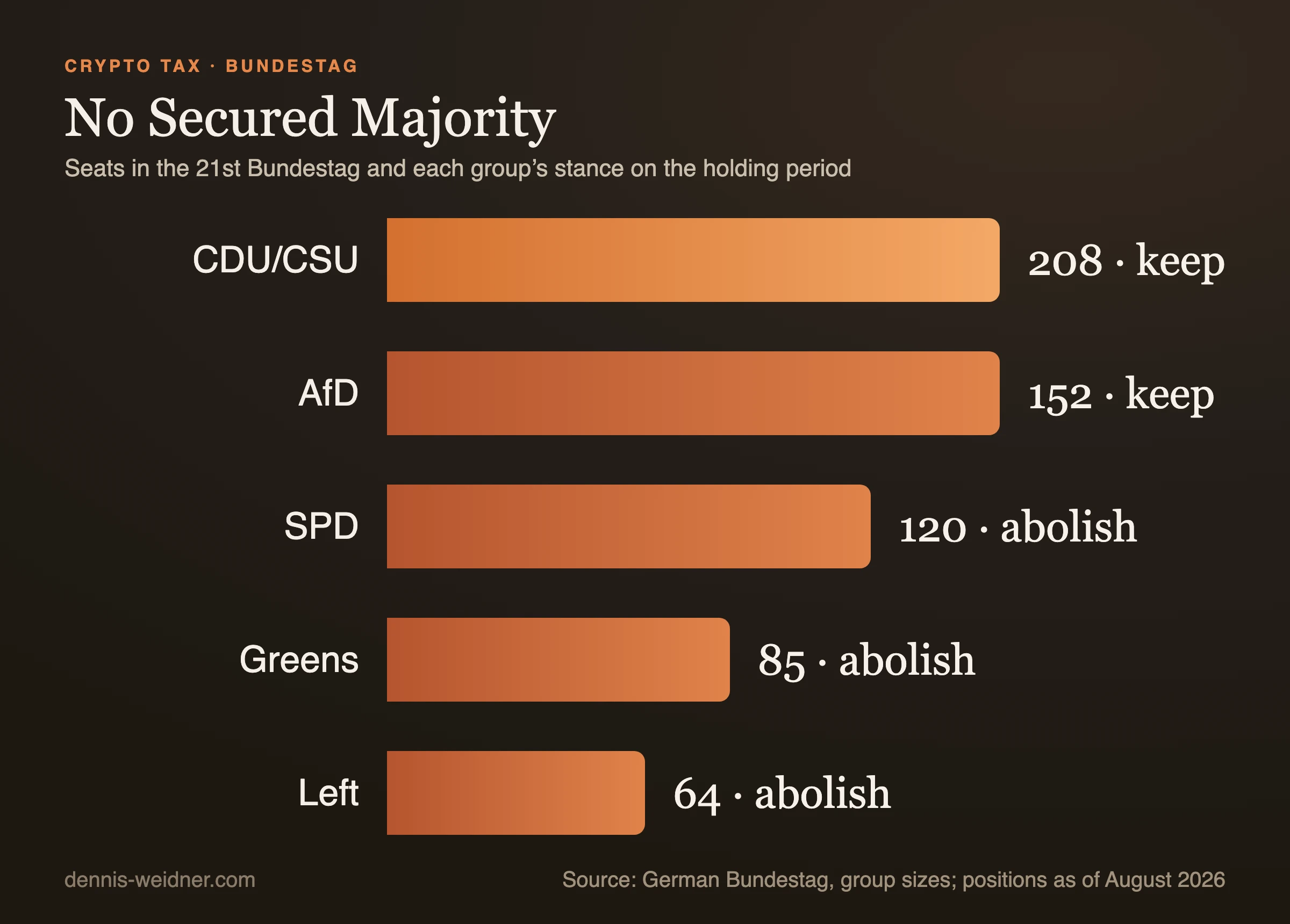
The SPD is driving the project. Finance Minister Klingbeil introduced it through the budget and wants crypto reclassified as investment income, taxed at 25 per cent plus the solidarity surcharge.
The Greens also want abolition, but by a different route: crypto stays in section 23 and is taxed at the personal rate. That is the bill this article is about.
The conservatives (CDU/CSU) defend the holding period. In committee they argued the Green bill would have „opened up new gaps in fairness“ by treating crypto differently from precious metals or foreign currency. On grandfathering they have committed themselves: anyone who invested in reliance on the law as it stood must stay protected.
The Left goes furthest, wanting the new regime to apply from promulgation with no transition at all, plus an exit tax on unrealised gains.
The FDP, currently outside parliament, came out in July for keeping the rule and additionally raising the exemption threshold from 1,000 to 10,000 euros. The AfD also opposes the reform.
In arithmetic terms: 269 seats favour abolition, 360 favour keeping the rule. A majority for abolition exists only if the conservatives abandon their position or coalition discipline moves them. That is why the outcome is genuinely open, and why writing to members of parliament is worth the effort.
The paradox at the heart of the German crypto tax plan
The most interesting criticism of the plans comes not from the crypto industry but from the conservatives, and it turns the fairness argument on its head.
CDU member of parliament Olav Gutting worked out in late July what the Klingbeil model means for short-term sellers. Anyone selling within a year today pays their personal rate, up to 45 per cent. Under a reclassification to section 20 it would be a flat 25 per cent. For day traders and speculators, the reform would be a tax cut. The burden would fall on exactly those who hold for the long term and are tax-free after twelve months today.
That is no detail but an inversion of the stated purpose. If the aim is to capture speculation more fairly, a model that relieves speculators and burdens long-term holders misses by a wide margin. The Green route through section 23 avoids that tax cut, but buys the disadvantage against shares and the ring-fenced loss pot instead. Both models on the table have a design flaw; they simply have different ones.
Can any of this still change? Yes. There is no ministerial draft, no consultation of associations and no parliamentary reading. The 12th of August was widely reported as the date by which the cabinet would have had to adopt a draft to take the regular route without shortened deadlines. It is not a formal cut-off, and the government can accelerate. But the schedule is tight, the Annual Tax Act of 13 July did not contain the provision, and the tighter it gets, the more weight falls on what remains unresolved: grandfathering, loss relief, staking, a de-minimis threshold.
This is the moment when getting involved changes something. I was at the Bundestag with the Bundesblock association at the invitation of the CDU, discussing distributed ledger technology, its economic significance and the holding period among other things. Conversations like that do not create majorities, but they make sure the technical arguments arrive before a draft is written. Anyone who waits until the law is in the federal gazette has missed the point at which wording can still be changed.
What a workable reform of the crypto holding period would look like
Heuberger writes that the aim is not to hinder innovation or punish small investors. Taken at its word, that would produce a different law. Four points.
First, if parity, then real parity. Allocation to section 20 at 25 per cent, with loss relief inside the investment-income pool and the saver's allowance, not the variant reaching 47.475 per cent with a ring-fenced loss pot.
Second, a cut-off date that does not lie in the past. Acquisition-based grandfathering as of the date of promulgation, as in 2009 for shares.
Third, a de-minimis threshold for everyday transactions. Otherwise every swap between two crypto-assets, every Lightning payment and every staking payout becomes a reportable event, at a compliance cost bearing no relation to the revenue.
Fourth, settle loss relief and staking in the statute rather than leaving them to administrative practice. Both remain open.
Concretely: Article 1(2) of document 21/5752, the application rule, is the paragraph that has to change, because that is where the backward-looking cut-off date sits. Article 1(1) sentence 3 would need to be replaced by an allocation to section 20 if parity with shares is genuinely the goal.
I told Heuberger in advance that I would publish this exchange and offered him the chance to add to it. I am accepting his invitation to a constituency surgery. He was the only one of the MPs I wrote to who engaged on the substance, and that is why this is not a takedown.
If you work on this subject, in politics, in advisory or as a founder in the crypto space, I am happy to talk. I share the underlying data openly, sources included.
Frequently Asked Questions
Has Germany's crypto holding period already been abolished?
No. There is neither a law nor a ministerial draft. The cabinet decision of 6 July 2026 on the 2027 federal budget only states the intention to reclassify crypto-assets as investment income. Both chambers of parliament still have to decide; the first reading planned for September 2026 did not take place.
When would the new crypto taxation take effect?
The announced date is 1 January 2027. The only legislative text tabled so far, Bundestag document 21/5752, attaches to acquisitions after 31 December 2025. That bill was rejected on 20 May 2026 and is therefore not law.
Are coins bought in 2024 protected?
Under the rejected bill, yes, because they were acquired before the cut-off date. For the government bill that does not yet exist, the question is open: the cabinet paper of 6 July 2026 contains no grandfathering or transitional rule at all.
What about crypto bought during 2026?
That is the contested point. Under the application rule in Article 1(2) of document 21/5752 they would be caught, even though the one-year period is still running. The explanatory memorandum says so explicitly, relying on a Federal Constitutional Court ruling. Whether the government bill adopts the same cut-off date is unknown.
Will crypto be taxed like shares in Germany?
It depends on the model. The cabinet decision points to section 20 of the Income Tax Act at 25 per cent flat plus solidarity surcharge, that is 26.375 per cent. The Green bill instead keeps crypto in section 23 and taxes it at the personal rate of up to 45 per cent plus surcharge. That would not be parity with shares but a disadvantage.
Do gold, art and classic cars stay tax-free?
Under the bill, yes. It removes only crypto-assets from the one-year period of section 23. Physical gold, antiques, works of art, historic vehicles and foreign currency keep it. That is the basis of the equal-treatment objection under Article 3(1) of the Basic Law.
How much tax would apply to a 100,000 euro gain?
Under current law, nothing, once the one-year holding period is met. Under the flat-tax model it would be €26,375, under the personal top-rate model €47,475, each including the solidarity surcharge and excluding church tax. The two models under discussion are €21,100 apart.
How much revenue would abolition actually raise?
Estimates range from roughly €300 million to €11.4 billion a year, a factor of 38. Austria serves as a reality check: its finance ministry reports €33,839,499.66 in capital gains tax withheld on crypto for 2024. That is the total crypto tax take rather than the isolated effect of abolishing the holding period, so it works as an upper bound for comparison.
What share of crypto transactions is illicit?
According to the Chainalysis Crypto Crime Report 2026, illicit addresses received at least 154 billion US dollars in 2025, up 162 per cent on 57.2 billion in 2024. The share of all attributed transaction volume rose slightly and still sits below one per cent. The increase is driven overwhelmingly by sanctioned entities, up 694 per cent; the Russian rouble-backed token A7A5 alone moved more than 93.3 billion US dollars in under a year according to the report. None of this has any connection to Germany's holding period for private investors.
Is there a majority in the Bundestag for abolishing the holding period?
Not a secured one. The SPD, Greens and Left favour abolition with 269 seats combined; the CDU/CSU and AfD favour keeping the rule with 360 seats combined. The conservatives would have to abandon their position or be moved by coalition discipline. On 20 May 2026 the SPD voted against the Green bill, but only to wait for the finance minister's own proposal.
Would the reform be a tax cut for day traders?
Under the finance minister's model, yes. Anyone selling within a year today pays their personal rate of up to 45 per cent. Reclassified under section 20 it would be a flat 25 per cent plus the solidarity surcharge. CDU member of parliament Olav Gutting made this point in late July: the burden would fall mainly on investors who hold for the long term.
This article is a personal assessment of a political debate and does not constitute tax advice. Seek professional advice for your own situation.
Warm regards,
Dennis Weidner
Note: AI tools supported me in writing this article, and some images were edited with AI. I stand behind its content and every statement with my name.