Being self-employed in Germany for more than twenty years has meant being excluded from subsidised private retirement provision for more than twenty years. That ends on 1 January 2027: the self-employed and members of professional pension schemes become directly eligible. I ran the numbers on my own case: an advantage of 17,856 euros over twenty years, and three reasons why I still will not pay in the maximum.
Twenty years self-employed, twenty years not the target group
I have been self-employed for more than twenty years. For that entire period, state-subsidised private retirement provision in Germany was an offer that did not mean me. Riester was tied to the statutory pension insurance, and anyone not compulsorily insured there stood outside the door. Rürup remained, but Rürup is a different animal: a tax deferral without a subsidy, without a lump-sum option, without inheritability in the usual sense.
That changes on 1 January 2027. Self-employed people with income under sections 15 and 18 of the Income Tax Act, and compulsory members of professional pension schemes, become directly eligible for subsidies. It is the single largest substantive change in the reform, and it receives the least coverage, because the volume sits with employees.
I have calculated what this opening is actually worth, using my own case. The answer is less spectacular and considerably more useful than the number €540 suggests. The full overview of the law is in Germany’s New Retirement Account: How One Law Redistributes a Market. This piece is about one group only.
What changes for the self-employed
The difference fits into five lines. Four of them concern every saver, one concerns this group alone.
Legal basis is the German retirement reform act, promulgated on 29 May 2026.
The decisive line is the third, and it is almost never mentioned. Riester demanded 4 per cent of the previous year’s income as an own contribution, otherwise the subsidy was cut pro rata. For a fluctuating self-employed income that is an unpleasant construction: a good year retroactively raises the requirement for the next one. The new system drops that link entirely. €120 a year is enough for the full subsidy rate, whatever you earned.
For members of professional schemes there is one more point worth knowing before you calculate: eligibility does not depend on whether you also pay into such a scheme. Both run in parallel.
The calculation on my own case
Marketing will lead with €540. That figure is correct, but it is only half the information, because it hides the own contribution attached to it. €540 of subsidy requires €1,800 of your own money per year. That is a subsidy rate of 30 per cent, not 100.
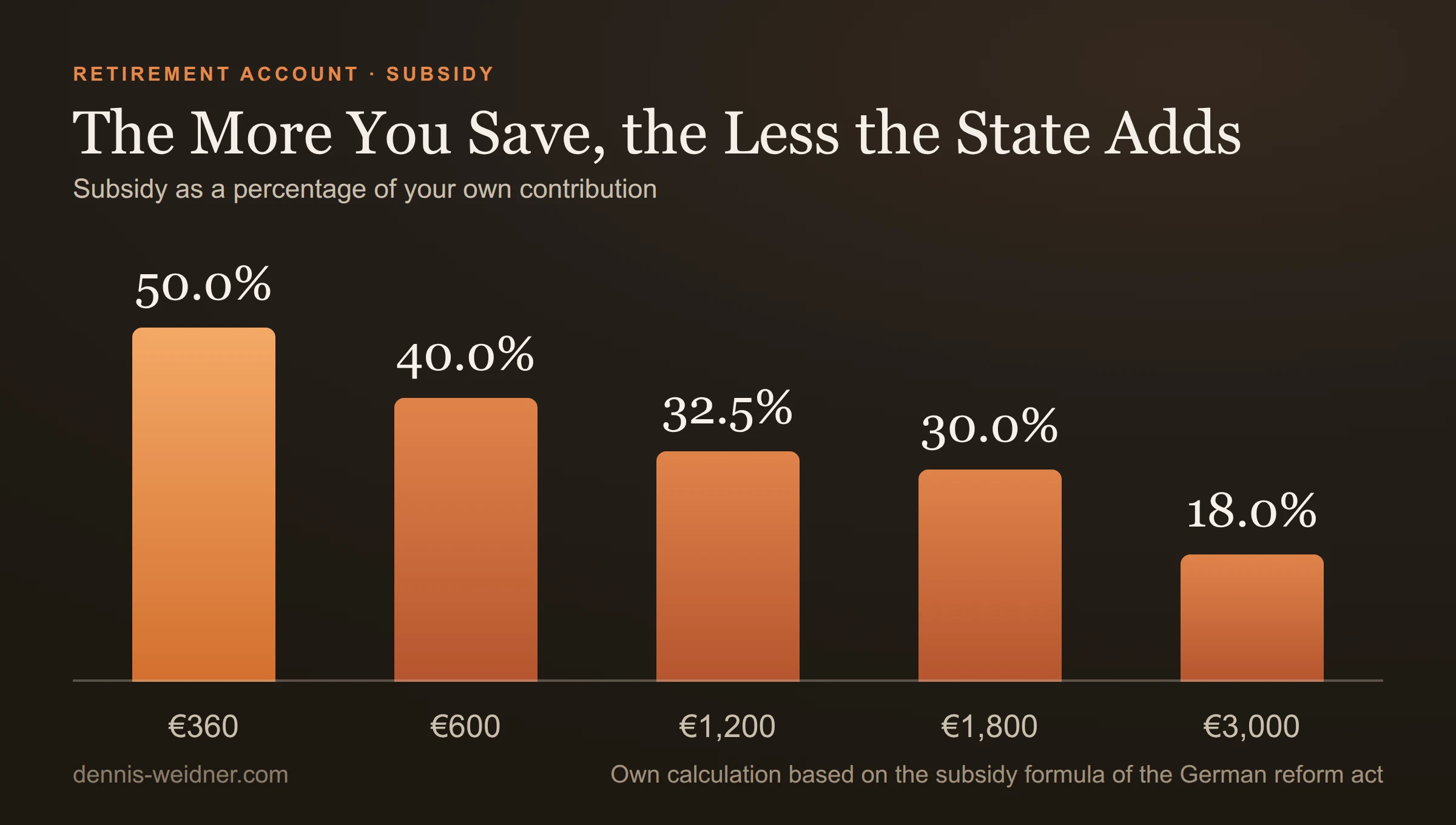
Calculated with annual contributions at year end, a 5 per cent return after costs, a 20-year term and no tax on the payout. The subsidy is shown at the maximum of €540, which requires the full €1,800 own contribution.
The advantage after twenty years is €17,856 in this calculation. That is clearly more than the €10,800 the state paid in gross, because the subsidies earn a return as well. It is also a long way from what the headline figure of 30 per cent suggests at first glance.
Where the calculation tips over for the self-employed
There are three points where I decided differently for my own case than the subsidy arithmetic suggests.
First, the lock-up. Money in this account is available at 65 at the earliest. For an employee that is a side condition. For someone whose liquidity carries their own company, it is a decision with weight. In twenty years I have repeatedly found that available capital inside the business was worth more than any subsidy.
Second, the order of operations. Before €1,800 goes into a locked product, two other things belong in place: a cash reserve that carries two bad quarters, and occupational disability cover. Both are unglamorous and both beat any subsidy rate, because they cover the case in which nothing gets paid in at all.
Third, the portion above €1,800. There is no subsidy on it, while it still carries product costs and the withdrawal restriction. Anyone wanting to save more sensibly saves the excess in a free brokerage account rather than the subsidised one.
What I am actually doing, and why
I will use the new account, with a contribution close to the edge where the subsidy rate falls from 50 to 25 per cent. The reason is not a return forecast but a rule I learned across twenty years of self-employment: a savings amount that can stay in place through a bad year is worth more than a high one you have to suspend.
The second reason is the cost side. A cap of one per cent changes not only what a product costs but who still offers it at all. I have written that up separately, because it is an entrepreneur’s question rather than a saver’s.
And the third: anyone holding an old Riester contract has to answer a different question first, namely what happens to it. That too is its own piece, because the answer depends on things no brochure mentions.
What remains open
Two things cannot be answered today.
The first is the products. So far no provider has presented a retirement account with actual prices. Whether the one per cent cap is fully used or whether competition pushes below it will decide more money than the entire subsidy.
The second is the tax treatment in the individual case. Payouts are taxed on a deferred basis. What that means for a self-employed person whose retirement income looks different from an employee’s is a question for a tax adviser, not for a blog article.
My running commentary on these topics sits under crypto and finance.
This article is an entrepreneur’s assessment of the legal position and constitutes neither investment nor tax advice. Seek professional advice for your own situation.
Frequently Asked Questions
Can self-employed people use Germany's new retirement account?
Yes. Self-employed people with income under sections 15 and 18 of the Income Tax Act, and compulsory members of professional pension schemes, become directly eligible for subsidies from 1 January 2027. Under Riester both groups were only indirectly eligible or not eligible at all. It is the largest substantive change in the reform.
How much subsidy does a self-employed person receive?
A maximum of 540 euros a year, and that requires an own contribution of 1,800 euros. The formula is 50 per cent on contributions up to 360 euros and 25 per cent on the portion up to 1,800 euros. The rate is therefore degressive: 50 per cent on the first 360 euros, but only 30 per cent across the full 1,800.
Do I need to prove a minimum income?
No, and for fluctuating incomes that is the most important difference from Riester. There, 4 per cent of the previous year's income was required as an own contribution or the subsidy was cut. In the new account 120 euros a year is enough for the full rate, regardless of income.
Is the account worth it alongside a professional pension scheme?
Eligibility exists independently of whether you also pay into a professional scheme; both run in parallel. Whether it is worthwhile depends on the individual case, in particular on liquidity and on whether disability cover and a cash reserve are already in place. That is a question for a tax adviser rather than an article.
When can I withdraw the money?
At 65 at the earliest. Options are a lifelong annuity or a payout plan running to at least age 85, plus a partial lump sum of up to 30 per cent at the start of retirement. For the self-employed this lock-up is an argument in itself, because capital available inside a business has a different value than it does for an employee.
Should I pay in more than 1,800 euros a year?
There is no subsidy on the portion above 1,800 euros, while product costs and the withdrawal restriction still apply. Anyone wanting to save more usually saves the excess in a free brokerage account. Up to 6,840 euros can be paid in with tax relief, but only the first 1,800 attract the subsidy.
What is the difference between this account and Rürup?
Rürup works through a special-expenses deduction, is structured as a lifelong annuity and offers neither a subsidy nor a lump-sum option. The new account uses direct subsidies, allows a partial lump sum of up to 30 per cent and caps the standard product's costs at one per cent. Which is cheaper depends on the marginal tax rate and on how much flexibility you want.
Warm regards,
Dennis Weidner
Note: AI tools supported me in writing this article, and some images were edited with AI. I stand behind its content and every statement with my name.