
In February 2026 stablecoins moved more volume in a single month than the American ACH network. Four months later market capitalisation fell for the first time in four years, while transaction volume hit a record. Together those two facts are the real picture: measuring this market by the stock is measuring the wrong quantity. What becomes infrastructure by 2027, and what stays hype.
Stablecoin volume in 2026: the rails have shifted
In February 2026 something happened that would have sounded like science fiction three years ago: in a single month stablecoins moved more volume than the American ACH network, the system that carries salaries, rent and bills.
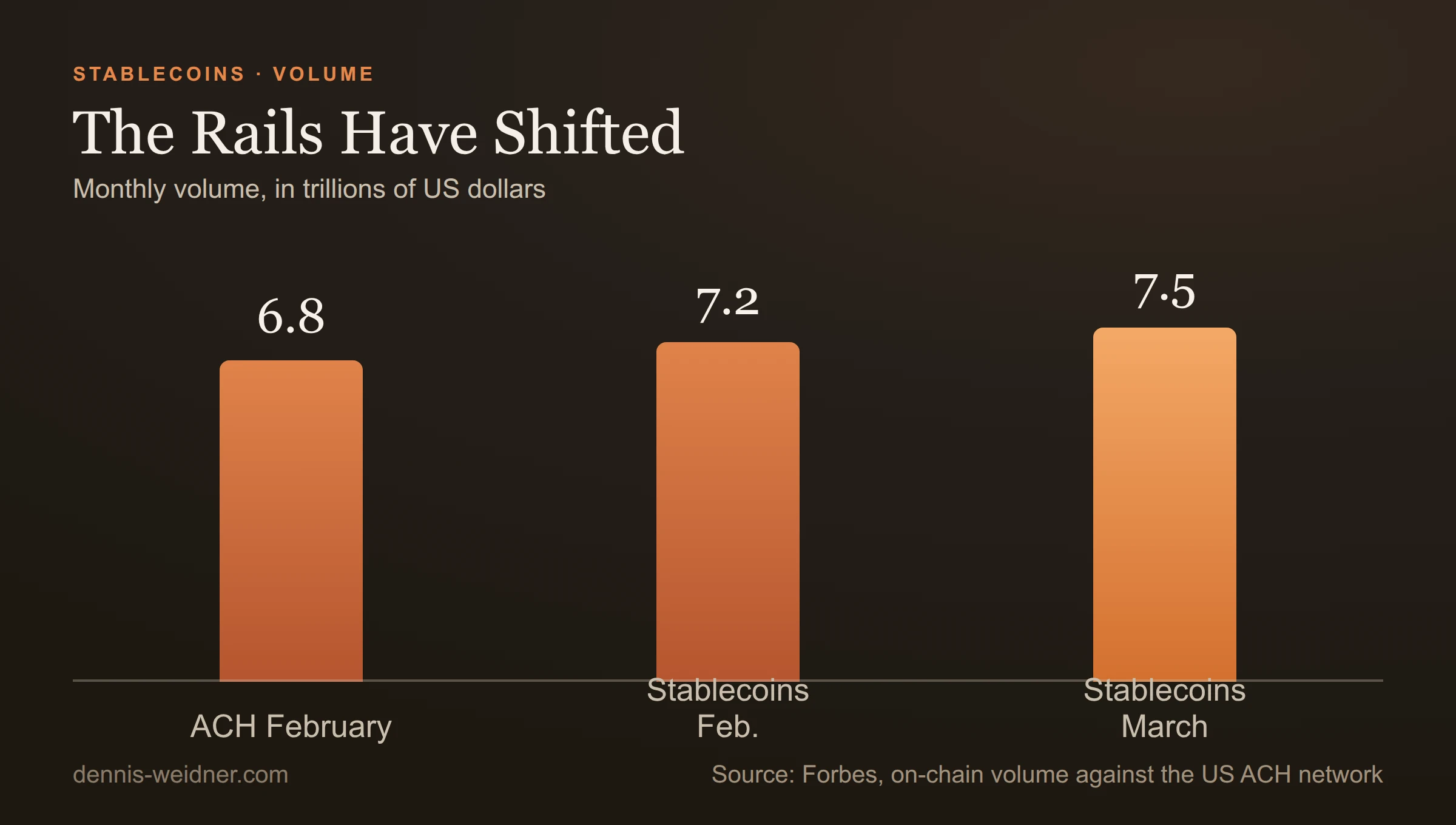
I have followed this market since 2017, among other things through CryptoTicker, and rarely has a shift been this legible. The number is also easy to misread: it measures volume moved, not invoices paid. A large part of it is trading, arbitrage and shifting liquidity between venues.
The first contraction in four years: why market capitalisation is shrinking
More interesting than the record is the counter-move. In June 2026 the stablecoin market posted its largest monthly decline since the collapse of Terra in May 2022: around $10 billion, roughly 3 per cent below the May peak. For comparison, 2022 saw 26 per cent.
The cause is a rule, not a loss of confidence: the GENIUS Act bars issuers from paying yield on stablecoins. Anyone holding dollars who wants a return moves into tokenized money market funds paying around four per cent. I described the same movement from the other side two days ago in tokenizing real-world assets: the outflow here is the inflow there.
And while balances fall, usage climbs. June 2026 saw $1.79 trillion in adjusted transaction volume, an all-time record, 63 per cent above the previous month and 125 per cent above the previous year. Measuring this market by the stock is measuring the wrong quantity. A payment system is judged by what flows through it, not by what sits in it.
The GENIUS Act and the deadline of 18 January 2027
The most important shift is legal rather than technical. The GENIUS Act of July 2025 is the first federal stablecoin law in the United States: full reserves, issuers treated like financial institutions, anti-money-laundering duties included.
The timetable points straight at 2027, and it is slipping. Final rules were due by 18 July 2026. Instead the agencies published a joint proposal on 22 June whose comment window closes on 21 August 2026. The deadline has been missed, with no operational consequence: the regime takes effect on 18 January 2027 or 120 days after final rules, whichever comes first.
For companies that means one thing: 2027 is the first full year in which the world’s largest stablecoin market runs under a single rulebook. That clarity is why banks and corporates are moving now. Nobody builds payment infrastructure on legal quicksand.
MiCA in Europe: eight euro tokens and a size problem
Europe moved earlier. Under MiCA, e-money tokens face hard rules: only licensed e-money institutions or banks may issue, reserves must be full and segregated, redemption at par is mandatory. The transitional period ended on 30 June 2026; anyone offering services without a licence since then is in breach of EU law.
As of June 2026 eight euro stablecoins met the MiCA requirements, up from five at the start of the year. The largest is Circle’s EURC with roughly $220 million in circulation and about 41 per cent of the euro segment.
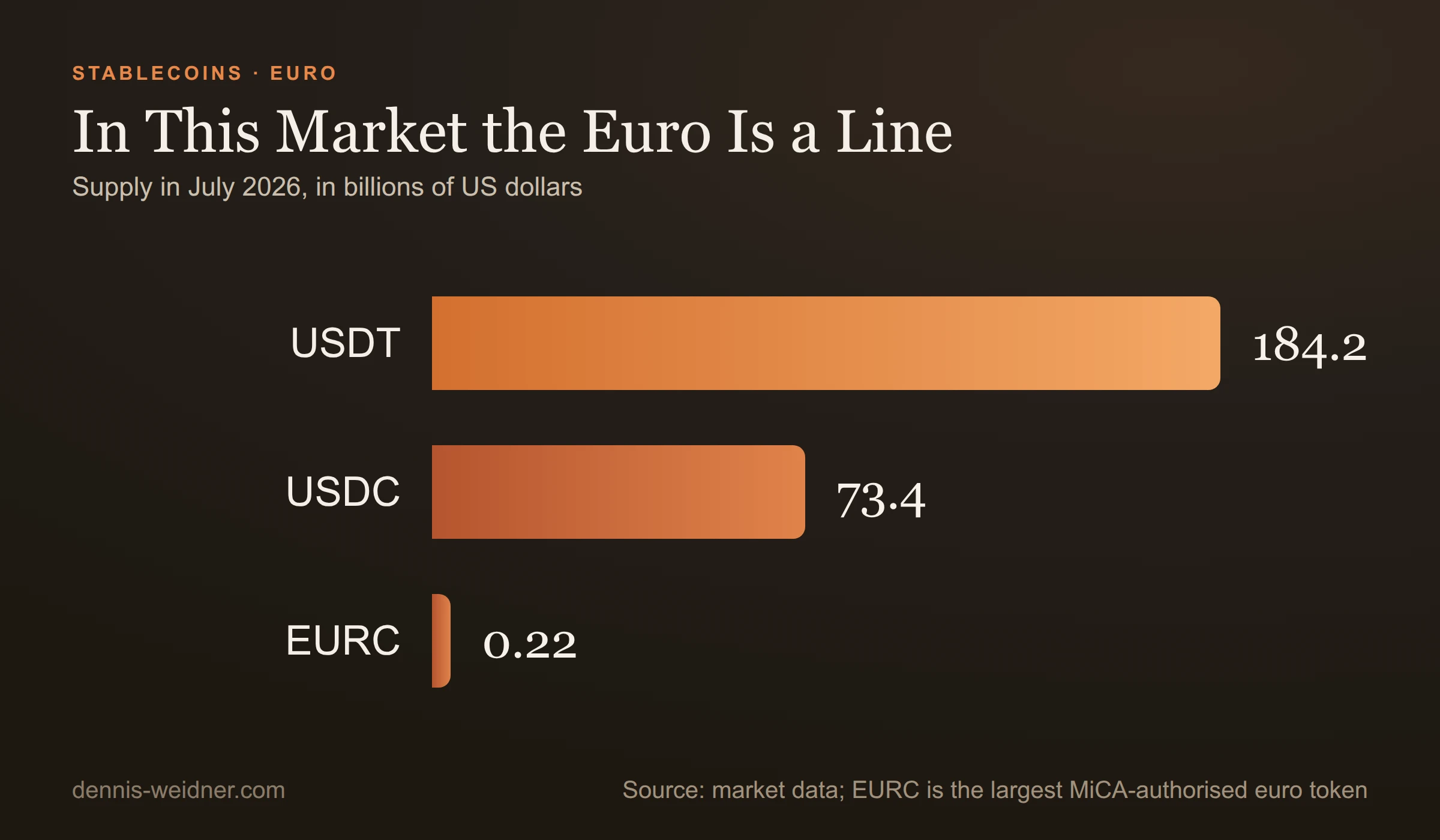
Europe built the better rulebook first, but demand arises where the trading currency sits. When European companies use stablecoins today, they almost always use dollar tokens. That is strategically uncomfortable, and one of the reasons the Eurosystem is pushing on tokenized central bank money.
What actually becomes infrastructure by 2027
Now the assessment, and it is more differentiated than the headlines suggest.
The first three rows share what defines infrastructure: the benefit is measurable and the end customer notices nothing. The groundwork is in stablecoins and the quiet rebuild of payments.
What stays hype: the everyday checkout
Nobody in Germany will pay for their weekly shop with stablecoins in 2027. Cards and instant transfers are too good, too cheap and too routine. A technology wins where it solves a problem, and in a German supermarket that problem does not exist.
The second narrative falls short as well. Only a small share of that enormous transfer volume is a real-economy payment. Confusing turnover with everyday use overstates the position by an order of magnitude. The market is a small, fast-growing real core inside a large speculative shell.
What companies should do now
If your business moves money internationally, this belongs on the table in 2026, soberly and with regulated providers in mind. Three concrete steps:
First, price a corridor, not the topic. Take one real payment route, say to a supplier outside the EU, and set fees, FX spread and settlement time against the stablecoin alternative. One corridor with numbers beats any debate of principle.
Second, examine the issuer like a bank. Who issues, under what licence, how are the reserves held, and how fast is redemption at par when it matters? Under MiCA these questions have answers, and a provider who will not answer them has answered them.
Third, plan for reporting. Anyone holding or moving crypto-assets through service providers shows up in the data reported under DAC8. No reason to panic, every reason to document properly from day one.
My conclusion for 2027: no revolution with a bang, but a quiet normalisation. Stablecoins work in the background, in settlement, treasury and B2B payments, while the GENIUS Act and MiCA hold the frame. My wider view of digital finance sits under crypto and finance.
This article is an entrepreneur’s assessment and does not constitute investment advice.
Frequently Asked Questions
How large is the stablecoin market in 2026?
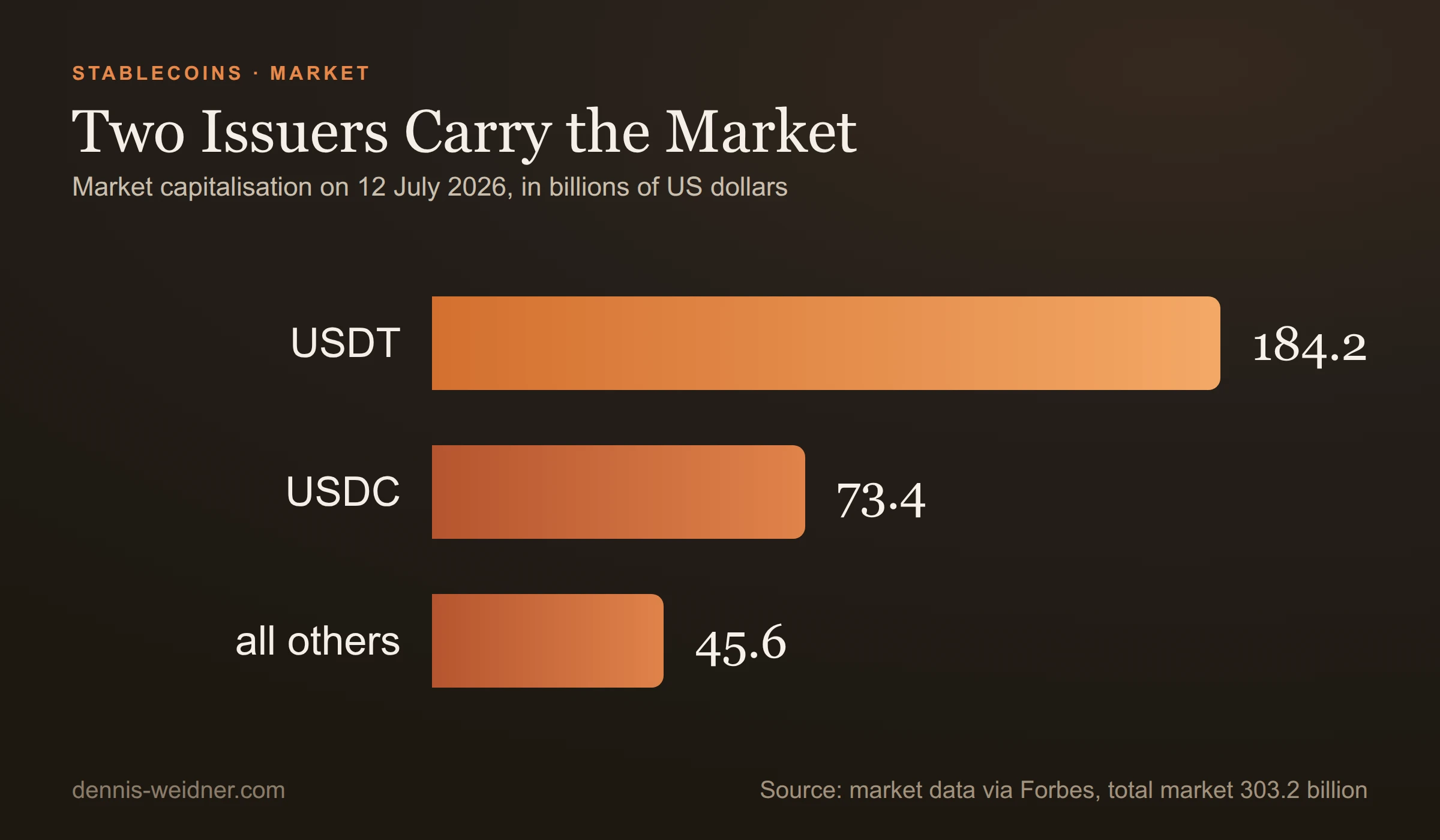
Market capitalisation stood at around $303.2 billion on 12 July 2026, of which $184.2 billion was USDT and $73.4 billion USDC. In February 2026 monthly on-chain volume reached $7.2 trillion, overtaking the US ACH network at $6.8 trillion for the first time.
Why did stablecoin market capitalisation fall in 2026?
The GENIUS Act bars issuers from paying yield on stablecoins, so holders of dollar liquidity who want a return move into tokenized money market funds. June 2026 brought the largest monthly decline since the Terra collapse in 2022, about 3 per cent below the May peak. In the same month transaction volume hit a record $1.79 trillion.
What does the GENIUS Act require, and when does it fully apply?
Full reserves, issuers treated as financial institutions, and no yield paid on stablecoins. Final rules were due by 18 July 2026; instead a joint proposal has been open since 22 June with a comment window closing on 21 August 2026. The regime takes effect on 18 January 2027 or 120 days after final rules, whichever comes first.
Are there MiCA-authorised euro stablecoins?
Yes. As of June 2026 eight euro stablecoins met the MiCA requirements, up from five at the start of the year. The largest is Circle's EURC with roughly $220 million in circulation. Measured against the whole market, euro tokens remain at around 0.2 per cent.
Will stablecoins replace ordinary payments by 2027?
Not in everyday life. Cards and instant transfers already solve the problem in Europe. Stablecoins become infrastructure in the background: in cross-border B2B payments, in treasury and in settlement, where the benefit is measurable and the end customer notices nothing.
What should a company watch out for?
Three things: price one real payment corridor instead of debating the topic; examine the issuer like a bank, meaning licence, custody of reserves and redemption at par; and document reporting obligations under DAC8 properly from the start.
Warm regards,
Dennis Weidner
Note: AI tools supported me in writing this article, and some images were edited with AI. I stand behind its content and every statement with my name.