German state tax offices audited 140,764 businesses in 2024, 1.6 percent of all registered businesses, and assessed around 10.9 billion euros in additional tax. Large businesses are audited almost without gaps, while a small business is audited on average only once every 38 years, although tax offices select cases by risk. For taxes arising from 2025, the law caps how long an audit can keep years open at five years after the year of the audit order, and a prepared company gets through much faster.
As of 1 October 2026. Not tax advice, see the note at the end.
More on this topic: Finance & Crypto Assets – background, practice and every article in one place.
What a German tax audit is and who can be audited
A tax audit in Germany (Betriebsprüfung, formally an Außenprüfung or field audit) is the tax office's on-site review of a business. Under section 193(1) of the German Fiscal Code (Abgabenordnung, AO), it is permitted for anyone running a commercial, agricultural or forestry business or working as a self-employed professional. The tax office needs no specific reason. The audit re-examines years that have already been filed, and it must establish the facts both in the taxpayer's favour and against them.
The procedure is governed by sections 193 to 203a AO, and the details sit in the Tax Audit Regulation (Betriebsprüfungsordnung, BpO), an administrative instruction from 2000. Its section 2 commits auditors to proportionality and the least intrusive means, its section 7 to what is material. Those two sentences matter more in practice than they sound. In the opening piece of this series, Entrepreneurs and Politics, I explained why I think Germany's tax administration needs reform. The audit is where you see whether a sense of proportion is actually applied.
How often are businesses audited? The German tax audit by size class
How often a tax audit comes depends mainly on the size class. Under section 3 of the Tax Audit Regulation, every business is classified as large, medium, small or micro, usually for three years. For large businesses, each audit should follow on seamlessly from the last one (section 4(2) BpO). For everyone else, an audit normally covers no more than three consecutive years. The table sets the thresholds for trading businesses next to the figures in the Federal Ministry of Finance's tax audit statistics for 2024.
| Size class | Trading business, turnover above | Audited in 2024 | Audited on average every |
|---|---|---|---|
| Large | €14.0 million | 31,210 of 105,605 (29.6%) | 3.4 years |
| Medium | €8.6 million | 31,300 of 169,330 (18.5%) | 5.4 years |
| Small | €1.1 million | 28,501 of 1,075,070 (2.7%) | 38 years |
| Micro | below that | 49,753 of 7,482,702 (0.7%) | 150 years |
The last column is simply the inverse of the audit rate, an average rather than a schedule. Taxable profit counts as an alternative to turnover: a trading business with more than 68,000 euros of profit is at least a small business, even with low turnover. In its report for 2023 the ministry describes the selection plainly: large businesses are in principle audited without gaps, all others are selected on risk criteria. For a small company that means the odds are low while the numbers look ordinary. Jumps in turnover, margin, input VAT or shareholder accounts raise them considerably.
The German tax audit since 2024: new thresholds, far fewer medium-sized businesses
On 1 January 2024 the tax authorities moved the size thresholds up by a full step. Until the end of 2023 a trading business counted as large from 8.6 million euros in turnover and as medium from 1.1 million. Since 2024 the thresholds are 14 and 8.6 million euros. The statistics show the effect: the number of large businesses fell from 196,211 to 105,605, medium-sized ones from 820,030 to 169,330. The jump in the audit rate for large businesses from 17.8 to 29.6 percent is therefore mostly a result of the new classification.
For growing companies this is good news. A GmbH, the German limited company, with three million euros in trading turnover and less than 335,000 euros profit used to be a medium business and is now a small one. On 1 January 2027 the large-business thresholds rise again, to 14.7 million euros in turnover for trading and other service businesses, according to the Finance Ministry letter of 8 June 2026. The limits for medium and small businesses stay the same.
Fewer auditors, fewer tax audits in Germany: the figures since 2017
The number of tax audits has been falling for years. In 2017, 13,651 auditors examined 188,826 businesses. In 2024 it was 12,359 auditors and 140,764 businesses. That is a quarter fewer audits with just under ten percent fewer staff. The drop came in 2020, and the number has not recovered since.
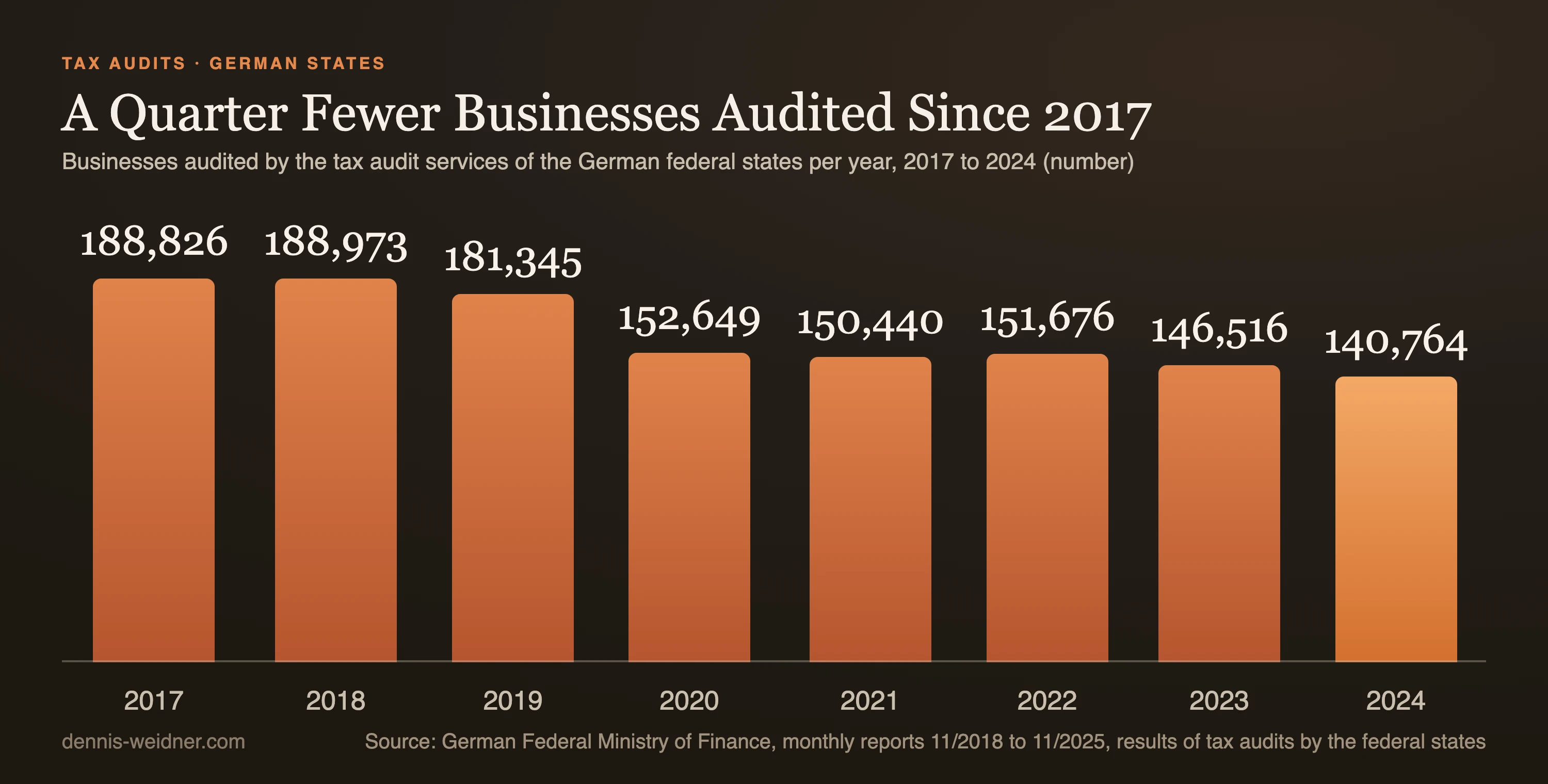
The additional tax assessed fluctuates more: 17.5 billion euros in 2017, 10.9 billion in 2024, of which 7.6 billion came from large businesses. On average each auditor assesses around 882,000 euros a year. The ministry itself stresses that this figure is not the same as actual extra revenue, because objections, court cases and ability to pay still change a lot afterwards. My view: fewer auditors mean a more targeted, risk-based selection. That makes it all the more worthwhile to keep your own figures easy to explain at first glance.
How long can a tax audit in Germany take?
There is no fixed maximum duration for a tax audit. Section 7 BpO only requires the duration to be limited to what is necessary. Since the DAC7 implementation act of 20 December 2022, which also modernised field audits, there is an outer limit, though. Under section 171(4) sentence 3 AO, the suspension of the assessment deadline ends no later than five years after the end of the calendar year in which the audit order was issued. If the order arrives in 2027, the suspension ends by the end of 2032 at the latest. If the regular assessment period has run out by then, the tax office can no longer amend the audited years. The rule applies to taxes arising after 31 December 2024 (Article 97 section 37 of the Introductory Act to the Fiscal Code).
Two exceptions matter. If you postpone the start or have the audit interrupted at your own request, the limit is extended by exactly that time. And if a late-cooperation penalty is imposed, it is extended by at least one year. Duration costs money anyway through interest: additional tax bears interest from 15 months after the end of the tax year, at 0.15 percent per month, or 1.8 percent a year (sections 233a and 238 AO).
Steps of a German tax audit, with deadlines
The procedure is set out in detail. The overview shows the steps business owners should know.
| Step | Legal basis | Deadline or rule |
|---|---|---|
| Audit order | ss. 196, 197 AO, s. 5 BpO | usually 4 weeks (large) or 2 weeks ahead |
| Postponing the start | s. 197(2) AO | on request, for an important reason |
| Data and focus areas | s. 197(3) and (4) AO | machine-readable data, then focus areas |
| Formal cooperation request | s. 200a AO | after 6 months at the earliest, reply within 1 month |
| Partial final assessment | s. 180(1a) AO | on request, if there is a significant interest |
| Closing meeting | s. 201 AO | required if changes, also by phone or online |
| Audit report | s. 202 AO | on request in advance, with a chance to comment |
The sharpest new tool is the late-cooperation penalty (Mitwirkungsverzögerungsgeld) under section 200a AO. If a business does not meet a formal cooperation request within one month, the tax office sets 75 euros per calendar day, for at most 150 days, so up to 11,250 euros. For repeat cases or large companies, the law names 12 million euros of turnover as a guide, a surcharge of up to 25,000 euros per day can be added. The penalty does not apply if the delay is excusable.
Why the tax audit often hits founders in year three or four
A young company gets off to a good start for a year or two. In the third or fourth year the first tax audit arrives, and it ties up money, time and energy exactly when the company should be growing. The mechanism is simple: the audit period usually covers three years, meaning the founding years, when bookkeeping, contracts and accruals were not yet running smoothly. The back taxes for those years, plus interest, land in the growth phase. On top come weeks in which founders explain receipts instead of winning customers.
In my view, how both sides handle it matters more here than the law. An auditor who shows a sense of proportion and a business owner who seeks a conversation instead of exchanging formal letters reach the end considerably faster. Open points belong on the table early, not only in the closing meeting. If things still get stuck, it helps to know who supervises the tax office, which I describe in How German Tax Offices Are Supervised.
Preparing for a tax audit in Germany: what to sort out beforehand
The shortest tax audit is the one where the auditor finds what they need on day one. Five things are worth doing long before any audit order:
- Test the data export. Accounting data must be exportable in a machine-readable format (section 197(3) AO). Running the export once as a trial saves weeks.
- Put shareholder agreements in order. Managing director contract, loans, rent and services between related companies in writing, in advance and at market terms.
- Name a contact person. Under section 8 BpO the business can name who primarily answers questions. That keeps day-to-day operations calm.
- Ask for the focus areas. Once the data has been provided, the tax office should state its audit priorities (section 197(4) AO). Preparation can concentrate on those.
- Only postpone with good reason. A postponement at your own request extends the five-year limit. If financing or a sale is coming up, a partial final assessment is often the better route.
More finance topics for business owners are collected under Crypto and Finance.
Frequently Asked Questions
How often is a small business audited in Germany?
Rarely. In 2024, 2.7 percent of small businesses and 0.7 percent of micro businesses were audited, on average once every 38 and 150 years respectively. Selection follows risk, however, not chance.
How long can a German tax audit last?
There is no fixed maximum. For taxes arising from 2025, however, the suspension of the assessment deadline ends no later than five years after the end of the year in which the audit order was issued (section 171(4) AO). Postponements you request extend that limit.
Do I have to host the tax auditor on my premises?
In principle yes. The audit takes place at the business premises, with a workspace provided free of charge. If there is no suitable room, the tax office audits at your home or at its own offices (section 200(2) AO, section 6 BpO).
What is the late-cooperation penalty in a German tax audit?
A means of pressure under section 200a AO: anyone who does not meet a formal cooperation request within one month pays 75 euros per day, at most 11,250 euros. For repeat cases or large companies a surcharge of up to 25,000 euros per day can be added.
How much notice does the tax office give before an audit?
The audit order must arrive a reasonable time in advance. The Tax Audit Regulation names four weeks for large businesses and two weeks for all others as the usual rule.
Note: This article is not tax advice. It describes the legal position in Germany as of 1 October 2026 and deliberately simplifies: payroll tax audits, special VAT audits, group audits and the transitional rules for taxes arising before 2025 follow their own rules. The figures come from the Federal Ministry of Finance statistics for 2024; the ministry usually publishes the next year's figures in October or November of the following year. Anyone who receives an audit order should plan the preparation with their tax adviser.
Best,
Dennis Weidner
Note: AI tools supported me in writing this article, and some images were edited with AI. I stand behind its content and every statement with my name.