While the headlines follow prices, the financial industry is quietly moving real assets on-chain: government bonds, money market funds, loans. On 9 August 2026 more than 38 billion dollars of them sat on-chain, and the forces behind it are BlackRock, Circle, Citi and the Eurosystem. Here is what has substance, what is merely a label, and the one number that tells them apart.
Tokenizing real-world assets: what actually happens
Tokenization means a real asset is represented as a digital token on a blockchain: a share in a bond, a fund, a loan. The appeal is not speculation but mechanics. Settlement in seconds instead of two days, divisible units, trading around the clock and a register that says the same thing to everyone involved.
Nobody shouts about tokenization, and that is what makes it interesting. While the headlines follow prices, the financial industry is quietly moving real assets on-chain. The forces behind it are not crypto startups but BlackRock, Circle, Citi and the Eurosystem.
This is less a revolution than better plumbing for existing assets. For entrepreneurs that is the more interesting part: infrastructure survives cycles, bets do not.
The market for tokenized assets: 38 billion dollars
Let us talk about magnitudes rather than visions. On 9 August 2026 the data platform rwa.xyz counted around $38.17 billion of tokenized real-world assets on-chain, excluding stablecoins. At the start of 2026 it was around $21 billion.
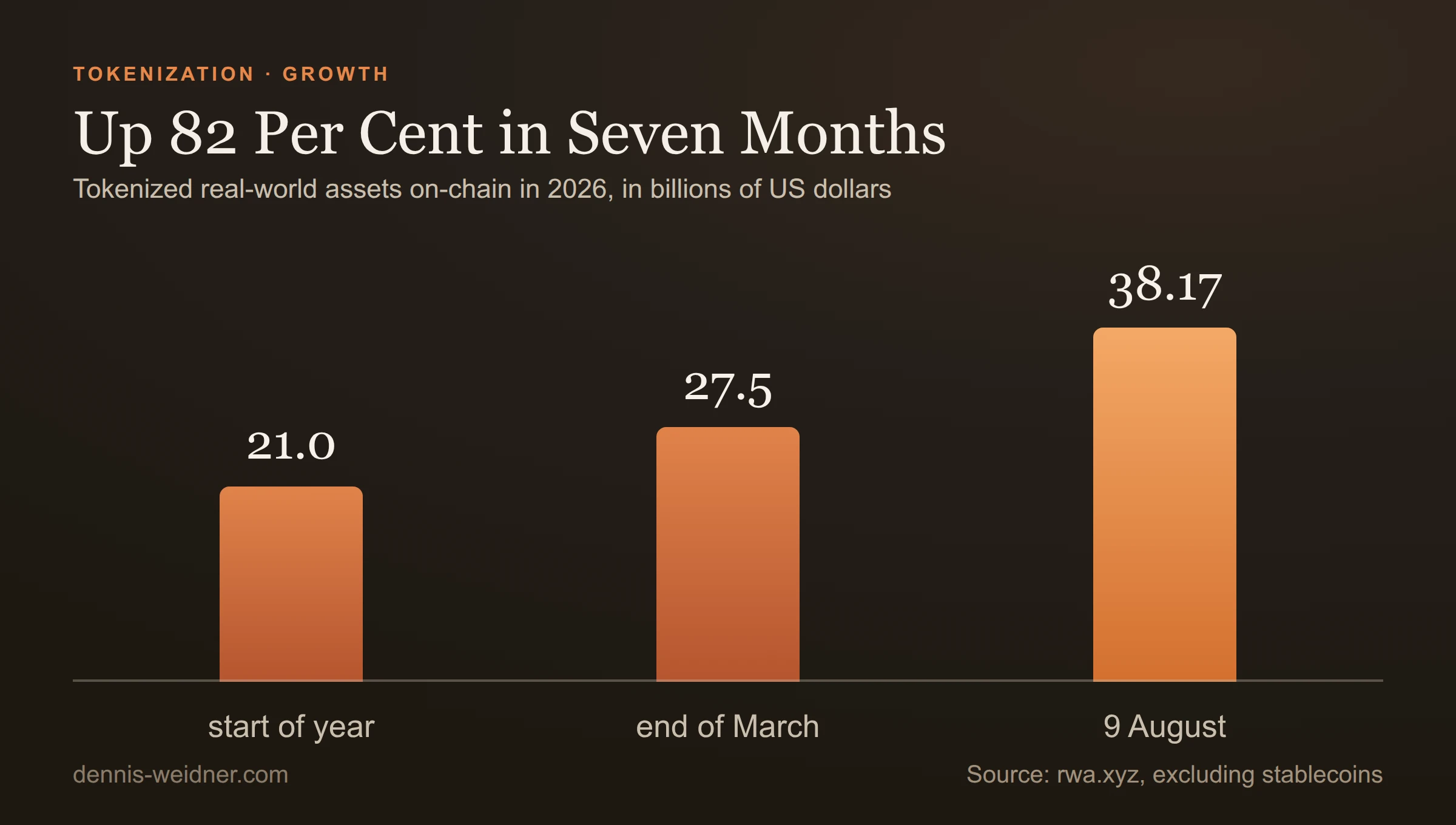
The growth is real, the scale is not yet. Measured against a US Treasury market counted in trillions, $38 billion is a rounding error. Anyone who leaves that sentence out is selling a narrative rather than a market.

Tokenized Treasuries are the one undisputed use case
If you want to sort this field, one question does the work: who uses the product today, and for what?
For tokenized Treasuries and money market funds there is a clear answer. Trading firms, crypto companies and stablecoin issuers park liquidity there, collect the yield of short-dated US government debt, and can move the units at any time or post them as collateral. It is the same idea that makes stablecoins effective in payments, applied to yield-bearing assets.
One detail explains the 2026 surge better than any vision: the American GENIUS Act bars issuers from paying yield on stablecoins. Anyone holding dollar liquidity who still wants a return therefore moves into tokenized money market funds. The inflow here is in large part an outflow there.
Figures: rwa.xyz, 9 August 2026. The verdict in the third column is mine, not the data source’s.
Tokenized real estate: where the story meets the land register
Fractional real estate is a different matter. The idea sounds charming: a stake in an apartment building from fifty euros. But a token does not solve the underlying problem that property is immovable, regulated and legally complex.
The land register knows no blockchain. The promised liquidity often exists only on paper, because there is no buyer when you want to sell. And in a dispute what counts is the legal framework behind the token, not the token itself: usually a subordinated loan or profit-participation structure with the risk profile written into it.
My rule of thumb here is unromantic: first the enforceable claim, then the technology. Anyone who cannot answer „what exactly do I owe you if I go insolvent?“ in two sentences is selling a story.
Pontes: the ECB connects blockchain and central bank money from September 2026
The most underrated building block comes from Frankfurt. The Eurosystem is pursuing a two-track strategy to settle distributed-ledger transactions in central bank money. In the short term Pontes connects market blockchain platforms to the existing TARGET Services; it launched on 21 September 2026, with full operation as a TARGET service by the end of 2027. In the long term Appia is to become an integrated system. The Bundesbank contributes its trigger solution, linking the securities leg on the blockchain to the cash leg in the classic system.
This matters because institutions do not want to settle large amounts against a private stablecoin, they want central bank money. That is the missing piece the Eurosystem is now building. Once it stands, the last big argument against tokenized securities falls away for banks and fund houses.
Worth noting: Pontes lost the label „pilot“ along the way. That is not marketing, it is a commitment.
Tokenization forecasts to 2030: what the numbers are worth
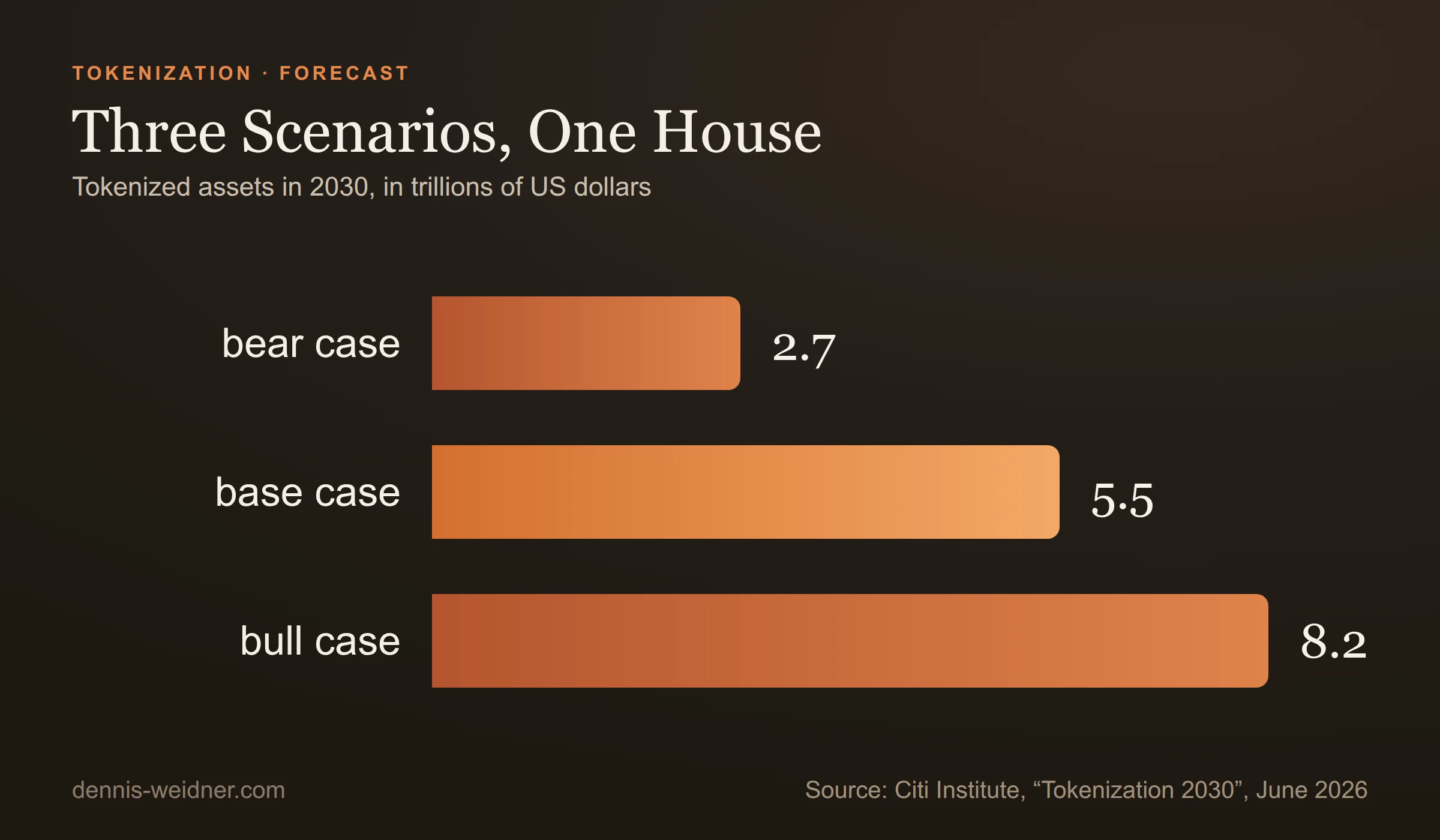
In June 2026 the Citi Institute published „Tokenization 2030“: a base case of $5.5 trillion by 2030, with a range from $2.7 to $8.2 trillion. Growth, it argues, will be led by public markets, equities and Treasuries, not by private assets.
I read numbers like these with the same scepticism I apply to any business plan put in front of me. In 2022 the Boston Consulting Group estimated $16 trillion by 2030; in 2024 McKinsey arrived at roughly $2 trillion. When serious houses differ by a factor of eight on the same subject, it mainly tells you that nobody knows.
Even the present is measured differently. Citi counts narrowly and arrives at roughly $17 billion, rwa.xyz counts more broadly and arrives at $38.17 billion. Both are correct; they simply do not measure the same thing. Placing them side by side without naming the definition manufactures a doubling out of nothing.
The risks: claim, custody, fragmentation
For all the sympathy the trend deserves, hard questions remain, and they are the same with every provider.
The claim. Does the token represent an enforceable claim, including in the issuer’s insolvency? With the large money market funds, yes, because a fund structure with a depositary sits behind it. With smaller offers it is either in the prospectus or it is not.
Custody. Who holds the keys, and what happens if the smart contract has a bug? A programming error is not market risk, but it costs the same money.
Fragmentation. Liquidity spread across many chains is worth less than liquidity in one place. That is why the large products now run on several chains in parallel.
Regulation. The United States and Europe are building different rulebooks, and both are still moving. For the German tax side the same framework applies as for crypto-assets in general, including the open question of the holding period, which I set out in Crypto Holding Period: What the German Bill Actually Says.
What tokenization means for entrepreneurs in practice
You do not have to buy anything to take this trend seriously. But it is worth understanding that the border between traditional finance and crypto is dissolving at an unspectacular point: the question of how assets are held and moved.
Three practical conclusions. First, anyone moving corporate liquidity internationally will see offers that sell tokenized money market funds as a treasury building block; the question is never the technology, it is the depositary. Second, anyone raising capital should treat tokenization not as a distribution trick but as a question about the register: investors ask first who holds what if things go wrong. Third, the pattern is the same as with every rule change that reorders a market, most recently visible in Germany’s new retirement account: the work does not arise where the licence sits, it arises next to it.
The most interesting shifts are almost always the quiet ones. My running commentary sits under crypto and finance; if you work on this operationally, I am happy to talk.
This article is an entrepreneur’s assessment and does not constitute investment advice.
Frequently Asked Questions
What is the tokenization of real-world assets?
A real asset such as a bond, a fund or a loan is represented as a digital token on a blockchain. The token stands for a share and can be transferred faster, in smaller units and against a shared register than the original in the classic system.
How large is the tokenized asset market in 2026?
According to rwa.xyz, around $38.17 billion of tokenized real-world assets sat on-chain on 9 August 2026, excluding stablecoins. At the start of the year it was around $21 billion. Measured against classic capital markets that is still very small.
Which segment is the largest?
US Treasuries and money market funds at $16.21 billion across 87 products, more than 40 per cent of the market. The largest single products are Circle's USYC at $3.00 billion and BlackRock's BUIDL at $2.68 billion.
What is Pontes and when does it launch?
Pontes is the Eurosystem's bridging solution connecting market blockchain platforms to TARGET Services so that transactions can settle in central bank money. It launched on 21 September 2026, with full operation as a TARGET service by the end of 2027. The long-term target architecture is called Appia.
Is tokenized real estate a sensible investment?
Caution is warranted. A token solves neither the legal complexity nor the illiquidity of property, and the land register knows no blockchain. What matters is the enforceable claim behind the token, usually a subordinated loan or profit-participation structure. This is not investment advice; examine each provider individually.
How reliable are the forecasts to 2030?
Not very. In June 2026 the Citi Institute put its base case at $5.5 trillion with a range of $2.7 to $8.2 trillion. The Boston Consulting Group estimated $16 trillion in 2022, McKinsey around $2 trillion in 2024. Even the present is measured differently: Citi counts about $17 billion, rwa.xyz $38.17 billion.
Warm regards,
Dennis Weidner
Note: AI tools supported me in writing this article, and some images were edited with AI. I stand behind its content and every statement with my name.