On this blog I do not take sides with any political party. I do have a clear view, though: Germany needs to reform its tax administration. File late and you pay a surcharge; get an incorrect assessment corrected and you carry your own costs; and enforcement often starts before any court has looked at the case. This article opens my series “Entrepreneurs, the State and Politics” and sorts the topic into three parts: politics and majorities, the tax office, and Germany as a business location.
As of 30 September 2026. Not tax or legal advice, see the note at the end.
More on this topic: Finance & Crypto Assets, with background, practice and every article in one place.
Why entrepreneurs should follow politics, even without a party card
Politics sets the conditions under which we start companies, invest and live. Taxes, permits, energy prices, skilled labour and access to capital are all political variables in the end. That is why I follow the debates closely, even though I am not a member of any party.
In September, German television aired an unusual number of strong political talk shows, from Markus Lanz to Caren Miosga and maischberger. One question kept coming up: should a government follow the public mood, or do what is objectively right and necessary? I recommend that every founder watches or listens to such debates regularly. Hearing how others argue helps you place your own view and spot earlier what is coming for your business. That more and more people now get their political information only from social media feeds is a topic of its own, which I cover in the article on political interest and news use in Germany.
Part 1, politics: forming a government gets harder as the centre shrinks
To me, democracy is first of all about winning majorities for your proposals. That is getting harder. In the 1998 federal election, the two big centrist parties, the Christian Democrats (CDU/CSU) and the Social Democrats (SPD), won 76.1 percent of the party-list vote between them. In February 2025 they won 44.9 percent, according to the Federal Returning Officer. Together they no longer reach half of the vote.
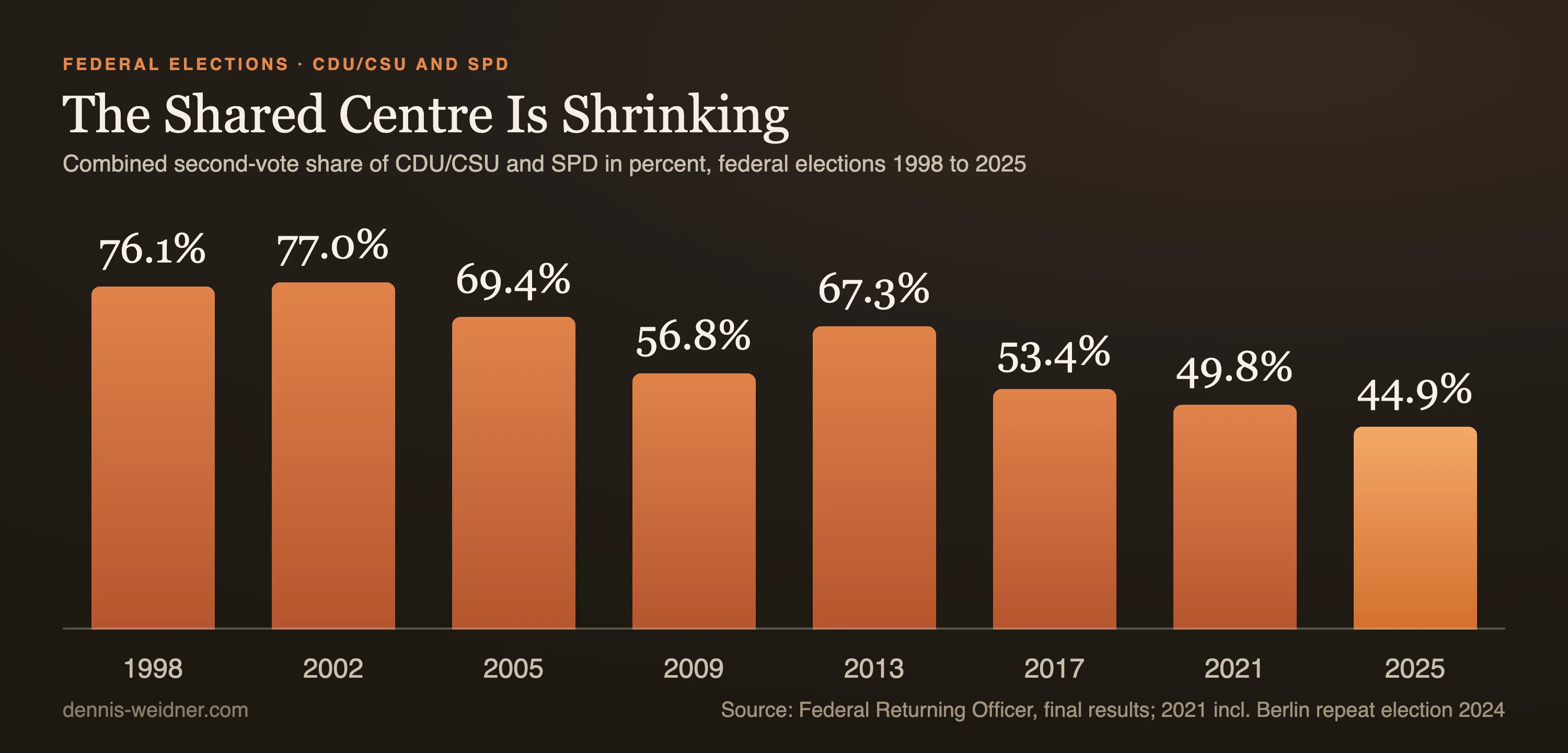
More parties means more voices at the table. That is pluralism, and it has value. It also makes coalition building slower, as the Bundestag data handbook shows:
| Election | CDU/CSU and SPD | Parliamentary groups | Days until chancellor elected |
|---|---|---|---|
| 2005 | 69.4 % | 5 | 65 |
| 2009 | 56.8 % | 5 | 31 |
| 2013 | 67.3 % | 4 | 86 |
| 2017 | 53.4 % | 6 | 171 |
| 2021 | 49.8 % | 6 | 73 |
| 2025 | 44.9 % | 5 | 72 |
In 2017 it took 171 days to elect a chancellor. For a business, that is almost half a year without a clear line on taxes, subsidies and energy. How coalitions come about today, what Article 63 of the Basic Law provides if no majority emerges, and what a long stalemate means for companies is covered in detail in the article on government formation in Germany.
Discontent: why so many voters are turning away from the centre
I understand why so many people in Germany vote for the far-right AfD or the Left Party. Not because I share their programmes, but because I know the frustration behind those votes. Many citizens, and especially many self-employed people, experience a state that demands, audits and enforces, but rarely listens. The centrist parties have carried this system for decades without reforming it.
Compromise happens where parties share the same foundations and only differ on the route. It gets difficult when the basic direction no longer matches, for example on Germany's ties to the West, which have shaped the CDU since Konrad Adenauer. On Lanz on 24 September, historian Andreas Rödder argued for “red lines” instead of a blanket firewall against the AfD, while political scientist Herfried Münkler strongly disagreed. I think it is right to have this debate openly. The best answer to growing fringes remains a centre that visibly solves problems. What the data on discontent shows is in the article on political discontent in Germany, and how algorithms sharpen opinions in the article on social media algorithms and radicalisation.
Part 2, tax administration: the tax office needs a new understanding of its role
One issue concerns me more than any other: the tax administration is part of a community that lives off its businesses. Many founders today do not experience the tax office (Finanzamt) as a partner, but as a counterpart that does not understand how a company is built. Many entrepreneurs feel they first have to justify themselves, as if running a business were suspicious in itself. Where that image comes from and what surveys say about how entrepreneurs are seen in Germany is the subject of the article on how Germany sees entrepreneurs.
With several of the companies we have built, we have had contested proceedings with tax offices again and again. Often it was about crypto: how crypto assets are taxed, how a token swap is treated, how holdings are valued. Every error in an assessment costs days of paperwork, objections and calls with the tax adviser. Fellow entrepreneurs tell me similar stories: input VAT is refused on grounds that do not hold up, and as soon as money sits in a company account, the tax office asks the Federal Central Tax Office (BZSt) where accounts exist and garnishes them.
These account queries have become routine. According to the federal government, about 1.4 million account queries were carried out across all authorities in 2023, most of them for bailiffs. For tax offices alone, the Federal Central Tax Office ran 169,901 queries, as the Bundestag press service reported. In 2014 there were 237,126 in total, according to the Federal Data Protection Commissioner, roughly one sixth. Those affected often learn about it only afterwards.
The imbalance: surcharges for lateness, no compensation for the tax office's errors
The imbalance is clearest in the consequences of mistakes. Lateness triggers fixed surcharges under Section 152 and Section 240 of the Fiscal Code (AO). An incorrect assessment brings no compensation at the objection stage; adviser costs are only reimbursed after winning a court case (Section 139 of the Tax Court Code, FGO).
| Situation | Consequence | Provision |
|---|---|---|
| Tax return filed late | Late-filing surcharge, at least 25 euros per month started | Section 152 AO |
| Tax paid late | Late-payment surcharge, 1 percent per month started | Section 240 AO |
| Tax paid later or refunded | Interest both ways, 0.15 percent per month | Section 233a AO |
| Assessment wrong, objection succeeds | No reimbursement of adviser costs or time | Section 139 FGO, court cases only |
Nobody pays for the working time an entrepreneur puts into correcting a wrong assessment. You are proven right, and that is all. A state that charges a surcharge for every delay and pays nothing for its own mistakes applies double standards. That is not acceptable, and it could be fixed with one amendment to the Fiscal Code. How to challenge a wrong assessment in time, and which correction rules exist, is explained in the article on incorrect tax assessments in Germany.
Enforce first, review later: where the separation of powers comes too late
The tax office can garnish accounts, issue personal liability notices against managing directors, set estimated assessments and open criminal proceedings before any court has looked at the case. Filing an objection does not stop enforcement. That requires a suspension of enforcement under Section 361 AO, and the application is first decided by the same tax office that issued the assessment. If it refuses, the remaining route is an application to the tax court under Section 69 FGO, and a decision often takes weeks or months.
Enforcement continues in the meantime. The account is empty, partners and banks get nervous. If the court later finds the tax office was wrong, a young company may already have lost its ability to act, and damages are only available through a state liability claim with high hurdles. A separation of powers that only takes effect months after the intervention does not protect a young company. How the suspension application works is covered in the article on suspension of enforcement, and who supervises the tax office in the article on how German tax offices are supervised.
My wife and I see these errors privately as well. Several times we received assessments with a miscalculated progression rate or with amounts counted twice because an adjustment by our tax adviser was added instead of replacing the original entry. Many assessments today are issued without any human review; the Fiscal Code expressly allows fully automated assessments. So it pays to check every assessment, or have it checked, before the objection deadline expires. And anyone who pushes back and wins often has the feeling of being treated as an awkward case afterwards: several times a successful objection was followed by the next query, the next audit, the next assessment. It should never be a contest.
Judgement instead of insisting on being right
This is not about individual officials imposing their view. It is about judgement and about people. Anyone writing an assessment that hits a young company should understand what liquidity looks like in the first years and what a garnishment does at that stage. A phone call often settles more than three letters.
Many start-ups in Germany get off to a good start for a year or two. In the third or fourth year comes the first tax audit or an assessment that does not hold up, tying up money, time and energy exactly when the company should be growing. That is not how a country becomes a founder nation. How often the tax office audits and how to prepare is covered in the article on tax audits in Germany.
What a reform of the tax administration has to deliver
I would support this at any time, whichever party is in power. Five points would make the biggest difference:
- Costs reimbursed at the objection stage: anyone who demonstrably had to correct a wrong assessment gets adviser costs reimbursed at the objection stage too.
- Suspension as the rule: for seriously disputed claims, suspension of enforcement is the rule, and a conversation comes before an account query.
- Specialist units for digital business models: crypto and platform businesses are handled by specialist units, so that not every tax office reinvents the taxation.
- A fixed contact person: young companies get a named contact with a phone number in their first years.
- Short audits: tax audits are concluded in months rather than years.
Part 3, location: property, capital and where founders choose to stay
Property. In Berlin's referendum “Deutsche Wohnen & Co. enteignen” on 26 September 2021, 59.1 percent voted yes to expropriating large housing companies. In March 2026 the state parliament passed a framework law on socialisation that is due to take effect 24 months after its promulgation, in 2028. As an entrepreneur, I cannot support expropriation. More housing comes from more building, and that needs capital that wants to stay.
Capital from abroad. In recent weeks, American investors wanted to invest in a German company. The answer was a notarial contract of around 30 pages and signatures in several rounds. Under Section 15 of the GmbH Act, the transfer of GmbH shares must be notarised, and unlike an incorporation or a capital increase it cannot be done by video. For a purchase price of 5 million euros, the notarisation alone costs 16,270 euros net under the German notary fee table. That is hard to explain to a US investor. The full calculation is in the article on German notaries and online notarisation.
Choice of location. Many founders I know now set up in Dubai or Cyprus. I explained the calculation behind that in the article on emigrating as an entrepreneur, and what the tax office demands when you leave in the article on leaving Germany and the tax office. Almost two years ago we moved from Berlin to Brandenburg and deliberately founded SLABHIT here, because we see the greatest potential here and a state government that visibly wants founders. People greet each other and know each other, and for families this quality of life helps decide where entrepreneurs live and work. How the launch went is in the article on the SLABHIT launch.
The series “Entrepreneurs, the State and Politics” at a glance
I cover the topics of this article in depth in separate pieces. They appear one after another until December; whatever is already online is linked.
Politics and society: Government formation in Germany · Political discontent · Social media algorithms and radicalisation · Political interest and news use · How Germany sees entrepreneurs · Gen Z, work and entrepreneurship
Tax office and authorities: Who supervises the tax office · Tax audits · Suspension of enforcement · Incorrect tax assessments · Director liability notices · German tax court · Input VAT deduction denied · Leaving Germany and the tax office
Founding in Germany: Business formation in Germany in numbers · German businesses after Covid · Sole trader or GmbH · Notaries and online notarisation · Start-up funding without a degree · Applying for business grants · Linked enterprises and funding
Changing your mind when the arguments are stronger
I have positions and I stand by them. But an opinion may change when other arguments become stronger. That applies to entrepreneurs and politicians alike, and it applies to authorities too. Staying rational and pragmatic, testing your own positions and seeking majorities for a good idea is democracy at its best. Tell me about your experiences with the tax office and which debate last made you think. I reply to every message.
Frequently Asked Questions
Why does Germany need to reform its tax administration?
Because the rules are one-sided and young companies suffer from them. File late and you pay surcharges; correct a wrong assessment through an objection and your costs are not reimbursed. On top of that come account queries and enforcement before disputed questions are settled.
Are the costs of an objection against a wrong German tax assessment reimbursed?
No. At the objection stage each side bears its own costs, even if the objection succeeds. Adviser costs for this stage are only reimbursed if the case is won before the tax court and the court declares the adviser's involvement necessary.
Can the German tax office check my bank accounts without asking me?
Yes. Via the Federal Central Tax Office, the tax office can find out at which banks someone holds accounts and securities accounts. In 2023 the Federal Central Tax Office ran 169,901 such queries for tax offices, according to the federal government, and around 1.4 million across all authorities. The tax office does not see balances this way, only bank, account number and holder.
Does an objection stop the tax office from garnishing my account?
No. An objection does not suspend enforcement. For that, a suspension of enforcement must be applied for and granted.
Why is forming a government in Germany getting harder?
Because the big parties are shrinking and more parliamentary groups sit in the Bundestag. CDU/CSU and SPD won 76.1 percent of the party-list vote together in 1998 and 44.9 percent in 2025. In 2017 it took 171 days to elect a chancellor.
Can GmbH shares be transferred online in Germany?
No. The transfer of existing GmbH shares must be notarised under Section 15 of the GmbH Act, and online notarisation by video is not permitted for it. Incorporations, register filings and unanimous resolutions such as a capital increase can be done by video. For a purchase price of 5 million euros, the notarisation fee is 16,270 euros net.
Note: This article reflects my opinion and experience and is not tax or legal advice. The rules mentioned are simplified, as of 30 September 2026.
Best,
Dennis Weidner
Note: AI tools supported me in writing this article, and some images were edited with AI. I stand behind its content and every statement with my name.