While many people are still arguing about swinging crypto prices, a much quieter but far more consequential shift is happening in the background: stablecoins are changing how money moves around the world. And not in theory, but in growing volume, every single day.
What a stablecoin actually is
Put simply, a stablecoin is digital money whose value is pegged to a stable currency like the euro or the dollar. It combines the best of two worlds: the stability of a traditional currency and the speed and programmability of digital assets. No waiting for bank business days, no steep fees for cross-border transfers.
More on this topic: Finance & Crypto Assets – background, practice and every article in one place.
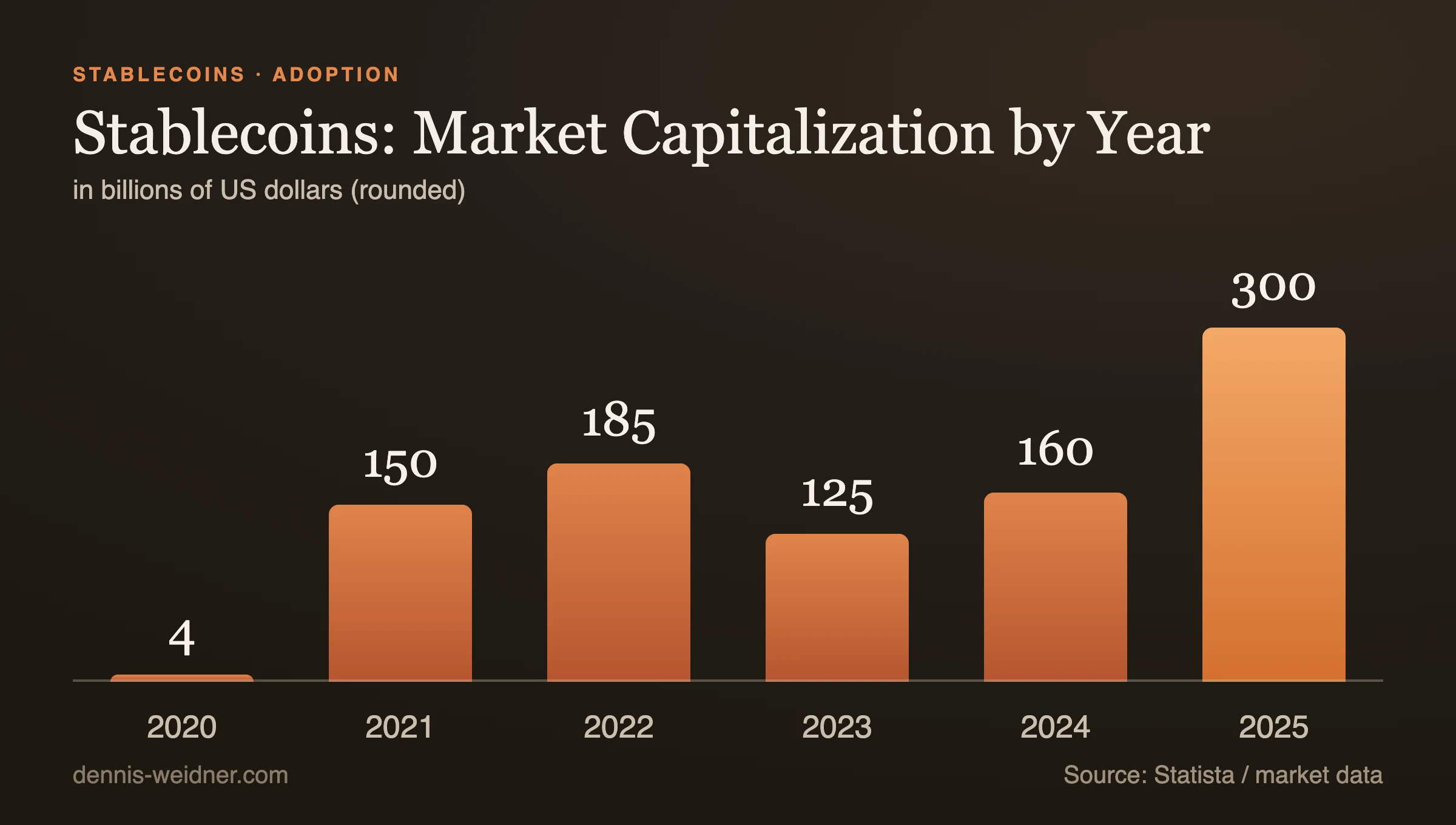
The scale shows how serious this has become: the combined market capitalization of all stablecoins has grown from a few billion in 2020 to several hundred billion dollars. This is no longer a niche experiment. It is a payment layer in its own right.
The scale almost nobody sees
Even more striking than the market cap is the transaction volume. According to an analysis by a16z crypto, stablecoins moved roughly 27.6 trillion dollars in 2024, surpassing the combined volume of Visa and Mastercard. That number needs context: a large share of it is automated activity from bots and trading systems. Strip that out, and around 9 trillion dollars of genuine payment volume remains, still several times PayPal and more than half of Visa.
That adjusted figure is the interesting one. It shows that stablecoins are no longer just a playground for crypto traders, but a serious rail for real payments. Especially where traditional infrastructure is weak, in countries with unstable currencies, in cross-border trade, in supplier payments between continents, digital dollars are already quietly replacing the slow correspondent-banking route.
Why this matters so much
Traditional payments are surprisingly slow and expensive, especially across borders. A transfer from one country to another takes days and carries fees that make smaller amounts uneconomical in the first place. An example: sending 500 euros from Europe to Southeast Asia today can easily cost double-digit fees through traditional providers and take two to five business days. Stablecoins solve exactly that: value moves in seconds, around the clock, at a fraction of the cost.
For companies with international customers or suppliers, that is a real advantage. What used to be friction becomes an afterthought. And because stablecoins are programmable, payments can be automated, tied to conditions, and embedded into workflows. Building blocks like these fit an agentic world, where software runs processes on its own. An AI agent that buys things on its own needs money it can send on its own, and that is not a bank transfer form, but a programmable token.
Rules catch up with reality
For a long time the biggest question mark was regulation. That is changing fundamentally. In the EU, the MiCA regulation brings a single legal framework for the first time: since June 30, 2024, according to the European Banking Authority (EBA), the obligations for so-called e-money tokens, meaning euro or dollar stablecoins, apply. Issuers must back their tokens fully with liquid reserves, publish regular attestations, and are subject to supervision. For particularly large tokens, the EBA takes over oversight directly.
That is a turning point. Because a stablecoin is only as stable as the reserves behind it and the rules that secure it. Binding backing, transparency obligations and supervision will separate the serious providers from the dubious ones. For companies that want to build stablecoins into real processes, that is exactly the precondition: only once the rules are clear does the build become worth it.
The risks of stablecoins
Not every stablecoin is equally well backed, and trust is quickly squandered. But the direction is clear: payments are becoming more digital, faster, and more programmable. Why I see crypto in general as a toolbox rather than a casino, I laid out in Crypto 2026, and how I frame the topic overall, in my overview of Crypto and Finance.
My advice to entrepreneurs: do not watch this development as a crypto story, watch it as an infrastructure story. Whoever understands early how money will move in the future can build processes that are faster and cheaper than the competition's. The rebuild is quiet, but it is real.
Frequently Asked Questions
What is a stablecoin?
Digital money whose value is firmly pegged to a currency like the euro or the dollar, combined with the speed and programmability of digital assets.
What are stablecoins useful for?
Above all for fast, low-cost cross-border payments, around the clock, and for automated, programmable workflows.
How large is the transaction volume?
According to a16z crypto, stablecoins moved roughly 27.6 trillion dollars in 2024, more than Visa and Mastercard combined. Adjusted for automated activity, around 9 trillion dollars of genuine payment volume remains.
Where does the risk lie?
In the backing and the regulation. Since mid-2024, the EU's MiCA rules impose binding reserve and transparency obligations, but a stablecoin remains only as reliable as the reserves behind it and the rules that secure it.
Warm regards,
Dennis Weidner
Note: AI tools supported me in writing this article, and some images were edited with AI. I stand behind its content and every statement with my name.