German Riester new business ends on 1 January 2027. What happens to the 14.663 million existing contracts is the most frequently asked and most poorly answered question of the reform, because the answer that is most often correct earns nobody anything. This is not advice but a decision tree: four options, four questions in a fixed order, and why the three million dormant contracts are a case of their own.
14.663 million contracts and a question nobody answers
At the end of 2025 Germany had 14.663 million Riester contracts. The peak was 16.61 million in 2017. Around three million of them are dormant, meaning nothing flows in any more. From 1 January 2027 not a single new one will be added.
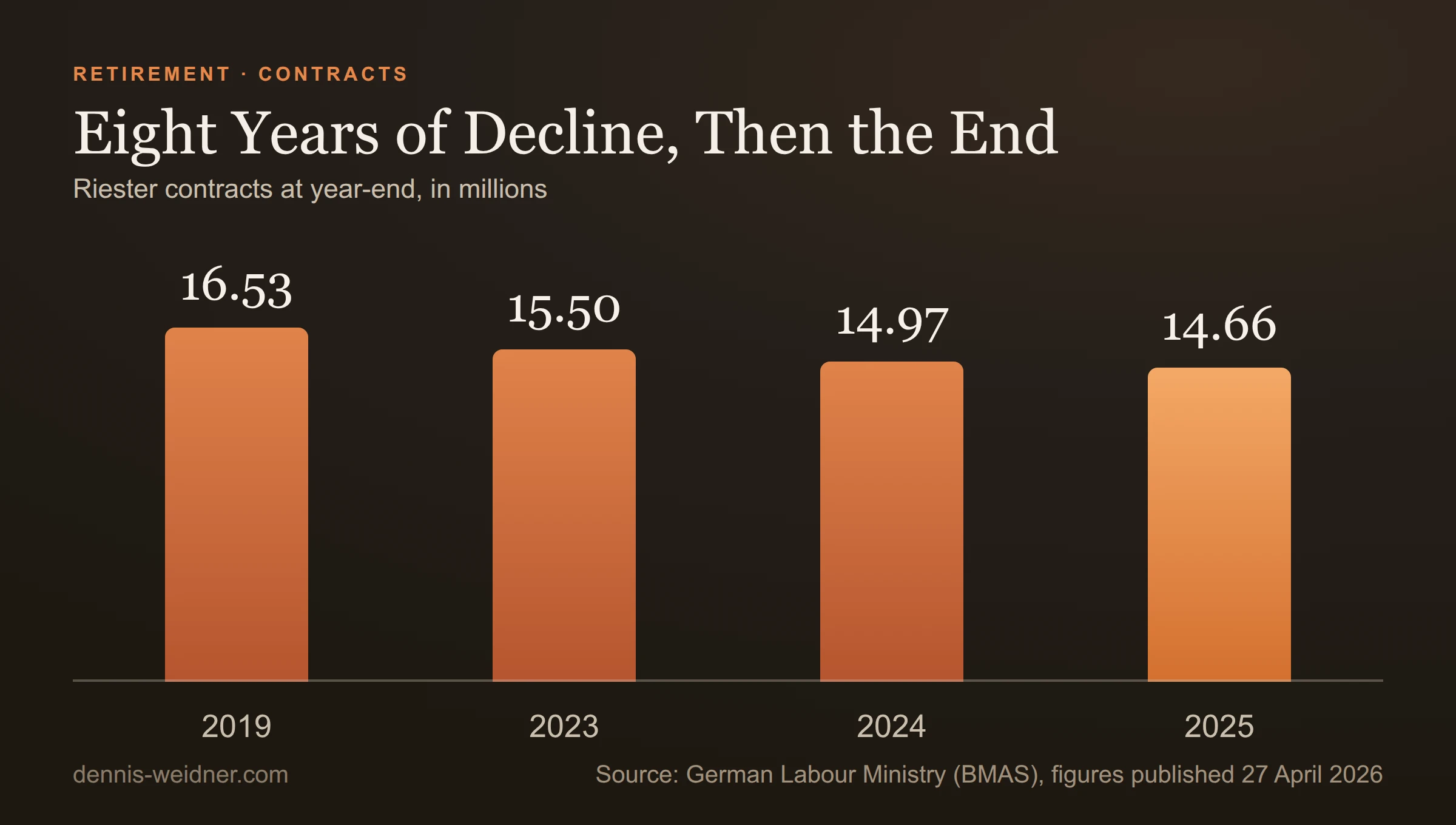
What happens to the existing ones is the most frequently asked and the most poorly answered question of this reform. The reason is structural rather than malicious: a provider has no interest in recommending that a customer leave, and an intermediary earns nothing when somebody leaves everything as it is. The answer that is most often correct is the one nobody likes to give.
So this piece offers no recommendation but a decision tree. At the end there is no number, only the order in which to read your own paperwork. The overview of the new law is in Germany’s New Retirement Account.
First, clear up the misunderstanding: what changes for Riester in 2027
The most common error is that Riester is being abolished and you have to act now. That is wrong, and the error is expensive because it produces decisions under time pressure.
What ends on 1 January 2027 is new business only. Existing contracts continue unchanged, with their guarantees, their subsidies and their terms. Nobody is switched over, nobody loses anything, and there is no deadline by which something must be decided. The federal government’s overview of the reform says the same: no automatic cancellation, no conversion.
What is new from 2027 is that two doors open: switching to the new subsidy with the existing contract, and transferring the balance into a retirement account. Both are voluntary.
Keep, freeze, switch or cancel your Riester contract: the options compared
Four options stay open indefinitely. Then there is the exit, cancellation, which almost always costs the most. Which option fits depends on your own contract, not on the reform.
The first four options remain open indefinitely after 1 January 2027. What ends on that date is new business only.
The decision tree: four questions in this order
The order is not arbitrary. Each question can settle the ones after it.
Question 1: what technical interest rate does the contract carry? That is in the original contract, not in the annual statement, and it only concerns Riester annuity insurance; Riester bank savings plans and fund savings plans have no technical interest rate. The maximum is set by the Actuarial Reserve Regulation (DeckRV) according to the year of signing: 3.25 per cent for the first Riester contracts of 2002 and 2003, then down in steps to 0.25 per cent for contracts signed from 2022 to 2024. Since 2025 it has been back at 1 per cent.
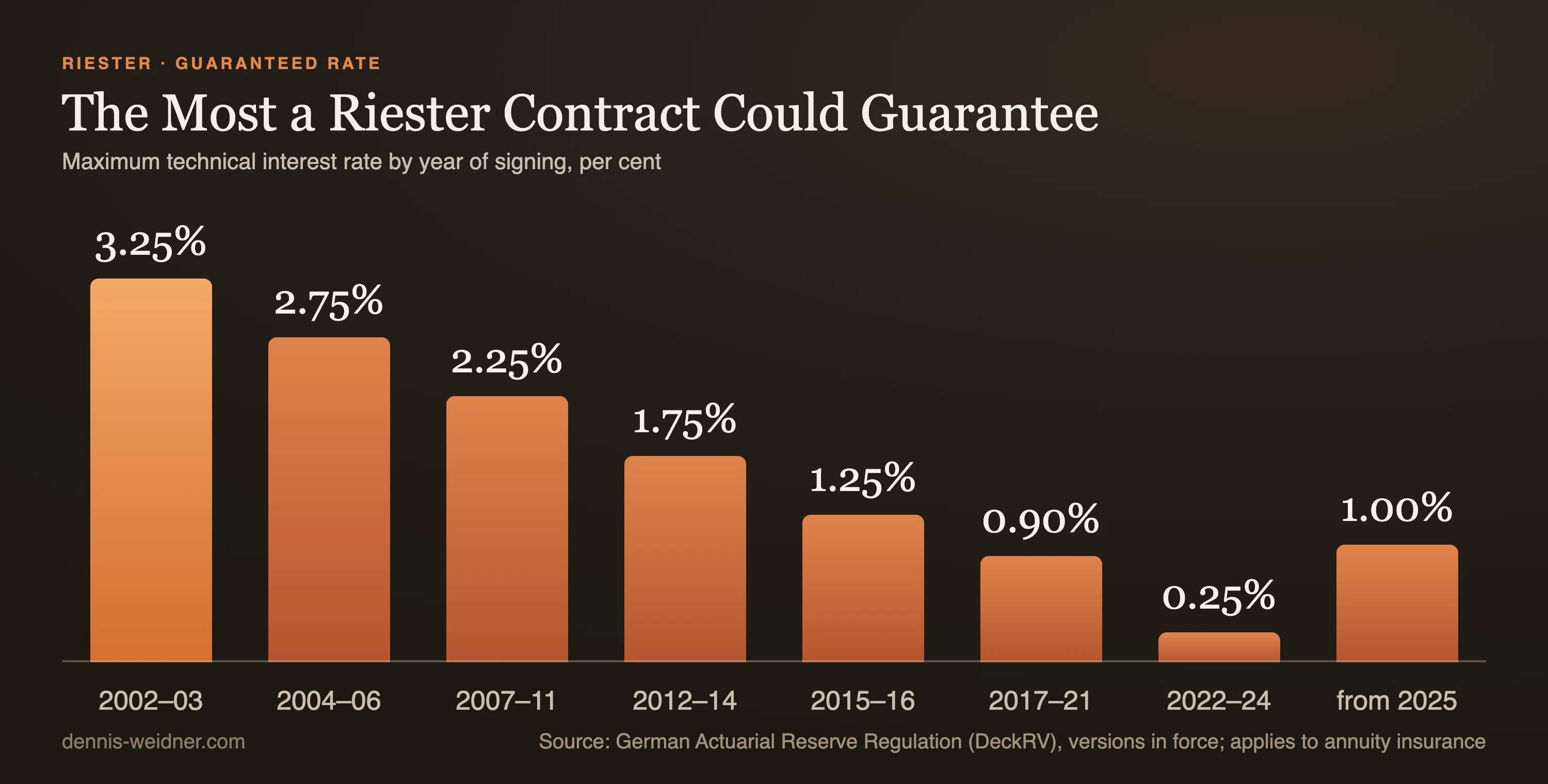
A contract from the years up to 2006 with a 2.75 or 3.25 per cent guarantee cannot be manufactured in today’s market. If the rate is high, the answer is usually keep, and the remaining questions fall away.
Question 2: are the acquisition costs paid off? Acquisition costs are charged in the early years. Anyone past that phase has already paid the expensive part. Switching then means paying the same kind of cost a second time. Anyone still in the middle of it is in a different position.
Question 3: what does the contract cost per year, in euros? Not in per cent, in euros. Percentages on a small balance sound harmless and are not. On a dormant contract with little capital, flat annual fees can consume the entire return. That is the most common case in which freezing is the worst of all options.
Question 4: how many years remain until retirement? A transfer needs time for lower costs to pay back the cost of transferring. Below roughly ten years it rarely works. Above twenty years it can be substantial.
The three million dormant contracts are their own case
Around three million contracts are dormant. They are the reason I think this piece is needed, because for them the comfortable answer is precisely wrong.
A dormant contract receives no further subsidies, because subsidies require contributions. It still carries costs. In some tariffs those are fixed amounts per year, independent of the balance. On a balance of a few thousand euros that is a cost ratio exceeding any plausible return. The money shrinks slowly, quietly, and without anybody being notified.
So anyone holding a dormant contract should establish exactly one number: what it costs per year in euros. That figure is in the annual statement, usually not on the first page. It decides between leaving it alone and moving it faster than any return forecast.
How to freeze a Riester contract: request, consequences and template
Freezing a Riester contract is a right, not a favour from the provider. Every certified contract must allow it until the payout phase begins, as required by section 1(1) no. 10 of the Retirement Contracts Certification Act (AltZertG). The technical term is Beitragsfreistellung. The law sets no maximum duration.
The request needs no form. According to the Central Allowance Office for Retirement Assets (ZfA), a letter to the provider with contract number and signature is enough. Anyone who has authorised the provider to claim the subsidy every year revokes that mandate in the same letter. Anyone who has already paid in during the current year then files the claim for that year themselves; there is time until the end of the year after next.
What happens next is limited, and still worth knowing before the letter goes out.
According to the Central Allowance Office for Retirement Assets (ZfA) at the German Pension Insurance.
The row that matters is the fourth. Freezing is only the cautious choice if the running costs in euros are small compared with what the balance earns.
Cancelling a Riester contract: what is left of the balance
Anyone who cancels and takes the money out uses it in a way the law treats as harmful (section 93 Income Tax Act). The consequence: all subsidies and all tax reductions from the tax return go back to the state. The provider deducts them directly from the balance; if that is not enough, the allowance office claims the rest from the saver.
Three further points are often overlooked. The gains in the contract are taxed after the payout. The protection of the balance against seizure ends. And anyone cancelling in the first five years bears acquisition costs not yet charged, because those are spread over exactly that period.
Worked example with assumed figures: single, no children, full basic allowance of 175 euros over 15 years, 1,500 euros of additional tax relief, 3,000 euros of gains, personal tax rate 30 per cent. The real figures are in the annual statement and in the information from the allowance office.
A good quarter of the balance is gone in this example; a transfer would have cost at most 150 euros. Anyone who still wants to cancel should look at the alternatives first, freezing or transferring, and request two figures: the surrender value from the provider and the total subsidy received, which the allowance office provides on request.
The only route without repayment is your own home: anyone using the balance to buy or build an owner-occupied property, or to repay the building loan, applies to the allowance office for the withdrawal. That is Wohn-Riester and a topic of its own.
Switching Riester: changing provider and the new subsidy from 2027
Switching can mean two things, and they are often confused.
Changing provider. The balance moves into another certified contract, with the same or another provider. Notice is three months to the end of a calendar quarter. The old provider may charge at most 150 euros for the transfer, and the new one may charge acquisition and distribution costs on only half of the capital transferred; both are set out in section 1 AltZertG. Because such a transfer is not a harmful use, the entire state subsidy is kept. A change of tariff with the same provider follows the same rules. The new provider does have to accept the contract. From 2027 the retirement account becomes a possible destination as well.
Switching only the subsidy. From 2027 the existing contract can move onto the new allowance without being touched: by a declaration to the provider, with all other terms unchanged. That is how the German Pension Insurance describes it. Anyone who also signs a new subsidised contract automatically has the new rules applied to the old one too.
Who gains is shown by comparing the basic allowances. The old one is 175 euros and requires an own contribution of 4 per cent of previous-year income, minus the allowance; anyone paying less gets a proportionally reduced allowance (section 86 Income Tax Act). The new one is 50 per cent on the first 360 euros and 25 per cent on the portion up to 1,800 euros, at most 540 euros.
Single, no children, previous-year income subject to contributions of 40,000 euros. Old: 175 euros, reduced in proportion to the minimum own contribution of 1,425 euros (4 per cent of previous-year income minus the allowance). New: 50 per cent on the first 360 euros, 25 per cent on the portion up to 1,800 euros. Excluding tax relief, rounded to whole euros.
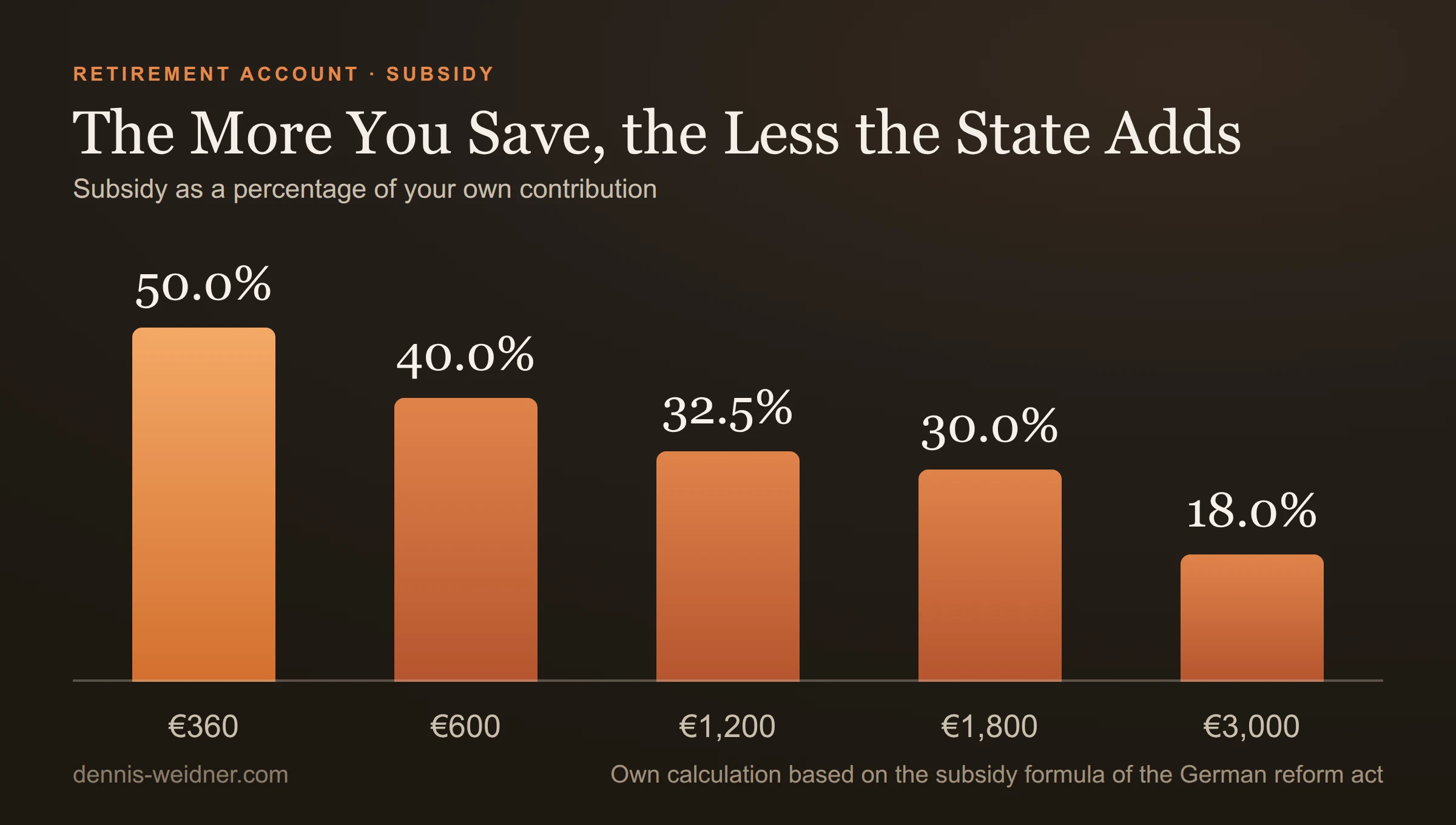
For single savers without children on a middle income the comparison is clear: the new allowance pays more at every contribution level from 120 euros, 446 instead of 175 euros at 1,425 euros a year. On a very small income it can be the other way round, because there the minimum contribution of 60 euros already triggers the full old allowance, while the new one only starts at an own contribution of 120 euros. With children the result depends on income and the number of children, because the old child allowance lowers the required own contribution; there it pays to run your own numbers.
Even so, a declaration should only follow a look at the contract. It changes the subsidy, not the costs: an expensive contract stays expensive, even with a higher allowance.
What no provider writes, and I can
There are constellations in which the correct answer is: this contract was a mistake, and the sooner the balance moves into a cheaper contract, the less it costs. No provider and no intermediary will write that sentence, because their incentives run against it.
The constellation usually looks like this: a contract from the late 2010s, high ongoing costs, no meaningful guaranteed rate, a small balance, and a saver who stopped paying in years ago. Here, leaving it alone is not the neutral option but the expensive one. There is no neutral option, because doing nothing also costs money.
The reverse holds just as firmly: anyone with a Riester annuity from 2002 or 2003 carrying a 3.25 per cent guarantee should not touch it, whatever the new product promises. Contracts like that cannot be manufactured today.
What the new system means for the self-employed is calculated in Germany’s New Retirement Account for the Self-Employed, and what the cost cap does to providers in What a One Percent Cost Cap Does to a Market. My running commentary sits under crypto and finance.
This article is an entrepreneur’s assessment of the legal position and constitutes neither investment nor tax advice. Seek professional advice for your own situation.
Frequently Asked Questions
What happens to my Riester pension from 2027?
As long as the saver does nothing, nothing. From 1 January 2027 no new Riester contracts are signed; existing ones continue with their guarantees, subsidies and terms. Nobody is switched over automatically. What is new is the option to move onto the new subsidy by a declaration to the provider, or to transfer the balance into a retirement account.
How do I freeze my Riester contract, and what does it cost?
With an informal letter to the provider stating the contract number and bearing your signature; freezing is a statutory right until the payout phase begins. A standing mandate for the annual subsidy claim is revoked in the same letter. Subsidies already received stay, no new ones arrive. Administration costs keep running and are deducted from the balance, in some tariffs as a fixed amount per year.
What happens if I cancel my Riester contract?
Cancelling with a payout is a harmful use under section 93 of the Income Tax Act. All subsidies and tax reductions are reclaimed, the gains are taxed and the protection against seizure ends. In this article's example a 20,000 euro balance leaves 14,975 euros, against at least 19,850 euros on a transfer to another contract.
How much does it cost to change Riester provider?
The old provider may charge at most 150 euros for the transfer, as set out in section 1 of the AltZertG. The new provider may charge acquisition and distribution costs on only half of the capital transferred. Notice is three months to the end of a calendar quarter, and the subsidies are kept in full.
Is it worth switching to the new Riester subsidy?
For single savers without children on a middle income usually yes: with 40,000 euros of previous-year income and an own contribution of 1,425 euros, the basic allowance rises from 175 to 446 euros. On a very small income the old subsidy can pay more, because there a minimum contribution of 60 euros already triggers the full allowance. With children the result depends on income and the number of children.
When is it worth switching to the new retirement account?
Mainly when the old contract carries high ongoing costs, offers little guaranteed return and many years remain until retirement. Below roughly ten years of remaining term, lower costs rarely repay the cost of switching. Above twenty years the difference can be considerable.
How do I know I should keep my contract?
Look at the technical interest rate in the original contract of a Riester annuity, not in the annual statement. Contracts signed in 2002 and 2003 could carry up to 3.25 per cent, up to 2006 up to 2.75 per cent, and from 2022 to 2024 only 0.25 per cent. If the rate is high and the acquisition costs are long paid off, keeping is usually right.
Warm regards,
Dennis Weidner
Note: AI tools supported me in writing this article, and some images were edited with AI. I stand behind its content and every statement with my name.