From 2027 the German state pays ten euros a month into an account for every child from age six to eighteen. One camp calls it far too little, the other applies seven per cent to age 65 and arrives at a large number. Both are choosing an assumption and calling it a result. I calculated it with three: 18,921, 31,309 or 51,617 euros. The actual finding lies elsewhere.
Ten euros a month, and what actually becomes of it
The German cabinet adopted the government bill for the early-start pension on 12 August 2026. From 1 January 2027 the federal government pays ten euros a month into an individual account for every child from their sixth to their eighteenth birthday, starting with the 2020 birth cohort. Payout comes at 65 at the earliest.
Ten euros sounds like very little, and half the commentary says exactly that. The other half applies seven per cent through to age 65 and arrives at a figure that looks like wealth accumulation. Neither camp is calculating; both are choosing an assumption and calling it a result.
I ran the numbers for three scenarios. The outcome is more interesting than either camp: the state benefit itself is small. What it triggers is not. The overview of the whole reform is in Germany’s New Retirement Account.
The calculation: 1,440 euros from the state, 47 years of time
The government pays 120 euros a year for twelve years, so 1,440 euros in total. What matters after that is not the sum but the holding period: 47 years from age 18 to 65 in which nothing is added and compounding works alone.
Calculated with €120 a year for twelve years, paid at each year end, from the sixth to the eighteenth birthday. Then left untouched for 47 years with no further contributions. The federal government pays in €1,440 in total. Before costs, before tax, before inflation.
The spread is the actual finding. Between five and seven per cent lies a factor of 2.7. Anyone quoting one of these three numbers as “the result” is concealing that the assumption produced the result, not the policy.
All three figures are before costs, before tax and before inflation, a point almost every calculation omits. Over a 47-year horizon the last point in particular is no small matter. What 31,309 euros will be worth in 2091 is an entirely different question from its nominal size.
Why the top-up is the real story
The construction only becomes interesting through what parents, and later the child, are allowed to add. Because then a small regular amount meets a term no other product offers.
Calculated at 6 per cent a year, otherwise as above. The difference does not come from the state benefit but from the top-up and the time it has.
Twenty-five euros a month from the parents, roughly the price of a streaming subscription, turns 31,309 euros into about 109,582 euros. The difference comes not from the state benefit but from the top-up and from the fact that it starts very early.
The decision parents have to make earlier than they think
If no dedicated account is opened by the start date, the child’s capital is invested collectively by the Bundesbank. That is explicitly not a bad solution, and for many families it will be the right one. But it is a decision somebody else then makes.
The practical issue is the top-up. Additional contributions cannot readily be made into the collective investment. Yet according to the calculation above, the top-up is what turns this programme into more than a symbolic gesture. So anyone intending to add money needs a dedicated account, and the moment for that arrives well before the eighteenth birthday.
Two things belong in the same consideration, uncomfortable though they are. First, the money is locked until 65, so it is not available for education, a driving licence or a first flat. Anyone saving for those purposes needs a second, unrestricted account. Second, nobody knows today whether a child will be glad of that lock-up at 65.
What it costs the state, and what stands out
Federal spending starts at 198 million euros in 2027 and rises to 411 million by 2030. At full rollout, once every cohort from six to eighteen is in the programme, it reaches around one billion euros a year.
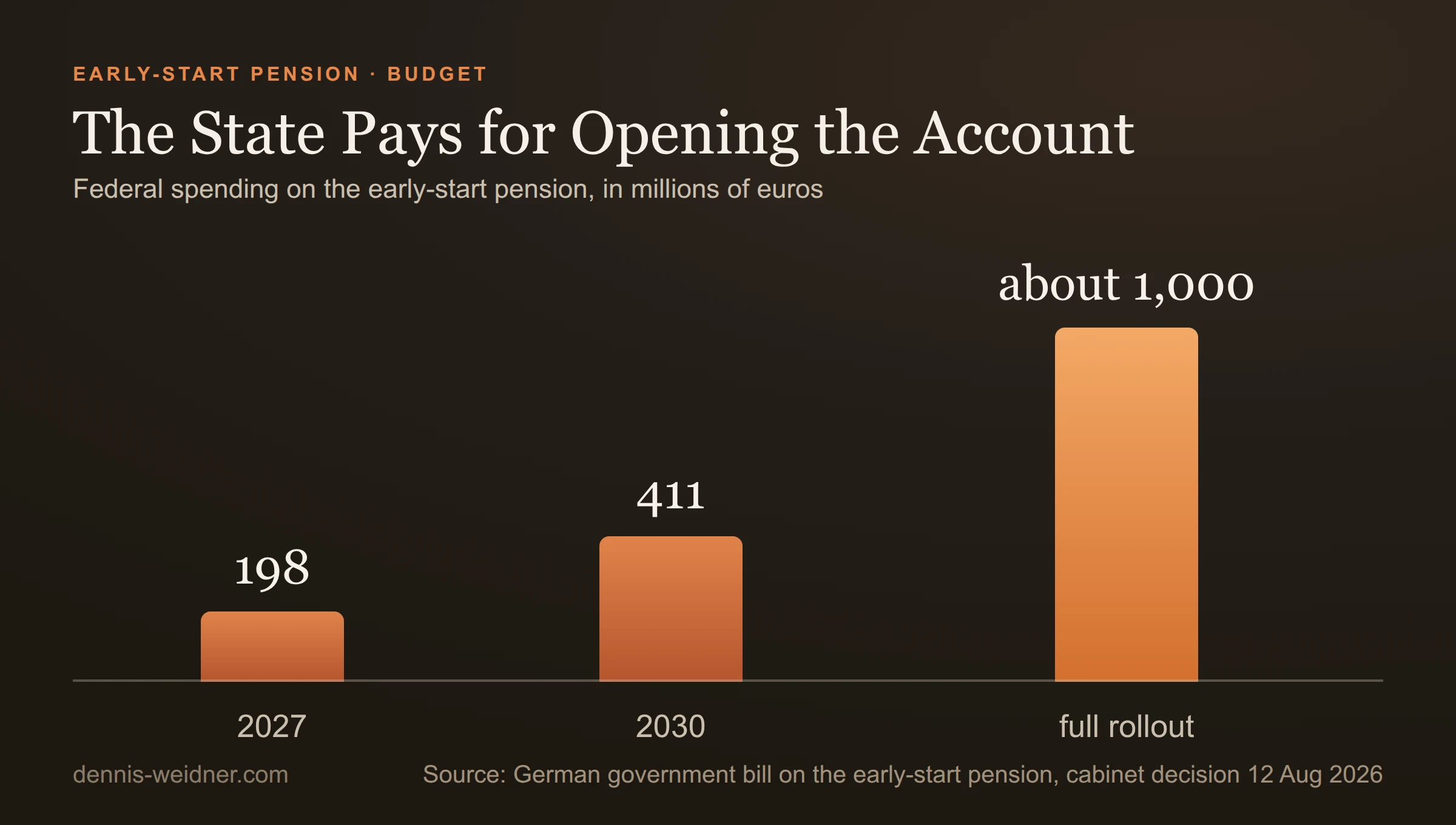
Measured against the federal budget, a billion is a small line item. Measured against what it sets in motion it is one of the more effective ones: for roughly a billion a year the state is not primarily buying retirement provision but the near-universal opening of securities accounts for an entire generation. In a country with a traditionally low rate of share ownership, that is the real event.
What this means for the provider side is described in What a One Percent Cost Cap Does to a Market. In short: millions of very small accounts can only be served automatically or in bundles under a one per cent cost ceiling.
What is still open
The government bill has been adopted; the statute has not. The parliamentary process is meant to conclude by the end of the year. Until then details can change, and here the details decide a great deal: which investment forms are permitted, how top-ups work in practice, and how the payout at 65 is taxed.
Also open is the question that interests me most: how many parents will actually top up? The entire effect of this programme depends on it, and there is no empirical benchmark, because nothing like it has existed in Germany before.
My running commentary sits under crypto and finance.
This article is an entrepreneur’s assessment of the legal position and constitutes neither investment nor tax advice. Seek professional advice for your own situation.
Frequently Asked Questions
What is Germany's early-start pension?
From 1 January 2027 the federal government pays ten euros a month into an individual retirement account for every child from their sixth to their eighteenth birthday, starting with the 2020 birth cohort. The cabinet adopted the government bill on 12 August 2026. Payout comes at 65 at the earliest.
How much will the early-start pension be worth at retirement?
That depends entirely on the return assumption, which most coverage omits. By own calculation, twelve years of 120 euros produce about 18,921 euros at 5 per cent, 31,309 euros at 6 per cent and 51,617 euros at 7 per cent by age 65. All three figures are before costs, tax and inflation.
How much does the state pay in per child in total?
1,440 euros, being twelve years at 120 euros a year. Everything beyond that comes from compounding across the following 47 years to age 65, during which nothing further is paid in.
Can parents pay in extra?
Yes, and by the calculation that is the deciding factor. An extra 25 euros a month turns roughly 31,309 euros into about 109,582 euros by age 65 at a 6 per cent return. The difference comes from the top-up and the early start, not from the state benefit.
What happens if I do not open an account for my child?
The capital is then invested collectively by the Bundesbank. That is not a bad solution, but it is a decision somebody else makes. The practically relevant point is that additional contributions cannot readily be made into the collective investment.
What does the scheme cost the German state?
198 million euros in 2027, rising to 411 million euros by 2030. At full rollout, once all cohorts from six to eighteen are covered, it reaches around one billion euros a year.
Can my child use the money before retirement?
No, the capital is locked until age 65. It is not available for education, a driving licence or a first flat. Anyone saving for those purposes needs a second, unrestricted account.
Warm regards,
Dennis Weidner
Note: AI tools supported me in writing this article, and some images were edited with AI. I stand behind its content and every statement with my name.