Until recently, land was the easy part of a storage project. You secured the grid connection, and someone would always turn up willing to lease a field next to the substation. Since 1 April 2026 that order has flipped. In the German transmission operators' new maturity-based connection process, site control sits first among the assessment criteria, and since 23 December 2025 a new provision in the federal building code decides which plots even qualify. Together, the two have pushed the price of the right piece of land into a range most owners have not yet heard of.
What the market is paying
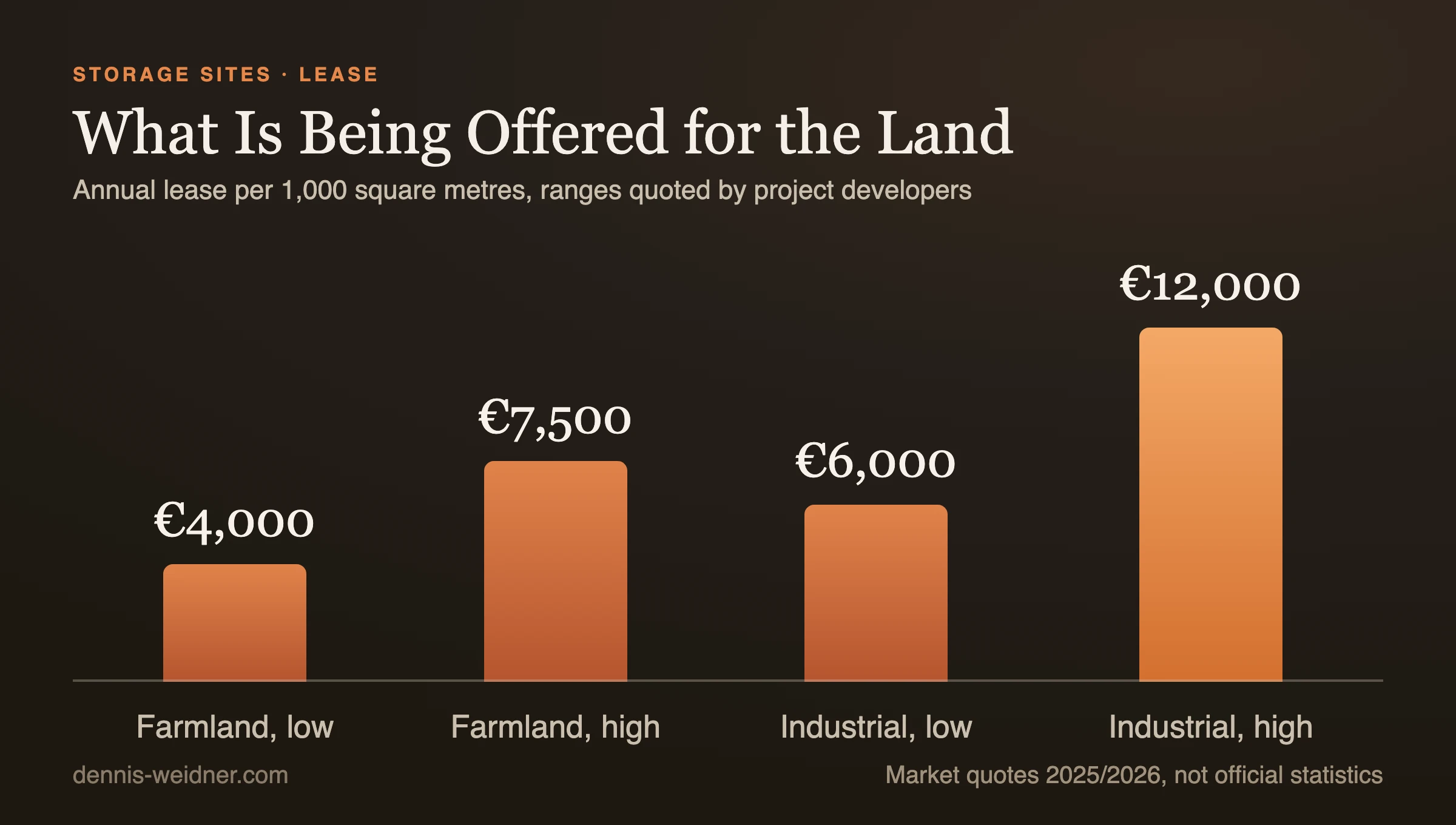
For industrial land, offers currently sit at roughly 6,000 to 12,000 euros per 1,000 square metres per year; for suitable farmland at roughly 4,000 to 7,500 euros. Terms typically run 20 to 30 years.
More on this topic: Battery Storage & Energy, with background, practice and every article in one place.
The figures come from project developers and land brokers, and the offers consistently fall in the same range. If you are leasing out land, still do not trust a table on the internet; get two or three offers in parallel. If you are leasing land in, do not assume the range is open at the top just because somebody published it that way.
Why the price looks like this
The jump only becomes visible once you convert to hectares and put it next to what the same land used to earn.
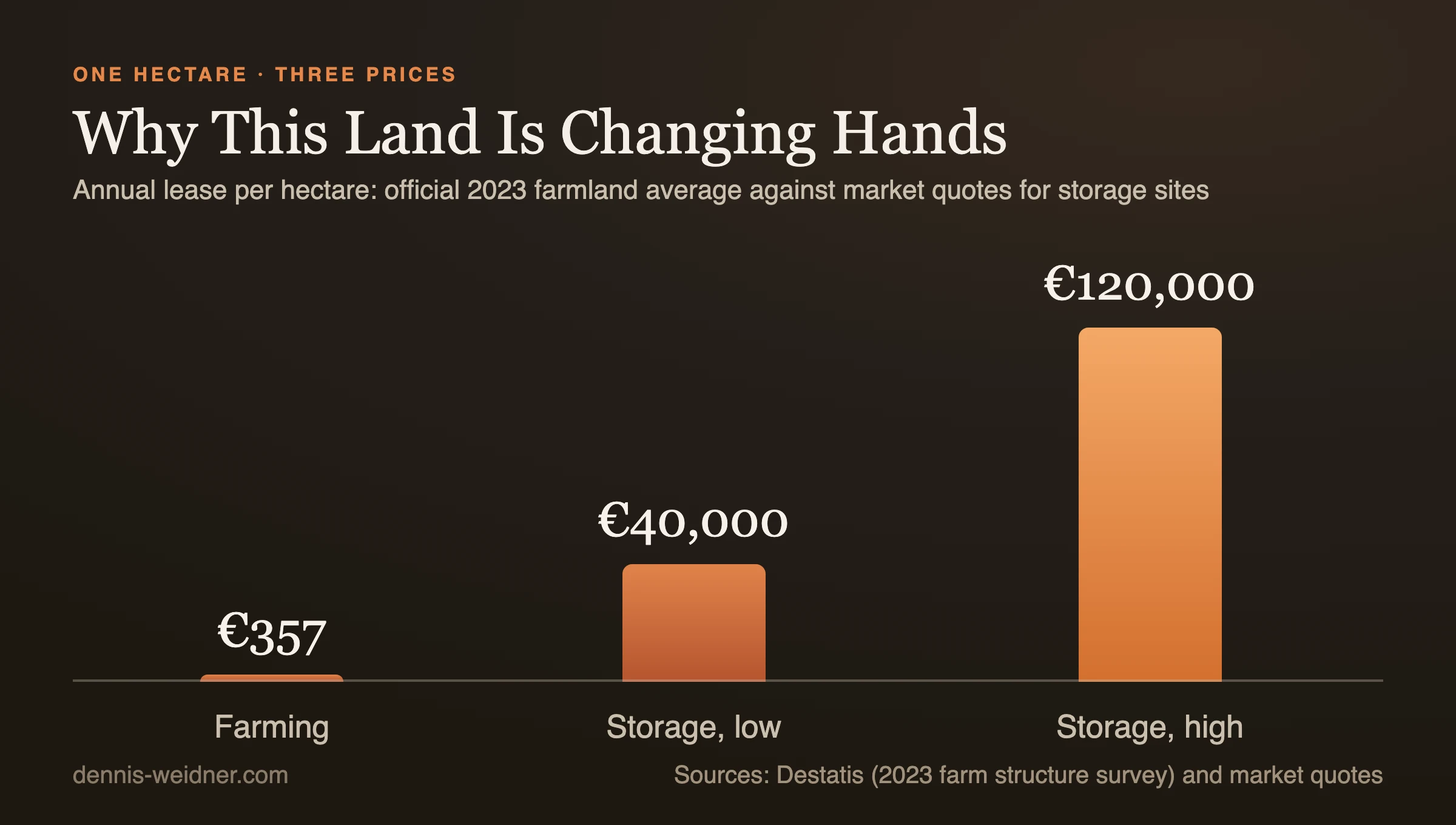
The Federal Statistical Office put the average lease for agricultural land in 2023 at 357 euros per hectare, nine percent above 2020. The range runs from 99 euros in Saarland to 560 euros in North Rhine-Westphalia. A storage project pays between 40,000 and 120,000 euros a year for the same hectare. Depending on location, that is a hundred to a thousand times as much.
Reading that as an overpriced market confuses two things. Nobody is paying for soil. They are paying for a position relative to the grid. A battery needs very little land: a 20 megawatt project often fits into one or two hectares. What it needs is a point where that power can actually enter the network, and such points are finite. The lease is therefore not the price of square metres, it is rent on a place in a queue that currently holds 400 gigawatts of requests.
The second reason is more mundane and regularly forgotten at the negotiating table: in the project model, the lease is a small line. For a 20 megawatt battery earning a six-figure sum per megawatt in a good year, 60,000 euros of ground rent is not a cost driver. That is why developers are willing to pay far above the agricultural level, and why the landowner's bargaining power is greater than they usually assume.
Since December 2025, distance to the substation decides
At the end of 2025 the German legislator added two new privilege categories to section 35 (1) of the Federal Building Code. Privileged means the project is generally admissible in the undesignated outer zone, so it needs a building application rather than its own land-use plan. In practice that saves one to two years.
Number 11 covers storage in spatial and functional connection with an existing renewable generation asset, meaning classic co-location next to wind or ground-mounted solar.
Number 12 covers the stand-alone battery, and it sets three conditions that must all be met at once. The plot lies no more than 200 metres from the property boundary of a substation stepping extra-high to high voltage or high to medium voltage, or from the boundary of an operating or decommissioned power plant of at least 50 megawatts rated output. The installation has at least 4 megawatts. And the site exceeds neither 0.5 percent of the municipal area nor 50,000 square metres.
Those 200 metres are the real price driver of this year, and they are barely present in most lease negotiations. A plot 180 metres from the substation is a different product in planning law than one 250 metres away. The first gets a building application; the second gets a land-use planning procedure with an open outcome and a municipality that has to agree. Anyone who owns land inside that radius should know it before discussing price. Anyone developing should have the boundary properly surveyed rather than estimated in a mapping tool. The distance is measured from the project itself to the substation's property boundary, not to the transformer.
What makes a lease expensive is not the rent
In the contracts that land on my desk, the money is rarely decided by the number in front of the euro sign. It is decided at five points next to it.
The easement and its rank. A lease on its own is not collateral for a bank. A battery gets financed once the use is secured in rem, through a restricted personal easement registered in section II of the land register, ideally in first rank. If a mortgage already sits ahead of it, the easement is worth little in a forced sale. For the owner this is the single strongest negotiating position, and it costs nothing beyond a willingness to talk to their own bank.
Powers of attorney. A clause allowing the developer to grant easements in favour of third parties hands over control of your own land register. The scope of the easement belongs in writing, precisely, and must not exceed what the lease itself permits.
Adjacent land and side rights. Many drafts quietly collect further rights: cable routes across other parcels, compensation and landscaping measures, a future substation, occasionally even an electrolyser. Every one of these is negotiable and every one has its own price. They belong in a separate agreement or nowhere.
Decommissioning. At the end sits the obligation to remove the plant, and it is worth exactly as much as the security behind it. A removal obligation owed by a project company with no assets is a sentence on paper. What counts is a bond or a deposited amount that grows over time, plus a rule for what happens if the company is sold first. Over 25 years, a storage project very probably changes hands more than once.
The option period. Two to four years pass between signature and construction while the developer chases permits and the grid connection. During that time the land is tied up but the full rent usually is not yet flowing. Three things belong in writing here: a reasonable reservation payment, a hard end date on which the tie-up simply lapses, and the question of what happens to permits and the connection offer if the project fails. Secure those, and the owner can market the site themselves afterwards.
The thirty-year trap
One detail regularly lost in project models with a thirty-year horizon: under section 544 of the German Civil Code, where a contract is concluded for longer than 30 years, either party may terminate extraordinarily at statutory notice once 30 years have passed. Section 581 (2) applies this to leases as well, with agricultural tenancies as the only exception. A storage lease on a field is generally not an agricultural tenancy, precisely because the land is no longer being farmed.
So a 35-year contract is not a 35-year contract. It is a 30-year contract plus a hope. That is entirely manageable once you know it: 30 years firm, then extension options the operator can exercise. For a storage project that is enough, because the cells get replaced or the project gets restructured before then anyway. It only becomes uncomfortable for whoever finds out during an investor's exit diligence.
How I read it
What strikes me about this shift is how fast it moved the negotiating table. Two years ago developers held the stronger hand, because there was more land than there were grid connections. Today the plot near a substation is the scarce good, because the maturity process turned it into the entry ticket and section 35 defines the radius in which it counts at all.
For owners that means: do not take the first offer, and above all do not give away two years of exclusivity without being paid for it. For developers it means: secure land before the project is modelled, and set terms so the security actually qualifies as security in the maturity assessment. A preliminary agreement with a right of withdrawal is not evidence. For both it means the contract meant to last 25 years deserves four weeks of legal review, not four days.
How the revenue that pays this rent is put together is written up in the revenue stack of a grid battery. Why it matters considerably whether the electricity going in is green or grey is covered in the piece on grey power, green power and mixed storage. The overview of the whole field sits at BESS and energy storage.
Land is the one component of a battery you cannot reorder. Everything else is just lead time.
Frequently Asked Questions
How much lease income does land for a battery storage project generate?
Project developers currently offer around 6,000 to 12,000 euros per 1,000 square metres per year for industrial land and around 4,000 to 7,500 euros for suitable farmland, on terms of 20 to 30 years. Per hectare that is 40,000 to 120,000 euros a year. For comparison, the German Federal Statistical Office reports an average of 357 euros per hectare of agricultural land for 2023.
Does a battery storage project in the outer zone need a land-use plan?
Since 23 December 2025, not necessarily. Section 35 (1) no. 11 of the German Building Code privileges storage in spatial and functional connection with an existing renewable generation asset. No. 12 privileges stand-alone storage only cumulatively: no more than 200 metres from the property boundary of a substation or of a power plant of at least 50 megawatts, at least 4 megawatts of installed power, and no more than 0.5 percent of the municipal area or 50,000 square metres.
Why is a lease alone not enough to secure a site?
Because it only binds in contract. Banks finance a battery once the use is secured in rem, usually through a restricted personal easement in section II of the land register, and its rank determines its value. The transmission operators' maturity-based connection process likewise counts robust site control, not a letter of intent.
Can a lease run for more than 30 years?
You can agree one, but you should not rely on it. Under section 544 of the German Civil Code, applied to leases through section 581 (2) outside agricultural tenancies, either party may terminate extraordinarily at statutory notice once 30 years have elapsed on a contract concluded for longer. The common structure is therefore 30 years firm followed by extension options.
Best,
Dennis Weidner
Note: AI tools supported me in writing this article, and some images were edited with AI. I stand behind its content and every statement with my name.