In Germany, any business that uses more than 100,000 kilowatt hours of electricity a year pays grid fees not only for the amount it consumes but also for the highest load it draws from the grid in a single quarter hour. That peak, taken from the load profile, is multiplied by the demand charge and applies to the entire billing year. In the worked example below, one unplanned load peak costs a mid-sized manufacturer €13,200 in grid fees without any change in consumption. Few items on a power bill can be cut as precisely as this one.
As of September 11, 2026.
More on this topic: Battery Storage & Energy, with background, practice and every article in one place.
What a Load Profile Is: A Company's Power Curve in Quarter Hours
A load profile records the power a connection draws from the grid over time. Businesses with interval metering, known in Germany as registrierende Leistungsmessung or RLM, get a meter that records an average value for every quarter hour. That is 96 values a day and 35,040 values a year. This type of metering is generally required from an annual consumption of 100,000 kilowatt hours. Below that threshold, the grid operator bills on a standard load profile: it assumes a typical curve and only measures the total amount.
A load profile shows what an annual bill hides: when a business needs power, how evenly it uses it and where the peaks are. The data belongs to the customer. Metering operators and suppliers usually provide it as a spreadsheet or in a customer portal, and an informal request is often enough. Below the RLM threshold, a smart meter also delivers quarter-hour values. Why installation is still slow is covered in the article on Germany's smart meter rollout.
How the Demand Charge Is Calculated: Annual Peak Times Price
The rule is set out in Section 17(2) of the German Electricity Grid Fee Ordinance (StromNEV). The grid fee for each withdrawal point consists of an annual demand charge in euros per kilowatt and an energy charge in cents per kilowatt hour. The demand component is the annual demand charge multiplied by the annual peak load; the energy component is the energy charge multiplied by the amount withdrawn.
The annual peak load is the highest quarter-hour value of the billing year. A single value. It does not matter whether a business ran at 300 kilowatts on 364 days: if it draws 500 kilowatts for one quarter hour on a Monday morning in January, it pays the demand charge for 500 kilowatts, and it pays it for the whole year. A peak in February cannot be saved away in the remaining months.
According to Section 17(1) StromNEV, the price per kilowatt depends on three factors: the voltage level the business is connected to, the metering at the connection and the utilization hours. The prices themselves are listed in each grid operator's price sheet, which is republished every year.
One detail is often overlooked: if a company has several withdrawal points at the same grid node and voltage level, their load profiles are combined simultaneously under Section 17(2a) StromNEV, a mechanism called pooling. The grid user has to prove that the conditions are met. Two halls whose peaks occur at different times then pay for their combined peak, not for two separate ones.
The 2,500 Utilization Hours Threshold in German Grid Fees
Utilization hours are annual consumption divided by the annual peak. A business consuming 1.6 gigawatt hours with a peak of 500 kilowatts reaches 3,200 hours. The figure shows how evenly a connection is used: a business drawing exactly the same load around the clock would reach 8,760 hours.
Annex 4 of the StromNEV sets a break point at 2,500 annual utilization hours. Two different price systems apply below and above it:
- Below 2,500 hours: a low demand charge and a high energy charge. Businesses with occasional peaks mainly pay for the amount they consume.
- From 2,500 hours: a high demand charge and a low energy charge. Businesses with an even load mainly pay for their peak.
At the break point itself, both systems cost the same. In practice this means that a business above 2,500 hours pays a lot for every additional kilowatt of peak, while a business below pays a lot for every additional kilowatt hour. Anyone who wants to cut costs first needs to know which side of the line they are on.
Worked Example: What a Load Peak Costs in Demand Charges
The example uses a manufacturing business connected at medium voltage with an annual consumption of 1.6 gigawatt hours and a price sheet with values in a typical range. The prices are assumptions; what counts is always the price sheet of your own grid operator.
| Price component (assumption) | below 2,500 hours | from 2,500 hours |
|---|---|---|
| Annual demand charge | €20 per kW | €110 per kW |
| Energy charge | 4.50 cents per kWh | 0.90 cents per kWh |
Four cases, each with the same annual consumption:
| Case | Annual peak | Utilization hours | Demand component | Energy component | Total grid fee |
|---|---|---|---|---|---|
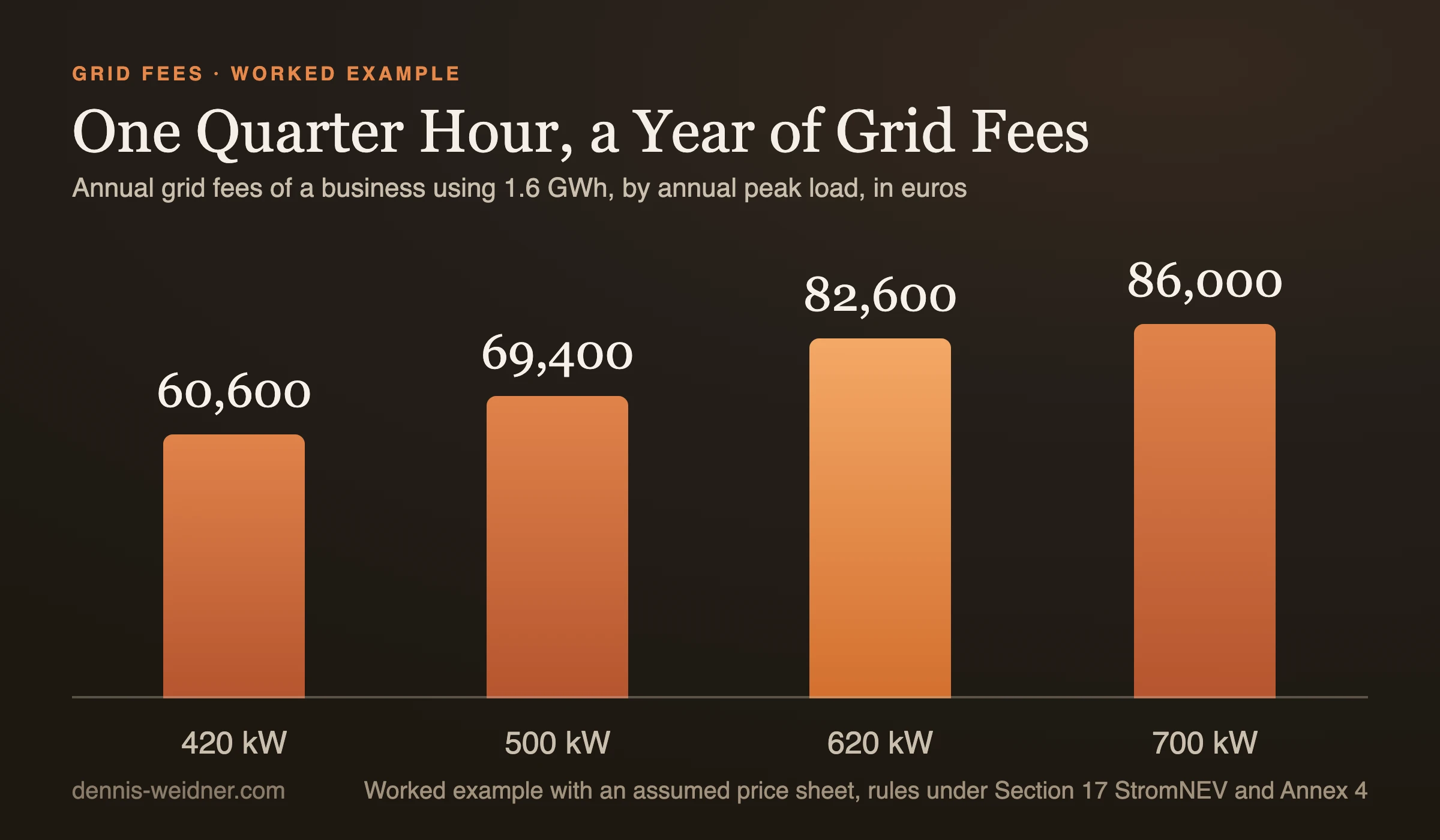
| A: normal operation | 500 kW | 3,200 | €55,000 | €14,400 | €69,400 |
| B: one unplanned peak | 620 kW | 2,581 | €68,200 | €14,400 | €82,600 |
| C: peak drops below the break point | 700 kW | 2,286 | €14,000 | €72,000 | €86,000 |
| D: peak shaved | 420 kW | 3,810 | €46,200 | €14,400 | €60,600 |
Case B is the most common in practice. After a shutdown, compressors, furnaces and ventilation start at the same time, and for one quarter hour the business draws 620 instead of 500 kilowatts. Consumption barely changes, but the grid fee rises by €13,200, or 19 percent.
Case C shows the effect of the break point. At 700 kilowatts, the business falls below 2,500 utilization hours and switches to the other price system. The demand charge falls, the energy charge rises, and the year costs €16,600 more than in normal operation.
Case D is the good news. Shaving the peak by 80 kilowatts saves €8,800 a year without using a single kilowatt hour less. In this example, every kilowatt of peak avoided is worth €110 a year. That figure is the key input for every investment decision that follows.
Reducing Load Peaks: Load Management Before Battery Storage
The order matters, because the cheapest measure is usually also the most effective.
First: read the load profile. The twenty highest quarter hours of the previous year almost always reveal a pattern: the start of a shift, a restart after maintenance, heaters and refrigeration overlapping by chance, or a vehicle fleet charging at every charge point at once in the morning. Once the cause is known, it can often be solved through organization: start equipment in stages, cap charging power, move cleaning cycles.
Second: a control system with a load limit. A load management system measures the running quarter hour and briefly switches off or throttles flexible loads before the limit is reached. It requires metering, setup and discipline on the shop floor, but no large equipment.
Third: a battery for peak shaving. The battery discharges as soon as the load reaches the limit and recharges during quiet hours. How much it may cost can be derived from the example: in case D it saves €8,800 a year, or €88,000 over ten years before interest. A battery including installation and controls must not cost more than that if it is to pay for itself through the demand charge alone. Additional revenue comes on top if it also stores solar power or uses the cheap hours of a dynamic electricity tariff. How such revenues stack up in larger systems is explained in the overview of battery storage and BESS.
There is one risk: a battery that misses the peak even once, for example because it happens to be empty, loses the benefit of the entire year in a single quarter hour. Reserve capacity and control logic therefore matter more than nominal capacity.
Atypical and Intensive Grid Use: Individual Grid Fees Under Section 19 StromNEV
Section 19(2) StromNEV provides individual grid fees for two usage patterns.
Atypical grid use: if it is foreseeable that a business's contribution to peak load deviates significantly from the simultaneous annual peak of all withdrawals at its voltage level, the grid operator must offer an individual grid fee. It may not be lower than 20 percent of the published grid fee. In practice, the grid operator publishes high-load time windows when its grid is most heavily used. A business whose own peak reliably falls outside those windows, such as one with a night shift or a cold store that pre-cools during the day, pays a lower demand charge. The Federal Network Agency has set out the details, and the agreement is concluded with the grid operator.
Intensive grid use: if a connection reaches at least 7,000 utilization hours and consumption exceeds ten gigawatt hours a year, an individual grid fee must also be offered. This applies to industrial plants with baseload demand; the business in the example, at 3,200 hours, is far away from it.
Demand Charges and PPAs: Why Cheaper Power Does Not Lower the Peak
A common misconception: buying cheaper electricity is thought to lower grid costs as well. A power purchase agreement with a solar park, as calculated in the article on PPAs for mid-sized companies, lowers the energy price. With an off-site PPA, however, the power still flows through the public grid, grid fees remain, and the demand charge depends solely on your own peak. A rooftop solar system does not help much either, because the annual peak often occurs on a dark winter morning when the system produces nothing.
For households and small businesses with a heat pump or wall box, the lever works differently: through time-variable grid fees for controllable consumption devices. This is described in the article on dynamic grid fees.
How the Rules for German Grid Fees Are Changing
The Electricity Grid Fee Ordinance is being phased out. On September 2, 2021, the Court of Justice of the European Union ruled in case C-718/18 that the German government may not prescribe the fee methodology to the regulator by ordinance. The Federal Network Agency is therefore working on its own determinations to replace the ordinance, and is reviewing the demand charge, the break point and special grid fees in the process. Until then, the familiar logic continues to apply.
For planning purposes, this means: anyone investing in load management today should run the numbers with the current price sheet rather than bet on a rule that does not exist yet. Grid operators publish their price sheets for 2027 around the turn of the year. That is the right moment to recalculate the value of an avoided kilowatt.
Checklist: Review Your Own Demand Charge in One Week
- Request last year's load profile from your metering operator or supplier.
- Mark the twenty highest quarter hours and assign a cause to each.
- Look up the demand charge, energy charge and voltage level in your grid operator's price sheet and calculate your utilization hours.
- Determine the value of an avoided kilowatt: above 2,500 hours, it is simply the annual demand charge.
- Check organizational measures and a control system first, then a battery.
- Compare your grid operator's high-load time windows with your own load profile: if your peak regularly falls outside them, it is worth discussing atypical grid use.
Frequently Asked Questions About Load Profiles and Demand Charges
What is a load profile?
A load profile records the power drawn over time. With interval metering, the meter records an average value for every quarter hour, which amounts to 35,040 values a year.
How is the demand charge calculated in Germany?
The demand component is the annual demand charge in euros per kilowatt multiplied by the annual peak load, meaning the highest quarter-hour value of the billing year (Section 17(2) StromNEV). The prices are listed in the grid operator's price sheet.
What does the 2,500 utilization hours threshold mean?
It is the break point from Annex 4 of the StromNEV. Below it, a low demand charge applies together with a high energy charge; above it, a high demand charge applies together with a low energy charge. Businesses above 2,500 hours mainly pay for their peak.
What is atypical grid use?
A business whose peak foreseeably deviates significantly from the peak load of its voltage level can claim an individual grid fee (Section 19(2) StromNEV). It amounts to at least 20 percent of the published fee. The grid operator's high-load time windows are decisive.
Is a battery worth it for peak shaving?
That depends on the value of an avoided kilowatt. In the example, a peak shaved by 80 kilowatts saves €8,800 a year. Over ten years, the battery including installation may cost at most that much if it is to pay off through the demand charge alone. Load management is almost always the cheaper first step.
Note: The prices in the worked example are assumptions for illustration, not market data and not energy or legal advice. What counts is the price sheet and the terms of your own grid operator. Next review of this article: January 2027, after the new price sheets are published.
Best,
Dennis Weidner
Note: AI tools supported me in writing this article, and some images were edited with AI. I stand behind its content and every statement with my name.