A power purchase agreement, or PPA, is a long-term electricity supply contract directly with a wind or solar park. For a mid-sized company it is above all a price insurance: part of its electricity demand costs a fixed price for ten years. The savings compared with a utility are often smaller than providers promise, because the residual power gets more expensive and surpluses are sold below value. The worked example below shows where the break-even point really lies.
As of September 11, 2026.
More on this topic: Battery Storage & Energy, with background, practice and every article in one place.
What a PPA Is: the Power Purchase Agreement Between Producer and Company
With a PPA, a company does not buy electricity through a tariff from a utility but contractually and directly from a specific plant. Terms of five to fifteen years are common. The operator gets what a bank wants to see before financing a park: a fixed offtaker and predictable revenue. The company gets a fixed price and proof of where its power comes from.
Since wind and solar parks in Germany are also built without state subsidies, the PPA has moved from a product for large corporations to a topic for mid-sized companies. Anyone working with storage knows the logic from the overview on battery storage: revenue that no longer comes from a subsidy scheme has to be secured by contract.
Types of PPA Compared: On-Site, Off-Site and Virtual PPA
| Type | How the power flows | For whom |
|---|---|---|
| On-site PPA | Plant on your own roof or premises, operated by a third party, power flows without the public grid | Businesses with large roof or open areas |
| Off-site PPA, physical | Plant is located elsewhere, delivery via the public grid, a utility handles balancing and residual power as a service provider (sleeved PPA) | Companies with high, steady consumption |
| Virtual or financial PPA | No power flow, only a price settlement: if the exchange price is below the PPA price, the company pays the difference, if it is above, the producer pays | Companies with several sites that want to keep their utility |
With an on-site PPA, grid fees and many grid-related levies do not apply because the power never touches the public grid. With an off-site PPA they still apply, and the fixed price covers only the energy share of the bill.
Pay-as-Produced or Baseload: the Profile Risk in a PPA
The most important contract question is not the price but the profile. Under a pay-as-produced PPA, the company takes the output as it comes: for a solar park, a lot of power at midday in summer and nothing at night. A utility has to fill the gaps, and surpluses have to be sold, if need be at exchange prices that regularly sit at zero or below in sunny midday hours. Under a baseload PPA, the producer or a trader delivers a steady band. That is more convenient and correspondingly more expensive, because someone wants to be paid for the structuring.
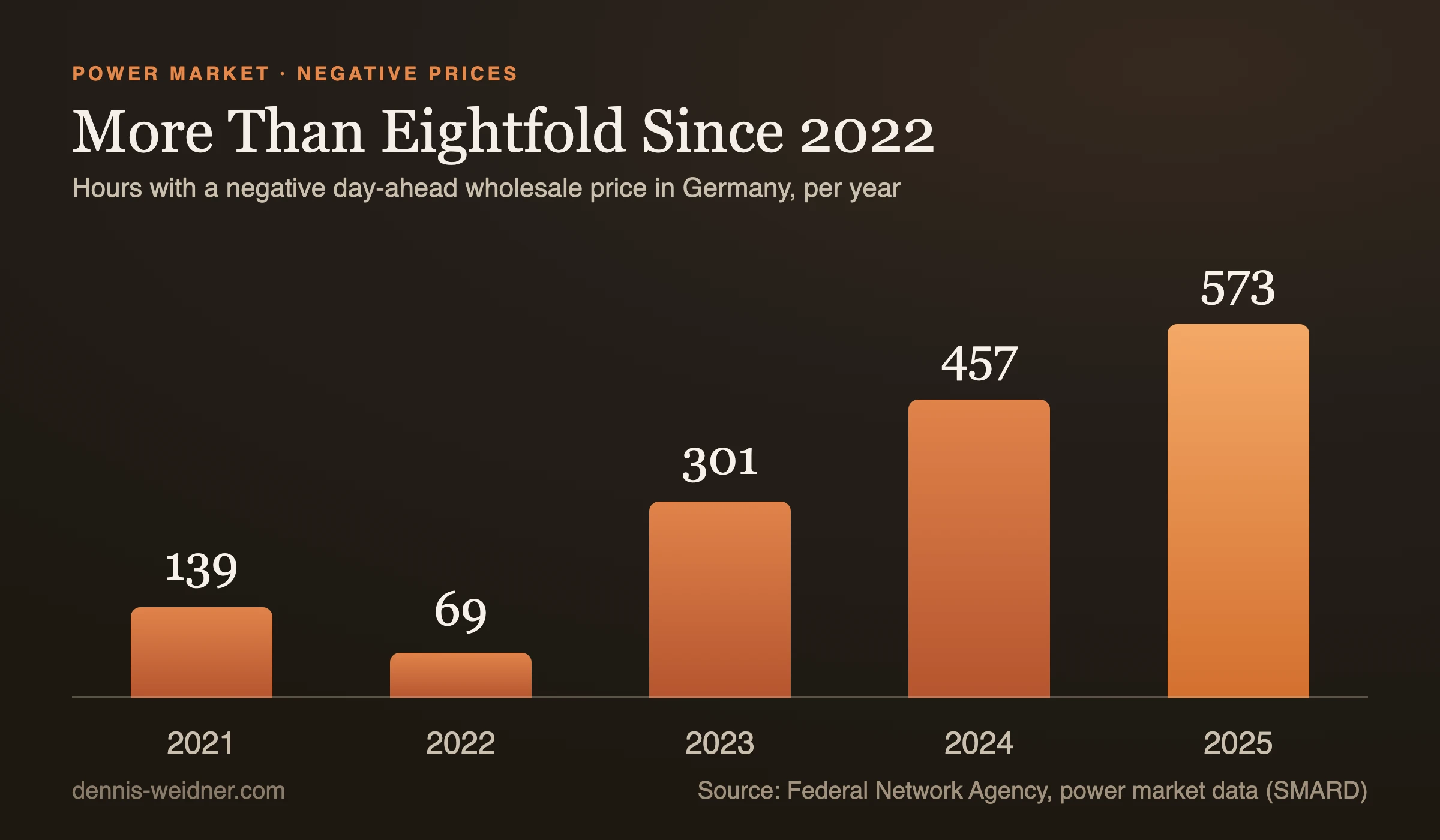
Negative prices are no longer a side issue. According to the Federal Network Agency's annual figures, the wholesale price was negative in 573 of 8,760 hours in 2025, up from 301 hours in 2023. Since Germany's Solar Peak Act of February 2025, new subsidized plants receive no support in hours with negative prices (Section 51 EEG). That makes unsubsidized plants with a PPA more attractive for operators, and for offtakers it means a negative-price clause belongs in every contract. Hourly prices can be checked on the Federal Network Agency's SMARD platform.
Worked Example: What a Solar PPA Saves a Mid-Sized Company
A business consumes 2,000 megawatt hours of electricity per year. It signs a pay-as-produced PPA for 600 megawatt hours of solar power for ten years. All prices are assumptions for the energy component, excluding grid fees, levies and taxes, which apply equally in both cases. They show the mechanics, they are not market prices.
| Item | Without PPA | With PPA |
|---|---|---|
| Power from the utility | 2,000 MWh × €95 = €190,000 | 1,520 MWh × €100 = €152,000 |
| Power from the PPA | none | 600 MWh × €60 = €36,000 |
| Sale of surpluses | none | 120 MWh × €25 = minus €3,000 |
| Energy costs per year | €190,000 | €185,000 |
Assumptions: utility price 95 euros per megawatt hour, PPA price 60 euros. 480 of the 600 megawatt hours coincide with consumption, 120 megawatt hours of surplus fetch an average of 25 euros. The residual power costs 5 euros more per megawatt hour because the utility has to supply a patchy profile.
The saving is 5,000 euros or 2.6 percent. That is the honest number, and it is small. The real value lies elsewhere: 30 percent of demand has a fixed price for ten years. If the utility price rises to 130 euros, a level the wholesale market clearly exceeded in 2022, the same contract saves 21,800 euros per year with unchanged surplus revenue.
In this example the break-even point is not the PPA price of 60 euros but a utility price of around 85 euros per megawatt hour. Below that, the business pays extra. The reasons are the 120 megawatt hours sold below value and the surcharge on residual power. A PPA is a bet on predictability, not on cheap electricity.
Guarantees of Origin: How a PPA Proves Renewable Power
Anyone who wants to report their electricity purchases as renewable to customers, banks or in a sustainability report needs guarantees of origin. In Germany they are issued by the Federal Environment Agency in the Guarantee of Origin Register, and only for electricity that receives no support under the Renewable Energy Sources Act (Section 79 EEG, ban on double marketing in Section 80 EEG). A PPA with an unsubsidized plant delivers both from one source, the power and the proof. How green and grey power come together in a storage system is covered in Grey Power, Green Power, Mixed Storage.
Who a PPA Pays Off For: Five Questions Before Signing
- Consumption: Is demand large and stable over years? Anyone moving sites within five years should not sign a ten-year contract.
- Load profile: How much consumption happens during the day? A business running day shifts uses solar power better than a cold store that runs mainly at night.
- Credit rating: The producer finances its park with the contract. It will ask for collateral, such as a bank guarantee.
- Clauses: Negative prices, shortfalls, changes in law and termination rights must be settled before the price is negotiated.
- Alternative: Does an own plant with storage pay off better? With enough roof space, self-supply is often the simpler route. How flexible consumption lowers costs is covered in Dynamic Electricity Tariffs 2026.
Frequently Asked Questions
What is a PPA in the electricity market?
A power purchase agreement is a long-term electricity supply contract directly between a producer, usually a wind or solar park, and an offtaker. Terms of five to fifteen years at a fixed or agreed price are common.
Does a PPA pay off for smaller companies?
An off-site PPA usually pays off only with high, stable consumption, because the contract, credit checks and structuring take effort. Smaller businesses tend to look at an on-site model or their own plant with storage.
What is the difference between a physical and a virtual PPA?
In a physical PPA, power is delivered, either directly or via the public grid. In a virtual PPA no power flows, the parties only settle the difference between the PPA price and the exchange price.
What happens with negative electricity prices in a PPA?
The contract decides. Without a clause, the offtaker under a pay-as-produced PPA has to take and pay for the power even when it is worth nothing on the exchange. Common clauses allow the plant to be curtailed in such hours.
Do I get guarantees of origin with a PPA?
Yes, if the plant receives no support under the Renewable Energy Sources Act. The Federal Environment Agency issues the guarantees in its register. Subsidized electricity gets no guarantees of origin.
Note: The prices in the worked example are assumptions for illustration, not market data, and this is neither legal nor energy advice. PPA contracts are individual and belong with a specialized lawyer before signing. Next review of this article: March 2027.
Best,
Dennis Weidner
Note: AI tools supported me in writing this article, and some images were edited with AI. I stand behind its content and every statement with my name.