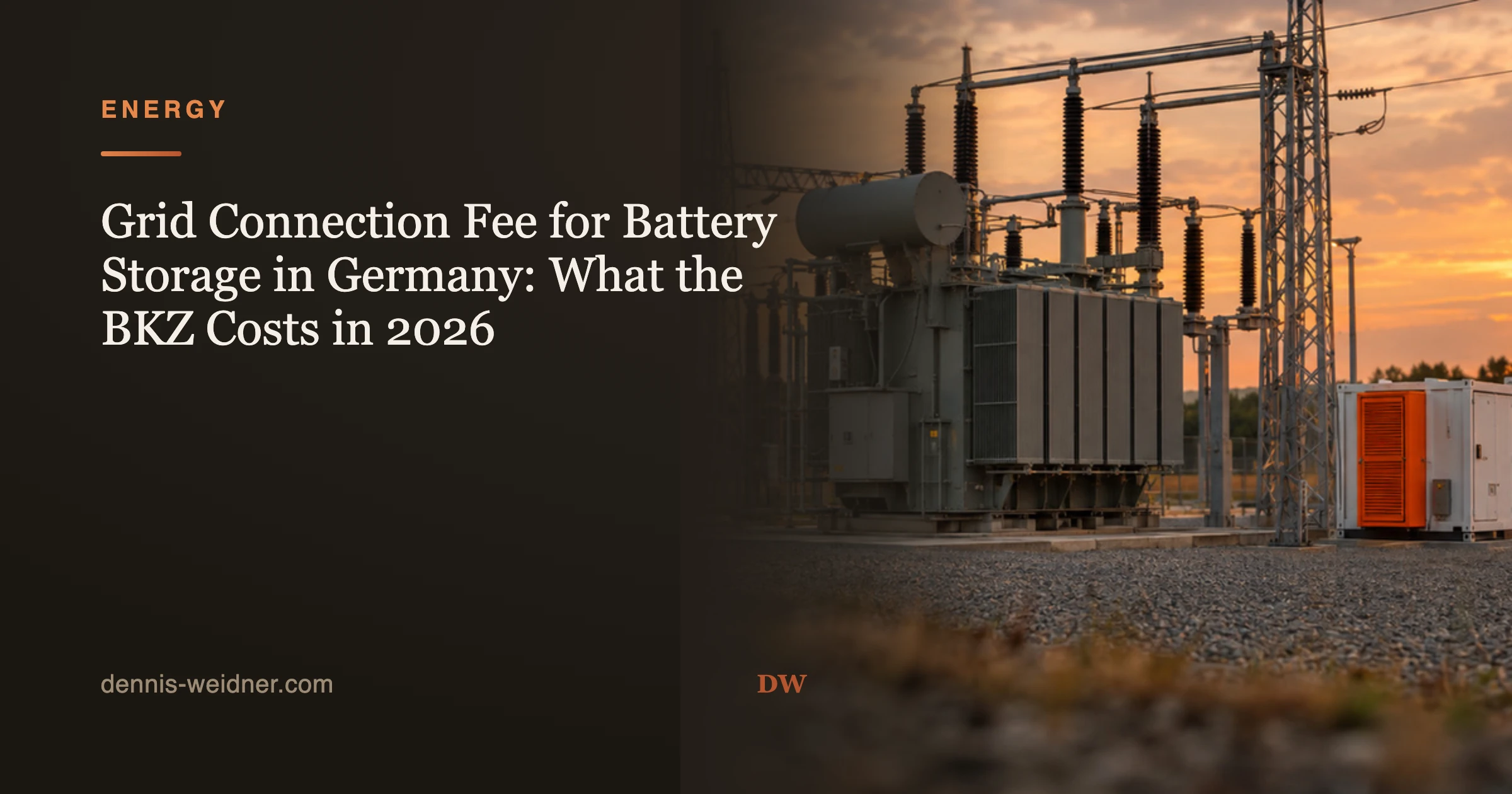
German grid operators may charge a battery storage project a one-off grid connection fee, the Baukostenzuschuss or BKZ, with no discount for the fact that the battery feeds power back. The Federal Court of Justice confirmed this on 15 July 2025 (EnVR 1/24). At high voltage and above, the 2026 rates range from roughly 46 to 163 euros per kilowatt of withdrawal capacity. For a 50 megawatt battery that means 2.3 to 8.1 million euros, up to half the price of the system itself at two hours of duration.
As of 25 September 2026. Not legal advice, see the note at the end.
More on this topic: Battery Storage & Energy – background, practice and every article in one place.
What Is the Grid Connection Fee for Battery Storage in Germany?
The Baukostenzuschuss, literally a "construction cost contribution", is a one-off payment to the grid operator towards expanding the upstream grid whenever a connection is built or reinforced. It depends on the capacity ordered, not on consumption, and it applies only to power drawn from the grid, never to feed-in. That is how the Federal Network Agency (Bundesnetzagentur, BNetzA) describes it in its position paper on construction cost contributions of 20 November 2024. The legal basis is Section 17 of the Energy Industry Act (EnWG): connection terms must be reasonable, transparent and non-discriminatory.
The cost of the connection itself, meaning switchgear bay, cable and substation equipment, is billed separately. The BKZ is the share a project pays towards the grid behind it.
For grid-scale batteries it matters more than for most customers. Storage that starts operating by 4 August 2029 is exempt from grid charges on its charging power for twenty years under Section 118 (6) EnWG. Under the Federal Network Agency's draft ruling on the AgNes grid fee reform, new projects would only keep this if the final investment decision is taken before the planned cut-off date of 1 January 2027. Where no recurring charges apply, the BKZ carries almost the entire contribution a new battery makes to the grid.
What the Federal Court of Justice Decided on the BKZ for Battery Storage
The Federal Court of Justice (Bundesgerichtshof, BGH) upheld the fee for batteries and rejected an exemption for grid-supportive storage. The case concerned a purely grid-connected battery with 1,725 kilowatts of power and 3,450 kilowatt hours of capacity, whose operator requested a connection in May 2021. The regulator dismissed the operator's abuse complaint on 6 December 2022, the Higher Regional Court of Düsseldorf sided with the operator on 20 December 2023, and the court's antitrust division overturned that ruling (press release no. 129/2025).
Three paragraphs carry the decision. Under para. 31, a connection must be sized for the maximum withdrawal capacity, and later feed-in changes nothing about that. Under para. 34, any grid benefit depends on how the battery is operated, and operation follows commercial logic first, not the local grid situation. Under para. 36, an exemption would shift the cost onto all other consumers through grid charges. The operator's offer to hand control to the grid operator during congestion did not change the outcome (para. 35).
What the court left open matters just as much. Whether grid operators reward grid-supportive operation lies within their discretion. The ruling creates no right to a discount, but no ban on one either.
How the BKZ for Battery Storage Is Calculated: the Capacity Price Model
The BKZ equals the ordered capacity multiplied by the capacity price (Leistungspreis) of the connecting voltage level for customers with more than 2,500 full-load hours a year. Since the 2024 position paper, operators no longer use a single year's price but the arithmetic mean of the year the contract is signed and the four years before. The regulator justifies this with price swings caused by interventions such as federal subsidies.
The 2026 price sheet of transmission operator 50Hertz shows how strong that smoothing is. Thanks to a 6.5 billion euro federal subsidy, the annual capacity price for extra-high-voltage withdrawal drops to 53.06 euros per kilowatt in 2026. For the BKZ, the four transmission system operators (TSOs) still use 96.91 euros, the five-year mean. The subsidy lowers the recurring charges at once, the BKZ by only a fifth.
The position paper allows two adjustments. TSOs may differentiate by grid node in five steps, but never below 20 percent of the capacity price, depending on how much redispatch an additional load causes there. Distribution system operators must charge one uniform rate across their area. And where capacity is contractually not available at all times without restriction, the regulator considers an appropriate reduction justifiable. Contracts signed up to the end of 2025 are protected.
BKZ by Voltage Level: What German Grid Operators Charge Battery Storage in 2026
The 2026 price sheets span almost a factor of four. Netze BW charges 162.97 euros per kilowatt on its high-voltage grid and 164.94 euros at the transformation to medium voltage. EAM Netz charges 156.79 euros for the high-to-medium-voltage transformation level, WSW Netz in Wuppertal 143.84 euros for high voltage. Regionetz in Aachen voluntarily halves its rate and ends up at 46.49 euros.
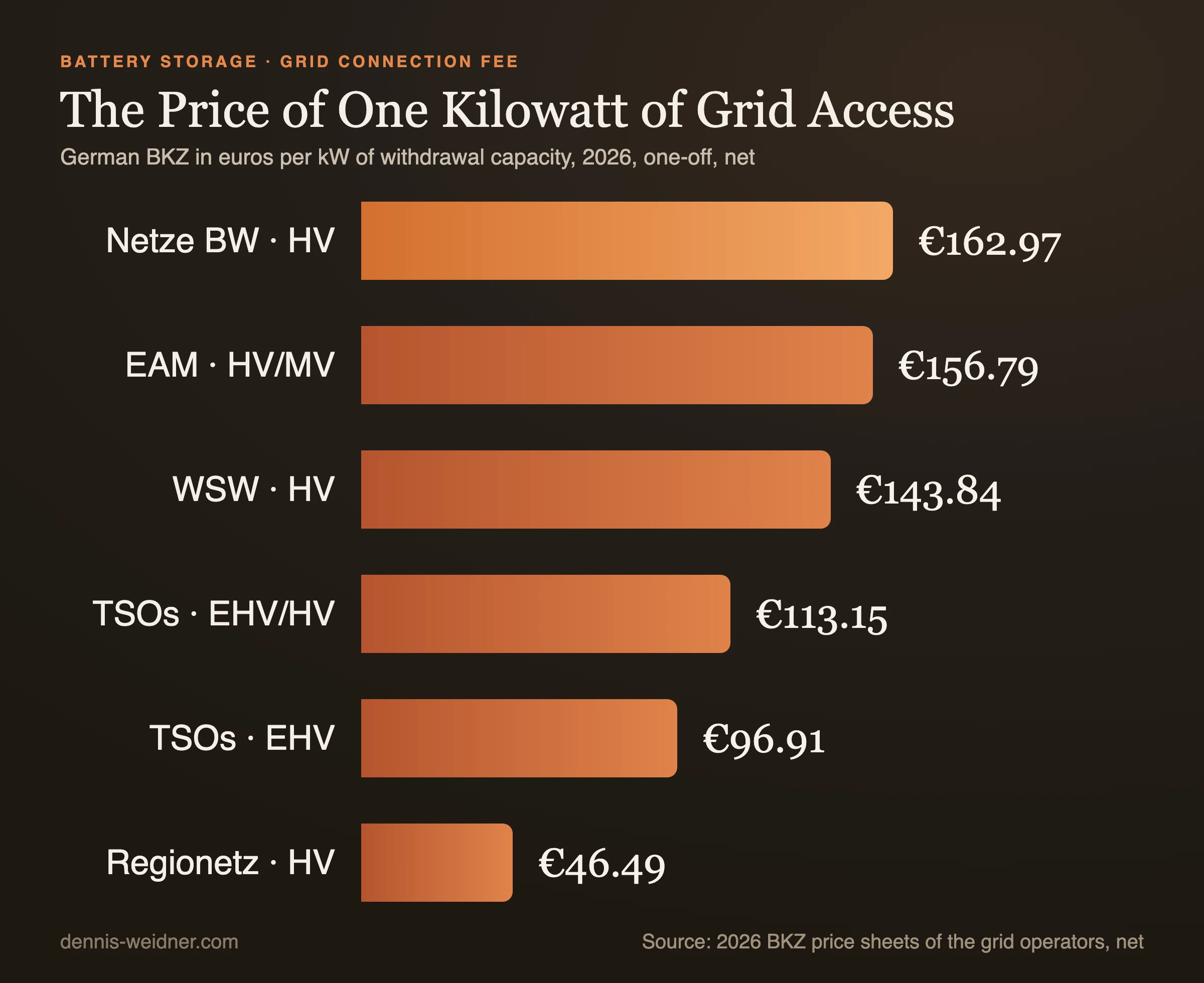
The order is striking. Per kilowatt, the transmission grid is cheaper than many high-voltage grids below it: 113.15 euros at the extra-high-to-high-voltage transformation level, 96.91 euros directly at extra-high voltage, both before the regional factor. TransnetBW, for example, applies 80 percent at 39 substations and the full rate at seven, and splits payment into three instalments: 50 percent at contract signing, 30 percent at start of construction, 20 percent at commissioning.
Worked Example: the Grid Connection Fee for a 50 MW Battery at a Substation
The table prices a battery with 50 megawatts of withdrawal capacity, once with two hours (100 megawatt hours) and once with four hours (200 megawatt hours). As system price it uses the European average of 177 US dollars per kilowatt hour for turnkey systems from the 2025 BloombergNEF survey, which I discussed in the piece on what a BESS EPC contractor actually does. Converted at the ECB reference rate of 24 September 2026 (1.1367 dollars per euro), that is 155.71 euros per kilowatt hour.
| Connection | BKZ per kW | BKZ for 50 MW | relative to system price, 2 h | relative to system price, 4 h |
|---|---|---|---|---|
| System price (benchmark) | €155.71 per kWh | €15,571,391 | €31,142,782 | |
| Netze BW, high voltage | €162.97 | €8,148,500 | 52% | 26% |
| WSW Netz, high voltage | €143.84 | €7,192,000 | 46% | 23% |
| Transmission grid, extra-high-to-high-voltage transformation, factor 100% | €113.15 | €5,657,500 | 36% | 18% |
| Transmission grid, same level, factor 80% | €90.52 | €4,526,000 | 29% | 15% |
| Transmission grid, extra-high voltage, factor 80% | €77.53 | €3,876,400 | 25% | 12% |
| Regionetz, high voltage | €46.49 | €2,324,500 | 15% | 7% |
The table shows the real lever. The BKZ grows with megawatts, the system price with megawatt hours. At two hours of duration, the Netze BW connection works out at 81 euros per kilowatt hour of storage, at four hours at 41 euros. A short-duration battery in an expensive grid area therefore pays more than half of what the battery itself costs just for the grid behind it. That puts the BKZ on the same list as cell prices and EPC quotes.
What Is Changing for the Battery Storage Grid Connection Fee in 2026
As of 25 September 2026 there is no new binding rule on the BKZ; the 2024 position paper still governs. Three procedures are moving towards one, though.
- AgNes. In its draft ruling on the general grid tariff system for electricity (AgNes), with comments due by 18 September 2026, the regulator explicitly leaves the BKZ out and announces separate method rulings (paras. 193 and 444). Anyone negotiating a connection contract today is still priced under the old model.
- The federal government's grid package. The bill (Bundestag printed paper 21/7866), debated at first reading on 24 September 2026, would add to Section 17 (2a) EnWG that a battery at an existing grid connection point may not be refused for lack of capacity if the previous maximum capacity stays unchanged through a flexible agreement or co-location with renewables.
- The Bundesrat. The upper house's own bill (printed paper 21/7734) would allow stand-alone batteries to connect only under a flexible connection agreement. The federal government considers it unnecessary alongside its grid package.
The direction is clear: whoever does not claim the grid fully and at all times gets connected faster. Why speed now matters more than price is covered in 400 Gigawatts Want In.
How Developers Can Reduce the Grid Connection Fee for Battery Storage
In my view the BKZ belongs in the first site assessment, not in the last line of the financial model. These are the four levers I would test.
- Order withdrawal capacity separately. The BKZ attaches only to withdrawal. A battery that exports 50 megawatts but charges at 40 megawatts saves 1,629,700 euros with Netze BW. The price is a charging time of two and a half hours instead of two, and that has to fit the revenue model.
- Choose voltage level and node. Between the most expensive and the cheapest rate in the table lie 5.8 million euros at 50 megawatts. The TSOs' regional factor is public and belongs on the same list as land price and distance to the substation. What land near a substation costs is covered in securing land for battery storage.
- Use existing connections. A BKZ is triggered by a new connection, a change of location, a change of voltage level or a capacity increase. A battery behind an existing solar or industrial connection that does not raise the existing withdrawal capacity falls under none of these.
- Write flexibility into the contract. A flexible connection agreement under Section 17 (2b) EnWG is currently an offer by the grid operator, not an obligation. Anyone accepting a cap should ask in return for the reduction the position paper expressly considers justifiable, in writing and with a number.
More on storage projects is collected under BESS and energy storage.
Frequently Asked Questions
Does a battery storage system in Germany have to pay a grid connection fee?
Usually yes, when it is newly connected or increases its withdrawal capacity. On 15 July 2025 the Federal Court of Justice confirmed that grid operators may charge the BKZ for grid-connected batteries under the capacity price model (EnVR 1/24).
How much is the BKZ per kW?
It depends on the grid operator and voltage level. In the 2026 price sheets, rates from the medium-voltage transformation level upwards range from 46.49 euros (Regionetz, high voltage) to 164.94 euros (Netze BW, transformation to medium voltage) per kilowatt, net.
Is the fee also charged on export capacity?
No. The BKZ applies only to power drawn from the grid. What counts is the contracted withdrawal capacity; export capacity may be higher.
Is there a discount if the battery supports the grid?
There is no right to one. The Federal Court of Justice leaves it to the grid operator whether to reward grid-supportive operation. Under the regulator's position paper, a reduction is justifiable if capacity is contractually not available at all times without restriction.
When is the grid connection fee due?
Usually with the connection contract. Some operators split it, TransnetBW for example into 50 percent at signing, 30 percent at start of construction and 20 percent at commissioning.
Note: This article is not legal advice. It describes the situation in Germany as of 25 September 2026 and deliberately simplifies: all amounts are net, the system price is a European average used for both durations, regional factors apply per grid node, and some operators apply their own rules for storage. What counts is the price sheet valid in the year the contract is signed. Next review of this article: once the regulator publishes its announced ruling on construction cost contributions or the grid package is passed.
Best,
Dennis Weidner
Note: AI tools supported me in writing this article, and some images were edited with AI. I stand behind its content and every statement with my name.