You might know the feeling. You read everywhere about the German smart meter mandate, you want a digital meter and a dynamic tariff at last, and then nothing happens. No appointment, no letter, no meter. Germany's rollout has been stalling for years, and that is officially documented. The good news: you do not have to wait until your metering operator eventually rings your doorbell. Since 2025 you have a real legal claim, and in 2026 you can actively enforce it.
What actually applies in 2026
The legal basis is the Metering Point Operation Act, in German the MsbG, which was tightened considerably with the 2023 relaunch of Germany's energy-transition digitalization. Since then there are clear thresholds above which an intelligent metering system must be installed. And an intelligent metering system is more than a digital meter. It is a modern meter plus a secure communication module that transmits your consumption data.
More on this topic: Battery Storage & Energy, with background, practice and every article in one place.
Installation becomes mandatory in three cases. First, if your household consumes more than 6,000 kilowatt hours per year. Second, if you run a solar array of 7 kilowatt-peak or more. Third, if you own a controllable load such as a heat pump, a wallbox, or a home battery under Section 14a of the Energy Industry Act. In these cases the operator decides and installs. Every other household gets at least a digital meter by the end of 2032, meaning a modern metering device without a communication module (section 29(3) MsbG). It only gets a smart metering system if the operator installs one voluntarily or you request it yourself.
Why the rollout keeps stalling
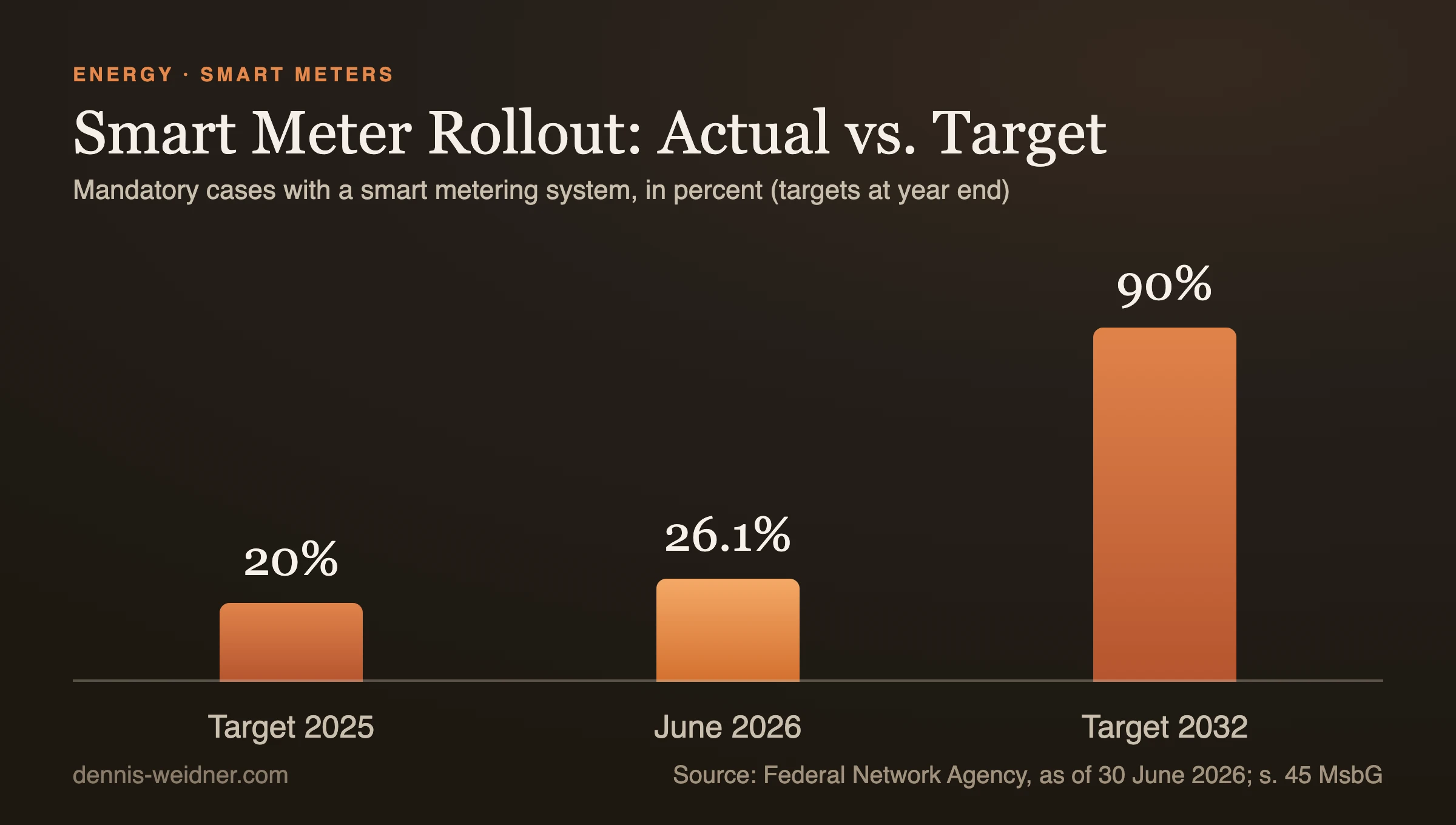
The plan runs in stages: at least 20 percent of mandatory cases equipped by the end of 2025. After that, section 45 MsbG as it now stands no longer sets a fixed interim quota for the installed base, but requires 90 percent of the newly added mandatory cases in each period and at least 90 percent of all mandatory cases by the end of 2032. On average the first mark has been passed: as of 30 June 2026, the Federal Network Agency survey counts 26.1 percent of mandatory cases equipped, but only 5.9 percent of all metering points in Germany. The 591 small operators with fewer than 30,000 metering points average just 19.2 percent. The Federal Network Agency has therefore opened 77 supervisory proceedings against companies that had not even started their rollout.
The reasons are unspectacular and still stubborn: missing devices, complex certification of the gateways, too few field technicians, outdated IT at some municipal utilities. For you as a consumer this means that waiting for your operator to call voluntarily can take a long time. That is exactly why it pays to become active yourself instead of disappearing into the queue.
Step by step to your smart meter
Here is the concrete path for 2026. It is less bureaucratic than most people expect.
Step one: Find your default metering point operator. As a rule this is your local grid operator, not your electricity supplier. You will find the name on your electricity bill or directly on the old meter. Note down the meter number, you will need it in a moment.
Step two: Submit an active installation request. Since January 1, 2025 you have the right to actively demand an intelligent metering system, even if you are below every mandatory threshold. An informal email or the operator's online form is enough. State your meter number, your address, and your clear request for an intelligent metering system.
Step three: Watch the deadline. The operator must in principle meet your request within four months. That is written into the MsbG. It may only postpone the appointment if doing so would jeopardize its statutory rollout plan, and it must then give you a concrete timeline. A vague brush-off without a date is something you do not have to accept.
Step four: Prepare for the appointment. The meter swap usually takes under an hour. The meter cabinet must be accessible, and the power is off briefly. After installation you receive a confirmation with the technical details of your new system.
What it costs you
Here I want to clear up the biggest worry. The prices are capped by law, so your operator cannot charge whatever it likes. The current ceilings are laid out transparently by the German consumer association Verbraucherzentrale.
For a mandatory installation with consumption between 6,000 and 10,000 kilowatt hours you pay a maximum of 40 euros per year. For a controllable load such as a heat pump or wallbox the ceiling is 50 euros per year. A simple modern meter without a communication module costs at most 25 euros per year including VAT (section 32(1) MsbG).
For the voluntary active installation request the operator may charge a one-time fee of up to 100 euros (section 35(1) no. 1 MsbG). If you are below every mandatory threshold, this is an optional installation case: then up to 30 euros per year under section 30(3) MsbG plus up to 30 euros per year in additional fees apply, at most 60 euros a year in total. These caps apply with the default operator. If you switch to a competitive metering operator, its own conditions apply, and those are often cheaper or even free.
Why the effort is worth it
A smart meter is not an end in itself, it is the ticket into a smarter electricity market. Without one you cannot use a dynamic tariff, because that settles hour by hour against the exchange price and needs exactly this fine-grained measurement. Anyone with large, flexible loads, an electric car, a heat pump, a home battery, turns the meter into a genuine savings tool. How that works in detail and who it pays off for, I have written up in my article on the dynamic electricity tariff in 2026.
For me this is the exciting part. Millions of small households reacting to price signals and charging in cheap hours end up behaving like one huge distributed battery. That is exactly where private meters meet the large battery storage systems that stabilize the grid. Why storage is the real key to the energy transition, I explain in my article on BESS and energy storage. The smart meter is the first small step in that direction, and in 2026 you can take it yourself.
Frequently Asked Questions
Is a smart meter mandatory for everyone in 2026?
No. Installation is mandatory for annual consumption above 6,000 kilowatt hours, for solar arrays of 7 kilowatt-peak or more, and for controllable loads such as a heat pump or wallbox. All other households get at least a modern metering device by the end of 2032 and can request a smart metering system themselves at any time.
How do I get a smart meter voluntarily?
Through the active installation request. You contact your default metering point operator, usually the local grid operator, informally with your meter number and address. The operator must in principle meet your request within four months.
What does a smart meter cost per year?
The prices are capped by law. For a mandatory installation above 6,000 kilowatt hours the ceiling is 40 euros per year, and 50 euros for controllable loads. For a voluntary installation request a one-time fee of up to 100 euros plus possibly 30 euros per year may apply.
Why is the rollout taking so long?
Because many metering operators are missing the statutory rollout targets. In 2026 the Federal Network Agency opened supervisory proceedings against 77 companies that had not yet started their rollout. Missing devices, certification, and staff shortages slow things down further.
Warmly,
Dennis Weidner
Note: AI tools supported me in writing this article, and some images were edited with AI. I stand behind its content and every statement with my name.