A split air conditioner with a heating function is technically an air-to-air heat pump. That is not just a claim in trade articles, it is written verbatim in the technical FAQ to the German building efficiency funding scheme. Yet most advice sites claim the opposite or invent conditions that do not appear there. I read the document, and the gap between what is required and what is being told is substantial.
Why the subsidy decides the case for split units
I wrote about costs, refrigerants and what is even permitted in a rented flat in Split Air Conditioning in Germany. What deliberately did not appear there, because it needs its own piece, is the subsidy question. It is the one place where the economics of such a system can shift by a five figure amount.
More on this topic: Battery Storage & Energy – background, practice and every article in one place.
It is also the place where most of the nonsense online sits. Not out of bad intent, but because a funding guideline is unattractive to read and a copied paragraph is cheaper than a 44 page PDF.
What the technical FAQ actually says
The authoritative source is the list of technical FAQ for the federal building efficiency scheme, individual measures, currently version 7.0 of June 2026. Item 8.21 deals with air-to-air heat pumps and says more in one sentence than most guides manage in an entire article. Translated:
Air-to-air heat pumps within the meaning of the funding guideline are heat generating systems, provided they serve to heat buildings. Air-to-air heat pumps also include split air conditioners or air conditioners with a heating function which are, for example, retrofitted to an existing heating system.
The final clause is the important one. The guideline explicitly covers retrofitting to an existing heating system. It does not say the old boiler has to go.
Two things are required: the equipment must meet the technical minimum requirements, and there must be proof that at least 65 percent renewable energy is reached for the supply area being renovated. In bivalent operation, meaning heat pump alongside an existing boiler, that proof can be provided in detail under DIN V 18599. Alternatively a simplification applies, and that is the real door opener: in predominantly parallel operation it is enough for the heat pump to cover at least 30 percent of the total heating output or of the standard heat load, and 40 percent in alternating operation.
Three myths that refuse to die
Myth one: the old heating system must be fully replaced. Not what the FAQ says. The text names retrofitting as an example. What is required is the 65 percent proof for the supplied area, and for that the 30 or 40 percent simplification exists.
Myth two: you need a seasonal performance factor of at least 3.0. Item 8.18 says literally the opposite: for air-to-air heat pumps, calculating a seasonal performance factor is not necessary for the proof. Verification runs through the energy label or the manufacturer data sheet, not through a performance calculation.
Myth three: you get up to 70 percent on 30,000 euros. That was true until 20 July 2026. Since 21 July the eligible maximum cost for the first residential unit is 28,000 euros, the climate speed bonus is 16 instead of 20 percent, and the ceiling is 80 percent, but only with the income bonus. The details are in Heat Pump Subsidies: The Mandate Is Gone, the Money Is Running Out.
Old figures lingering online three weeks after a reform is not in itself terrible. It becomes a problem when someone builds a quote on them.
The conditions that really count
The outdoor unit must be listed in the BAFA heat generator portal. That is the hard entry ticket. In addition the combination of outdoor and indoor units has to meet the requirements of item 8.21, because efficiency depends on the combination, not on the outdoor unit alone.
Efficiency up to 12 kilowatts: the combination must show energy label class A++ or A+++ for the average climate zone under Regulation (EU) 626/2011. If indoor units existed before the renovation and stay in service, they must appear in the overall combination on the label too.
Efficiency above 12 kilowatts: here a manufacturer data sheet under Regulation (EU) 2016/2281 with a seasonal space heating energy efficiency of at least 150 percent is sufficient. VRF systems have it easiest: if the outdoor unit is listed, all combinations with suitable indoor units are eligible without further proof.
No hydraulic balancing, but air flow adjustment instead. Item 8.04 clarifies that for air heating systems the hydraulic balance is replaced by regulating the air volume flows, confirmed in the installer declaration.
Grid-friendly interface. Here too air-to-air has its own rule: it is enough for the system to meet the requirements of the current status report 60 of the German building climate association. That special rule exists because funding for these units was temporarily suspended in February 2023 over precisely this question and released again in March 2023 with this solution.
The time window nobody mentions
Two dates turn a comfort decision into a scheduling decision.
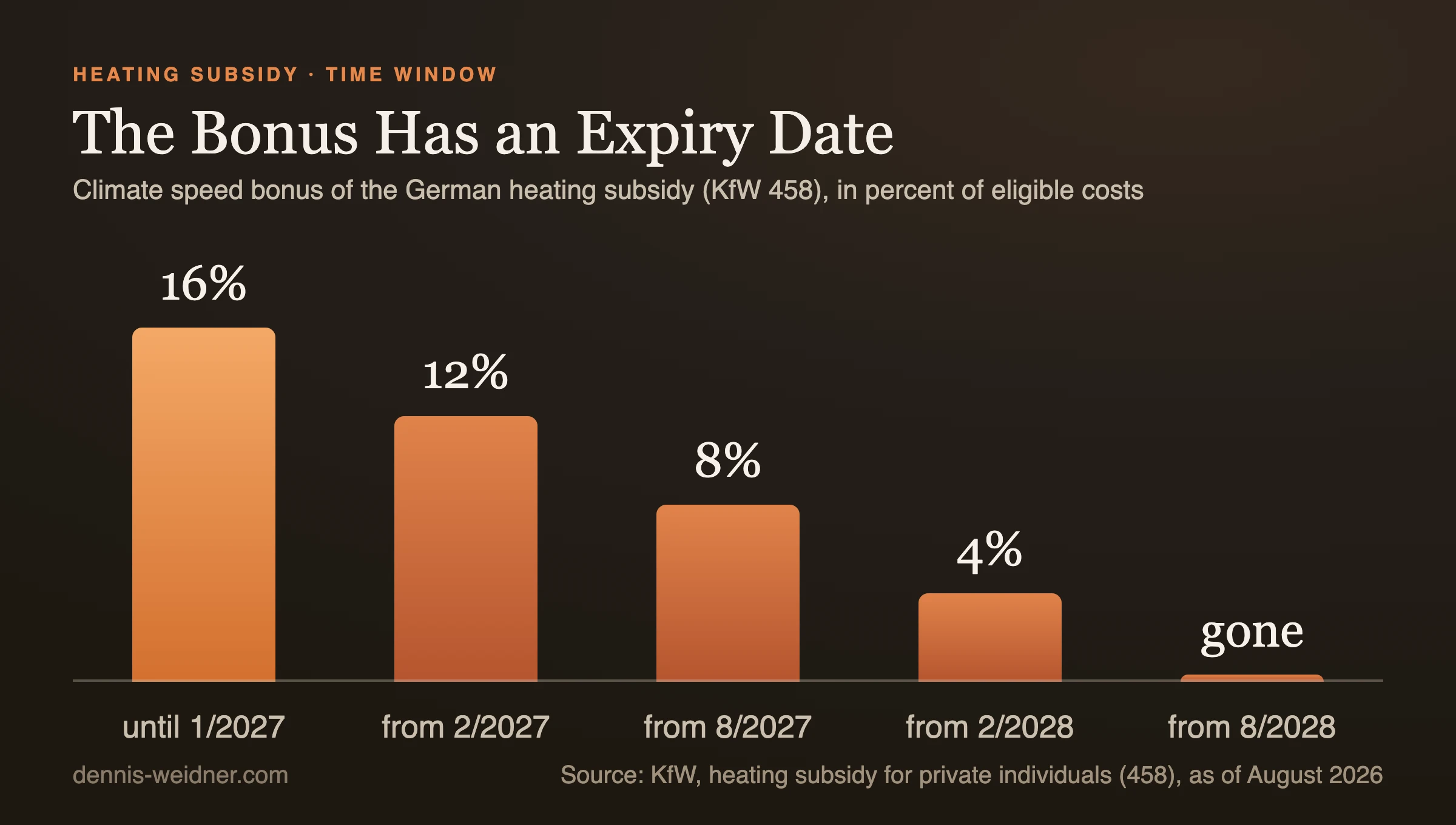
The first is the climate speed bonus. It stands at 16 percent until 31 January 2027 and then falls every six months until it disappears in August 2028. At the same time eligible maximum costs fall by 750 euros every six months from February 2027.
The second is harder. Under item 8.24 of the technical FAQ, from 1 January 2028 only heat pumps with natural refrigerants will be funded. For split systems that is the real turning point, because the common units run on R32, a fluorinated refrigerant. Read together with the deadlines of the EU F-gas regulation, a window is closing from both sides: technically through the refrigerant, and legally through the bonus.
Who earns from this and how to get in
Refrigeration and air conditioning firms that master the funding path. The split market is a price market as long as only the unit is sold. The moment a company designs, documents and files the system as an eligible air-to-air heat pump, it is selling something else. The number of firms that can do this is small, and the number actively offering it is smaller still.
Manufacturers with listed outdoor units and a propane roadmap. Being listed in the heat generator portal is a sales property, not a technical footnote. From 2028 it becomes existential.
The design and documentation layer. Heat load, area definition, 65 percent proof, installer declaration. That is work nobody offers cleanly today, because it sits between refrigeration engineering and energy consulting and belongs fully to neither.
And the simplest gap of all: reliable information. When three of the most read guides on this topic assert conditions that are not in the guideline, that is not a competitive problem. It is an open door.
I am building a comparison platform for the entire energy world, from split systems and heat pumps through solar and storage to the circular economy. Every figure there carries its source, every subsidy claim its reference in the actual guideline, and the research behind this article is part of it.
What I make of it
The interesting part of this story is not the grant amount. It is that a device most people buy as a luxury is treated as a heating system in funding law the moment it supplements one. That is quite a reinterpretation, and it has been in force for years without the market picking it up.
At the same time I would not advise anyone to buy a split system just for the subsidy. It has to suit the building, the insulation, the layout and the household load profile. If it does, the subsidy is a very good reason not to push the appointment into 2028. How cooling, solar power and a dynamic electricity tariff add up together is the real argument, not the grant.
Frequently Asked Questions
Is a split air conditioner eligible for German subsidies?
Yes, if it has a heating function and therefore counts as an air-to-air heat pump. The technical FAQ to the federal building efficiency scheme explicitly names split air conditioners and air conditioners with a heating function, including where they are retrofitted to an existing heating system.
Does the old heating system have to be removed?
No. The guideline names retrofitting to an existing system as an example. What must be proven is a 65 percent renewable share for the supply area being renovated. In bivalent parallel operation the simplified route requires the heat pump to cover at least 30 percent of the heating output or the standard heat load, and 40 percent in alternating operation.
Does a split system need a seasonal performance factor of 3.0?
No. The technical FAQ states explicitly that for air-to-air heat pumps a seasonal performance factor calculation is not necessary for the proof. Verification runs through the energy label for units up to 12 kilowatts, or a manufacturer data sheet above that.
What efficiency does the unit have to reach?
Up to 12 kilowatts the combination of outdoor and indoor units must reach energy label class A++ or A+++ for the average climate zone. Above 12 kilowatts a manufacturer data sheet with a seasonal space heating energy efficiency of at least 150 percent is sufficient. The outdoor unit must also be listed in the BAFA heat generator portal.
Why not wait until 2028?
Because two deadlines converge. The climate speed bonus falls by four percentage points every six months from February 2027 and disappears in August 2028. And from 1 January 2028 only heat pumps with natural refrigerants will be funded, which is a hard limit for the R32 split units common today.
Warm regards,
Dennis Weidner
Note: AI tools supported me in writing this article, and some images were edited with AI. I stand behind its content and every statement with my name.