Since 1 August, a new solar system up to 10 kilowatts in Germany earns 7.70 cents per kilowatt hour for the power it feeds into the grid. Twenty-two years ago the figure was 57.4 cents. And on 29 July the federal cabinet decided that from 2027 there should be no fixed tariff at all for small new systems. That sounds like an ending. It is in fact a redistribution, and the only open question is who ends up on the receiving side.
Two dates that belong together
The first is routine and happens every six months: on 1 August 2026 the applicable values under the Renewable Energy Sources Act (EEG) fell by another one percent. The Federal Network Agency now lists 7.70 cents per kWh for partial feed-in and 12.22 cents for full feed-in for rooftop systems up to 10 kilowatts, and 6.66 and 10.24 cents respectively up to 40 kilowatts. These rates apply to systems commissioned until 31 December 2026; after that, the successor rules now before the Bundestag take over. The figures are published in the Federal Network Agency's tariff overview.
More on this topic: Battery Storage & Energy – background, practice and every article in one place.
The second date is the real break. On 29 July 2026 the cabinet approved an EEG amendment together with a grid connection package. For new photovoltaic systems below 25 kilowatts, the fixed feed-in tariff is to be abolished. The economics minister's reasoning: these systems deliver such high returns that they would be built anyway. Parliament and the upper house start deliberating in September, and the reform is meant to take effect on 1 January 2027. There is time pressure because the state aid approval expires at the end of the year.
The curve nobody took seriously
The collapse of the feed-in tariff is usually told as a scandal. It is not. It mirrors almost exactly what a solar system cost over the same period. The interesting part is not the slope. It is the end.
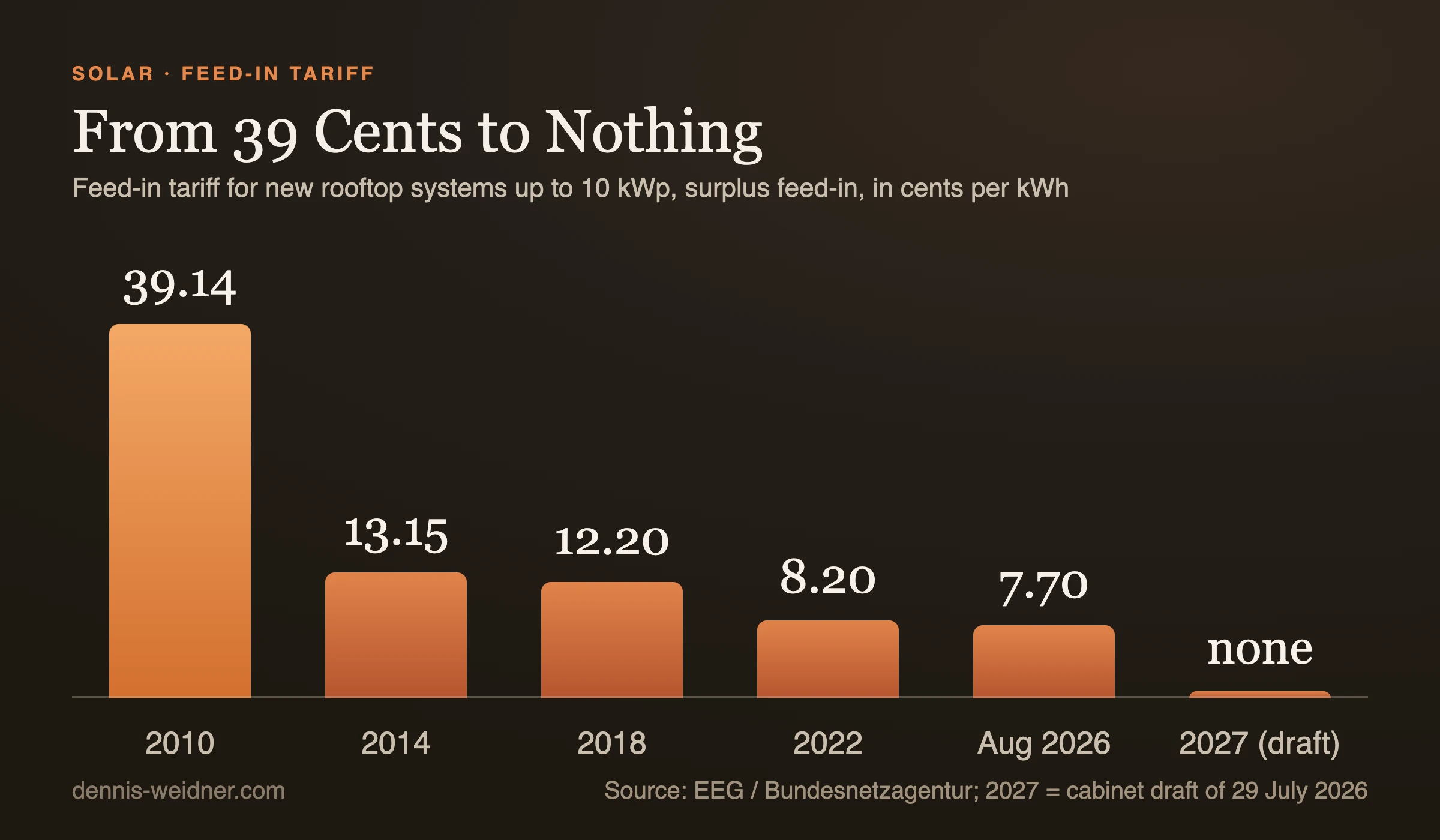
Between 2010 and 2014 the rate fell by two thirds because modules became dramatically cheaper in the same period. After that it was quiet for twelve years: barely five cents separate 2014 from today. The 2027 bar is of a different kind. It is not degression. It is a design decision.
What is meant to replace the tariff
The draft does not leave small systems with nothing. It moves them into a different mechanism. Four points that only make sense together:
Mandatory direct marketing. New systems will refinance themselves on the power market instead of through a fixed rate. On top comes a direct marketing bonus of 1.5 cents per kWh for systems below 25 kilowatts, paid for at most 48 months.
Feed-in capped at 50 percent. Small rooftop systems may only feed half their capacity into the grid connection point. This saves grid expansion and flattens the midday peak.
A transitional payment. Systems below 50 kilowatts connected by the end of 2027 receive a tariff roughly one cent below today's rate for up to 36 months.
Grandfathering. Everything connected by the end of 2026 keeps its twenty years unchanged. Anyone planning a system now has a very specific date in the calendar.
The 50 percent cap is the point readers should stop at. It turns a system that could push everything into the grid into one that only realises its full yield if the owner stores or shifts consumption. That is the transition from a subsidy business to a systems business.
What this means for an actual system
To keep the debate concrete, a worked example. A single family home with a 10 kWp system generates roughly 9,500 kilowatt hours a year in Germany. Without storage an average household consumes about a third of that itself, so around 6,300 kilowatt hours go into the grid.
Under current law that yields roughly 485 euros a year at 7.70 cents, for twenty years, predictable to the cent. Under the draft, two things change from 2027. First, only 5 kilowatts may be fed in at any moment, which bites exactly on clear summer days. Second, the revenue depends on the exchange price plus the 1.5 cent bonus, and the exchange price at midday in summer is regularly very low and sometimes negative.
The restructuring sits precisely in that calculation. The revenue side gets smaller and less certain while the savings side stays the same. The value of a system therefore moves from what it exports to what it replaces. And since a kilowatt hour bought from the grid currently costs four to five times the tariff, that was already the bigger advantage. The draft merely makes it indispensable.
Who earns from this
Whenever a fixed payment is replaced by a market mechanism, a service layer appears in between. Here there are four.
Direct marketers. Until now this was a business with wind farms and large ground-mounted plants, meaning a few hundred or a few thousand customers per provider. From 2027 potentially hundreds of thousands of small systems join every year. That is not a bigger business, it is a different one: sales, onboarding, billing and support have to work at consumer level, not at project developer level.
Metering operators. Direct marketing without quarter-hourly metering is impossible. The entire reform therefore hangs on a rollout that has been stalling in Germany for years. How badly, I described in Germany's Smart Meter Rollout 2026. Anyone who can install and operate smart metering systems today holds a bottleneck from 2027 onwards.
Storage vendors. The 50 percent cap is effectively a storage subsidy without a grant. If you may not feed in the other half, you have two options: give it away or keep it.
Energy management. A household that charges, heats and stores according to price needs software to make those calls. Combined with a dynamic electricity tariff, the system becomes a small power plant with a schedule.
How to get in without owning a power plant
The reflex in shifts like this is to pick the biggest field. That is usually the most expensive route. Three entries I consider realistic:
The translation layer. There is a gap between a cabinet draft and the person comparing two quotes. Who explains that an offer quoting 7.70 cents has to be modelled differently from 2027 onwards? That layer is empty today, and it needs the least capital.
Installers with systems competence. A company that delivers panels, storage, wall box and control from one hand and handles the grid connection properly is selling something different from a company that mounts modules. The margin moves from hardware to integration.
The small aggregator. A thousand systems with storage are a tradeable portfolio. The route there runs through existing customers, not new ones. Whoever already services systems sits closer to this business than any new entrant.
I am building a comparison platform for the entire energy world, from solar through storage and heat pumps to split systems and the circular economy. Every figure there carries its source and every subsidy claim its reference in the actual guideline, and the research behind this article is part of it.
What I make of it
I do not think the direction is wrong. Permanently propping up a technology that already pays for itself ties up money that would do more elsewhere. And the midday peak is a real problem, not an invention of grid operators.
What I do think is wrong is the sequence. Direct marketing for small systems presupposes a metering infrastructure that does not exist. The old instrument is being removed on a date at which the new one demonstrably does not yet carry. Criticising that is not criticising the idea. It is criticising the calendar.
For your own decision this means: build in 2026 and you buy twenty years of known rules. Build in 2027 and you buy a market product. Either can be right. You should just know which one you are buying. How generation, storage and trading add up together is in my overview of battery storage and the energy transition.
Frequently Asked Questions
What is the German feed-in tariff in August 2026?
For new rooftop systems up to 10 kilowatts it is 7.70 cents per kWh for partial feed-in and 12.22 cents for full feed-in. Up to 40 kilowatts the figures are 6.66 and 10.24 cents. According to the Federal Network Agency these rates apply to systems commissioned between 1 August and 31 December 2026.
Is the feed-in tariff really being abolished in 2027?
The federal cabinet approved a draft on 29 July 2026 under which new systems below 25 kilowatts would no longer receive a fixed tariff. It is not settled yet: parliament and the upper house begin deliberating in September 2026. The planned start date is 1 January 2027.
What happens to my existing system?
Nothing. Existing systems and all new systems connected by the end of 2026 keep their twenty-year tariff unchanged. The draft applies only to later commissioning dates.
What is the direct marketing bonus?
A premium of 1.5 cents per kWh which, under the draft, systems below 25 kilowatts would receive for at most 48 months if they sell their power on the market. It does not replace the fixed tariff one for one; it shifts the revenue risk to the operator.
Why should small systems only feed in 50 percent?
To reduce grid expansion costs and dampen the midday peak. In practice the rule works like a storage subsidy without a grant: if you may not feed in the second half, you have to use or store it yourself, otherwise it is lost.
Warm regards,
Dennis Weidner
Note: AI tools supported me in writing this article, and some images were edited with AI. I stand behind its content and every statement with my name.