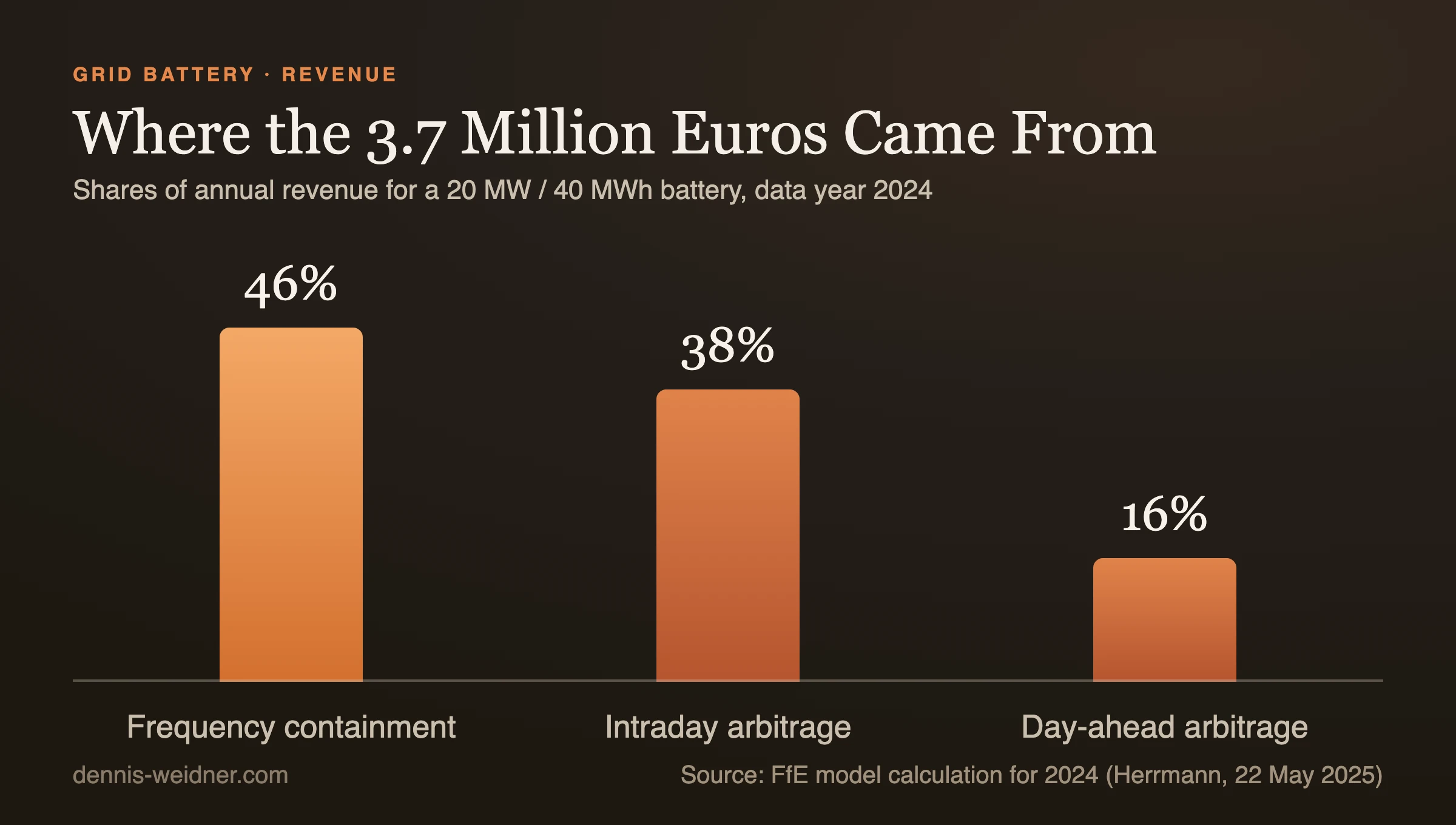
One set of numbers shows up in every second deck on grid-scale batteries: 46 percent from frequency containment reserve, 38 percent from intraday, 16 percent from day-ahead. It comes from a model calculation for a 20 megawatt, 40 megawatt-hour battery that earned around 3.7 million euros in 2024. The numbers are correct. They just describe a market that no longer exists in that shape. Anyone pricing a battery today on that split is budgeting with the weather from the day before yesterday.
Why it is a stack and not a pie
The term revenue stack sounds like a pie chart, and that is where the misreading starts. A battery does not have three parallel income streams. It has one physical resource that it sells in sequence: power in megawatts and energy content in megawatt-hours. Every megawatt committed to a balancing product for an hour is a megawatt unavailable for trading in that hour. The stack is a waterfall.
More on this topic: Battery Storage & Energy – background, practice and every article in one place.
The order inside that waterfall follows the deadlines. Balancing markets sit at the top because they become binding earliest. Win an award there and you have to hold the committed power across the entire product window, whatever the spot market does. What is left of power and energy after that goes into the day-ahead auction. Whatever is still free, or becomes free again through other people's forecast errors, moves into continuous intraday trading, which stays open until shortly before delivery.
This sequence is why a 20 megawatt, 40 megawatt-hour battery does not simply earn money four times over. It has two hours of duration. Park part of that in balancing and there is less range left for arbitrage. Need the full range for arbitrage and there is no balancing capacity to offer. The optimizer making that call hour by hour is the real earnings driver of a battery, not the cell.
The four floors, briefly
Frequency containment reserve (FCR). The fastest reserve in the European interconnected grid. The battery has to reach full output within 30 seconds and hold it for at least 15 minutes. Procurement runs daily in six four-hour blocks, the minimum bid is one megawatt, and everyone is paid the price of the last accepted bid. Activation happens automatically off grid frequency as soon as it leaves the band between 49.99 and 50.01 hertz. For years this was the perfect battery product: lots of power, almost no energy throughput.
Automatic frequency restoration reserve (aFRR). Slower, but split in two. There is a capacity price for merely standing by and an energy price for what is actually delivered. That split is precisely what now makes aFRR more attractive for batteries than FCR, because it offers two independent revenue sources.
Day-ahead. The previous day's auction for all 24 hours of the following day. Predictable, liquid, and the spread between the daily low and the daily high is the entire return. It depends on how hard solar and wind push down the midday hours.
Intraday. Continuous trading until shortly before delivery. What earns money here is not the best forecast but the fastest reaction to somebody else's bad one. This is the market where a battery plays its physical advantage.
Why the 46 percent is falling apart
The model behind that 46 percent dates from May 2025 and describes the year 2024. What makes it worth reading is that the authors put the decisive question on the very next slide: will this trend continue? The answer sits in a table the transmission system operators publish twice a year.
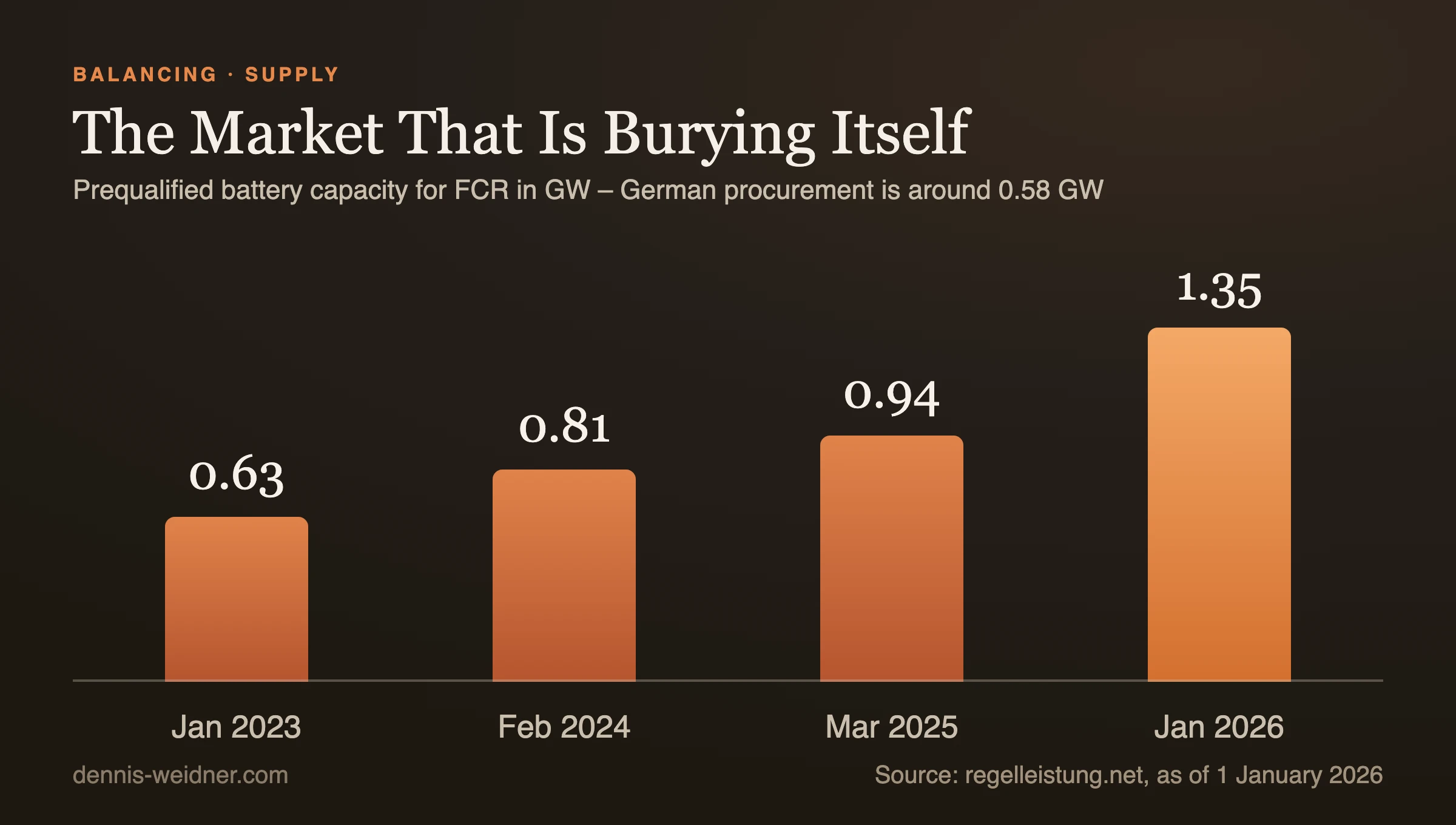
Prequalified battery capacity for FCR alone rose from 0.63 gigawatts in January 2023 to 1.35 gigawatts in January 2026. Germany procures around 580 megawatts. Batteries by themselves therefore offer more than twice what is needed, and next to them stand 2.91 gigawatts of hydro, 0.46 of lignite and 0.26 of gas. In total, 5.13 gigawatts are prequalified for a product that buys 0.58 gigawatts.
The same story is playing out in aFRR, two years later and faster: prequalified battery capacity for positive aFRR jumped from 0.33 gigawatts in February 2024 to 1.20 gigawatts in January 2026. Anyone modelling 2025 aFRR prices into a 2027 case is repeating the mistake everyone made with FCR in 2024.
One footnote to that same table is regularly skipped and matters for the maths: prequalified capacity may only ever be marketed in one balancing product, or split proportionally across several. Being prequalified in three products does not triple the marketable volume. It only widens the choice.
What the stack actually pays
There is now a usable yardstick for the absolute level. ISEA at RWTH Aachen University publishes the Battery Revenue Index for a reference battery of one megawatt and two megawatt-hours. Optimised across all markets, the value stood at roughly 309,000 euros per megawatt in 2024. In 2025 it was 259,000 euros, down 16 percent. For a one-hour battery it fell from 183,000 to 151,000 euros.
The shift underneath is more interesting than the total. The index also reports what each market would yield on its own. For the two-hour battery in 2025 that was 106,000 euros in FCR, down almost 7 percent. 146,000 euros in the aFRR capacity price, up 39 percent. 76,500 euros in the aFRR energy price, down 66 percent. And 91,000 euros in day-ahead, up 17 percent. These four figures must not be added up, which is the most common way this index gets misread: they are single-market potentials, not components of the 259,000 euros.
The first quarter of 2026 then delivered the hardest knock so far. Annualised, the revenue potential came in at 132,000 euros per megawatt, 40 percent below the same quarter a year earlier. February dropped to roughly 95,000, March recovered to roughly 200,000. The enervis index, which models more conservatively, put June 2026 at around 18,000 euros per megawatt per month and the twelve-month average at just over 12,500, so around 150,500 euros a year.
Sales decks almost never mention that these values are backtests run with perfect foresight. They calculate what a battery would have earned if it had known the day's prices in advance. A real optimizer does not. Take the index numbers straight into an investment model and the haircut for forecast error, unavailability and trading fees is still ahead of you.
The door is called prequalification
Before any of this counts, the asset has to be prequalified. That is not a form but a technical suitability proof filed with the transmission system operator through the PQ portal: measure the step response, evidence the activation time, demonstrate the communication link and schedule capability, sign the contract set. The proof is product-specific and has to be filed separately for each balancing product.
And it has teeth. Deliver less than committed and the capacity payment is cut proportionally; repeat it and penalties follow, up to withdrawal of the prequalification. A battery that loses its balancing route loses close to half its revenue stack on the split above. In project finance, prequalification is therefore not a technical detail but a milestone with drawdown consequences.
The grid connection reaches straight into the stack
There is a link between this and the other topic I have written about in recent days. When a grid operator connects a battery only at limited power, through an envelope that permits less feed-in or offtake at certain times of day, annual revenues in that same model fall by 15 to 30 percent. The burden is not spread evenly, though: frequency containment takes the hardest hit and collapses by 50 to 75 percent, while spot trading gains 5 to 15 percent as the power lands there instead.
This matters in practice, because a flexible connection agreement often decides whether a project gets connected at all. Knowing the numbers changes how you negotiate: an envelope that leaves the midday hours alone and trims the evening peak costs an arbitrage-led battery very little and a balancing-led battery a great deal. What is currently happening in the German battery storage connection queue, and why the new maturity-based process inverts the development sequence, is written up there in full.
How I read it
A revenue stack is not a yield promise. It is a snapshot of a market design. It has resorted itself twice in three years, and it will do so again as soon as enough battery capacity sits in aFRR. Building a storage case on the assumption that one particular market keeps carrying half the revenue means building on a premise that the very boom you are part of is busy disproving.
What follows for my own projects is unspectacular and still rarely done. First: prequalify in several products, even when only one of them is currently paying. Second: model revenues as ranges rather than point values, and take the lower bound from a year like 2026, not from 2024. Third: keep trading contracts short or build exit windows into them, because the optimizer who was best in 2024 need not be best in 2027. Fourth: settle early whether the battery charges green, grey or mixed power, because grid fees and electricity tax often move more money than the difference between two trading strategies.
For the wider picture on why storage is the backbone of the energy transition, there is an overview at BESS and energy storage. The metering rules that apply alongside are covered in the piece on the new German rules for battery storage and charge points.
A revenue stack mainly tells you which market is currently scarce. And scarcity is the thing that disappears fastest.
Frequently Asked Questions
What is the revenue stack of a battery storage system?
The sum of all markets in which a battery sells the same capacity in sequence: frequency containment reserve, automatic frequency restoration reserve, the day-ahead auction and continuous intraday trading. Because every committed megawatt is missing from the other markets, the stack works as a waterfall rather than an addition. In a model calculation for 2024, a 20 MW / 40 MWh battery earned 46 percent of its revenue from frequency containment, 38 percent from intraday arbitrage and 16 percent from day-ahead.
How much does a grid-scale battery earn per megawatt per year?
The ISEA Battery Revenue Index at RWTH Aachen University reports 309,000 euros per megawatt for 2024 and 259,000 euros for 2025 for a 1 MW / 2 MWh battery optimised across all markets. In the first quarter of 2026 the annualised figure was 132,000 euros. These values are backtests run with perfect foresight and are therefore an upper bound, not a planning value.
Why is frequency containment reserve losing importance?
Because supply has long overtaken demand. According to regelleistung.net, prequalified battery capacity for FCR rose from 0.63 gigawatts in January 2023 to 1.35 gigawatts in January 2026, while Germany procures only around 580 megawatts. Across all technologies, 5.13 gigawatts are prequalified. In a market that pays every winner the clearing price, that oversupply pushes revenues down.
What does prequalification for balancing markets involve?
It is the technical suitability proof an asset must file with the transmission system operator through the PQ portal before it may offer balancing services: step response, activation time, communication link and contract set, filed separately for each product. Under-delivery leads to a proportional cut in the capacity payment and, if repeated, to penalties up to withdrawal of the prequalification. Prequalified capacity may also only ever be marketed in one product, or split proportionally.
Best,
Dennis Weidner
Note: AI tools supported me in writing this article, and some images were edited with AI. I stand behind its content and every statement with my name.